
Yes, you can use CPF Ordinary Account (OA) savings to buy a private condominium. They can pay the downpayment, the monthly loan instalments, stamp duty and legal fees, up to limits set by the property's remaining lease, the buyers' ages and the loan type. The CPF Board states that OA savings can be used to buy or build private residential property in Singapore. You still need some cash, and every dollar of CPF you use must go back into your account when you sell. If you are weighing a new launch such as Hougang Central Residences, this guide shows the numbers to run before you register at a showflat.
TL;DR
- CPF OA savings can pay a condo's downpayment, monthly instalments, stamp duty and legal fees.
- With a bank loan, you can use OA up to the lower of the purchase price or the valuation. Going up to 120% of that requires setting aside your Basic Retirement Sum.
- A property needs a remaining lease that generally covers the youngest buyer to age 95, or your CPF use is pro-rated.
- On sale, you refund the CPF used plus accrued interest. Paying part in cash keeps more in your OA.
- Run the official housing usage calculator with your own dates of birth before you commit.
Table of Contents
- What CPF can and cannot pay for on a condo
- The cash you still need: the 5% minimum
- How much CPF you can use: two limits
- The lease and age test
- Use the official calculator before you view units
- Should you use CPF or cash for the mortgage?
- What you refund when you sell
- Which buyers benefit most from using CPF
- Our perspective
- See what a Hougang Central Residences home costs
- FAQ
- Sources
What CPF can and cannot pay for on a condo
Your OA is the account that matters here. It is the CPF account built for housing, and it is the one you can draw on for a property. For a private condo, the CPF Board lists the following uses: the downpayment, the housing loan, stamp fees and legal fees. The same page covers loans for house construction and for buying vacant land for private property. It is not limited to completed condos.
In practice that gives you four buckets to plan:
- Downpayment. The part of the price that the bank loan does not cover.
- Monthly instalments. You can have your OA pay the bank each month, or pay in cash instead.
- Stamp duty. Buyer's Stamp Duty is payable on the purchase. Depending on the transaction, it can be paid from OA directly or paid in cash first.
- Legal fees. Conveyancing and related costs are covered by the same OA usage.
Some costs sit outside CPF. Renovation, furnishing and any amount you pay above the valuation must come from cash. So must the minimum cash portion of the downpayment, covered below. For a full walk-through of the upfront cost stack, see our guide to the condo downpayment in Singapore.
The cash you still need: the 5% minimum
With a bank loan on a private condo, buyers must put down some cash even if their OA is large. Under the usual 75% loan-to-value limit for a first housing loan, the downpayment is 25%. At least 5% of that must be cash. CPF OA savings, cash, or a mix can cover the other 20%. We explain how the 75% cap behaves and where the cash gaps appear in our piece on loan-to-value limits.
Here is a worked example. The figures are illustrative arithmetic, not a quote for any unit:
| Item | Share | On a S$1,500,000 purchase |
|---|---|---|
| Bank loan | 75% | S$1,125,000 |
| Minimum cash | 5% | S$75,000 |
| CPF OA or cash | 20% | S$300,000 |
If your OA holds S$300,000 or more, you can cover the 20% from CPF. If it holds less, the remainder is cash. Stamp duty and legal fees come on top, and CPF can pay them within your usage limit.
New launches add one more cash point. Buyers pay a booking fee when they select a unit, and CPF cannot cover that option fee. Progressive payments then follow construction stages, which we cover in the progressive payment schedule guide.

How much CPF you can use: two limits
The rules look complicated until you see that two numbers do the work.
The Valuation Limit
The Valuation Limit is the lower of the purchase price or the valuation price at the time of purchase. The valuation is the property's market value as assessed for the loan. With a bank loan, where you have no existing property financed with OA savings, you and your co-owners may use OA up to this figure. It is the main ceiling for most first-time condo buyers. The CPF Board sets this out in its detailed rules for properties whose lease covers the buyer.
If you pay above the valuation, say because the market has run ahead of the valuer, the excess is cash. The CPF Board's calculator also notes that it does not apply where the transaction is not at or above market valuation, per its housing usage calculator page.
The Withdrawal Limit
The total amount all owners may use can rise by 20% of the lower of the purchase price or valuation price. That gives 120% of the Valuation Limit. The condition is that you set aside the Basic Retirement Sum (BRS). The Basic Retirement Sum is the minimum amount the CPF Board expects you to hold for retirement income. The same rules explain that this extra 20% exists to make sure you have a monthly income for a basic standard of living in retirement. Savings in your Special Account and Retirement Account, if you are above 55, can count towards the BRS together with your OA.

If you still have an outstanding housing loan on another property, you can keep using OA for it as long as you set aside the applicable BRS. If you own more than one property, only OA savings in excess of your BRS can be used. Members below 55 use the BRS applicable to those turning 55 this year, according to the CPF Board's calculator page.
The lease and age test
This is the rule that surprises buyers most. The amount of OA you can use depends on the property type, the remaining lease, the owners' ages and the loan type, as the CPF Board explains in its guide to how much CPF you can use for your home.
- Lease covers the youngest buyer to age 95: OA use is capped at the lower of purchase price or valuation, subject to the limits above.
- Lease does not cover that age: use is pro-rated. Once you reach the pro-rated limit, no further OA savings can be used on that property.
- Remaining lease under 20 years: the CPF Board says a property generally needs at least 20 years of lease left before CPF savings can be used, according to its page on using OA for your next home.
Age enters through the youngest owner. A couple buying with one spouse aged 35 and the other 60 is judged by the 35-year-old, which helps. A retiree buying alone is judged by their own age. That is why older buyers should check lease length and tenure before anything else. If the lease runs short of age 95, the pro-rated limit applies even if the OA balance looks large.
One practical point for estate planning: CPF savings and property pass differently on death, and the housing charge on the property matters. An overview of CPF and estate planning mistakes covers what families often overlook.
Use the official calculator before you view units
The CPF Board provides a housing usage calculator that estimates how much OA you can use. You enter co-owners' dates of birth (up to three co-owners), the purchase date, the valuation price and lease information. Run it with your real figures, then compare the result to your OA balance. The gap between the two is your cash requirement, and it should be settled before you pay a booking fee.
A sound order of work:
- Check your current OA balance on your CPF statement.
- Run the calculator for each co-owner combination you are considering.
- Subtract the 5% minimum cash and your expected stamp duty and legal fees.
- Decide how much OA you want to keep, and use cash for the rest.
- Only then shortlist unit sizes and price points.
Should you use CPF or cash for the mortgage?
Both work, and many buyers mix them. The trade-off is simple to state.
Using CPF OA keeps your cash free for the renovation, emergencies or other investments. But when you sell, you refund the principal plus accrued interest, so the OA balance does not simply disappear: it is owed back to your own retirement account.
Using cash leaves OA savings in place to earn interest and keeps more of it for retirement. The CPF Board's guidance on managing your housing loan notes that paying in cash preserves CPF savings and lets OA earn risk-free interest. It also says you can make a voluntary housing refund to return OA savings early, so you refund less on sale and receive more cash proceeds.
The interest is the number to anchor on. For the quarter 1 April to 30 June 2026, the CPF Board kept the OA rate at its 2.5% floor. The rate is reviewed and announced every quarter, so check the CPF Board's page for the current one. Members under 55 also earn extra interest on the first S$60,000 of combined balances, with S$20,000 of that counted from the OA. When you use OA for housing, you give up that interest and instead owe it back as accrued interest.
Two habits keep you safe:
- Keep a buffer. The CPF Board says you can retain S$20,000 at the point of home purchase to pay your monthly instalment in times of need. Its advice on housing budgets says a mix of cash and CPF is worth considering, and describes a couple who chose to pay fully in cash.
- Match the choice to your horizon. If you plan to hold for decades, the refund is far off. If you plan to upgrade in a few years, work out the refund early.
For families who may need a bridge between selling one home and buying another, the bridging loan guide covers how CPF figures in.
What you refund when you sell
When you sell, you return to your CPF account the amount of OA savings you used plus the accrued interest. If you pledged the property to meet your retirement sum, you must also refund the pledged amount. This is stated on the CPF Board's home-ownership page. The Ministry of Manpower explains the mechanism: using OA creates a CPF charge on the property, and discharging the charge means refunding the amount used with accrued interest.
A simple illustration at the 2.5% accrual rate: S$100,000 of OA, compounded yearly for 10 years, becomes about S$128,000 to refund. The sale proceeds first settle the bank loan, then the CPF refund, and the balance is your cash. Your seller's agent or lawyer will request the refund figure from the CPF Board during conveyancing, so it is worth understanding before you ever list the unit.
Investors should factor this in. The refund returns to your own account, so it is not a loss, but it does reduce the cash you take away at exit.
Which buyers benefit most from using CPF
Different buyers in our audience use CPF differently:
- Young professionals and urban families often rely on OA for the 20% downpayment and for monthly instalments, which keeps monthly cash flow free for childcare, transport and savings.
- Upgraders can use the sale proceeds and refunded CPF from a previous home, within the rules above.
- Investors can use OA on a second property only to the extent it exceeds the BRS, so cash plays a larger part. Additional taxes also apply to second properties; see our note on ABSD and cash planning.
- Retirees are judged by their own age for the lease test, so check the remaining lease first. Our ageing-in-place checklist covers the building-side questions.
Our perspective
We talk to buyers who start with a unit and then work out the money. We think it works better the other way round: know your OA balance, your cash floor and your buffer, then choose the home.
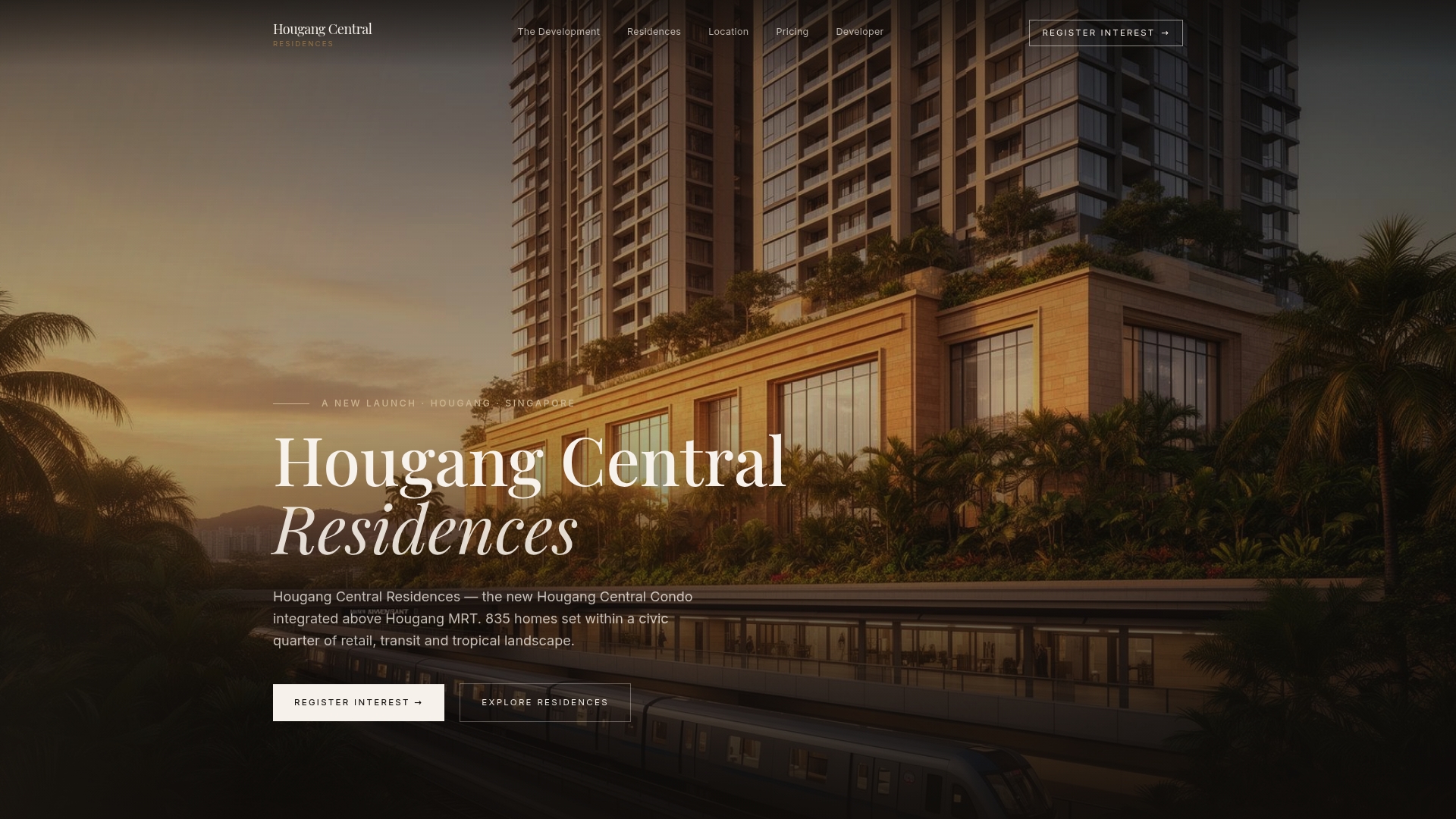
A condo above a transit hub shifts the equation in a useful way. When the MRT station, bus interchange and mall sit under your building, daily transport costs fall and the home is easier to rent or resell to people who value that convenience. That is the case we make for Hougang Central Residences: 835 homes, from 1-bedroom plus study to 5-bedroom penthouses, so a single buyer, a growing family and an investor can each find a size that fits their CPF and cash position.
Our advice is to size the purchase to the cash you hold after the 5% minimum, stamp duty and legal costs, and to keep part of your OA as a cushion. Use the official calculator, then talk to us about which unit types suit your figures.
Simon
See what a Hougang Central Residences home costs
Once you know your CPF and cash budget, the next step is to match it to a unit. Hougang Central Residences sits above the Hougang MRT station and is integrated with a retail mall and bus interchange. It offers smart-home systems and premium European fittings, and it has a future Cross Island Line interchange. Pricing is published from S$2,800 per sq ft on the pricing page, and the residences page lists every type, from 1-bedroom plus study to the 5-bedroom penthouse.
Bring your calculator result to the showflat registration, and compare unit sizes on the floor plan page.
FAQ
Can I use CPF for the whole condo downpayment?
Not entirely. With a bank loan, at least 5% of the lower of the price or valuation must be paid in cash. CPF OA and cash can cover the rest of the downpayment, up to your usage limit. The option fee also needs cash.
How much CPF can I use for monthly condo instalments?
You can pay instalments from your OA as long as your total usage stays within the limit for your property. That limit is the lower of price or valuation, or up to 120% of it if you set aside your Basic Retirement Sum. You may instead pay in cash and leave your OA untouched.
Do I have to pay CPF back when I sell?
Yes. You refund the OA amount used plus accrued interest to your own CPF account. If you pledged the property for your retirement sum, that pledged amount is refunded as well. What remains after the loan and CPF refund is your cash proceeds.
Does the remaining lease affect how much CPF I can use?
Yes. If the lease covers the youngest buyer to age 95, the usual cap applies. If not, your usage is pro-rated and stops at that pro-rated limit. A property also generally needs at least 20 years of lease left for CPF use.
Sources
- CPFB: Using your CPF to buy a home
- CPFB: How much CPF savings you can use for your home purchase
- CPFB: CPF housing usage calculator
- CPFB: Detailed rules for a property whose remaining lease covers the buyer
- CPFB: How much CPF OA savings you can use when buying your next home
- CPFB: 3 questions to help you manage your housing loan
- CPFB: Financially savvy budgeting tips for your home
- CPFB: CPF interest rates from 1 April to 30 June 2026
- MOM: How you can use your CPF