
Singapore's Progressive Payment Scheme (PPS) is a legislated, milestone-based payment schedule that governs every new-launch private condo and executive condominium sold while under construction.
The single most important planning rule: You must have at least 25% of the purchase price available within roughly 8 weeks of booking — 5% in cash at OTP, and the remaining 20% in cash and/or CPF Ordinary Account (OA) at S&P — plus Buyer's Stamp Duty and legal fees on top. Bank loan drawdowns only begin from the foundation stage onward, so that first 25% is entirely on you.
The standard PPS milestone percentages are prescribed under the Housing Developers Rules, so they are not negotiable. CPF Board rules govern what portion of the S&P balance you can fund from CPF OA. IRAS sets the stamp duty deadlines. DBS explains exactly when and how your bank starts drawing down the loan. Use the MoneySmart progressive payment calculator to convert percentages into exact S$ amounts for your purchase price.
- 5% cash due at OTP (booking fee, non-refundable if you do not exercise)
- 15% at S&P (cash and/or CPF OA), within 8 weeks of OTP
- Staged drawdowns from 5%–10% each as construction milestones are certified
- 25% at TOP, 15% at CSC — the two largest single tranches
- BSD and ABSD due within the statutory window after S&P signing
Key Takeaways
| Point | Details |
|---|---|
| First 8-week liquidity | Have 5% cash (OTP) plus 20% cash/CPF OA (S&P) ready, plus BSD and legal fees, before the bank draws down anything. |
| Staged bank drawdowns | Bank loan disbursements begin at the foundation stage and grow with each certified milestone, keeping early repayments low. |
| TOP and CSC tranches | The two largest payments — 25% at TOP and 15% at CSC — are back-loaded by design to preserve buyer liquidity during construction. |
| Stamp duty timing | BSD (and ABSD if applicable) is due within 14 days of S&P signing per IRAS rules; budget this separately from PPS tranches. |
| Hougang-central-residences | Follows statutory PPS percentages; registered buyers receive a sample S&P schedule and worked cashflow spreadsheet on request. |
Table of Contents
- What is the Progressive Payment Scheme and when does it apply?
- What are the typical PPS stages, percentages, and timing?
- How do downpayment, CPF OA, and your bank loan interact with PPS?
- What stamp duties and fees must you budget for upfront?
- How to run a progressive payment calculator: a worked example
- What happens if the developer delays, defaults, or there are defects?
- How to plan cashflow for PPS: a practical checklist
- Why PPS is a better deal than most buyers realize
- Hougang Central Residences makes PPS planning straightforward
- Sources
- FAQ
What is the Progressive Payment Scheme and when does it apply?
The PPS is the statutory milestone payment framework set under the Housing Developers (Control and Licensing) Act and its subsidiary Housing Developers Rules. Every licensed developer selling an uncompleted private residential property in Singapore must follow it. The percentages at each stage are fixed in the Third Schedule of those Rules, which means no developer can legally ask you to pay more at an earlier stage or restructure the schedule in your favor.
PPS applies to:
- New-launch private condominiums sold before or during construction (Buildings Under Construction, or BUC)
- Executive Condominiums (ECs) sold by developers while uncompleted
- Any private residential development where the developer holds a housing developer's licence
PPS does not apply to completed resale units. When you buy a resale condo on the open market, the full purchase price is due at completion, typically within 10–12 weeks of the Option to Purchase.
Payment notices are triggered by certified construction milestones. A licensed architect inspects the site, issues a certificate confirming the milestone is complete, and the developer then sends you a formal payment notice. You have 14 days to pay from the date of that notice.
Pro Tip: Ask your conveyancing lawyer to walk through the milestone definitions in your specific Sale & Purchase Agreement before you sign. "Reinforced concrete framework" and "partition walls" can be defined slightly differently across projects, and the wording determines exactly when each tranche falls due.
What are the typical PPS stages, percentages, and timing?
The standard PPS schedule prescribed under the Housing Developers Rules runs through ten milestones. The table below shows each stage, the typical percentage due, the cumulative total, and a rough timing guide from OTP date.
Timing is indicative. Actual dates depend on your project's construction pace and must be confirmed in your S&P.
A few things worth noting about how this plays out in practice. That back-loading is the core liquidity benefit of PPS for buyers, as Mortgage Master notes — you retain cash and CPF OA funds longer because the bulk of the price is deferred.
For each payment notice, the developer must attach a licensed architect's certificate confirming the milestone. Payment is due within 14 days of the notice date. Your conveyancing lawyer coordinates the bank drawdown request and CPF withdrawal on your behalf, so the 14-day window is tighter than it looks if you have not already briefed them.
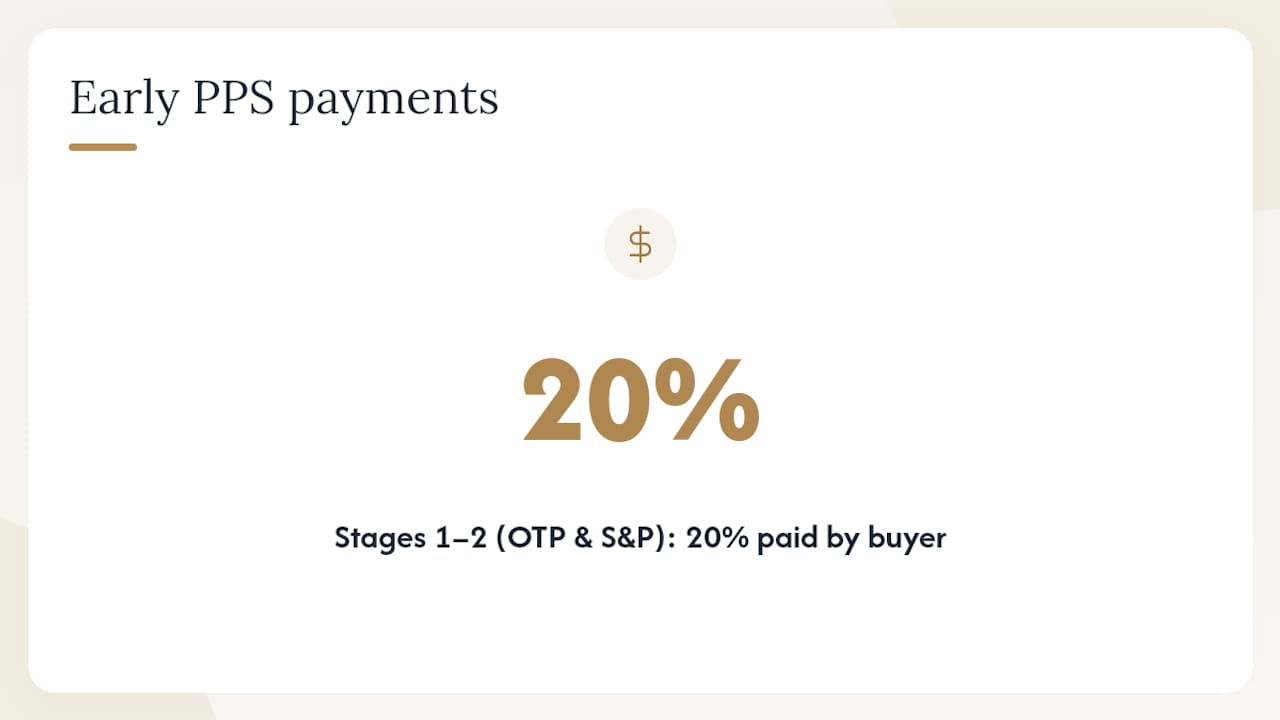
Statistic to remember: Stages 1 and 2 together (OTP + S&P) account for 20% of the purchase price and must be funded entirely by you — no bank loan disbursement occurs at these stages.
How do downpayment, CPF OA, and your bank loan interact with PPS?
The first two stages are entirely buyer-funded.
From Stage 3 (foundation) onward, your bank begins disbursing the loan progressively against each certified milestone.
Here is the practical sequence for each construction-stage payment:
- Developer issues payment notice with architect certificate attached.
- Your conveyancing lawyer receives the notice and prepares a drawdown request to your bank.
- The bank verifies the milestone certificate and disburses the relevant loan tranche directly to the developer.
- If CPF OA funds are being used for that tranche, your lawyer simultaneously submits a CPF withdrawal request to CPF Board.
- Any shortfall between the loan disbursement and the tranche amount is topped up from your cash or CPF OA.
Pro Tip: Get your In-Principle Approval (IPA) from your bank before exercising the OTP. Without it, you risk discovering a financing gap after you are already contractually bound.
Monthly repayments during construction are interest-only on the amounts drawn. As DBS explains, early instalments are materially lower because only a fraction of the loan has been disbursed. Repayments grow with each drawdown and reach their full principal-plus-interest level once the loan is fully disbursed, typically around TOP. Plan for this ramp-up: your monthly commitment at TOP will be noticeably higher than what you paid during the foundation stage.
What stamp duties and fees must you budget for upfront?
Stamp duties are not part of the PPS schedule, but they fall due very early and catch buyers off guard if not budgeted separately.
- Buyer's Stamp Duty (BSD): Due within 14 days of signing the S&P (or within 30 days if signed overseas). Rates per IRAS: 1% on the first S$180,000, 2% on the next S$180,000, 3% on the next S$640,000, 4% on the next S$500,000, and 5%–6% on amounts above S$1.5 million.
- Additional Buyer's Stamp Duty (ABSD): Applies if you are a Singapore Permanent Resident buying any property, a Singapore Citizen buying a second or subsequent property, or a foreigner. Rates vary by residency status and property count. See the ABSD rules guide for a full breakdown.
- Conveyancing legal fees: Typically S$2,500–S$3,500 for a standard new-launch purchase, plus disbursements (stamp fees, title search, CPF lodgement).
- Developer's administrative fees and stamp duty on the OTP: Usually a small fixed amount, payable at booking.
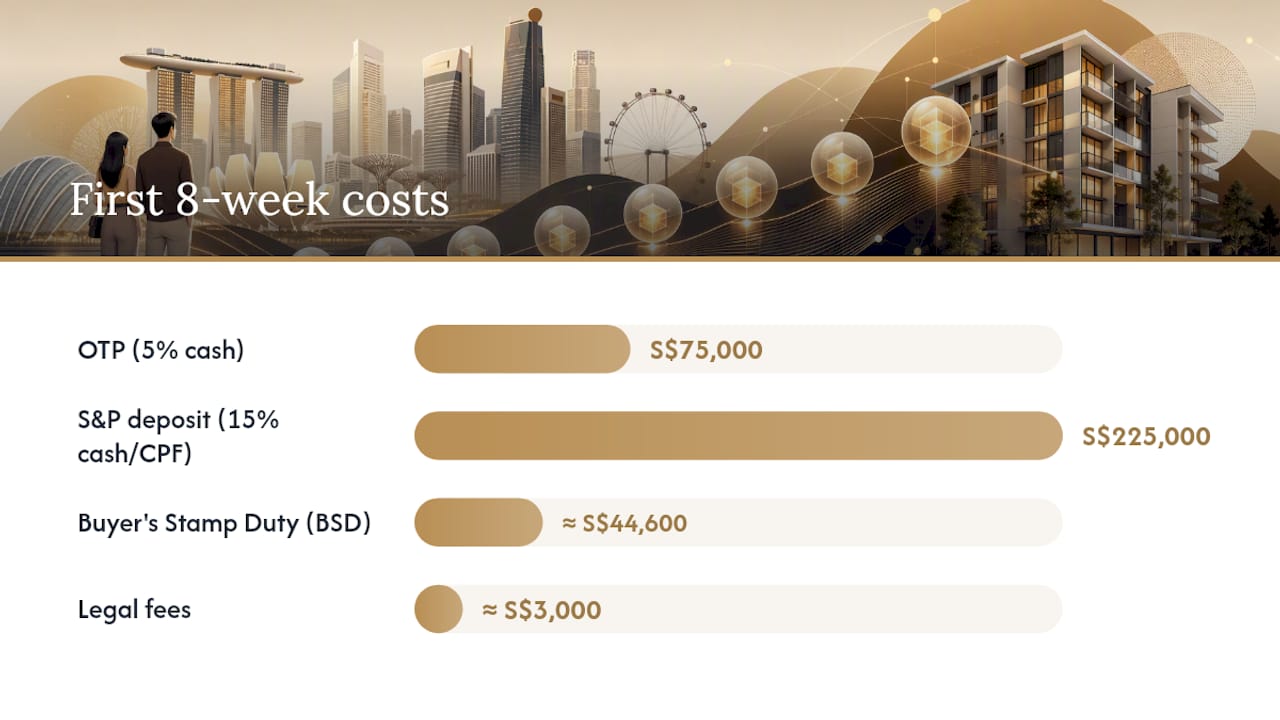
First 8-week cash requirement (illustrative, S$1.5M purchase): 5% OTP = S$75,000 cash. 15% S&P = S$225,000 (cash/CPF). BSD on S$1.5M ≈ S$44,600. Legal fees ≈ S$3,000. Total within 8 weeks: approximately S$347,600, before any ABSD.
BSD can be paid using CPF OA funds if your lawyer submits the withdrawal in time, but the 14-day deadline is firm. CPF Board processing takes a few business days, so instruct your lawyer the moment you sign the S&P.
How to run a progressive payment calculator: a worked example
The MoneySmart progressive payment calculator is the most practical free tool for Singapore buyers. To use it, you need these inputs:
- Purchase price (S$)
- CPF OA balance available for this purchase
- Target loan percentage (e.g., 75% LTV)
- ABSD status (citizen / PR / foreigner, first / subsequent property)
- Expected construction timeline (months per stage)
CPF OA allocation above is illustrative. Actual CPF usage depends on your OA balance, the property's valuation, and CPF Board withdrawal limits.
After the RC framework drawdown (S$300,000 total drawn), it rises to approximately S$875. By TOP, when the full S$1,200,000 is drawn, full principal-plus-interest repayments begin. As DBS notes, this progressive structure means early repayments are substantially lower than post-TOP repayments, but interest exposure accumulates across the entire build period.
- Download a spreadsheet template and replace the S$1.5M figures with your purchase price.
- Adjust the CPF OA column to your actual available balance.
- Update the loan percentage to match your IPA.
- Add BSD and legal fees as separate line items in the first 8-week block.
What happens if the developer delays, defaults, or there are defects?
The PPS framework protects buyers precisely because payment is tied to certified milestones, not to a calendar. A developer cannot issue a valid payment notice for a stage that has not been certified by a licensed architect. If construction stalls, the next tranche simply does not fall due.
Key protections:
- No certified milestone, no payment entitlement. The developer's right to call for each tranche is conditional on the architect's certificate. An uncertified stage cannot trigger the 14-day payment window.
- Defect Liability Period (DLP). After TOP, a statutory DLP (typically 12 months) requires the developer to rectify defects. The 15% CSC tranche is still due at CSC, but the DLP gives you a formal window to log and pursue defect claims before final payment.
- Developer insolvency. Because the bank disburses progressively and the loan is registered as an encumbrance on the property title, buyers have a secured interest in the property from the point of S&P. If the developer becomes insolvent, your conveyancing lawyer can advise on claims against the developer's project account, which licensed developers are required to maintain separately under the Housing Developers Rules.
- Controller of Housing Developers. If you suspect a developer is breaching licensing conditions or misusing project funds, you can escalate to the Controller of Housing Developers under the Ministry of National Development.
Pro Tip: Keep every payment notice, architect certificate, and bank drawdown confirmation in a single folder. If a dispute arises, the paper trail from each milestone is your primary evidence.
If milestones are repeatedly late without explanation, ask your lawyer to write formally to the developer requesting a revised construction schedule. Persistent delays with no certified progress can signal deeper project problems worth investigating early.
How to plan cashflow for PPS: a practical checklist
Getting the timing right across 10 payment stages over three to four years requires more than a spreadsheet. Here is a sequenced action plan:
- Before OTP: Secure your IPA from a bank. Confirm your CPF OA balance with CPF Board. Verify you have at least 5% in cash, plus BSD and legal fee reserves.
- At OTP: Pay 5% cash. Instruct your conveyancing lawyer immediately. Set a calendar reminder for the 8-week S&P deadline.
- Before S&P signing: Confirm CPF OA withdrawal eligibility with your lawyer. Arrange the 15% balance (cash and/or CPF OA). Ensure BSD funds are ready — either cash or CPF OA with enough lead time for processing.
- After S&P: Brief your bank on the project's expected construction timeline. Ask for a drawdown schedule so you know when each loan tranche will be released.
- For each construction stage: Set a calendar alert 3 weeks before the expected milestone. When the payment notice arrives, forward it to your lawyer the same day. Confirm the 14-day deadline and that the bank drawdown request has been submitted.
Red flags to watch:
- Milestone definitions in the S&P that are vague or inconsistent with the Housing Developers Rules' Third Schedule wording
- Developer issuing payment notices without attaching a licensed architect's certificate
- Repeated delays in issuing notices after milestones are visibly complete on site
- Sudden changes in the main contractor's name or project management team
A practical cashflow rule: keep at least the equivalent of the next two PPS tranches in liquid form at all times during construction. The 14-day window is short, and CPF transfers and bank drawdowns each take a few business days.
Pro Tip: Ask your conveyancing lawyer to set up a shared checklist or email thread that copies you on every payment notice, drawdown request, and CPF submission. Miscoordination between lawyer, bank, and CPF Board is the most common cause of missed 14-day deadlines.
Why PPS is a better deal than most buyers realize
What they underestimate is how much the middle stages matter for financial planning. That cadence is actually useful: it gives you a predictable schedule to match against salary cycles, CPF OA accumulation, and any other financial commitments.
The bigger insight, though, is about interest-rate risk. PPS defers large payments, which is a genuine liquidity benefit. But it also means your loan is drawn progressively over three to four years, and every drawdown locks in the prevailing interest rate at that point. If rates rise during construction, your post-TOP repayment will be higher than your IPA-era estimate.
The CSC tranche deserves more attention than it typically gets. Keep that reserve intact.
Hougang Central Residences makes PPS planning straightforward
Buying a new-launch condo above Hougang MRT means your progressive payment schedule is backed by a project with a clear construction timeline, an integrated retail and transport hub already in place, and a sales team that provides registered buyers with a sample S&P payment schedule and worked cashflow spreadsheet on request.
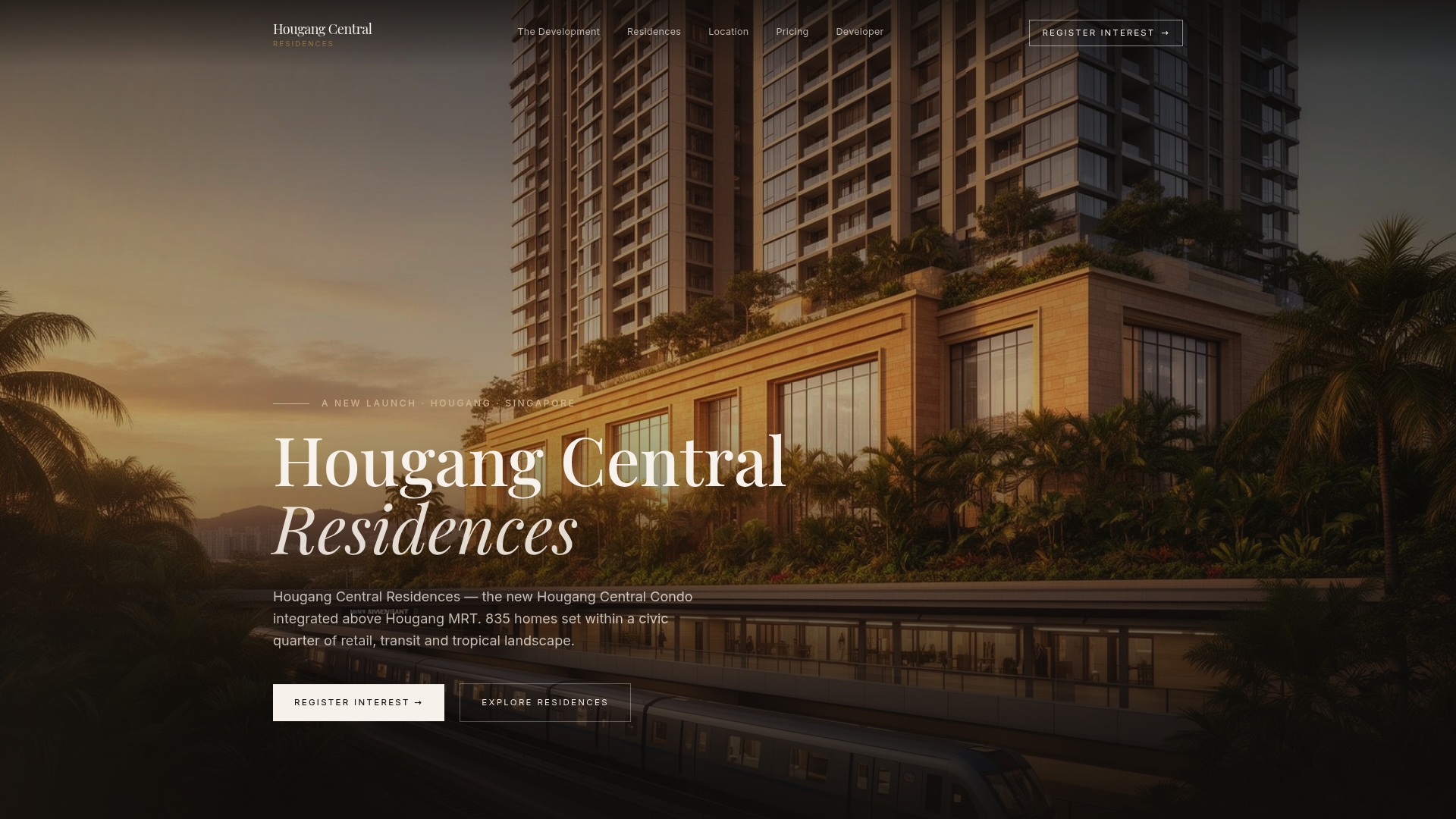
Hougang-central-residences offers 835 residences from 1-bedroom-plus-study to 5-bedroom penthouses, with smart-home systems and premium European fittings already specified, so you know exactly what you are paying toward at each milestone. The project follows the statutory PPS percentages, and your specific S&P terms will be provided to you at registration. To request the brochure, a worked cashflow example for your target unit size, or a showflat appointment, visit the project page and register your interest today.
Sources
These are the primary sources to bookmark and share with your conveyancing lawyer:
- Guide to Home Loan for Property Under Construction | DBS
- IRAS
- Progressive Payment Calculator for Private Property
- Mortgage Master blog: progressive payment scheme
Pass these links to your lawyer at the start of the conveyancing process so they can cross-reference your S&P milestone wording against the statutory schedule.
This article is general information, not a substitute for advice from a qualified financial advisor. Consult a qualified financial professional about your own circumstances before acting on anything here.
FAQ
What is the progressive payment schedule for new-launch condos in Singapore?
The PPS is a legislated milestone payment framework under the Housing Developers Rules.
When does the bank start disbursing my home loan under PPS?
Bank loan disbursements begin at the foundation stage (Stage 3), not at OTP or S&P.
How much cash do I need in the first 8 weeks of a new-launch purchase?
For a S$1.5M purchase, that is approximately S$347,600 before any ABSD.
Can I use CPF OA to pay progressive payment stages?
CPF OA can be used from the S&P stage onward (not at OTP), subject to CPF Board withdrawal limits and the property's valuation. Your conveyancing lawyer submits CPF withdrawal requests on your behalf for each eligible tranche.
What happens if the developer misses a construction milestone?
The developer has no legal entitlement to the next payment tranche until a licensed architect certifies the milestone. If a stage is uncertified, the 14-day payment window cannot be triggered, and you are not obligated to pay.