For most first-time buyers in Singapore, the minimum downpayment for a private condo is 25% of the purchase price — and at least 5% of that must be paid in cash. The remaining 20% can come from your CPF Ordinary Account (OA), cash, or a combination of both. Four regulatory bodies shape every dollar of this: MAS sets the Loan-to-Value (LTV) ceiling, CPF governs how much of your savings can go toward the purchase, and IRAS collects Buyer's Stamp Duty and Additional Buyer's Stamp Duty — both payable in cash within 14 days of signing.
Before you commit to any unit, two checks matter most: your CPF OA balance and your Total Debt Servicing Ratio (TDSR). Having the 25% ready doesn't guarantee a loan up to 75% LTV if your existing debts push you over the TDSR ceiling.
Quick reference for first-time Singapore Citizens buying one private condo:
- Minimum downpayment: 25% of purchase price
- Mandatory cash portion: at least 5% (cannot come from CPF)
- CPF OA allowed: up to 20% (subject to Valuation and Withdrawal Limits)
- Maximum bank loan (LTV): 75%
- BSD: payable in cash within 14 days, CPF reimbursement possible after stamping
- ABSD: 0% for first property (Singapore Citizen)
Key Takeaways
The minimum downpayment for a private condo in Singapore is 25% of the purchase price, with at least 5% payable in cash — CPF cannot cover that mandatory cash floor, and BSD is due in cash within 14 days of exercising the OTP.
| Point | Details |
|---|---|
| Minimum downpayment | 25% of purchase price for a first bank loan; at least 5% must be paid in cash. |
| CPF usage rule | CPF OA can cover up to 20% of the downpayment, subject to Valuation and Withdrawal Limits. |
| Stamp duty timing | BSD and ABSD are due within 14 days of OTP exercise; plan cash liquidity, not CPF balance. |
| TDSR check first | Run a TDSR simulation at 4% stress-test rate before signing any OTP to confirm your real loan ceiling. |
| Hougang Central option | Hougang-central-residences offers a Progressive Payment Scheme that spreads the downpayment across construction milestones, reducing day-one cash pressure. |
Table of Contents
- How does the downpayment for a condo work in Singapore?
- What factors change how much cash you actually need upfront?
- How much downpayment do you need by buyer type in 2026?
- Worked examples: what do the numbers look like at S$1.5M and S$2.0M?
- When do you pay, and what's due at each milestone?
- How can you fund the downpayment?
- Common mistakes that create cash shortfalls on signing day
- A local worked example using Hougang Central Residences
- What first-time buyers should actually prioritize
- Hougang Central Residences: a local option worth registering for
- Sources
- FAQ
How does the downpayment for a condo work in Singapore?
The 25% downpayment floor exists because MAS caps bank lending at 75% LTV for a first housing loan. That ceiling is a regulatory maximum, not a promise — your bank will run its own TDSR and credit assessment before confirming how much it will actually lend.
The minimum cash rule
Of the 25% downpayment, CPF rules confirm that the mandatory minimum cash portion cannot be paid from CPF savings. For a first property with a bank loan, that cash floor is 5% of the purchase price. The remaining 20% can come from CPF OA, additional cash, or a mix.
CPF Ordinary Account usage
CPF OA savings can fund the non-cash portion of your downpayment, but two caps apply:
- Valuation Limit (VL): CPF usage is capped at the lower of the purchase price or the property's market valuation.
- Withdrawal Limit (WL): Total CPF withdrawn for a property (including loan repayments over time) cannot exceed 120% of the VL.
If your CPF OA balance is low — common for younger buyers or those who recently started working — you'll need more cash upfront. Plan for this gap early.
TDSR and the stress-test rate
Banks apply a TDSR cap of 55% of gross monthly income, and they stress-test your loan at a rate typically around 4% when calculating affordability. Practitioners advise running a TDSR simulation before making any OTP commitment — many buyers who have the full 25% ready still find their loan capped below 75% LTV once other debts (car loans, student loans, credit card balances) are factored in.
Pro Tip: Run your TDSR calculation before signing the OTP, not after. Use your bank's online mortgage calculator with a 4% stress-test rate and include every existing monthly debt obligation. A shortfall discovered after you've paid the option fee is expensive.
What factors change how much cash you actually need upfront?
The headline 25% rule is a starting point. Several personal and transaction-level factors can push your real cash requirement significantly higher.
Buyer profile and citizenship status
Singapore Citizens buying their first residential property pay 0% ABSD. Permanent Residents pay 5% ABSD on a first purchase. Foreigners pay 60% ABSD on any residential property. IRAS confirms these rates apply on top of BSD and must be paid in cash within the statutory timeline — ABSD cannot be offset by CPF at the point of payment (though CPF can reimburse BSD after stamping). For a foreigner buying a S$2M condo, that's S$1.2M in ABSD alone, payable in cash.
Number of existing property loans
MAS reduces the LTV ceiling as outstanding loans increase:
- First housing loan: LTV up to 75%; minimum cash 5%; minimum downpayment 25%
- Second housing loan: LTV drops to 45%; minimum cash rises to 25%; minimum downpayment 55%
- Third and subsequent loans: LTV drops to 35%; minimum cash 25%; minimum downpayment 65%
The jump from first to second property significantly increases required downpayment and cash due, creating a much larger upfront financial commitment compared with a first-time purchase.
Loan tenure and borrower age
MAS also reduces LTV when the loan tenure extends beyond 30 years or when the loan runs past the borrower's age of 65. In those cases, the LTV ceiling drops by 5 percentage points, pushing the downpayment floor up accordingly.
New launch vs. resale
For resale condos, the full downpayment is typically due at completion. For new launches, developers use a Progressive Payment Scheme — payments are staggered across construction milestones, which spreads the cash outflow over two to four years. This can meaningfully reduce day-one cash pressure.
Bank-level restrictions
Even within MAS LTV ceilings, individual banks apply their own credit policies. A buyer with a variable income, self-employment, or a high debt-to-income ratio may receive a loan offer well below 75% LTV, requiring a larger downpayment from personal funds.
How much downpayment do you need by buyer type in 2026?
The table below maps the key variables by buyer profile for a first residential property purchase using a bank loan, under current 2026 rules.
For a second property (Singapore Citizen with one existing loan):
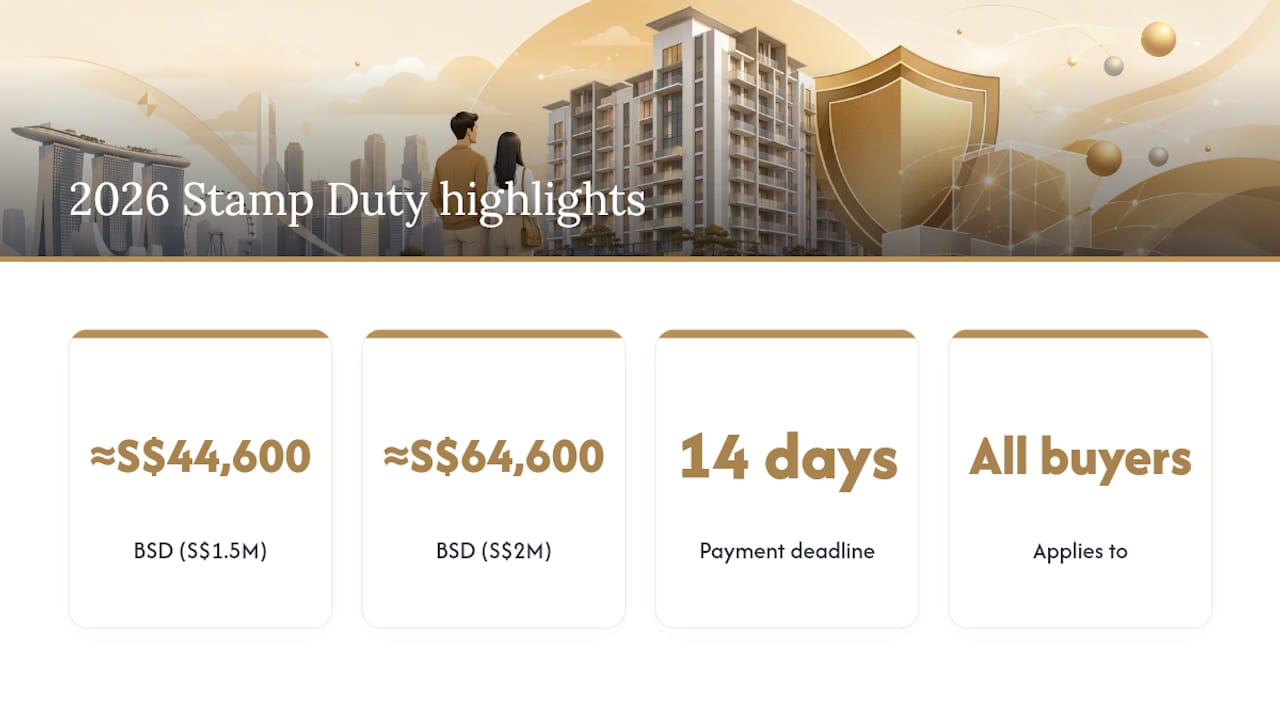
BSD applies to all buyers on every purchase. IRAS calculates BSD on the purchase price or market value, whichever is higher, using a progressive rate schedule. For a S$1.5M property, BSD is approximately S$44,600. For S$2M, it's approximately S$64,600. These figures must be confirmed using the IRAS stamp duty calculator before signing.
BSD and ABSD are both payable within 14 days of exercising the OTP or signing the Sale & Purchase Agreement (S&PA). Budget for both as immediate cash needs.
Worked examples: what do the numbers look like at S$1.5M and S$2.0M?
Case Study 1: First-time Singapore Citizen buying a S$1.5M condo
Assumptions: Purchase price S$1,500,000; first property; bank loan at 75% LTV; CPF OA balance S$150,000 available.
- Bank loan (75%): S$1,125,000
- Total downpayment (25%): S$375,000
- Mandatory cash (5%): S$75,000
- Remaining downpayment (20%): S$300,000 — covered by CPF OA (S$150,000) plus additional cash (S$150,000)
- BSD (approx.): S$44,600 — payable in cash within 14 days; CPF reimbursement possible after stamping
- ABSD: S$0 (first property, Singapore Citizen)
- Legal fees (estimate): S$3,000–S$5,000
- Valuation fee (estimate): S$500–S$800
Day-one cash required (before CPF reimbursement of BSD): approximately S$273,100–S$275,400
Case Study 2: Singapore Citizen buying a S$2.0M second property
Assumptions: Purchase price S$2,000,000; one existing property loan; LTV 45%; no CPF available (already used on first property).
- Bank loan (45%): S$900,000
- Total downpayment (55%): S$1,100,000
- Mandatory cash (25%): S$500,000
- Remaining downpayment (30%): S$600,000 — cash (CPF likely unavailable or limited)
- BSD (approx.): S$64,600
- ABSD (20% for second property, SC): S$400,000
- Legal fees (estimate): S$4,000–S$6,000
Total day-one cash required: approximately S$1,568,600
| Item | Amount |
|---|---|
| Mandatory cash downpayment (25%) | S$500,000 |
| Remaining downpayment (30%) | S$600,000 |
| BSD | S$64,600 |
| ABSD (20%) | S$400,000 |
| Legal fees | S$5,000 |
| Total day-one cash | approximately S$1,568,600 |
The second-property scenario is a stark illustration of why understanding ABSD implications before committing to a purchase matters so much.
When do you pay, and what's due at each milestone?
The payment schedule differs between resale condos and new launches. Both follow a defined sequence, but the cash flow timing is very different.
Resale condo payment timeline
- Option to Purchase (OTP) — Day 0: Pay the option fee, typically 1% of the purchase price (negotiable, up to S$1,000 for HDB but uncapped for private). This is cash only.
- Exercise OTP — within 14 calendar days: Pay the exercise deposit (usually 4% of purchase price, bringing the total deposit to 5%). BSD and ABSD are due within 14 days of exercise.
- Sale & Purchase Agreement (S&PA): Signed at exercise; legal fees payable around this point.
- Completion (typically 8–12 weeks after S&PA): Remaining downpayment (20%) and bank loan disbursement. CPF can be used here for the 20% portion.
New launch progressive payment schedule
New launches use a Progressive Payment Scheme where payments are tied to construction milestones — foundation, structural work, roof, walls, and so on — spread across two to four years. The 5% cash minimum is still due early (at booking and exercise), but the remaining 20% downpayment is staggered. This is a genuine cash-flow advantage over resale.
Key rule on stamp duty timing: BSD and ABSD must be paid within 14 days of exercising the OTP or signing the S&PA — whichever applies to your transaction. CPF can reimburse BSD after stamping, but the cash must be available first. Plan your liquidity accordingly, not your CPF balance.
How can you fund the downpayment?
Most buyers use a combination of sources rather than a single pot of money. The mix you choose has real trade-offs.
Common funding sources:
- Cash savings: The most flexible source. No restrictions, no retirement impact, no bank conditions.
- CPF Ordinary Account: Can cover up to 20% of the purchase price (subject to Valuation and Withdrawal Limits). Reduces retirement savings — weigh this carefully.
- Family support (gift or loan): Increasingly common for first-time buyers. Banks may ask for a statutory declaration confirming a gift is not a loan, since a loan would affect TDSR.
- Bridging loans: Short-term loans to cover the gap between selling an existing property and completing a new purchase. Interest rates are higher than standard mortgages; use only when the timeline is tight and the sale proceeds are confirmed.
- Staggered payments (new launch): Not a funding source per se, but the Progressive Payment Scheme reduces how much cash you need at any single point. Buyers who are still building savings often prefer new launches for this reason.
Pro Tip: Avoid using CPF OA to the maximum if doing so leaves your retirement savings dangerously thin. CPF savings compound over time; withdrawing the maximum for a property purchase can cost significantly more in retirement than the short-term cash relief is worth. Use CPF strategically, not reflexively.
For buyers comparing unit sizes and their likely price bands — and therefore their downpayment exposure — a look at studio vs. 1-bedroom options can help anchor the numbers before you commit.
Common mistakes that create cash shortfalls on signing day
First-time buyers consistently underestimate how much cash they need on day one. The downpayment percentage is just one line item.
The most common pitfalls:
- Assuming CPF covers the 5% cash floor. It cannot. The mandatory minimum cash portion must come from cash, full stop. Buyers who plan to use CPF for the entire downpayment will be short on signing day.
- Forgetting BSD and ABSD timing. Both are due within 14 days of exercising the OTP. Many buyers budget for stamp duties as a future cost and are caught off-guard by the immediate cash requirement.
- Skipping the TDSR stress test. A buyer with a S$375,000 downpayment ready for a S$1.5M condo may still be denied a 75% LTV loan if existing debts push the TDSR above 55% at a 4% stress-test rate.
- Ignoring legal and valuation fees. These are small relative to the downpayment but are payable in cash and often due before completion.
- Depleting emergency savings. Using every available dollar for the downpayment leaves no buffer for unexpected costs — renovation overruns, job disruption, or interest rate changes.
Practical steps to avoid these mistakes:
- Get a conditional in-principle approval (IPA) from your bank before signing any OTP. An IPA gives you a realistic loan ceiling, not just the MAS maximum.
- Run a TDSR calculation at 4% stress-test rate, including all existing monthly debt obligations.
- Keep at least three to six months of household expenses in liquid savings after the downpayment is paid.
- Use the IRAS stamp duty calculator to get exact BSD and ABSD figures before committing.
Pro Tip: For new launches, ask the developer's sales team for the exact progressive payment schedule before signing. Knowing when each tranche is due lets you plan CPF drawdowns and cash reserves around real dates, not estimates.
Buyers who also want to understand recurring costs after purchase — maintenance fees, sinking funds — should review condo maintenance fee structures as part of their total affordability picture.
A local worked example using Hougang Central Residences
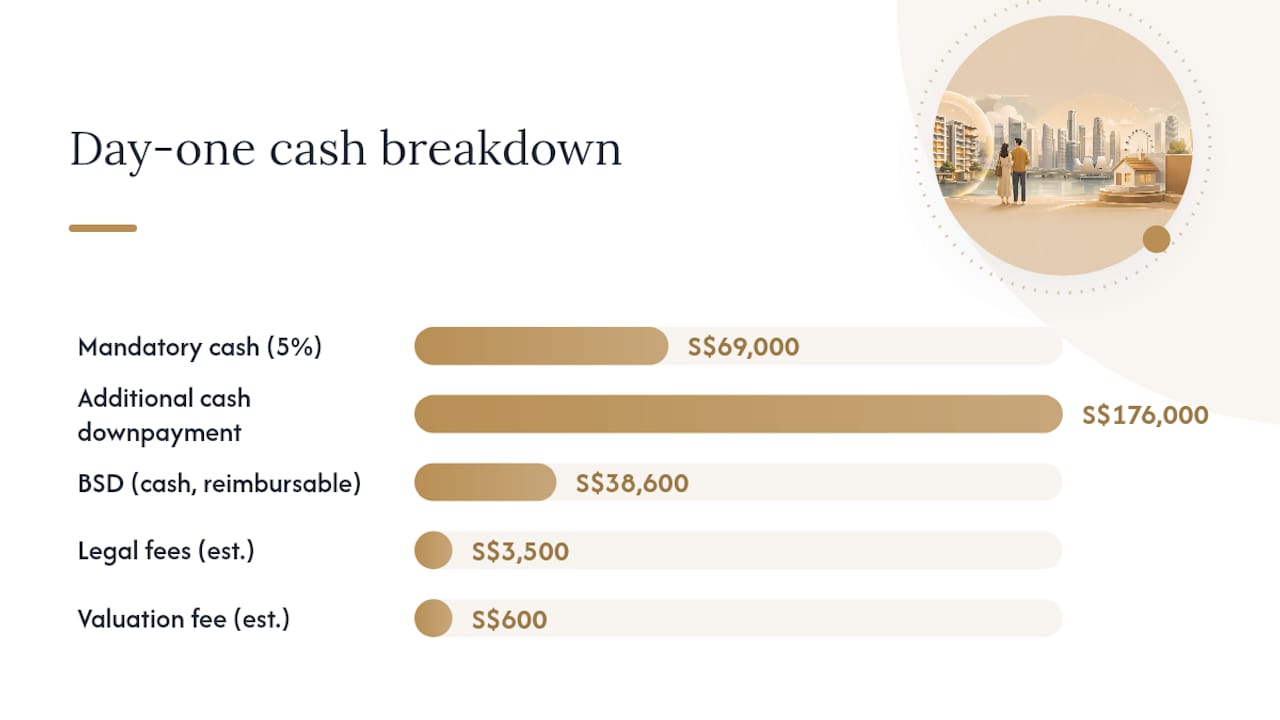
Hougang-central-residences sits directly above Hougang MRT station and offers 835 units ranging from 1-bedroom plus study to 5-bedroom penthouses. For this example, a 2-bedroom unit is used at an indicative price of S$1,380,000, purchased by a first-time Singapore Citizen with a CPF OA balance of S$100,000.
Assumptions: Purchase price S$1,380,000; first property; bank loan at 75% LTV; Singapore Citizen; CPF OA S$100,000 available.
- Bank loan (75%): S$1,035,000
- Total downpayment (25%): S$345,000
- Mandatory cash (5%): S$69,000
- Remaining downpayment (20%): S$276,000 — CPF OA covers S$100,000; remaining S$176,000 in cash
- BSD (approx.): S$38,600 — payable in cash within 14 days; CPF reimbursement possible after stamping
- ABSD: S$0 (first property, Singapore Citizen)
- Legal fees (estimate): S$3,500
- Valuation fee (estimate): S$600
| Item | Amount |
|---|---|
| Mandatory cash downpayment (5%) | S$69,000 |
| Additional cash downpayment | S$176,000 |
| BSD (cash, pending CPF reimbursement) | S$38,600 |
| Legal fees | S$3,500 |
| Valuation fee | S$600 |
| Total day-one cash | ~S$287,700 |
After CPF reimburses BSD (approximately S$38,600), the net cash outlay drops to roughly S$249,100.
Why location matters for affordability: Hougang Central Residences's direct MRT access and integrated retail reduce transport and daily living costs for residents, a practical offset to the upfront cash commitment that buyers often overlook when comparing units across different parts of Singapore.
Pro Tip: For a new launch like Hougang-central-residences, the Progressive Payment Scheme means your S$287,700 day-one cash requirement is spread across milestones rather than due in a single lump sum. Confirm the exact schedule with the sales team so you can time CPF drawdowns to match each payment tranche.
What first-time buyers should actually prioritize
Most guides on the condo downpayment focus on the percentages. The percentages are the easy part. What actually trips buyers up is the sequencing — specifically, the gap between when cash is due and when CPF can be applied.
The 5% cash floor is non-negotiable and immediate. BSD follows within 14 days. If you haven't stress-tested your TDSR before signing the OTP, you're making a six-figure commitment without knowing whether your bank will actually lend you 75% LTV. That's the real risk.
My recommendation: run the TDSR simulation first, get an IPA second, then look at properties. Not the other way around. Buyers who fall in love with a unit before confirming their loan ceiling often end up either over-leveraged or unable to complete the purchase.
On CPF: use it, but not to the maximum. The Withdrawal Limit exists for a reason. Buyers who drain their CPF OA for a downpayment often find themselves with inadequate retirement savings 20 years later. A reasonable rule of thumb is to preserve at least 20% of your CPF OA balance after the downpayment, though your specific situation warrants a conversation with a licensed financial advisor.
If the numbers don't work today, a new launch with progressive payments can buy you 18–24 months to build savings while locking in a price. That's not a compromise — for many buyers, it's the smarter move.
Hougang Central Residences: a local option worth registering for
Hougang-central-residences offers first-time buyers something genuinely rare in Singapore: a new launch condo directly above an MRT station, with 835 units across a full range of sizes and a built-in retail mall and bus interchange. For buyers who've worked through the downpayment math in this guide, the Progressive Payment Scheme at Hougang Central means the S$287,700 day-one cash requirement for a 2-bedroom unit is staggered across construction milestones — not due in one hit.
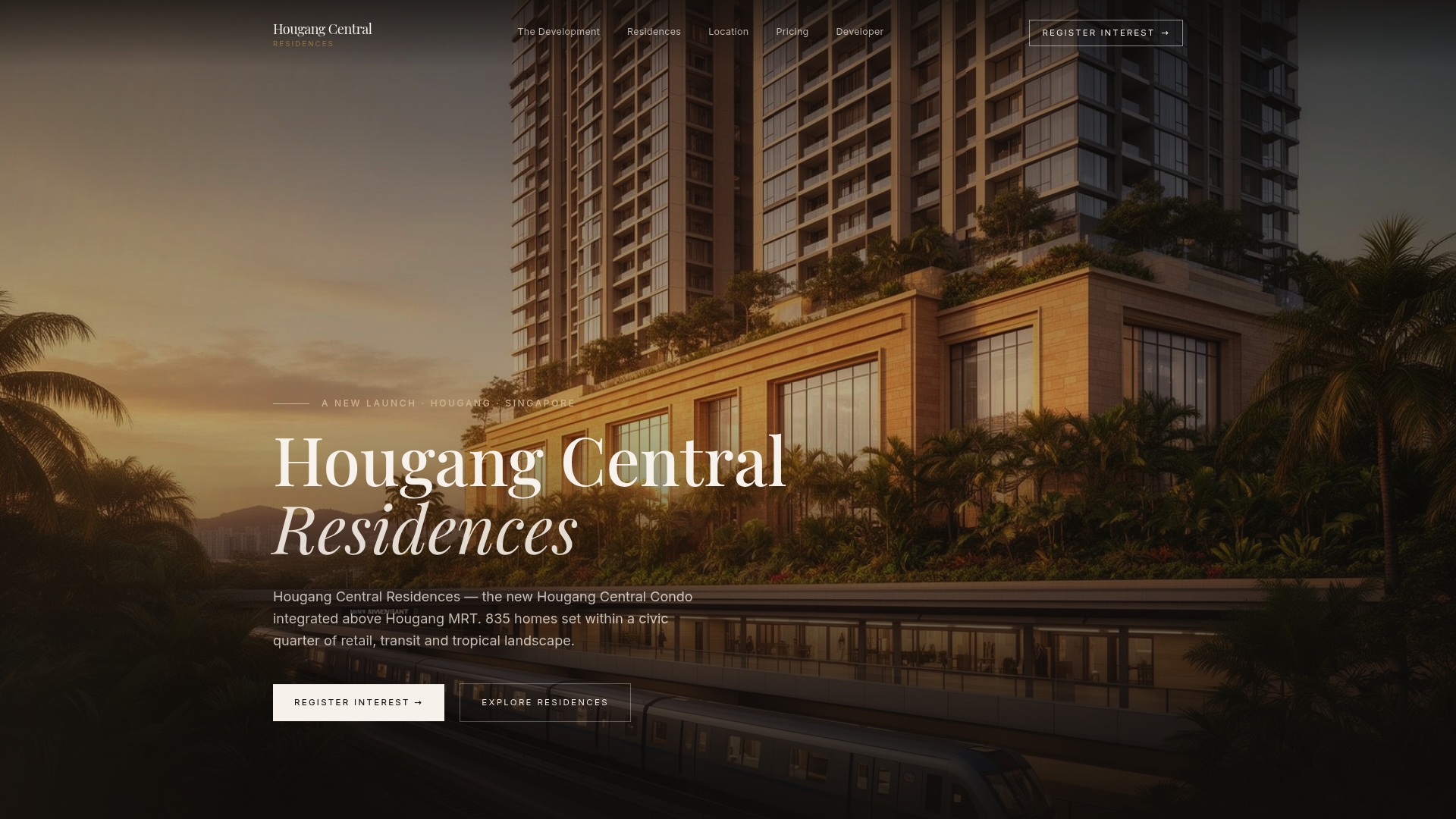
Units range from 1-bedroom plus study to 5-bedroom penthouses, covering the price bands most relevant to first-time buyers and upgraders alike. The future Cross Island Line interchange at Hougang MRT adds long-term connectivity value that supports both own-stay and investment decisions.
Register for a showflat appointment or request an e-brochure at Hougang-central-residences to get unit-specific pricing, the progressive payment schedule, and availability.
Sources
Check these pages before signing any contract. Rules and rates can change; always verify directly with the relevant authority.
- MAS - Loan tenure and loan-to-value limits (housing loans)
- CPF - Using your CPF to buy a home
- SmartCalculator - Condo downpayment calculator & 2026 rules
- Propkaki - Buying your first private condo in Singapore: step-by-step guide
- IRAS - Stamp duty rates (quick links)
This article is general information, not a substitute for advice from a qualified financial advisor. Consult a qualified financial professional about your own circumstances before acting on anything here.
FAQ
What is the minimum downpayment for a condo in Singapore?
The minimum downpayment is 25% of the purchase price for a first bank loan, with at least 5% payable in cash. The remaining 20% can come from CPF OA savings, subject to Valuation and Withdrawal Limits.
How much deposit is needed to buy a condo in Singapore?
At the OTP stage, buyers typically pay a 1% option fee in cash, followed by a 4% exercise deposit within 14 days — bringing the total initial deposit to 5% of the purchase price. The remaining 20% downpayment is due at completion or across progressive payment milestones for new launches.
Is the downpayment 20% or 25% for a private condo?
It's 25% under current MAS rules for a first bank loan (75% LTV ceiling). The 20% figure sometimes cited refers only to the CPF-eligible portion; the full downpayment is 25%, with 5% mandatory in cash.
What is the lowest downpayment possible for a condo?
For a first property with a bank loan, 25% is the floor set by MAS LTV rules. There is no lower option for private condos financed by a bank — unlike HDB purchases, no government housing loan is available for private condos, so the 75% LTV ceiling is the maximum loan any buyer can receive.
Can CPF cover the full condo downpayment?
No. CPF can cover up to 20% of the purchase price (the non-cash portion of the downpayment), but the mandatory 5% cash floor must be paid in cash. CPF also cannot be used to pay ABSD at the point of payment, though it can reimburse BSD after stamping.