
Early-bird, or VVIP, pricing usually gives you a lower launch PSF and priority unit choice, but whether it actually pays off depends on three things: your financing, your cash timing, and the unit you end up with. Verify how lenders treat the discount, how much cash you need before exercise, and confirm the numbers against actual sales terms, not just marketing slides. At Hougang Central Residences, checking these three items on preview day is the difference between a genuine deal and a rushed decision.
TL;DR:
- Developers' early-bird discounts mainly serve to generate quick sales and inventory control, but their actual value depends on unit preferences and financing terms.
- Bank approvals require deducting rebates and discounts from valuation, which can limit borrowing capacity and increase the cash needed at exercise.
- Buyers should verify whether incentives are actual price reductions, absorbed fees, or vouchers, as only true discounts impact loan calculations.
- It's crucial to have cash ready for stamp duties and deposit deadlines, as partial payments are often required before loan disbursement and CPF can be used.
- Comparing launch prices with recent sale trends and local market estimates ensures discounts are genuine and aligned with long-term property appreciation.
Table of Contents
- What "early bird" and VVIP preview offers look like
- Progressive payment scheme: your cash timeline from booking to TOP
- How financing, CPF, and stamp duties change the math
- Your decision checklist for evaluating an early bird deal
- Showflat tactics that go beyond the headline discount
- Why developers offer early bird pricing in the first place
- Check Hougang Central Residences pricing and register for a preview
- Sources
- FAQ
What "early bird" and VVIP preview offers look like
Early-bird or VVIP pricing is a promotional phase developers run before or at the start of a launch, giving a set group of registrants a lower headline price per square foot and first pick of units before the general public gets access. The incentives typically include a percentage discount off the base PSF, absorption of certain legal or stamp fees, or a voucher tied to furniture or renovation packages.
Developers use this phase to lock in early sales momentum and reward buyers who register and commit quickly, often before the project's full pricing grid is public. In practice, this means:
- A discount off the stated PSF, sometimes tiered by how early you register or which unit stack you choose.
- Priority queue numbers that let earlier registrants select from better-facing or higher-floor units first.
- Bundled perks such as absorbed legal fees or stamp duty rebates, which are marketing add-ons rather than price reductions in the eyes of a lender.
None of these labels are standardized. The only figures that matter are the ones written into your Option to Purchase and Sale and Purchase Agreement, and separately, MAS rules for new housing loans require banks to deduct any discount, rebate, or benefit before calculating how much they will lend against the unit.
Progressive payment scheme: your cash timeline from booking to TOP
New launches in Singapore use the progressive payment scheme, which ties each payment to a construction milestone rather than requiring the full price upfront. Understanding when cash is due, and when CPF can step in, prevents a scramble later.
- Booking (Option to Purchase): typically 5% of the purchase price, paid in cash to secure the unit and the option period.
- Exercise of the OTP: typically an additional 15%, due within the option period, bringing your initial commitment to about 20% before the loan and CPF portions kick in.
- Foundation stage: roughly 10%, due once the developer completes the foundation work.
- Superstructure stages: several payments totaling around 25 to 30%, staged across the building's progress.
- Roof and construction completion: further staged payments as the building reaches structural completion.
- Temporary Occupation Permit (TOP): typically the final 25%, due when the unit is ready for handover.
The booking and exercise payments are almost always required in cash, since CPF withdrawal and loan disbursement take time to process. Later progressive payments can usually be met with a mix of bank loan disbursements and CPF Ordinary Account funds, once your bank and CPF have processed the paperwork. Stamp duties sit on top of this timeline and are due within strict windows regardless of when your next construction payment falls.
Pro Tip: Keep at least six months of the booking and exercise deposit amount in liquid cash before you register for any VVIP preview, since option periods often run just one to two weeks.

How financing, CPF, and stamp duties change the math
A discounted PSF looks better on a brochure than it sometimes performs at the bank. MAS guidance on new housing loans requires financial institutions to strip out developer discounts, rebates, or absorbed fees before calculating your loan-to-value limit and serviceability. That means the bank's valuation, not the discounted sticker price, often determines how much you can actually borrow.
- A large headline discount can shrink the effective valuation a bank uses, which may increase the cash or CPF top-up you need at exercise.
- Loan-to-value limits cap borrowing well before the full price is covered, leaving a cash gap that early-bird buyers sometimes underestimate.
- Lenders also apply a medium-term interest rate floor when assessing your total debt servicing ratio, which can tighten your qualifying loan amount even if the discounted price looks affordable.
- IRAS stamp duty guidance confirms Buyer's Stamp Duty and Additional Buyer's Stamp Duty are computed on the purchase price or market value, whichever is higher, and both carry firm payment deadlines after the OTP is exercised.
- CPF budgeting guidance recommends checking your Ordinary Account limits and setting aside a cash buffer well before the deposit is due.
A CEA disciplinary case involving wrong advice on CPF use for stamp duties-.pdf) shows what happens when timing gets misread: buyers were left short of cash because they were told CPF could cover a payment window it could not.
Your decision checklist for evaluating an early bird deal
Before you commit at a preview, work through the same sequence every time rather than relying on the sales team's framing of the discount.
- Confirm in writing whether the discount is a price reduction, an absorbed fee, or a voucher, since only a true price reduction affects your loan base.
- Get an in-principle approval from your bank before registering, so you know your real borrowing limit against the discounted valuation.
- Compare the effective PSF, after every incentive, against recent transactions and URA's private residential price flash estimates, which showed the price index rising 0.5% quarter on quarter in the second quarter of 2026.
- Check the pipeline supply context; URA notes that the Government Land Sales program is keeping supply steady through 2026, which argues for weighing long-term comparables over a one-off launch discount.
- Confirm you have cash ready for stamp duties and the exercise deadline before you let unit choice pressure you into rushing the OTP.
| Factor | What to verify | Why it matters |
|---|---|---|
| Discount type | Price cut vs. absorbed fee vs. voucher | Only a price cut changes the bank's loan base |
| Financing | In-principle approval before registering | Avoids a cash gap if valuation comes in lower |
| Market comparables | URA flash estimates and recent resale PSF | Confirms the launch discount is real, not just a starting anchor |
| Cash readiness | Stamp duty and exercise deposit funds set aside | Prevents a forced abort within the option period |
For an investor, a simple break-even check matters more than the discount itself: divide the total incentive value by your expected holding period to see if it meaningfully changes your annual return, or if it is a rounding error against years of expected Singapore luxury condo appreciation.
Showflat tactics that go beyond the headline discount
At the showflat, ask for the actual PSF grid by stack and floor, not just the average discount quoted at the door. Ask which specific clauses in the Sale and Purchase Agreement cover the progressive payment schedule and any late payment penalties, since these rarely appear on marketing collateral.
Weigh a marginal PSF saving against factors that hold their value longer: proximity to the MRT concourse, orientation, and the quality of fittings specified in the agreement rather than the showflat display unit. Ask about the developer's licence conditions under the Housing Developers (Control and Licensing) Act, which govern the progressive payment structure and buyer protections, and check how the project's management corporation strata title rules will affect shared facilities once the building is handed over.

Pro Tip: Bring a printed copy of the unit mix and floor plan to the showflat and mark your top three stacks before you arrive, so queue-number pressure does not push you into a unit you have not actually compared.
Why developers offer early bird pricing in the first place
Developers front-load discounts to secure early cash flow and manage inventory risk before a project's full pricing grid is set. It is a legitimate pricing tool, not a favor, and it works best for buyers whose financing and unit preferences are already sorted before preview day. At Hougang Central Residences, the long-term case rests on the MRT connection and unit mix, not on the size of the launch-day discount alone. Treat any early-bird number as a starting point for your own checks against the SPA and your bank's approval, never as the final word.
— Simon
Check Hougang Central Residences pricing and register for a preview
If you want to see how early-bird pricing actually works at a live project, the pricing and PSF page for Hougang Central Residences lists current launch offers by unit type, and the full pricing details page breaks down the base rate starting from $2,800 per square foot one-off, before any preview incentives.
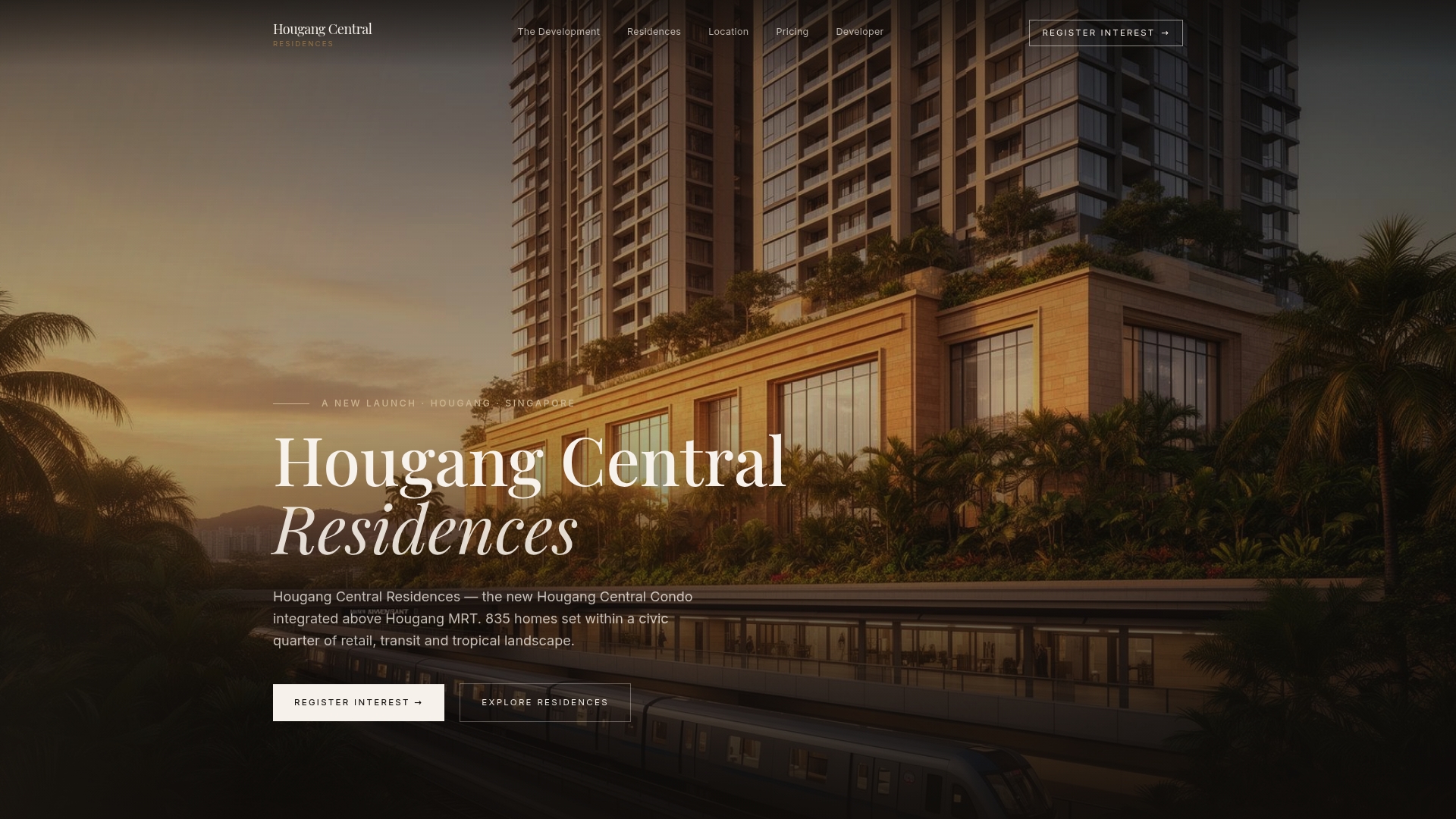
Hougang Central Residences is a condominium development with a range of unit types, featuring quality fittings and integrated smart-home systems. Browse the residence types and site plan to shortlist stacks before you register, then get your bank pre-approval and cash buffer sorted so you are ready to move the moment a VVIP preview slot opens. Register for the showflat preview or request an e-brochure to confirm current SPA payment timelines directly with the sales office before exercising any Option to Purchase.
Sources
- Release of 2nd Quarter 2026 real estate statistics | URA
- Rules for New Housing Loans | MAS
- Essential budgeting tips for your BTO flat | CPF
- Stamp duty rates and guidance | IRAS
This article is general information, not a substitute for advice from a qualified financial advisor. Consult a qualified financial professional about your own circumstances before acting on anything here.
FAQ
What is the current price trend for condominiums in Singapore?
Singapore's private residential price index rose 0.5% quarter on quarter in the second quarter of 2026, a modest increase rather than a sharp jump. URA also notes that Government Land Sales are keeping new supply steady through the year, which tends to keep price growth measured.
What is the cheapest condo price in Singapore?
Entry prices vary widely by location, unit size, and launch timing, and no single citywide floor price is published by URA or IRAS. At Hougang Central Residences, pricing starts from a few thousand Singapore dollars per square foot, viewable on the pricing page.
What happens after 50 years living in a condominium?
Private condominiums in Singapore are typically held on leasehold or freehold titles, and living in one for decades does not trigger an automatic event on its own. What matters is the remaining lease term, since it affects resale value and financing options as the lease shortens, which is a separate consideration from the property's age in use.
Will property prices drop in 2026?
With steady supply coming through the Government Land Sales pipeline, sharp declines are not indicated by the current official data, though buyers should keep checking URA's quarterly releases as the year progresses.