
A bridging loan makes sense if you have a genuine, documented buyer for your current property and just need six months to close the timing gap. It does not make sense as a bet that a sale will happen eventually. The tenure caps out around six months, lenders typically lend up to 20% to 25% of your new purchase price, and every dollar of repayment depends on your existing home actually selling on schedule.
TL;DR:
- Bridging loans should only be used if you have a confirmed buyer and a clear timeline, not as a speculation on an eventual sale.
- Repayment options include capitalized interest, which costs more overall, and simultaneous interest payments, which require stronger monthly cash flow.
- Loan approval depends on specific documentation such as exercised options, sale agreements, income proof, and current mortgage statements, with approval typically taking one to two weeks.
- The loan size should be based on net proceeds after deducting mortgage, CPF refunds, and legal costs, not the full sale price, to avoid shortfalls.
- Rates vary between 4% and 6% annually, with additional fees and penalties, so comparing total costs across lenders is crucial before committing.
Table of Contents
- Understanding Bridging Loans in Singapore and When You'd Use One
- Capitalized Interest vs Simultaneous Repayment: Which Costs Less?
- Eligibility and the Documents Singapore Lenders Ask For
- What a Bridging Loan Actually Costs You
- From OTP to Completion: How the Application Actually Runs
- What Happens If Your Sale Falls Through
- The Rules Behind Every Bridging Loan Offer
- Why We Talk Buyers Through Financing Before They Commit
- A Financing Path That Doesn't Depend on Your Old Flat Selling on Time
- Sources
- FAQ
Understanding Bridging Loans in Singapore and When You'd Use One
A bridging loan covers the gap between the completion payment you owe on your new property and the sale proceeds still sitting in your current, unsold home. Banks structure it as a short-term secured facility, typically capped at 20% to 25% of your new property's purchase price, with a maximum tenure of six months.
Three groups use this product most often in Singapore's market:
- HDB upgraders moving into private property who have an exercised Option to Purchase (OTP) on the new home but haven't cleared their flat's Minimum Occupation Period sale
- Private-to-private buyers juggling two transactions at once, especially when their buyer's financing takes longer than expected
- En bloc sellers and buyers with confirmed OTPs who need to move fast on a new unit before their payout lands
If you're weighing whether to sell first or buy first, that decision shapes whether you need a bridge at all. Our breakdown of the upgrader path walks through both routes. One detail buyers miss: your bridging loan application usually runs alongside your new home loan application, not after it, since the bank assesses both together.
Capitalized Interest vs Simultaneous Repayment: Which Costs Less?
Lenders offer two repayment structures, and picking the wrong one either strains your monthly cash flow or quietly inflates your total interest bill.
- Capitalized interest. You pay nothing monthly. Interest accrues and gets added to the principal, then the whole amount, principal plus accumulated interest, gets settled in one lump sum when your sale completes. This suits buyers whose cash is tight during the overlap period, but it costs more overall because you're paying interest on growing interest.
- Simultaneous repayment. You service the bridging loan's interest monthly, on top of your new mortgage payments, right from disbursement. Total interest ends up lower since the principal never balloons, but it demands real monthly cash flow discipline while you're carrying two properties.
Here's the math that matters: on a $200,000 bridging loan at roughly 4.25% p.a., interest for five months runs about $3,542. Stretch that same loan to six months under capitalized interest, and you're compounding on a larger base each month, so the gap between a 3-month bridge and a 6-month bridge widens faster than the extra three months alone would suggest. Shorter overlap almost always wins on cost.
Eligibility and the Documents Singapore Lenders Ask For
Banks won't process a bridging loan application on promises. They want paperwork proving both transactions are real and that you can service the debt if your sale timeline slips.
- An exercised Option to Purchase for your new property
- A signed OTP (Sales) or Sale and Purchase Agreement for your current home, proving you have an actual buyer, not just a listing
- Recent payslips or income tax statements showing stable income
- Outstanding mortgage statements on your current property
- CPF statements, since refund obligations affect how much of your sale proceeds you'll actually receive
Banks also run a serviceability check using Total Debt Servicing Ratio rules, stress-testing your combined obligations, new mortgage plus bridge interest, at an assessment rate around 4.8% rather than the advertised rate. Self-employed applicants face extra scrutiny on income documentation, and foreigners should expect tighter conditions or exclusion depending on the lender. Most banks, DBS among them, also set a minimum loan size, often around $100,000.
What a Bridging Loan Actually Costs You
Rates vary more between lenders than most buyers expect, and the fees around the loan matter almost as much as the headline rate.
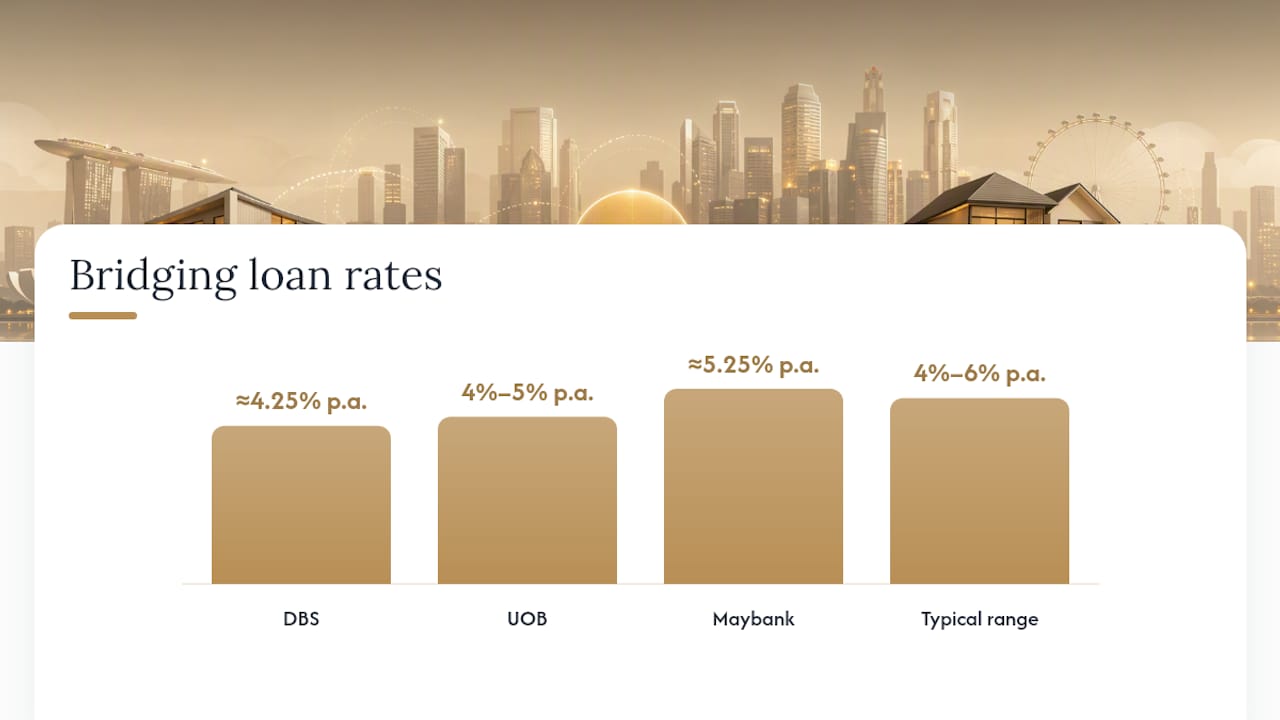
Indicative 2026 pricing across Singapore banks runs roughly 4% to 6% p.a., usually pegged to Prime rate or 3-month SORA plus a spread. DBS has priced around 4.25% on a Prime basis, UOB has ranged 4% to 5%, and Maybank has quoted closer to 5.25%, while Standard Chartered ties its bridging rate to SORA. On top of interest, expect processing fees, a valuation fee if the bank requires one, legal fees for the solicitor handling settlement, and penalty clauses for late repayment.
Don't size your bridge against the sale price of your current flat. Size it against net proceeds, sale price minus your outstanding mortgage, minus the mandatory CPF refund with accrued interest, minus agent commission and legal costs. Skip that step and you risk a shortfall right at completion.
From OTP to Completion: How the Application Actually Runs
Timing is everything with a bridging loan, and most delays trace back to paperwork gaps rather than lender slowness.
- Apply for the bridging loan at the same time you submit your new home loan application, since most banks assess both together and want a consistent picture of your finances.
- Submit your documents: OTPs for both properties, income proof, CPF statements, and existing mortgage details.
- The bank runs its serviceability and stress-test assessment, then issues a formal offer if you qualify.
- Your solicitor coordinates the bridge with both completions, arranging for the bridging loan to be repaid automatically from your sale proceeds at the point your existing property's sale completes.
Banks typically take one to two weeks to approve a bridging loan with complete documentation, though incomplete paperwork stretches that out considerably.
Pro Tip: Get your CPF statement and outstanding mortgage figures ready before you even sign your new OTP. Buyers who show up with these documents already in hand routinely shave days off approval, since it's the single biggest bottleneck loan officers report.
What Happens If Your Sale Falls Through
The entire structure rests on one assumption: your current property sells on schedule. When it doesn't, you're stuck carrying a bridge and a new mortgage at the same time.
- Build a savings buffer before you commit, enough to cover several months of bridge interest if your sale slips
- Line up standby personal loan or pre-approved credit as a fallback, arranged before you need it, not after
- Talk to your buyer's agent about renegotiating completion dates if their financing is the bottleneck
- Consider a short-term rental or staggered settlement arrangement to buy a few extra weeks without panic
- Approach a licensed moneylender only as a last resort. They can approve within 24 to 48 hours but at meaningfully higher cost than a bank
Read your loan terms for red flags before you sign: no guaranteed extension beyond six months, automatic conversion to a higher-rate facility if you need more time, or punitive penalty clauses. A faster sale strategy reduces this risk more than any contingency plan does.
The Rules Behind Every Bridging Loan Offer
Every bank offering a bridging loan in Singapore operates under a specific regulatory framework, and it shapes what terms you'll actually see on your offer letter.
MAS Notice 633 sets the conditions full banks must meet when disbursing bridging loans for property purchases, covering both HDB flat and private property transactions. It's the reason your bank asks for an exercised OTP before it will even discuss terms, and why disbursement timing is tied so tightly to your sale documentation.
CPF refund mechanics compound this. When your current property sells, CPF requires mandatory refund of whatever you withdrew plus the accrued interest, before you see a cent of net proceeds. Combine that with the standard 4.8% stress-test assessment banks apply to your Total Debt Servicing Ratio, and you get a system deliberately built to prevent buyers from overextending on a bridge they can't actually service.
Why We Talk Buyers Through Financing Before They Commit
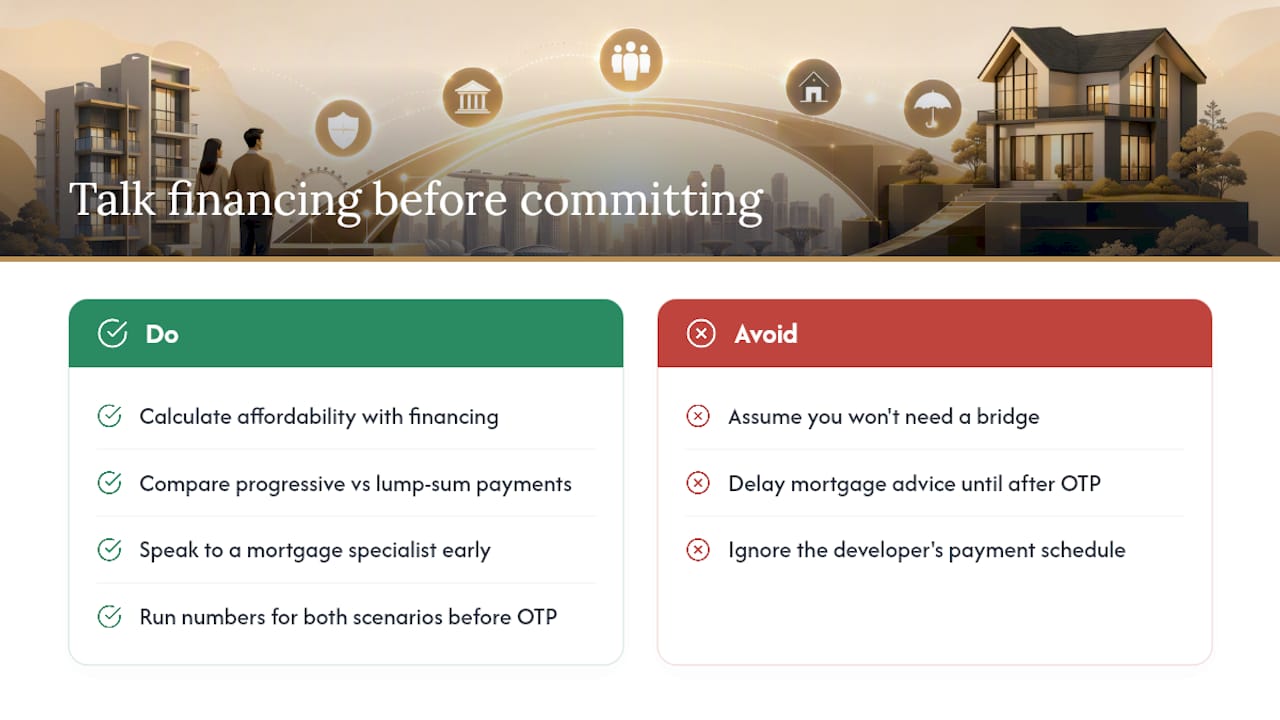
Financing shapes which unit a buyer can realistically afford, and at Hougang Central Residences, we've seen how much a developer's payment schedule can change that math. Progressive payment schemes tied to construction milestones spread out your cash outlay, which for some buyers reduces or eliminates the need for a bridge entirely, since you're not racing to fund a full completion sum before your old flat sells.
That said, financing decisions deserve real scrutiny, not assumptions. Talk to a mortgage specialist early, before you exercise any OTP, and work through your numbers against both scenarios. Our guide to the new launch booking process is a useful starting point if you're weighing a new-launch purchase against a resale upgrade.
— Simon
A Financing Path That Doesn't Depend on Your Old Flat Selling on Time
If the biggest risk in a bridging loan is timing, a developer payment scheme sidesteps that risk instead of managing it. A progressive payment structure means you're not funding a full completion sum upfront, which is precisely the gap a bridging loan exists to cover.
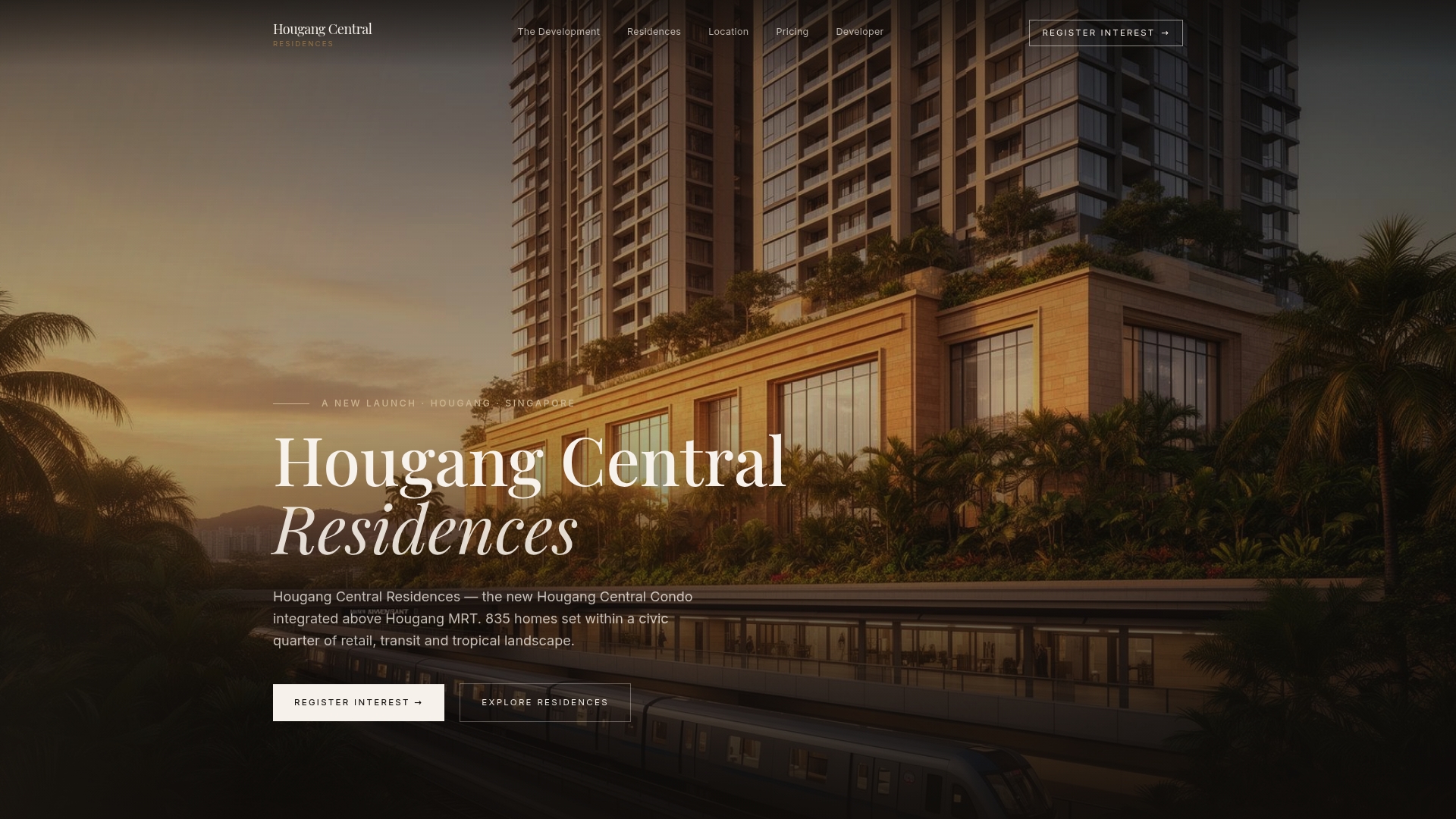
For buyers still deciding between resale and new-launch, that difference is worth weighing before you commit to a six-month bridge and its interest bill. You can review unit layouts, the 835-home mix from one-bedroom-plus-study to five-bedroom penthouses, and current payment options on the Hougang Central Residences project page. Request the e-brochure or book a consultation to see how the numbers compare against a bridging loan for your specific situation.
This article is general information, not a substitute for advice from a qualified financial advisor. Consult a qualified financial professional about your own circumstances before acting on anything here.
Sources
- Bridging Loan Singapore 2026: How It Works & Rates - SingSaver
- Notice 633 Bridging Loans for the Purchase of Immovable Properties
- DBS Home Loan - Singapore
- Bridging Loan Singapore 2026: HDB & Condo Timing Guide - SmartCalculator
FAQ
How Does a Bridging Loan Work in Singapore?
It's a short-term secured loan, typically up to six months and capped around 20% to 25% of your new purchase price, that covers your new property's completion payment while you wait for your existing home to sell. Your solicitor arranges repayment directly from the sale proceeds once that transaction completes.
Is It a Good Idea to Get a Bridging Loan?
It's a sound option when you already have a signed sale agreement or OTP on your current property and just need to cover a short timing gap. It becomes risky if your sale isn't confirmed yet, since you'd be carrying two loans with no guaranteed source of repayment.
What Are the Current Bridging Loan Rates in Singapore?
Rates in 2026 run roughly 4% to 6% p.a. across major banks, priced off Prime rate or SORA plus a spread, with licensed moneylenders charging considerably more for faster approval.
Who Qualifies for a Bridging Loan?
You'll need an exercised OTP on your new property, a signed sale agreement or OTP on your current one, stable income documentation, and you'll need to pass the bank's Total Debt Servicing Ratio stress test, typically assessed around 4.8%.
How Does a Bridging Loan Compare to a Personal Loan for This Purpose?
A bridging loan is secured against your property sale and tenure runs up to six months at bank rates around 4% to 6%, while a personal loan is unsecured, usually carries a higher rate, and isn't structured around your sale completion timeline at all.