
Yes, foreigners can buy private condominiums in Singapore without government approval, but the math changes fast once stamp duty enters the picture. Most foreign buyers pay an Additional Buyer's Stamp Duty of 60% on the purchase price or market value, on top of standard Buyer's Stamp Duty. Landed houses, new Executive Condominiums, and HDB flats are largely off limits unless you clear a separate government approval process.
TL;DR:
- Foreign buyers face a 60% Additional Buyer's Stamp Duty on top of standard stamp fees, significantly increasing the total purchase cost for condos above $1.5 million.
- Only private condominiums and some privatised Executive Condominiums are fully open to foreigners without approval, while landed homes outside Sentosa Cove require government clearance.
- Securing funds is the main challenge, as overseas money takes time to transfer, and legal deadlines for stamp duty payments are strict, often limiting buying options.
- Mortgage conditions for foreigners mirror those for citizens, with maximum LTV around 75%, but banks use stress testing, which can reduce the actual loan amount.
- Properties near transit nodes like Hougang Central Residences offer steadier demand and better liquidity for foreign owners managing the property remotely.
Table of Contents
- Which Properties Can a Foreigner Actually Buy in Singapore?
- How Much Stamp Duty Will You Actually Pay?
- What Do Banks Require From Foreign Borrowers?
- Can Foreigners Get Approval to Buy Landed Homes?
- What Are the Steps to Buying a Condo as a Foreigner?
- What Should You Have Ready Before Making an Offer?
- Why the Real Risk Isn't the Rules, It's the Timing
- Consider Hougang Central Residences for Your Singapore Purchase
- Sources
- FAQ
Which Properties Can a Foreigner Actually Buy in Singapore?
Private condominiums and apartments are the default answer to "can a foreigner buy a condo in Singapore," and they come with no approval requirement at all. The Singapore Land Authority confirms that foreign persons can purchase strata-titled condo units, whether freehold or leasehold, the same way a citizen would. That single fact drives most of the demand you see from expatriates and overseas investors scanning listings near MRT lines.
Beyond condos, the picture gets more restrictive. Here's how the categories break down:
- Private condominiums and apartments: fully open to foreign buyers, no approval needed.
- Privatised Executive Condominiums (generally past the 10-year mark): treated like private condos and open to foreign buyers.
- New Executive Condominiums and HDB flats: closed to foreigners under normal HDB eligibility rules, which reserve these for citizens and, in limited cases, permanent residents.
- Landed property outside Sentosa Cove: requires Land Dealings Approval Unit clearance under the Residential Property Act.
- Landed property within Sentosa Cove: the one geographic exception, where foreigners can apply to buy landed homes for owner occupation.
One detail trips people up: the Residential Property Act treats permanent residents as "foreign persons" for landed-property purposes. Getting PR status doesn't unlock landed housing on its own. If your search keeps landing on terrace houses or bungalows, you're already in restricted territory, and a condo, strata-landed unit inside a condo development, or privatised EC is the more realistic path.
How Much Stamp Duty Will You Actually Pay?
The Additional Buyer's Stamp Duty is where foreign buyer budgets get tested. IRAS sets the ABSD rate for foreign individuals at 60% of the purchase price or market value, whichever is higher, and that rate has held since 27 April 2023. Buyers from countries with a qualifying free trade agreement with Singapore, including the United States, may be eligible for ABSD remission, which brings their treatment closer to a citizen's. That remission isn't automatic. You apply for it, and a lawyer typically handles the paperwork.
Buyer's Stamp Duty stacks on top of ABSD and follows a tiered scale rather than a flat rate:
- 1% on the first $180,000
- 2% on the next $180,000
- 3% on the next $640,000
- 4% on the next $500,000
- 5% on the remaining amount above $1.5 million (with a further step to 6% past $3 million)
Both duties are payable in cash within a government-specified period after signing, and banks generally do not lend against stamp duty, so this money needs to be readily available before you exercise the Option to Purchase.
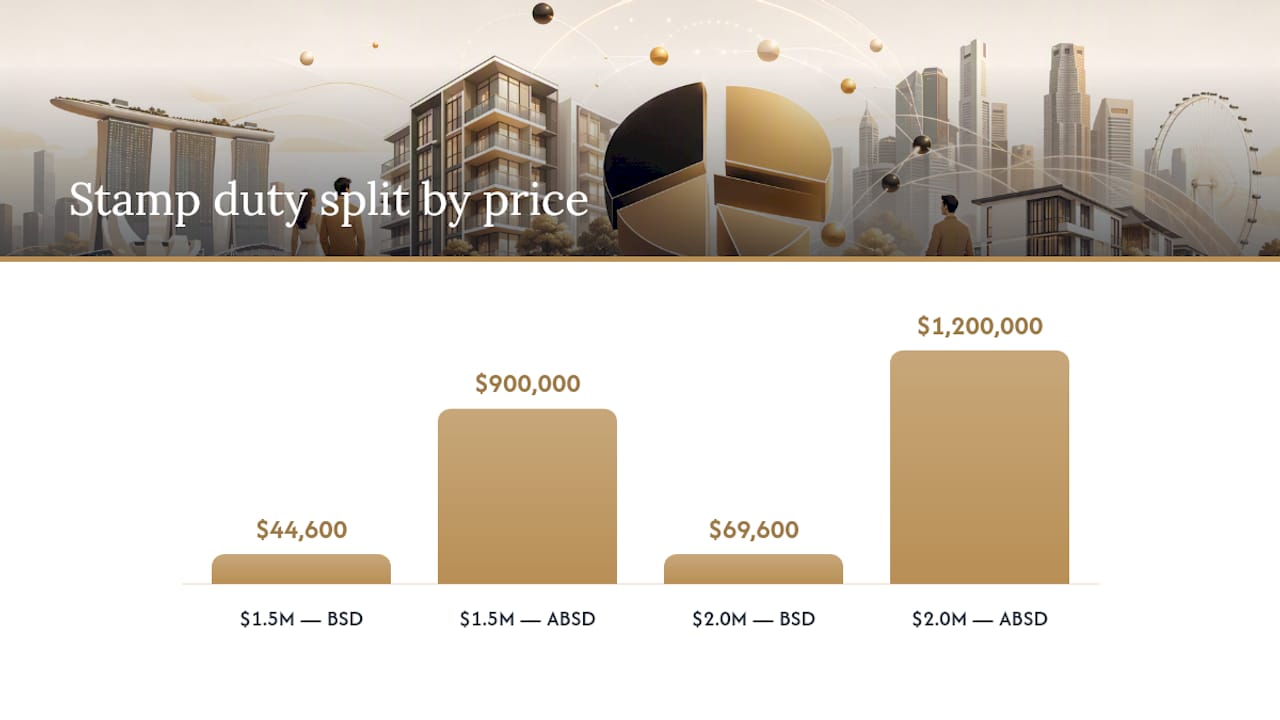
Run the numbers on a $1.5 million condo: BSD lands around $44,600, and ABSD at 60% adds $900,000, for a combined stamp duty bill near $944,600 before legal fees or agent commission. On a $2 million unit, BSD comes to roughly $69,600 and ABSD hits $1,200,000, pushing total duty past $1.27 million. Those figures alone often decide whether a foreign buyer's budget can stretch to the unit they actually want.
What Do Banks Require From Foreign Borrowers?
MAS caps the loan-to-value ratio for most buyers at 75%, though it drops as loan tenure extends past 30 years or the borrower's age pushes the loan past 65. Foreign borrowers typically see the same caps as citizens on this front, but banks apply extra scrutiny to income verification and often shave a few points off the maximum LTV for non-resident applicants.
The Total Debt Servicing Ratio framework caps your monthly debt obligations at 55% of gross income, and banks stress-test that calculation using a medium-term interest rate floor rather than today's actual rate. That means your approved loan amount can look smaller than your income would suggest.
Lenders generally ask foreign applicants for:
- Passport and Employment Pass or work pass details
- Latest Notice of Assessment or equivalent overseas tax document
- Six months of bank statements
- Payslips or audited accounts if self-employed
- An overseas credit report, where available
Pro Tip: Get an in-principle approval before you start viewing units seriously. It tells you your real borrowing ceiling, and it flags valuation gaps early, since a bank's valuation coming in below your offer price means you cover the shortfall in cash, not through the loan.
Can Foreigners Get Approval to Buy Landed Homes?
The Residential Property Act sets up a formal approval track through the Land Dealings Approval Unit for any foreign person wanting a landed home outside Sentosa Cove. The Act itself defines exactly who counts as a foreign person, and the SLA's guidance spells out that this approval sits separate from any condo purchase, which needs none.
LDAU applications typically call for:
- Proof of Singapore residency history and duration
- Tax records showing contribution to the local economy
- A statement of funds and financial standing
- A CV or profile demonstrating economic or professional contribution to Singapore
Processing takes weeks to months, and government guidance on the 2023 amendments outlines the supporting documentation in more detail. Sentosa Cove remains the practical shortcut. Foreigners buying there for owner occupation face a faster, more predictable approval path than anywhere else on the mainland. Outside Sentosa Cove, approval without long-term PR status or a demonstrable record of economic contribution is genuinely rare, so most foreign buyers looking at landed homes should treat a condo as the realistic fallback rather than a consolation prize.
What Are the Steps to Buying a Condo as a Foreigner?
The purchase timeline runs on fairly fixed milestones once you've picked a unit:
- Secure an in-principle approval from a bank and confirm your ABSD and BSD figures with a solicitor before making any offer.
- Negotiate and sign the Option to Purchase, paying an option fee (commonly 1% of the price) that locks the seller in for a set option period, usually two to three weeks.
- Exercise the OTP within that window by paying the exercise fee, which legally binds both parties to the sale.
- Pay stamp duty through your lawyer within 14 days (or 30 days if the OTP was signed abroad); late payment triggers penalty interest on top of the duty owed.
- Complete the purchase, typically 8 to 12 weeks after exercise, when your lawyer disburses the balance funds, the title transfers, and the sale gets registered.
Your conveyancing lawyer coordinates the IRAS stamping and the title registration in the background, but the cash needs to be sitting ready at each milestone. Missing the stamping deadline is one of the most common, and most avoidable, mistakes foreign buyers make.
What Should You Have Ready Before Making an Offer?
Before you sign an OTP, line up your passport, work pass or Employment Pass, latest Notice of Assessment, recent payslips, and six months of bank statements. Your lawyer and bank will both ask for these, and delays here stall everything downstream.

On the cash side, budget separately for the option fee, the stamp duty total, and legal fees, which typically run $2,500 to $3,000 for a straightforward purchase. Remember that ABSD alone runs 60% of the purchase price for most foreign nationals, so that figure needs to sit in a Singapore-accessible account, not locked in a foreign currency term deposit, well before you exercise the OTP.
Watch for two recurring red flags: anyone claiming they can waive or discount ABSD outside the legitimate FTA remission process, and requests to pay any portion of the price or duty off the books in cash. Once your documents are ready, instruct a licensed conveyancing lawyer and confirm your remission eligibility, if your nationality qualifies, before you start viewing seriously.
Why the Real Risk Isn't the Rules, It's the Timing
Most guidance on foreigners buying Singapore property focuses on whether you're allowed to buy, which is honestly the easy part. The harder problem is cash sequencing: having liquid funds positioned correctly across three different deadlines that don't care about currency transfer times, employment pass renewal timelines, or your home bank's international wire processing.
I've seen the pattern often enough that it's worth calling out directly: foreign buyers get pre-approved for financing, find a unit, sign the OTP, and then discover their overseas funds take 10 days to clear into a Singapore account. Fourteen days from OTP signing arrives faster than people expect.
This is where a transit-linked development like Hougang Central Residences offers something beyond convenience. Sitting directly above an MRT interchange with an integrated retail mall changes the ownership equation for a foreign owner who won't be on the ground full time. Tenant demand near transit nodes tends to be steadier, and a mixed unit range, from one-bedroom-plus-study to five-bedroom penthouses, means the building serves both an owner-occupier and a buy-to-let strategy without forcing a compromise on either.
— Simon
Consider Hougang Central Residences for Your Singapore Purchase
If you've made it through the ABSD math and the mortgage documentation and you're still looking for a condo that solves the ownership logistics for a non-resident buyer, Hougang Central Residences is built around exactly that problem. It sits directly above Hougang MRT station with an integrated mall and bus interchange, and it's positioned near a future Cross Island Line interchange, which matters if you're weighing rental demand or resale liquidity down the line as a foreign owner who can't always be physically present.
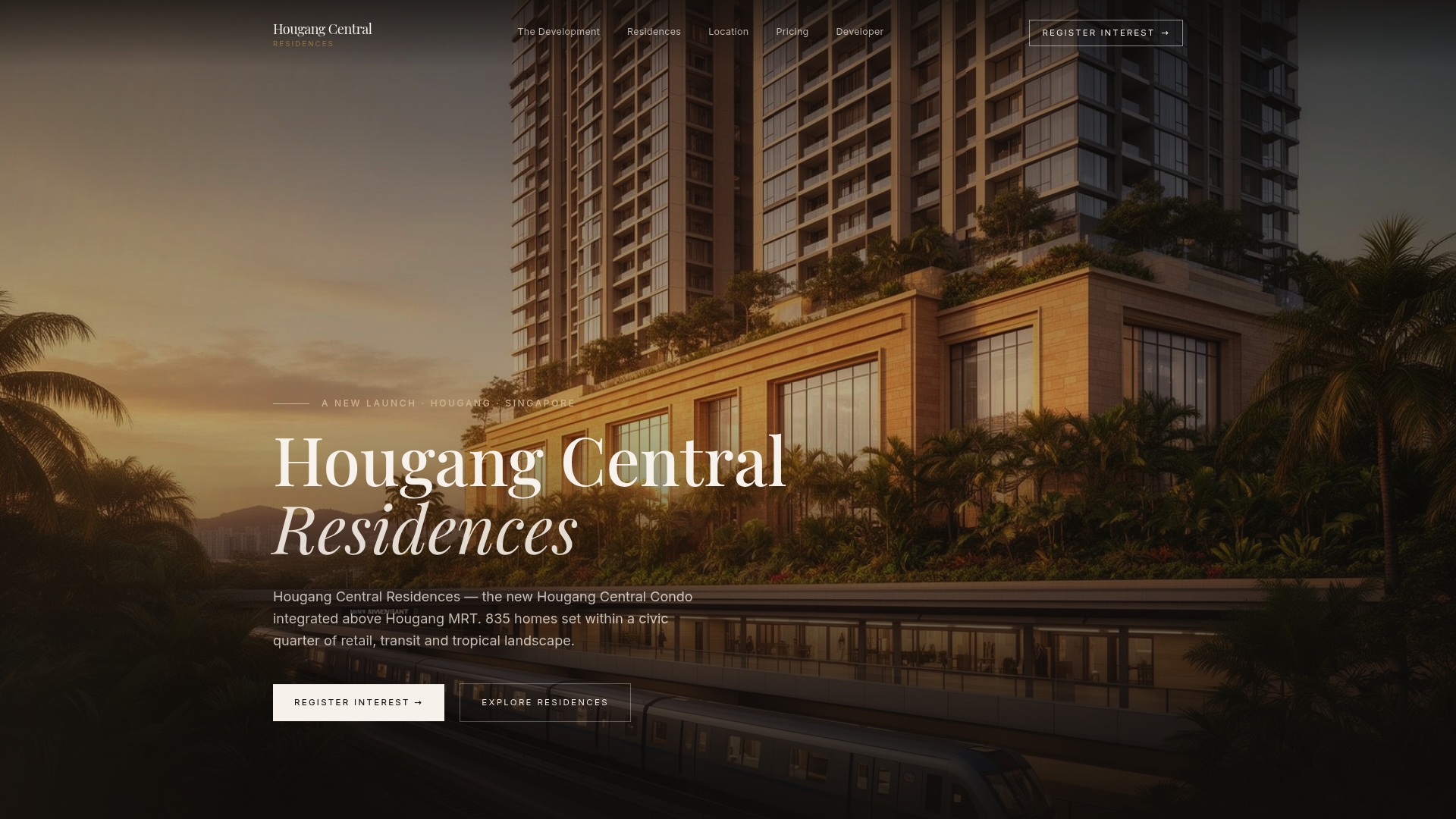
The development offers a full range of unit layouts, some with European fittings and smart-home systems. Pricing starts from $2,800 per square foot. Before you commit, confirm your ABSD and financing position with your lawyer, then browse the full range of residences to see which layout fits your ownership plan, whether that's a landing pad for regular visits or a straightforward rental investment.
This article is general information, not a substitute for advice from a qualified financial advisor. Consult a qualified financial professional about your own circumstances before acting on anything here.
Sources
- IRAS | Stamp Duty
- Foreign ownership of property | Singapore Land Authority
- Residential Property Act (RPA) — Attorney-General's Chambers
- MAS — Loan tenure and loan-to-value limits
FAQ
What Are the New Rules for Foreigners Buying Property in Singapore?
Private condominiums remain open to foreign buyers with no approval needed, while landed homes outside Sentosa Cove still require LDAU approval under the Residential Property Act. The main shift buyers need to track is the ABSD rate itself, which IRAS set at 60% for foreign individuals effective April 2023.
Do Foreigners Need to Pay ABSD?
Yes, almost all foreign buyers pay Additional Buyer's Stamp Duty, currently 60% of the purchase price or market value. Buyers from FTA-qualifying countries can apply for remission that brings their rate down.
Can a Singaporean and a Foreigner Buy an HDB Flat Together?
Generally no. HDB eligibility rules reserve flat purchases for citizens and, in limited schemes, permanent residents, and a non-resident foreigner does not qualify as a co-applicant. A private condominium is the standard workaround for mixed-status couples.
How Much Money Do I Need to Buy a Condo in Singapore?
Beyond the purchase price, budget for ABSD at 60%, tiered BSD (roughly 3 to 5% depending on price), legal fees around $2,500 to $3,000, and an option fee near 1% of the price. On a $1.5 million condo, stamp duty alone runs close to $944,600, all payable in cash within 14 to 30 days of signing.
Is Hougang Central Residences a Good Fit for Foreign Buyers?
It's a private condominium, so it falls under the standard foreign-buyer approval path with no SLA clearance required. Direct MRT access, an integrated mall, and unit types from 1-Bedroom + Study to 5-Bedroom Penthouse make it a practical option for both owner-occupiers and rental investors managing the property remotely.