If you're a U.S. citizen buying a condo in Singapore, Additional Buyer's Stamp Duty) (ABSD) is the single largest variable cost you'll face. Administered by IRAS, it sits on top of the standard Buyer's Stamp Duty and, for most foreign buyers, runs at a high rate of the purchase price. On a luxury condo purchase, that represents a substantial cash payment due within 14 days of exercising your Option to Purchase.
The fastest way to reduce that exposure depends on your situation:
- Sell first: If you currently own no Singapore residential property, you enter as a "first purchase" buyer. For foreigners, the 60% rate still applies regardless of property count, but eliminating any existing Singapore ownership keeps your profile clean.
- Buy first + remission: This route is only available to Singapore Citizen married couples upgrading from an HDB flat. As a U.S. buyer, you almost certainly don't qualify unless your spouse holds Singapore Citizenship.
- Check FTA status: A small number of nationalities benefit from reduced rates under Free Trade Agreements. The U.S. does not currently have an FTA with Singapore that reduces ABSD for American buyers.
Pro Tip: Before you sign anything, confirm your exact buyer profile with IRAS or a Singapore conveyancing lawyer. A single inherited property share you forgot about can push you into a higher ABSD tier.
Hougang-central-residences, situated directly above Hougang MRT, is the kind of transit-integrated luxury project U.S. buyers increasingly target. Understanding ABSD rules before you engage a developer or agent is what separates a smooth purchase from a costly surprise.
Table of Contents
- What ABSD is and which purchases it covers
- Who pays ABSD and what U.S. buyers must verify first
- Sell-first vs. buy-first: which strategy works for you?
- How ABSD changes your financing and cash needs
- Conveyancing checklist and cross-border steps for U.S. buyers
- Why Hougang-central-residences matters for transit-focused U.S. buyers
- Key Takeaways
- What U.S. buyers often get wrong about ABSD timing
- Hougang-central-residences: a practical starting point for Singapore condo buyers
- Primary sources and further reading
- FAQ
What ABSD is and which purchases it covers
ABSD is a Singapore residential stamp duty, not a U.S. tax. IRAS levies it in addition to the standard Buyer's Stamp Duty on every qualifying residential purchase. ABSD rates vary depending on buyer status, with lower rates for Singapore Citizens and higher rates for other entities such as companies and trusts.
ABSD applies to private condos, HDB resale flats (post-MOP), Executive Condominium resale units (post-MOP), and residential land. Commercial properties are exempt unless they contain a residential component, in which case only the residential portion is liable. Offices, retail units, and industrial spaces don't count toward your residential property tally for ABSD purposes.
Timing matters: ABSD is assessed at the point of purchase, meaning when you exercise the OTP or sign the Sale and Purchase Agreement. It is not deferred to completion or handover.
| Property type | ABSD applies? |
|---|---|
| Private condominium | Yes |
| HDB resale (post-MOP) | Yes |
| EC resale (post-MOP) | Yes |
| Residential land | Yes |
| Commercial office/retail | No |
| Mixed-use (residential component) | Residential portion only |
Who pays ABSD and what U.S. buyers must verify first
Your ABSD rate depends on your citizenship, residency status, and how many residential properties you already own anywhere in Singapore.
| Buyer profile | 1st property | 2nd property | 3rd+ property |
|---|---|---|---|
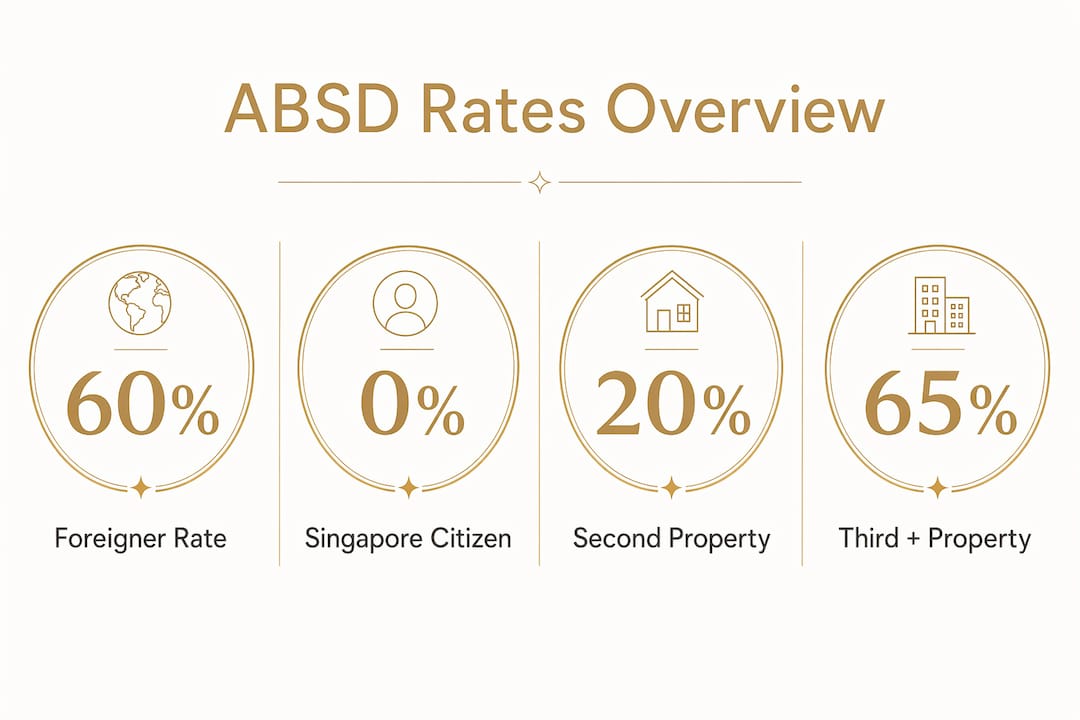
| Singapore Citizen | 0% | 20% | 65% |
| Singapore PR | 5% | 30% | 35% |
| Foreigner (non-FTA) | 60% | 60% | 60% |
| Entity (company/trust) | 65% | 65% | 65% |
For most U.S. buyers, the foreigner rate applies uniformly across all purchases. The applicable rates were revised recently and remain in effect currently.
Joint purchases follow the highest-rate buyer in the transaction. If you buy with a Singapore Citizen spouse, the foreigner rate applies to the entire purchase price, not just your share. Verify your spouse's or co-buyer's status before structuring the deal.
Partial or inherited ownership counts as full ownership for ABSD property-count purposes. A 10% inherited share in a Singapore apartment puts you in the "second property" tier, which for a foreigner changes nothing on rate but can affect remission eligibility for citizen co-buyers.
Pro Tip: Check the IRAS ABSD page directly for any FTA-based nationality exceptions before assuming the standard 60% applies. Some nationalities get parity with Singapore PRs under specific trade agreements.
Sell-first vs. buy-first: which strategy works for you?
Sell first is the lower-risk path. You dispose of your existing Singapore residential property before signing anything new, entering the next purchase with a clean ownership record. For a Singapore Citizen, that means 0% ABSD on the new purchase. For a U.S. buyer, the 60% rate still applies, but your financing is cleaner and you avoid the administrative complexity of the remission route.
The tradeoff is a housing gap. Between selling and buying, you'll need interim accommodation, whether that's a short-term rental or staying with family. For buyers targeting a new launch like Hougang-central-residences, timing the sell to align with the project's TOP date is worth planning carefully. A condo lease vs. purchase guide can help you think through interim housing costs.
Buy first + remission is only available to Singapore Citizen married couples upgrading from an HDB flat. The conditions are strict:
- At least one buyer must be a Singapore Citizen.
- The purchase must be made jointly under both names.
- Neither buyer can own any other residential property at the time of purchase.
- The HDB flat must be sold, with completion, within six months of the private property purchase (or within six months of TOP for new launches).
The ABSD remission requires paying the full 20% upfront, then applying for a refund once the HDB sale completes within the deadline. That's a significant cash outlay to carry for months.
Buyers frequently miss the deadline due to HDB sale delays. Engage a conveyancing lawyer early and build buffer time into every contract.
How ABSD changes your financing and cash needs
ABSD must be paid in cash. CPF savings cannot cover it. Combined with the standard down payment and BSD, the upfront cash requirement for a luxury condo purchase is substantial.
For a S$2 million condo purchased by a foreigner:
- BSD: approximately S$64,600 (progressive rates on purchase price)
- ABSD at 60%: S$1,200,000
- Minimum cash down payment (5% of purchase price): S$100,000
- Total minimum cash at exercise: roughly S$1,364,600, before legal fees
That figure illustrates why ABSD can exceed renovation budgets and fundamentally reshape affordability planning for foreign buyers.
On the loan side, holding an existing residential property reduces the maximum Loan-to-Value ratio available from a Singapore bank. For a first residential property with a bank loan, the maximum LTV is 75%, requiring at least 25% from cash and CPF, with a minimum 5% in cash. A second property typically reduces LTV further, increasing the cash portion required.
Bridging loans are commonly used during buy-first purchases to fund the upfront ABSD while waiting for the HDB sale to complete. ABSD must be paid within 14 days of OTP exercise, so the bridging facility needs to be arranged before you sign. If the HDB sale delays, the bridging loan continues accruing interest.
Pro Tip: Ask your Singapore bank for a written LTV confirmation before you exercise the OTP. TDSR rules cap total debt servicing at 55% of gross monthly income, and U.S.-sourced income may be assessed differently by local lenders.
Conveyancing checklist and cross-border steps for U.S. buyers
Getting the paperwork right is where most foreign buyers lose time or money. Work through this list before you exercise the OTP:
- Verify your buyer profile with IRAS or a Singapore conveyancing lawyer (citizenship, existing property count, any inherited shares).
- Confirm ABSD rate and payment deadline: ABSD is due within 14 days of OTP exercise or S&P signing.
- Engage a Singapore conveyancing lawyer before signing anything. They manage ABSD filings, remission applications, and HDB sale coordination.
- Arrange financing early: get LTV and TDSR confirmation from your Singapore bank, and set up a bridging loan facility if buying first.
- For new launches: note that the remission window runs from TOP/CSC date, not OTP date. Confirm the developer's projected TOP before committing.
- U.S. tax reporting: owning foreign real estate triggers potential FBAR (FinCEN Form 114) and Form 8938 obligations for U.S. citizens. Consult a U.S. tax advisor before purchase, not after.
- Foreign tax credits: Singapore stamp duties are generally not income taxes and may not qualify as creditable foreign taxes under U.S. rules. Get specific advice from a U.S. tax professional.
Pro Tip: Build a minimum four-week buffer between your target HDB sale completion and the six-month remission deadline. Written confirmation from your lawyer that the timeline is achievable is worth requesting before you commit.
Why Hougang-central-residences matters for transit-focused U.S. buyers
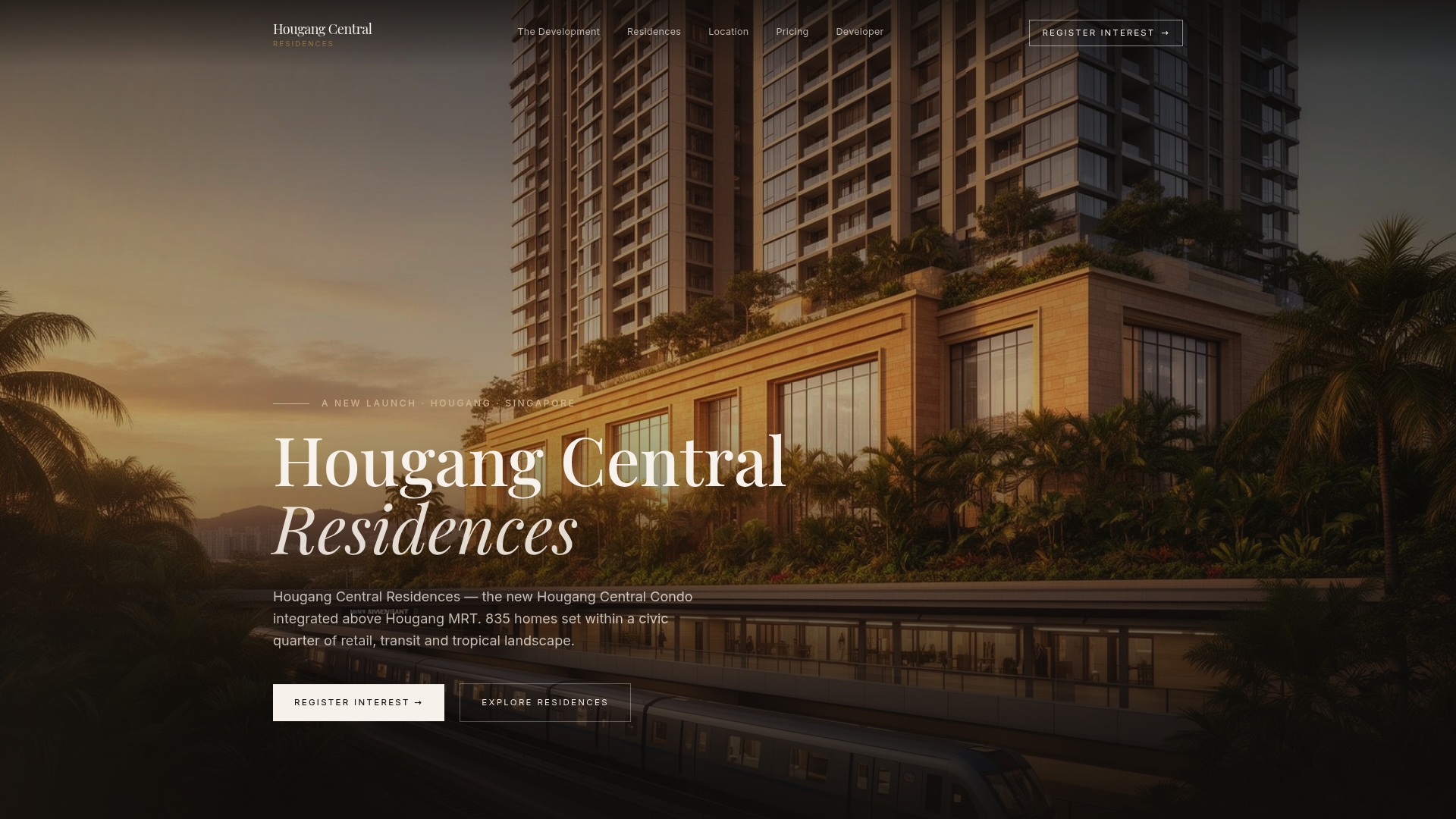
Hougang-central-residences sits directly above Hougang MRT station, offering a range of units from one-bedroom to larger configurations. The project integrates retail and transit access at the podium level, which is the kind of connectivity U.S. buyers accustomed to urban living tend to prioritize. Tropical landscaped areas, smart-home systems, and premium European fittings position it firmly in the Singapore luxury condo segment.
For ABSD planning purposes, Hougang-central-residences is a new launch, which means the remission window for eligible buyers runs from the TOP/CSC date rather than the OTP date. That gives citizen-couple buyers more time to complete their HDB sale before the deadline triggers. For U.S. buyers paying the 60% foreigner rate, the project's pricing and unit mix are worth modeling against total acquisition cost before committing.
| Feature | Detail |
|---|---|
| Location | Above Hougang MRT station |
| Unit range | 1-bedroom to larger configurations |
| Transit integration | Direct MRT and retail podium access |
| Smart-home systems | Included across unit types |
| Remission timing (new launch) | Six-month window from TOP/CSC date |
This section reflects publicly available project information. For current unit pricing, availability, and ABSD impact scenarios specific to your buyer profile, consult the project team directly.
Key Takeaways
Buying a condo under ABSD rules as a U.S. buyer requires confirming your buyer profile, calculating total cash needs before signing, and engaging a Singapore conveyancing lawyer before you exercise any Option to Purchase.
| Point | Details |
|---|---|
| Foreigner ABSD rate | U.S. buyers typically pay 60% ABSD on any Singapore residential purchase. |
| Cash payment deadline | ABSD must be paid in cash within 14 days of OTP exercise; CPF cannot be used. |
| Remission eligibility | Buy-first remission requires at least one Singapore Citizen spouse; most U.S. buyers don't qualify. |
| Six-month deadline | For new launches, the remission window runs from TOP/CSC date, not OTP date. |
| Hougang-central-residences | A new-launch transit-integrated condo above Hougang MRT; ABSD scenarios should be modeled before signing. |
What U.S. buyers often get wrong about ABSD timing
The conventional advice to "just pay ABSD and sort it out later" is expensive thinking. At 60%, ABSD isn't a rounding error on a luxury purchase. It's often larger than the renovation budget, the legal fees, and the first year of mortgage payments combined.
What most guides underplay is the interaction between ABSD and LTV. When you're carrying a large ABSD obligation in cash, your available liquidity for the down payment shrinks. Banks assess TDSR against your total debt load, and U.S.-sourced income sometimes gets haircut by local lenders who aren't familiar with American pay structures. That combination can push buyers into bridging loans they didn't plan for, at interest rates that compound quickly if the HDB sale drags.
For families relocating from the U.S. to Singapore, the smarter move is treating ABSD planning as a financing decision, not a tax afterthought. Model the total cash-out at exercise, confirm your LTV with the bank in writing, and align your interim housing plan with the purchase timeline before you fall in love with a unit. The family amenities checklist is worth running through only after the numbers work.
Hougang-central-residences: a practical starting point for Singapore condo buyers
For U.S. buyers who've done the ABSD math and are ready to explore what a transit-integrated luxury condo actually looks like in practice, Hougang-central-residences offers a concrete starting point. Positioned above Hougang MRT with direct retail access, family-scale unit options, and smart-home features built in, it addresses the connectivity and lifestyle priorities that drive most American relocations to Singapore.
A consultation with the project team can walk you through unit pricing, available configurations, and indicative ABSD impact scenarios for your specific buyer profile. They can also connect you with financing introductions for Singapore bank loans. Legal and tax decisions, including ABSD remission applications and U.S. cross-border reporting, require a Singapore conveyancing lawyer and a U.S. tax advisor respectively.
Explore Hougang-central-residences for project details, floor plans, and to request a consultation.
Primary sources and further reading
The authoritative source for ABSD rates, remission conditions, and payment deadlines is IRAS. Rates were last materially revised in April 2023 and remain in effect through 2026.
Key sources to consult:
- IRAS — Additional Buyer's Stamp Duty (ABSD)): primary authority for rates, remission eligibility, and payment timelines.
- Propkaki — Buying your first private condo in Singapore: detailed breakdown of BSD rates, LTV rules, and TDSR constraints.
- PropertyNet.SG — Timing your HDB sale and condo purchase: practical guidance on remission deadline risks.
- Mark Tan — ABSD Singapore 2026 complete guide: worked examples and payment timeline details.
This article is general information only, not legal or tax advice. Confirm current rules with IRAS and consult a Singapore conveyancing lawyer and a qualified U.S. tax advisor for your specific situation.
FAQ
What ABSD rate do U.S. buyers pay on a Singapore condo?
U.S. citizens are classified as foreigners under IRAS rules and pay 60% ABSD on any Singapore residential property purchase, regardless of how many properties they own.
Can a U.S. buyer avoid ABSD entirely?
No. The ABSD remission for the buy-first route requires at least one Singapore Citizen in the purchase. U.S. buyers without a Singapore Citizen spouse must pay the full 60% foreigner rate.
When exactly must ABSD be paid?
ABSD is due within 14 days of exercising the Option to Purchase or signing the Sale and Purchase Agreement. It must be paid in cash; CPF cannot be used.
Does buying a commercial property in Singapore affect ABSD?
No. Commercial properties are exempt from ABSD and don't count toward your residential property tally, unless the property includes a residential component.
How does Hougang-central-residences fit into ABSD planning for new launches?
As a new launch, the six-month remission window for eligible Singapore Citizen couples runs from the TOP/CSC date rather than the OTP date, giving more time to complete an HDB sale before the deadline triggers.