
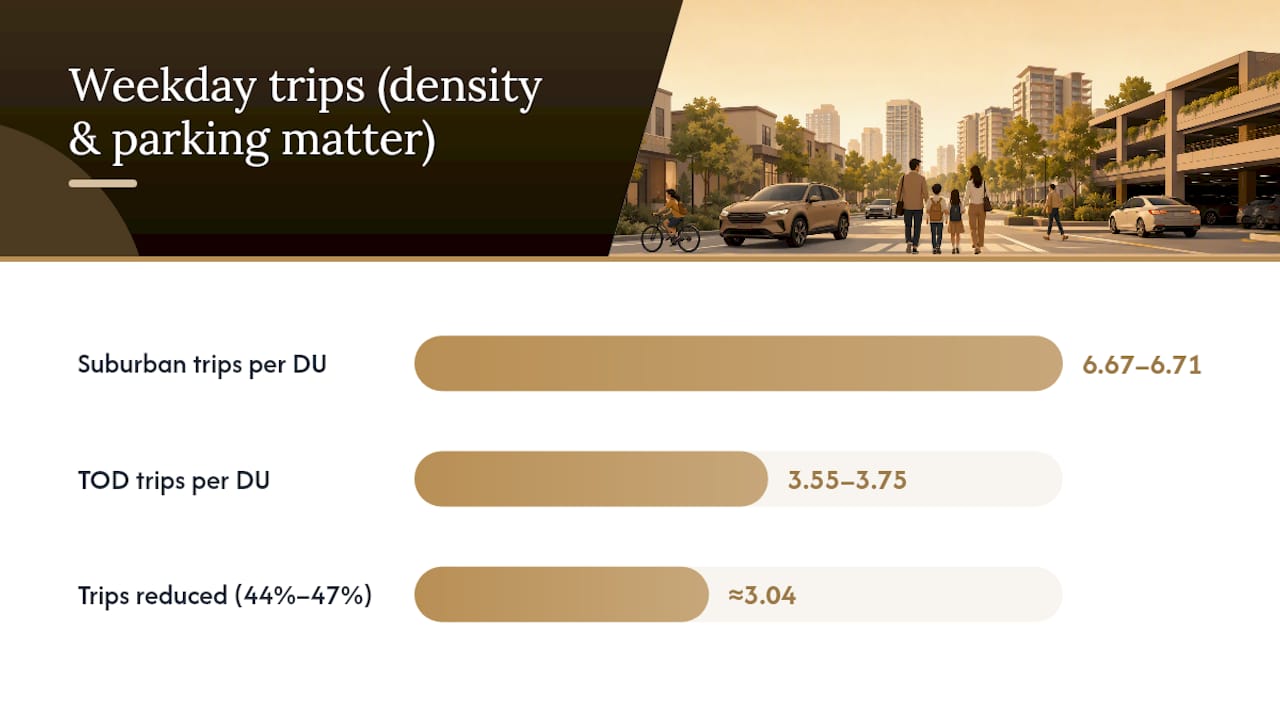
Families choose transit- and retail-integrated condominium residences because they convert commuting and daily errands into reclaimed time, cut household transportation costs, and put safe, walkable access to daily needs right outside the front door. The evidence backs this up: residents in transit-oriented developments (TODs) generate 44%–47% fewer vehicle trips per weekday compared with conventional suburban households, and rail-proximate condominiums carry property premiums of 2%–18% over comparable non-transit units.
The core features that make this possible:
- Direct station access with no street crossing or shuttle required
- On-site childcare, grocery, and healthcare that eliminate multi-stop errand chains
- Walkable, stroller-friendly circulation within a secure building perimeter
- Smart-home systems and flexible unit layouts sized for families from toddlers to teens
Key Takeaways
Families who choose transit- and retail-integrated residences consistently recover time, reduce vehicle trips by 44%–47%, and gain property value resilience that suburban alternatives rarely match.
| Point | Details |
|---|---|
| Vehicle-trip reduction | TOD residents generate 44%–47% fewer weekday vehicle trips than suburban households. |
| Transit premium range | Rail-proximate condos carry a 2%–18% price premium that tends to hold during market downturns. |
| Family checklist priority | Unit mix (3–4 bedrooms), on-site childcare, and school-district coordination are the three non-negotiable checks. |
| Tradeoffs to price in | HOA costs, parking needs, and noise from station-level units require honest assessment before purchase. |
| Hougang-central-residences | Offers direct above-station MRT access, podium retail, and units from 1-bedroom-plus-study to 5-bedroom penthouses. |
Table of Contents
- 1. Why families choose integrated residences: the concrete benefits
- 2. How to evaluate an integrated residence before you buy
- 3. Tradeoffs families must weigh before buying
- 4. What the research shows about TOD and family living
- 5. The amenity and design checklist that makes integration work for families
- 6. What a typical week looks like in an integrated residence
- What the evidence actually tells families who are ready to decide
- Hougang-central-residences maps directly to what families are looking for
- Sources
- FAQ
1. Why families choose integrated residences: the concrete benefits
The single biggest draw is time. When the MRT platform is one elevator ride away and the grocery store is on the ground floor, a weekday that once required two car trips collapses into a single building exit. UC Berkeley research on families and TODs confirms this: families specifically seek out "complete community" features — integrated grocery, childcare, and public space — because they reduce multi-stop errands and free up family time.
Money follows closely. Station-proximate properties show more resilient prices during downturns and deliver lower household transportation costs, so the premium paid at purchase tends to pay back through reduced car ownership and operating expenses.
A few quick examples of how this plays out:
- A parent drops a toddler at the on-site childcare center, steps onto the platform, and reaches downtown in 20 minutes, all without touching a car.
- A family picks up groceries on the way back from the MRT, skipping the weekend supermarket run entirely.
- Kids walk to a ground-floor afterschool program while parents finish the workday upstairs.
Pro Tip: When comparing total housing costs, add your current annual car-ownership expense to the suburban home price. For many families, the integrated condo's premium narrows or disappears once that line item shrinks.
Public transit access also carries health and lifestyle benefits beyond transport: reduced commute stress, more incidental walking, and stronger social connection within a walkable community.
2. How to evaluate an integrated residence before you buy
A checklist keeps the tour focused. Work through these in order of impact on daily family life:
- Transit quality. Time the walk from the lobby to the platform. Count transfer options and check peak-hour frequency. A five-minute walk to a high-frequency line beats a two-minute walk to a bus that runs every 30 minutes.
- Family-sized unit availability. Confirm 3- and 4-bedroom units are in the mix. CTOD guidance is explicit: without a deliberate unit-mix strategy, TODs skew toward studios and one-bedroom units that families cannot use.
- On-site services. Childcare, grocery, and a clinic or pharmacy are the tier-one integrations. A coffee shop and a nail salon are not. Ask whether the childcare center has priority access for residents.
- Parking policy. Check bundled vs. unbundled parking, visitor spots, and whether car-sharing is available on-site. Peak residential parking demand at TODs frequently runs well below ITE guidelines, so a project with fewer stalls than you expect may still serve your family fine.
- School access. Identify the zoned school, its enrollment capacity, and how the district handles demand from new high-density projects. Ask the developer whether any school-coordination agreements exist.
- Safety and stroller accessibility. Walk the ground-floor loop with a stroller. Check sightlines at the drop-off zone, lighting at the station entrance, and whether pedestrian paths are physically separated from vehicle lanes.
- HOA and maintenance costs. Mixed-use buildings carry higher operating costs than pure residential towers. Get the last two years of HOA financials and check the reserve fund balance.
Pro Tip: Visit twice: once during the weekday morning rush (7–9 AM) and once on a Saturday afternoon when retail is busy. The noise level, crowd density, and drop-off flow you see then is what you will live with every day.
3. Tradeoffs families must weigh before buying
No property type is without downsides, and integrated residences have specific ones worth naming plainly.
Purchase premium and HOA costs. The transit premium is real — 2%–18% above comparable non-transit units — and mixed-use buildings carry higher maintenance costs than standalone residential towers. Budget for both.
Parking and car-shedding. TOD households typically own fewer cars and are more likely to have zero-car households, but that shift is not automatic. Families with school-age children in activities spread across the city, or with elderly relatives to transport, often keep at least one vehicle. Be honest about your actual travel patterns before assuming you can drop a car.
Noise and footfall. Units directly above the station concourse or facing the retail street will carry more ambient noise. Simple on-site tests: stand in the unit during a weekday afternoon and listen; check whether windows are double-glazed; ask which floors the developer recommends for quieter orientation. Properties roughly 0.3–0.5 miles from the station entrance sometimes capture strong access premiums while avoiding the heaviest footfall, though that distance tradeoff depends on the specific site.
School enrollment pressure. New mixed-use projects add residents faster than school capacity adjusts. Confirm current enrollment figures and ask the district directly whether the school is at or near capacity.
- Ask for the developer's noise-attenuation specifications for units above the retail podium.
- Negotiate parking package terms before signing — bundled parking is easier to keep than to add later.
- Visit the zoned school's website for current enrollment data, not just the developer's marketing materials.
Pro Tip: Request a unit on an upper floor with an orientation away from the station entrance. The transit access stays identical; the ambient noise drops noticeably.
4. What the research shows about TOD and family living
The headline numbers are consistent across multiple studies, though the ranges are wide enough that local context matters.
Vehicle-trip reduction. TOD residents generate 44%–47% fewer vehicle trips per weekday than suburban counterparts, with TOD trip rates averaging 3.55–3.75 trips per dwelling unit versus 6.67–6.71 under standard ITE estimates. Density and parking supply are the strongest predictors of how large that reduction actually is.
Transit premium. Rail-proximate condominiums carry premiums of 2%–18% over comparable non-transit units, per APTA's summary of transit and property value studies. Commuter and heavy rail tend to show larger premiums than light rail, and the size of the transit network matters: system-wide station additions raise premiums modestly across the board.
Self-selection caveat. Part of the trip-reduction effect reflects who chooses to live in TODs, not just where they live. Families already inclined toward transit use self-select into these projects. That does not erase the built-environment effect, but it means the numbers should be treated as a range, not a guarantee for every household.
| Metric | Typical range | What it means for buyers |
|---|---|---|
| Weekday vehicle-trip reduction | 44%–47% vs. suburban | Meaningful transport cost savings for transit-oriented households |
| Condo transit premium | 2%–18% | Purchase price is higher; value tends to hold better in downturns |
| Car ownership | Often notably lower than suburban rates | One-car or zero-car households are realistic for many TOD families |
For mixed-use development investment context, the resilience of station-proximate values during market downturns is a consistent finding across multiple APTA and CNT studies.
5. The amenity and design checklist that makes integration work for families
Good intentions in the brochure do not always translate to a livable building. Here is what to verify on-site:
- On-site childcare with resident priority. A childcare center inside a transit hub directly reduces barriers for transit-dependent parents. Confirm it has dedicated drop-off access and is not simply a commercial tenant with no resident preference.
- Grocery at ground floor, not a food court. A full-range supermarket matters; a convenience store does not replace it.
- Stroller-friendly circulation throughout. Wide lift lobbies, ramped curb cuts, and no-step transitions from the MRT concourse to the residential lobby.
- Secure, lit pedestrian paths between the station entrance, retail, and residential tower with physical separation from vehicle lanes.
- Dedicated play areas with sightlines from common seating, not tucked behind a utility block.
- Parcel handling and bookable common spaces that reduce the friction of daily life with children.
- Flexible parking management with visitor allocation and car-share bays.
CTOD's family TOD guidance is direct on this point: developers that program ground-floor retail for family services — childcare, clinic, grocery — make TODs materially more attractive to families than projects that locate retail only for general convenience.
Integrated residences work for families when the design treats the ground floor as a family service layer, not just a commercial revenue layer. The difference shows up in daily life within the first week of moving in.
Pro Tip: Check the family amenities checklist before your site visit and bring it with you. Developers who have genuinely planned for families will answer every item without hesitation.
6. What a typical week looks like in an integrated residence
Three scenarios show where the time savings actually land:
- Weekday commute and daycare drop-off. A parent leaves the unit at 7:45 AM, drops a child at the on-site childcare center by 7:50, and boards the MRT by 7:52. No car, no parking search, no second trip. That routine, repeated five days a week, recovers roughly 30–45 minutes daily compared with a suburban equivalent involving a car drop-off and a separate commute.
- Afterschool and grocery. A parent collects a child from the ground-floor afterschool program, picks up groceries from the in-building supermarket, and is back upstairs by 6:15 PM. The weekend supermarket run disappears.
- Weekend errands and leisure. The retail podium handles pharmacy, café, and dry-cleaning in a single loop. Larger weekend trips still require a car or ride-share, but the frequency drops.
Weekly time savings vary by household type. Two-parent households with school-age children tend to see the largest gains because both commutes and school logistics compress. Single-parent households benefit most from the childcare proximity. Families with toddlers gain the most from stroller-friendly access; families with teenagers gain more from the transit independence the MRT gives older kids.
For more on how condo features support work-life balance, the daily-pattern benefits extend well beyond commute time.
What the evidence actually tells families who are ready to decide
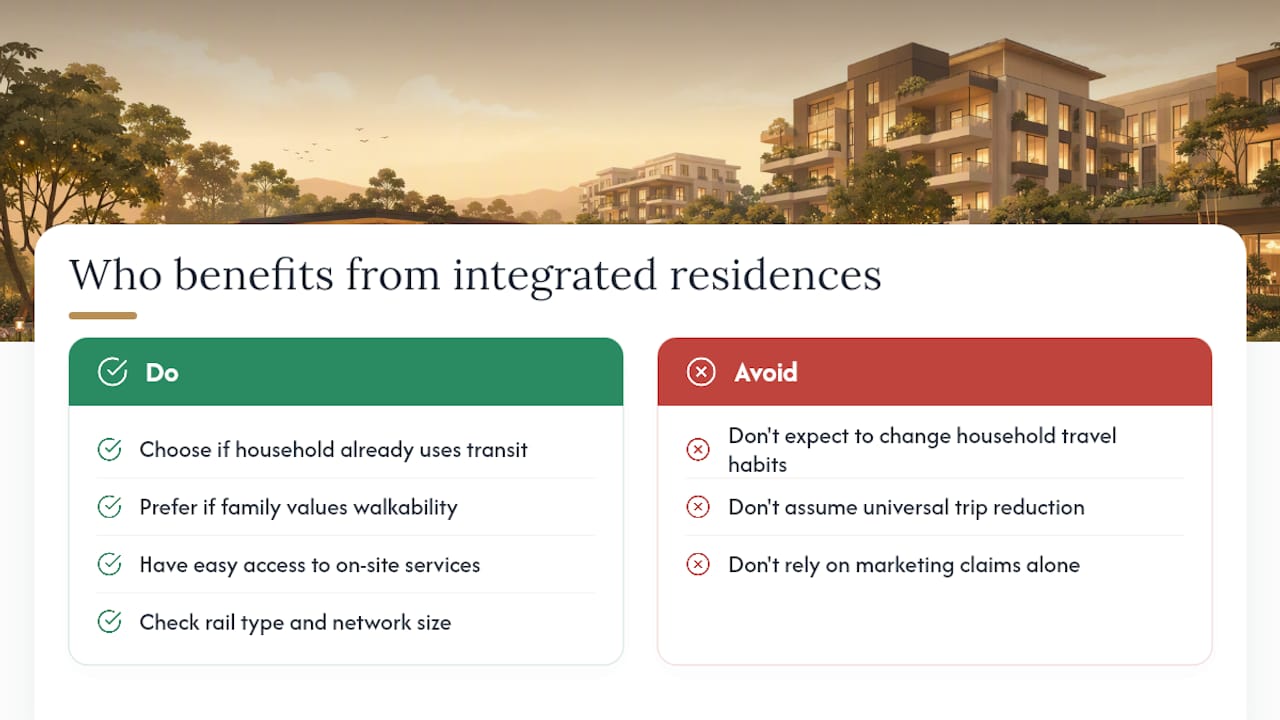
The research on transit-integrated living is more consistent than the marketing around it. Trip-reduction numbers are real, but they are averages across households that already preferred transit. The premium is real, but it varies by rail type, network size, and how close to the station the unit sits. What the evidence does not show is a universal outcome — it shows a strong probability that a family who already uses transit, values walkability, and can access the on-site services will spend less time in a car and more time at home.
The families who get the most from integrated residences are not the ones who move in hoping to change their habits. They are the ones whose habits already fit the building.
Hougang-central-residences maps directly to what families are looking for
Families who have worked through the checklist above will find that Hougang-central-residences addresses the four priorities that matter most: direct MRT access from within the building, on-site retail at the podium level, unit sizes from 1-bedroom-plus-study through 5-bedroom penthouses for households at every stage, and smart-home systems that reduce daily friction. The project sits above Hougang MRT station with a future Cross Island Line interchange planned, which means the transit access compounds over time rather than staying static.

The showflat is open for registered visits. Book a peak-hour slot — weekday morning or Saturday afternoon — so you see the building under real operating conditions, not a quiet Tuesday at noon. Register at Hougang-central-residences to request the full e-brochure and confirm current unit availability.
Sources
- Vehicle Trip Reduction Impacts of Transit-Oriented Housing (National Academies / related synthesis)
- TOD 205: Families and Transit-Oriented Development – Creating Complete Communities for All (CTOD / CC&S)
- TCRP Report 128: Effects of TOD on Housing, Parking, and Travel
This article is general information, not a substitute for advice from a qualified financial advisor. Consult a qualified financial professional about your own circumstances before acting on anything here.
FAQ
Why do families choose integrated residences over suburban homes?
Families choose transit- and retail-integrated condominiums primarily for time savings and lower transportation costs. TOD residents generate 44%–47% fewer weekday vehicle trips than suburban households, and on-site childcare and grocery eliminate multi-stop errand chains.
What unit sizes should families look for in a mixed-use development?
CTOD guidance recommends 3- and 4-bedroom units as the minimum for family retention in TODs. Without a deliberate unit-mix strategy, most mixed-use projects default to studios and one-bedrooms.
How much of a price premium do families pay for transit-integrated condos?
Rail-proximate condominiums typically carry a 2%–18% premium over comparable non-transit units, per APTA's summary of multiple studies. The premium varies by rail type, network size, and distance from the station.
Can families realistically reduce car ownership in an integrated residence?
Many can, but not all. TOD households own roughly half as many cars as suburban equivalents on average, though families with school-age children in dispersed activities or with elderly relatives to transport often keep at least one vehicle.
What is the most important thing to check on a site visit?
Walk the ground-floor loop with a stroller during peak hours and confirm that childcare, grocery, and the station entrance are all accessible without crossing a vehicle lane. That single test reveals more about daily livability than any brochure.