
Family condo selection criteria are the specific standards urban families use to evaluate whether a condominium unit and building will support their daily lives, growth needs, and long-term financial health. The process goes well beyond picking the right number of bedrooms. Families must weigh unit layout, building amenities, HOA governance, neighborhood quality, and financing requirements together. Getting any one of these wrong can cost years of frustration or tens of thousands of dollars. This guide breaks down each criterion with the specificity that generic condo buying guides skip.
What space and layout features are critical for family condos?
Layout usability matters more to families than raw square footage. A 1,200-square-foot unit with a well-placed kitchen, separate bedrooms, and a living area that flows into a dining space serves a family of four better than a 1,400-square-foot unit with awkward corridors and bedrooms that share a single thin wall. The way space is organized determines whether daily routines feel manageable or chaotic.

Bedroom functionality and privacy
Bedroom count alone does not tell the full story. Families need to ask whether each bedroom fits a full-size bed, a desk, and a closet without crowding. A child's room that fits only a twin bed and nothing else forces families to store clothes in hallways or living areas. For multi-child households, bedroom separation matters as much as size. Two children sharing a room works short-term, but a layout with bedrooms on opposite ends of the unit gives each child real privacy as they grow.
Living space and work-from-home flexibility
The living and dining area is where family life actually happens. A layout that allows the dining table to double as a homework station, or that has a small alcove suitable for a desk, adds genuine daily value. Remote work has made this criterion more important than it was a decade ago. Families should walk through a unit and ask whether two adults could work from home simultaneously without competing for space or quiet.
Growth horizons and storage
Families buying a condo should think at least five years ahead. A couple with one infant today may have two school-age children by the time they consider selling. Storage is the most underestimated factor in this calculation. Built-in closets, a utility room, and a dedicated space for strollers, bicycles, or sports equipment prevent the slow creep of clutter that makes smaller units feel unlivable.
Pro Tip: Walk the unit during a weekend afternoon, not a staged weekday morning. Noise transfer from neighbors, hallway traffic, and natural light levels all read differently when the building is fully occupied.
Key layout features to evaluate before signing:
- Bedroom count and individual room dimensions
- Living-to-dining flow and dual-use potential
- Storage volume including closets, utility rooms, and external storage cages
- Noise insulation between units and from common corridors
- Natural light in bedrooms and main living areas
How do building amenities and HOA rules influence family condo choices?
Families often overvalue flashy amenities with high maintenance costs and undervalue practical ones like well-maintained pools and secure parking. A rooftop lounge or a golf simulator sounds appealing during a sales tour. In practice, families with young children use a shallow-end pool, a fenced playground, and covered parking far more often. Every amenity the building maintains adds to HOA fees, so families pay for every feature whether they use it or not.
HOA governance and what it actually controls
The Homeowners Association (HOA) is the governing body that sets rules for the building and manages shared finances. HOA rules cover pet policies, guest stay limits, short-term rental restrictions, and renovation permissions. A family with a large dog or a habit of hosting extended family needs to read these rules before buying, not after. Violations can result in fines, and some rules are difficult to change even with majority owner support.
HOA fees in urban markets vary widely based on building age, amenity load, and management quality. These fees are a fixed monthly cost that does not disappear when interest rates drop. Families should add the full HOA fee to their monthly housing calculation from day one.
Reserve funds and special assessments
The HOA's reserve fund is the building's savings account for major repairs like roof replacement, elevator overhauls, or facade work. A reserve fund that is underfunded signals future special assessments. A special assessment is a one-time charge levied on all unit owners when the reserve fund cannot cover a major expense. These charges can run into thousands of dollars with little warning.
Board meeting minutes from the previous 12–24 months reveal pending repairs and contentious issues that do not appear in financial summaries. Requesting these minutes before making an offer is one of the most underused due-diligence steps in condo buying.
Pro Tip: Ask the HOA for the most recent reserve fund study. A healthy reserve fund covers at least 70% of projected repair costs. Anything below 50% is a red flag worth pricing into your offer.
Practical amenities worth prioritizing for families:
- Shallow-end pool or wading area for young children
- Covered, secure parking with room for strollers or cargo bikes
- Fenced outdoor play area or playground
- Package lockers or secure delivery room
- On-site management or responsive maintenance staff
Why location and neighborhood amenities matter for families in condos
Facilities outside the condo building, such as proximity to public parks and transit, often shape family lifestyle more than anything inside the building. A condo with a modest gym but a public park two blocks away gives families more usable outdoor space than a building with a private garden that closes at 9 p.m. Neighborhood quality compounds over time in ways that building amenities do not.
Schools, parks, and walkability
School quality is the single location factor that most directly affects resale value and daily family life. Families should check school district boundaries before buying, not just school ratings, because boundaries can shift. Walkability to grocery stores, pharmacies, and playgrounds reduces car dependency and improves daily quality of life. A Walk Score above 70 in an urban area generally means families can handle most errands without driving.
Transit connectivity and long-term value
Transit access protects condo value in urban markets over the long term. Buildings near major transit hubs attract a wider pool of buyers when families eventually sell. Hougang-central-residences sits directly above the Hougang MRT station, giving residents direct access to Singapore's rail network without street-level commuting. That kind of transit connectivity is a structural advantage that no building renovation can replicate.
"Neighborhood attributes, including parks and transit, shape family lifestyle more strongly than luxury building amenities." — The art of choosing the right condo facilities for your lifestyle
Urban neighborhoods vary significantly within short distances. Families should visit the area on a weekday morning, a weekday evening, and a weekend afternoon to get a realistic picture of noise levels, foot traffic, and community character before committing.
What financial and ownership factors should families consider when buying a condo?
Conventional condo loans from private lenders typically require a down payment of 20–25%, while government-backed loans allow down payments as low as 3–15%. That gap represents a significant difference in upfront capital. Families who stretch to meet a 20% down payment may leave themselves with insufficient cash reserves for HOA fees, moving costs, and early repairs.
Closing costs and total upfront budget
Closing costs in urban markets typically range from 2–5% of the purchase price. On a $500,000 condo, that is $10,000–$25,000 on top of the down payment. Families who budget only for the down payment often find themselves short at the closing table. The full upfront cost calculation must include closing costs, any immediate renovation needs, and three to six months of HOA fees held in reserve.
Ownership horizon and equity building
Experts recommend a 5–10 year ownership horizon for families to effectively absorb transaction costs and market fluctuations. Selling within two or three years typically means losing money after accounting for agent commissions, closing costs, and market timing risk. Families who plan to move within five years should weigh renting against buying carefully.
Legal structure and document review
A condominium is a separate legal corporation. Buying into one means accepting its bylaws, financial obligations, and governance structure. Legal experts advise reviewing the declaration, bylaws, and reserve fund status carefully before closing. Skipping this step is the most common and most expensive mistake first-time condo buyers make.
Pro Tip: Hire a real estate attorney who specializes in condominium transactions, not just general property law. Condo-specific legal review typically costs $500–$1,500 and can save families from inheriting six-figure building liabilities.
| Financial factor | What to check | Why it matters |
|---|---|---|
| Down payment | 20–25% conventional; 3–15% government-backed | Determines upfront capital requirement |
| Closing costs | Budget 2–5% of purchase price | Prevents shortfall at closing table |
| HOA fees | Monthly amount plus reserve fund health | Fixed cost that affects monthly affordability |
| Ownership horizon | Plan for 5–10 years minimum | Short holds increase financial risk |
| Legal documents | Declaration, bylaws, reserve fund study | Reveals hidden liabilities before purchase |
Key Takeaways
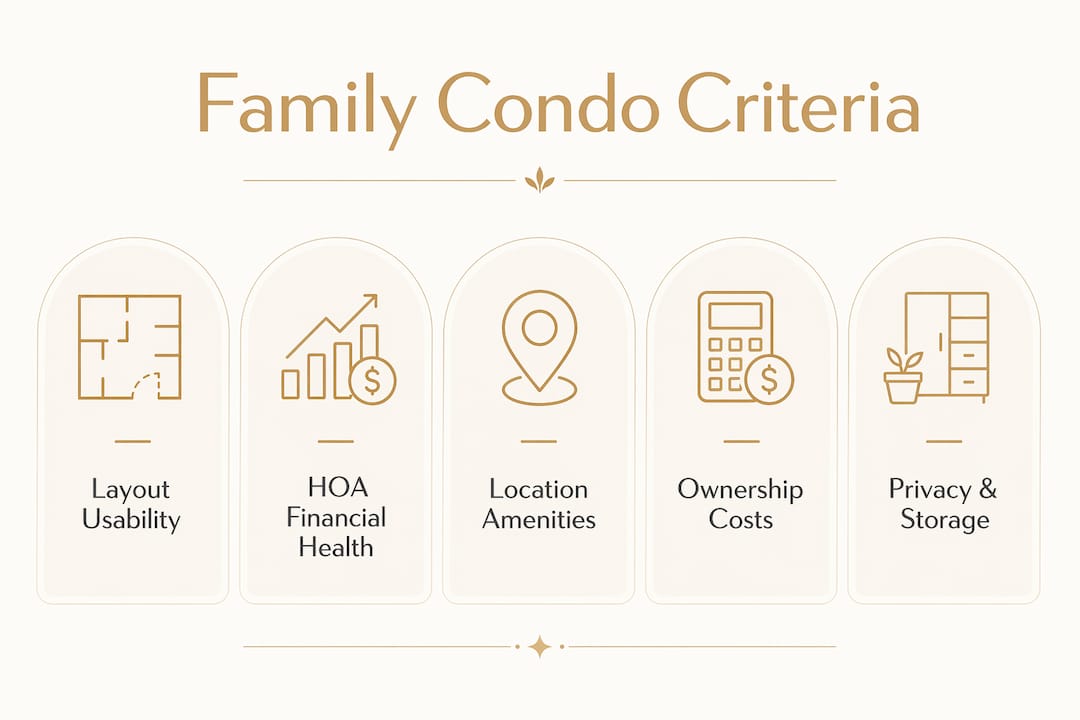
The most effective approach to choosing a family condo is to evaluate layout usability, HOA financial health, neighborhood quality, and total ownership costs together before making any offer.
| Point | Details |
|---|---|
| Layout over square footage | Prioritize bedroom privacy, storage, and living-area flow over raw size metrics. |
| HOA due diligence | Read board minutes from the past 12–24 months to catch pending assessments early. |
| Neighborhood beats amenities | Parks, schools, and transit access shape daily family life more than in-building facilities. |
| Full financial picture | Budget for down payment, closing costs of 2–5%, and HOA fees from day one. |
| Plan for 5–10 years | Short ownership horizons increase financial risk after transaction costs. |
What I've learned about choosing family condos in urban markets
The most common mistake I see families make is treating the condo tour as the primary research event. By the time you are walking through a staged unit with a broker, you have already missed the most important research window. The real work happens before the tour: pulling building violation histories through public records, requesting HOA board minutes, and checking school district boundary maps.
Building management quality is best evaluated through public building department violation histories, not broker marketing descriptions. A building with repeated elevator violations or unresolved water intrusion complaints tells you more about management than any glossy brochure.
I also think families underweight the neighborhood side of the equation. A modest unit in a walkable neighborhood near good schools will serve a family better over ten years than a larger unit in a building with a rooftop pool but poor transit access. The pool gets old. The school district and the 10-minute walk to the grocery store do not.
The financial documents deserve the same attention as the physical inspection. Reviewing bylaws and reserve fund studies is not exciting work, but it is the only way to know whether you are buying into a well-run building or inheriting someone else's deferred maintenance bill.
— Simon
Hougang-central-residences: a family-focused urban condo worth knowing
Urban families who want the criteria covered in this guide already built into a single address should look at what Hougang-central-residences offers.

Hougang-central-residences sits directly above the Hougang MRT station in Singapore, giving families direct rail access without a street-level commute. The development includes 835 residences ranging from 1-bedroom units to 5-bedroom homes, covering the full spectrum of family size and growth needs. Tropical landscaped areas, premium European fittings, and smart-home systems address both livability and long-term value. Families can explore Hougang-central-residences to review floor plans, amenity details, and location specifics before scheduling a visit.
FAQ
What are the most important criteria for selecting a family condo?
Layout usability, HOA financial health, school and transit proximity, and total ownership costs are the four most critical criteria. Families who evaluate all four together make significantly better long-term decisions than those who focus on price alone.
How much should families budget beyond the down payment?
Closing costs typically add 2–5% of the purchase price on top of the down payment. Families should also budget for three to six months of HOA fees held in reserve for unexpected assessments.
Why do HOA board minutes matter when buying a condo?
Board minutes from the previous 12–24 months reveal pending repairs and upcoming special assessments that do not appear in standard financial reports. They are one of the most reliable early-warning tools available to buyers.
How long should a family plan to own a condo before selling?
Experts recommend a minimum 5–10 year ownership horizon to absorb transaction costs and market fluctuations. Selling earlier typically results in a financial loss after commissions and closing costs.
Do in-building amenities or neighborhood features matter more for families?
Neighborhood features, including parks, schools, and transit access, shape daily family life more consistently than in-building amenities. Building amenities add convenience but depreciate in perceived value faster than a strong neighborhood does.