TL;DR:
- Integrated condos in Singapore offer higher prices and rental income, driven by direct MRT access and essential retail anchors. They tend to outperform standard condos in emerging districts during early development stages, but may underperform on resale gains in mature neighborhoods. Long-term investors should consider hold periods of 7 to 10 years to fully benefit from neighborhood growth and premium pricing.
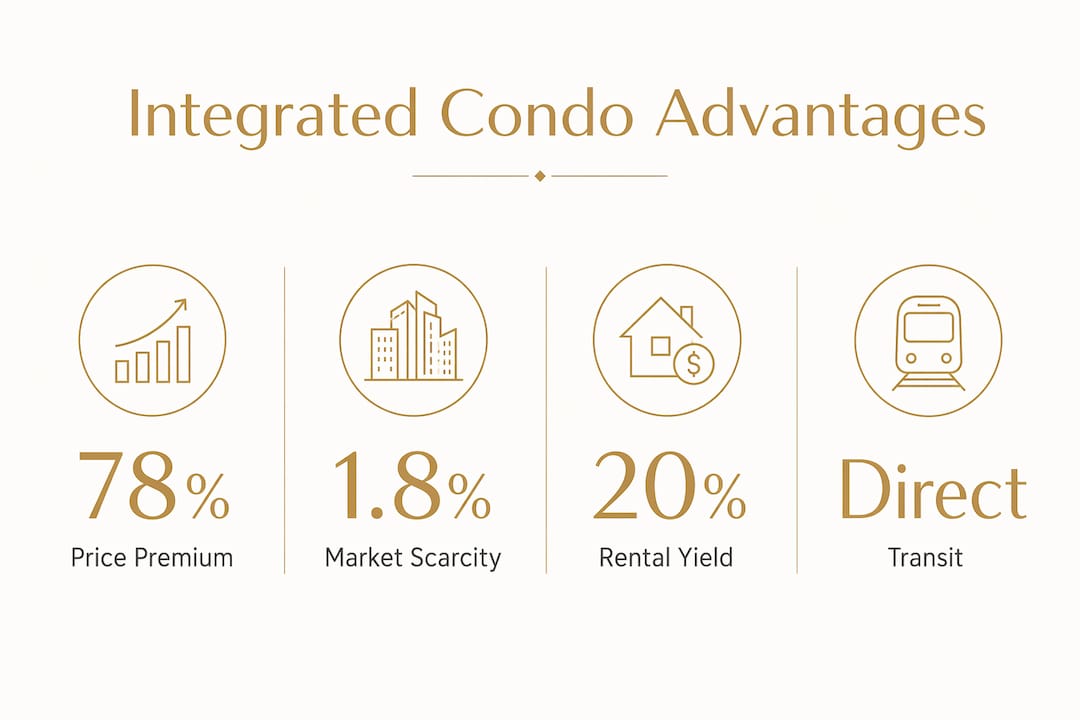
Integrated condominiums consistently beat the broader market on both price and rental performance, and the gap is wider than most buyers expect. Integrated condos command significant price premiums over comparable non-integrated condos in the same districts. Rental income is higher, with shorter vacancy windows, because professional tenants rank direct MRT and retail access among their top three criteria. The core reasons come down to a few structural facts:
- Direct transit integration cuts commute friction to near zero, a feature no amount of neighborhood maturity can replicate
- Anchored retail (supermarkets, childcare, F&B) creates daily-use foot traffic that sustains tenant demand through market cycles
- Structural scarcity: only about 1.8% of Singapore's private residential stock sits inside integrated developments, so supply rarely catches up to demand
- Resilient tenant base of professionals, expatriate families, and dual-income households who pay for convenience and rarely leave
Hougang-central-residences exemplifies this model, with 835 units positioned directly above Hougang MRT, combining transit access, curated retail, and smart-home systems in a single address.
How integrated condos price and rent above the market
The premium range is significant. Park Place Residences launched at a substantial premium over its district's average price per square foot, reflecting both land cost and the structural demand advantage baked into every integrated project. That premium varies by launch timing, location maturity, and how tightly the retail and transit components are executed.

| Factor | Integrated Condos | Standard Condos |
|---|---|---|
| Price premium vs. district avg. | substantially above baseline at launch | Baseline |
| Rental premium | higher than comparable units | Baseline |
| Vacancy periods | Shorter, driven by professional demand | Longer on average |
| Supply share | approximately 1.8% of Singapore’s private residential stock | Baseline |
Rental yield tells a more nuanced story. Higher rent is real, but the initial higher price per square foot can compress the yield percentage even as absolute rental income rises. Buyers who focus only on rentability without modeling yield against purchase price often miss this compression. The unit rents fast. Whether it yields well depends on what you paid.
Pro Tip: When evaluating an integrated condo's rental case, calculate gross yield against the actual purchase price, not the district average. A 5%–15% rental premium means little if the entry price is 30% above comparable non-integrated units nearby.
What compounding convenience actually does for residents
"Compounding convenience" is the cumulative daily time savings from living where the MRT platform, supermarket, childcare center, and gym are all reachable without stepping outside. Over a year, that adds up to dozens of hours. For a working professional or a family with young children, that time has real dollar value.
The lifestyle benefits go beyond speed:
- Weather-protected transit access from lobby to MRT platform, a meaningful advantage in climates with heavy rain
- Proximity to essential services: supermarkets, clinics, childcare, and F&B within the same building or podium
- Car-lite living that can eliminate the cost of vehicle ownership entirely, which often exceeds the rental premium itself
- Community programming and shared amenities that enhance integrated condo living beyond the physical structure
Demographic trends reinforce this demand. Professionals prioritizing short commutes, families who need childcare nearby, and downsizers who want to shed car dependency all converge on the same product type. Transit-oriented developments show the same pattern across urban markets globally: direct connectivity to transit nodes consistently lifts both demand and price resilience. A survey by EdgeProp Singapore found 79% of respondents preferred a non-central location with strong MRT connectivity over a central location without it. Convenience beats address.
Investment nuances: rental resilience versus capital appreciation
Rental resilience is the clearest financial advantage integrated condos hold. During the 2023 cooling measures, integrated developments in the Core Central Region held occupancy better than non-integrated peers, because the tenant base of professionals and expatriate families is relatively recession-resistant. That defensive quality matters when the broader market softens.
Capital appreciation is where the picture gets complicated:
- In 7 out of 10 districts, standard condos outperform integrated ones on resale-to-resale price gains
- The primary reason is entry price: a 20%–30% launch premium leaves less room for the next buyer to justify the same gap
- Neighborhood maturation erodes the integrated advantage over time, as more malls and MRT stations appear nearby
- First-mover projects in emerging precincts, where amenities are scarce at launch, have delivered the strongest appreciation
The location timing variable is decisive. Lentor Modern launched in 2022 as the only development in a precinct that barely existed. Buyers in 2022 owned the precinct's credibility before it was established. That first-mover advantage is not available to buyers entering a mature corridor where three other condos already sit within walking distance of the same mall.
Long-term hold horizons of 7–10 years or more are generally needed to fully capture appreciation benefits, given premium pricing and the time required for neighborhood maturation to work in the integrated condo's favor.
What separates a true integrated condo from a mixed-use development
The distinction matters more than most listings make clear. A mixed-use development combines residential and commercial uses under one roof. A true integrated development does something structurally different: it connects residents directly to a transit node, typically via a sheltered underpass or lobby-to-platform link, with no outdoor exposure required.
Features that define genuine integration:
- Direct MRT or bus interchange connection, sheltered and platform-level, not a 400-meter covered walkway
- Anchored essential retail: a supermarket, childcare center, and essential services that generate daily footfall
- Vertical circulation design: lifts and linkways built to handle residential and public traffic separately
- Civic amenities: libraries, clinics, or community centers embedded in the development
The structural MRT connection is the single highest-value integration feature. It creates a "moat" that no nearby standard condo can replicate by proximity alone. A development marketed as "near MRT" and one with a lobby-to-platform underpass are not the same product, and the resale data reflects that gap over time.
Hougang-central-residences: what a well-executed integrated condo looks like
Hougang-central-residences sits directly above Hougang MRT, with 835 units ranging from one-bedroom to five-bedroom configurations. That unit diversity serves professionals, growing families, and downsizers within a single address, which broadens both the buyer pool and the tenant base.
Key advantages of the development:
- Direct MRT connectivity to Hougang station, with proximity to future interchange upgrades
- Tropical landscaped areas and architectural design that prioritizes resident calm despite the transit-adjacent location
- Premium European fittings and smart-home systems that align with modern buyer expectations in 2026
- Curated retail and F&B within the podium, covering daily essentials without requiring residents to leave the building
- Community programming that builds neighborhood cohesion beyond the physical amenities
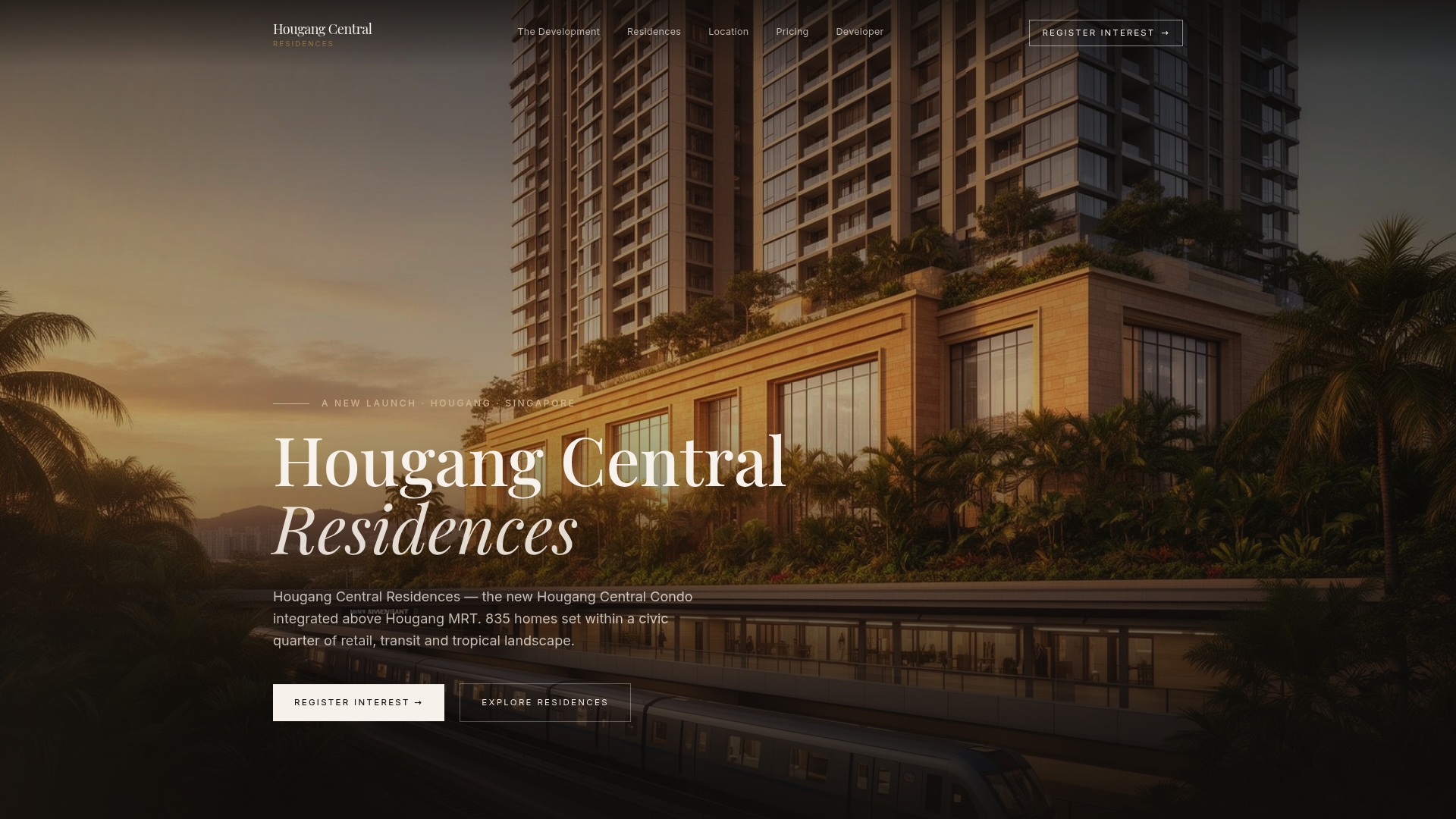
Hougang-central-residences also sits early in its precinct's maturation curve, which is precisely where first-mover advantage is most valuable. Buyers evaluating this development are entering before the surrounding area reaches full density, giving them the appreciation runway that mature-district integrated condos have already exhausted. For buyers who want to assess the integrated lifestyle before committing, the brand's editorial resources walk through exactly what daily life looks like at a transit-connected address.
Explore the full offering at Hougang Central Residences.
Why integrated condos remain strong assets in 2026
The 2026 case for integrated condominiums rests on three durable facts: structural scarcity, lifestyle demand that compounds over time, and a tenant base that holds through market cycles.
- Price premiums of 20%–78% at launch reflect real land cost and structural demand, not perception
- Rental premiums of 5%–15% with lower vacancy rates provide income resilience when capital appreciation is moderate
- True integration (sheltered MRT connection, anchored retail) creates a moat that mixed-use proximity cannot replicate
- First-mover location timing is the single biggest predictor of capital appreciation outperformance
- Dual maintenance fees are a permanent cost; model them honestly against rental yield before entry
- Hold for 7–10 years to allow the integration premium to compound and neighborhood maturation to work in your favor
- Demographic tailwinds from professionals, families, and downsizers continue to favor transit-connected, amenity-rich addresses
Key Takeaways
Integrated condos outperform the market primarily through structural scarcity, direct transit connectivity, and a resilient professional tenant base that sustains rental income through market cycles.
| Point | Details |
|---|---|
| Price premium range | Integrated condos command 20%–78% premiums over district-average non-integrated units at launch. |
| Rental advantage | Rental income runs 5%–15% above comparable non-integrated units, with shorter vacancy periods. |
| Capital appreciation caveat | In 7 out of 10 districts, standard condos outperform integrated ones on resale-to-resale price gains. |
| True integration standard | A sheltered lobby-to-platform MRT connection and anchored essential retail define genuine integration. |
| Optimal hold horizon | A 7–10 year hold is generally needed to fully capture appreciation benefits given premium entry pricing. |
FAQ
What makes integrated condos outperform the market?
Integrated condos benefit from structural scarcity (approximately 1.8% of Singapore’s private residential stock), direct MRT connectivity, and a resilient tenant base of professionals and families who consistently pay rental premiums of 5%–15% above comparable non-integrated units.
Do integrated condos always appreciate faster than standard condos?
No. In 7 out of 10 districts, standard condos outperform integrated ones on resale-to-resale price gains, largely because high launch premiums limit resale headroom. Integrated condos tend to appreciate most strongly in emerging precincts where amenities are scarce at launch.
What is the difference between integrated and mixed-use condos?
A mixed-use development combines residential and commercial uses. An integrated development adds direct, sheltered connectivity to an MRT station or bus interchange, plus anchored essential retail such as supermarkets and childcare, creating a structural advantage that mixed-use proximity cannot replicate.
Why do integrated condos cost more to own long-term?
Owners pay two sets of maintenance fees, one for the residential component and one for the commercial component, which can add up to a meaningful cost difference compounded over a decade of ownership.
Are integrated condos good for professional tenants?
Yes. Professional tenants consistently rank MRT access and retail convenience among their top three rental criteria, making integrated condos among the easiest units to rent and the most resilient during market downturns.