
TL;DR:
- Mixed-use developments offer diversified income streams and higher valuation potential when properly underwritten and actively managed.
- They are more resilient to market fluctuations due to mismatched lease terms and active placemaking that drives higher foot traffic and tenant retention.
Mixed-use developments deliver diversified, more stable cash flow and higher valuation upside than single-use assets — provided you underwrite them correctly and budget for the operational complexity they carry. The core case rests on five advantages: diversified income streams, cash-flow stability through blended lease structures, valuation upside from active placemaking, tenant synergies that support rent premiums, and growing institutional demand for walkable, amenity-rich locations.
Before you model any deal, note that blended NOI, lender DSCR requirements, and capital reserves for commercial tenant rollovers all need separate line items in your underwriting. Lenders treat mixed-use differently than pure multifamily, and the spread between those two treatments is where most first-time mixed-use investors get surprised.
Table of Contents
- 1. Diversified income streams cut your single-sector exposure
- 2. Cash-flow stability comes from mismatched lease terms
- 3. Placemaking and activation drive valuation upside
- 4. Tenant curation creates a "sticky" ecosystem
- 5. Rent premiums follow walkability and amenity density
- 6. Shared infrastructure lowers cost per square foot
- 7. Institutional capital is validating the asset class
- How location and transit access amplify these advantages
- Risks and costs you need to budget for
- How to quantify the advantages in your underwriting
- What industry research and experts say
- Your pre-underwriting checklist
- Key Takeaways
- What the evidence actually tells experienced investors
- Useful sources for further research
- Hougang Central Residences: a real-world model of integrated development
- FAQ
1. Diversified income streams cut your single-sector exposure
The most direct advantage of mixed-use real estate is that residential and commercial revenue do not move in lockstep. When office or retail softens, occupied apartments keep debt service covered. When residential vacancy ticks up, a long-term commercial anchor lease holds the floor. JPMorgan's commercial real estate analysis frames this as the primary appeal: a predictable, balanced profile that blends long-term commercial lease stability with residential demand to improve risk-adjusted returns.
For underwriting, model each use separately before blending. Pull the residential rent roll and the commercial rent roll as two distinct income schedules, then stress-test each independently before calculating blended NOI.
2. Cash-flow stability comes from mismatched lease terms
Residential leases typically run 12 months. Commercial leases in mixed-use buildings often run 5–10 years with built-in rent escalators. That mismatch is a feature, not a bug. When a residential unit turns over, the commercial income holds. When a retail tenant renews at a higher rate, the residential base is already stabilized.

This dynamic is what makes mixed-use properties more resilient than single-use assets during economic cycles. The blended income profile cushions the volatility that hits pure retail or pure office hardest.
Pro Tip: When reviewing lease abstracts, flag any commercial leases expiring within 18 months of your projected close date. A near-term commercial rollover is a capital event, not just a leasing risk, and it belongs in your acquisition reserves.
3. Placemaking and activation drive valuation upside
Passive ownership does not capture the full upside in mixed-use. The premium comes from intentional programming of shared spaces: farmers markets, pop-up retail, fitness classes, community events. McKinsey's research on mixed-use delivery identifies activation as a core component that creates a virtuous cycle, driving higher foot traffic, stronger retail renewal rates, and higher NOI over time.

For investors, this means the asset's income is partly a management output, not just a market function. Buildings with an activation plan and a dedicated community manager consistently outperform static developments on renewal rates. That operational investment pays back through NOI, not just resident satisfaction.
4. Tenant curation creates a "sticky" ecosystem
The resilience of a mixed-use asset depends heavily on which tenants you put in the commercial component. A grocery anchor, a fitness studio, and a neighborhood coffee shop create daily foot traffic that benefits every other tenant in the building. A collection of discretionary retailers with overlapping customer profiles does not.
Forbes contributor Mark Zettl describes this as building "sticky" tenant ecosystems that keep people local, reducing churn across both residential and commercial components. The practical investor action: score each prospective commercial tenant by visit frequency and necessity. Daily-need tenants anchor the ecosystem; occasional-use tenants fill it out.
Pro Tip: Prioritize tenants with high visit frequency (grocery, pharmacy, fitness) over high-margin but low-traffic tenants. The foot traffic they generate subsidizes the entire retail component's renewal probability.
5. Rent premiums follow walkability and amenity density
Residents pay more to live above or adjacent to services they use every day. That premium is measurable. Research by Ewing and Cervero found that walking trips increase approximately 0.15% for each 1% increase in land-use entropy, with transit trips rising roughly 0.12% per 1% increase in land-use mix. Higher walkability correlates directly with higher residential demand and, in tight markets, higher achievable rents.
For underwriting, check the Walk Score and Transit Score for the subject property and compare them to the submarket average. A property scoring 20 points above the submarket median on walkability typically supports a rent premium worth modeling explicitly.
6. Shared infrastructure lowers cost per square foot
Gensler's analysis of mixed-use development notes that high-density mixed-use projects are often more cost-efficient to build and operate than comparable single-use projects. Shared parking structures, shorter utility runs, and consolidated building systems reduce per-square-foot infrastructure costs. That efficiency shows up in operating margins and, ultimately, in cap rate compression relative to single-use comparables.
The investor implication: when evaluating a ground-up or value-add mixed-use deal, model shared-infrastructure savings explicitly. Shared parking alone can eliminate one or two structured parking levels, which is a material cost reduction in urban markets.
7. Institutional capital is validating the asset class
Mixed-use is no longer a niche strategy. Institutional investors are actively allocating to well-located mixed-use assets as cities prioritize walkable, integrated development and demand patterns shift toward amenity-rich living. Hybrid work patterns have accelerated this: residents want services within walking distance, and employers want offices embedded in activated neighborhoods.
For individual investors, institutional interest matters for two reasons. It compresses cap rates in core markets, raising exit values. It also validates the asset class for lenders, gradually improving financing terms as the track record grows. Portfolio diversification across property types, including mixed-use, is a strategy worth examining alongside approaches like multifamily ADU development when building a resilient real estate portfolio.
How location and transit access amplify these advantages
The advantages above are structural. Location determines how much of that structure you actually capture.
The strongest mixed-use locations share a consistent set of signals:
- Transit score above 70: Direct access to rail or frequent bus service drives residential demand and supports retail foot traffic without requiring car ownership.
- Daytime population density: High daytime population (office workers, students) supports lunch-hour and after-work retail, extending the commercial tenant's revenue window beyond evenings.
- Walk Score above 80: Residents in highly walkable locations use on-site retail more frequently, directly supporting commercial tenant sales and renewal probability.
- Household income in the top two quartiles for the submarket: Supports achievable rents and retail spending capacity.
- Employment density within half a mile: Anchors daytime foot traffic independent of residential occupancy.
Transit-oriented development (TOD) effects on rent are well-documented. The land-use mix research cited above shows that walkability and transit access are not just quality-of-life features; they are demand generators with measurable elasticity. In market due diligence, run three quick checks: pull the Walk Score, check the nearest transit stop's frequency and ridership data, and map the grocery and fitness options within a quarter mile. Those three data points tell you whether the location can support the tenant mix your underwriting assumes.
Amenity mix also affects residential retention directly. A building with a grocery anchor and a fitness option below it sees lower residential turnover than a comparable building without those services. Lower turnover means lower unit-prep costs and fewer vacancy days, both of which improve cash-on-cash returns without requiring any rent increase.
Risks and costs you need to budget for
The advantages are real. So are the costs. Here is what most investors underestimate.
Management complexity is the first surprise. Running a mixed-use building means managing residential leases, commercial leases, shared-area maintenance agreements, and potentially a parking operation, all under one roof. Each use has different operating hours, different maintenance cycles, and different tenant expectations. You need a property management team with genuine mixed-use experience, not a residential manager who also handles a few retail units.
Financing terms differ from pure multifamily. Lenders apply lower LTV ceilings and higher DSCR requirements to mixed-use deals than to comparable apartment buildings. The commercial component introduces concentration risk and higher re-leasing costs, both of which lenders price into their underwriting. Expect to bring more equity and demonstrate stronger cash flow coverage than you would for a pure residential deal.
Capital reserves for commercial rollovers are substantially higher than apartment turnover costs. Tenant improvement allowances, fit-out costs, and leasing commissions for commercial tenants are materially larger than standard apartment make-ready expenses. Budget a dedicated commercial rollover reserve, separate from your residential replacement reserve.
| Risk Category | What to Budget | Mitigation |
|---|---|---|
| Commercial TI allowances | Varies by market; negotiate caps in lease | Require personal guarantees on smaller tenants |
| Leasing commissions | Typically a few percent of lease value | Build into acquisition pro forma |
| Lease-up period | 12–24 months to stabilization | Model conservative lease-up in Year 1–2 |
| Zoning/entitlement delays | Project-specific; add 6–12 months buffer | Confirm entitlements before close |
| Management overhead | Higher than single-use | Hire mixed-use-experienced operators |
Regulatory and zoning pitfalls are deal-killers if you miss them in due diligence. Parking ratios for mixed-use are often calculated differently than for single-use residential, and a variance requirement can stall a project for months. Confirm that the current zoning permits all intended uses by right, not by variance, before you submit a letter of intent.
Stabilization typically takes several months to a few years for a new or repositioned mixed-use asset. Red flags that should pause underwriting: a high commercial vacancy rate, a pending zoning variance, leases expiring within 12 months of acquisition on more than one anchor tenant, and capital reserves below two months of gross commercial rent.
How to quantify the advantages in your underwriting
Blended NOI is the core metric. Calculate it by summing residential NOI and commercial NOI separately, then combining them into a single blended figure. Blended cap rate follows: divide total blended NOI by the purchase price or estimated value.
Simple blended cap rate formula:
Blended Cap Rate = (Residential NOI + Commercial NOI) / Total Asset Value
Two-scenario comparison (illustrative structure):
| Metric | Single-Use Multifamily | Mixed-Use (80% Res / 20% Retail) |
|---|---|---|
| Gross Income | Residential only | Residential + commercial rent |
| NOI Stability | Higher vacancy sensitivity | Cushioned by commercial leases |
| Cap Rate | Market residential rate | Blended; often slightly higher |
| LTV Ceiling | Up to 80% | — |
For sensitivity analysis, model two scenarios: one where retail occupancy drops to 70% and one where it holds at 95%. The spread between those two outcomes tells you how much income risk the commercial component actually carries in your specific deal. If the 70% retail scenario still covers debt service, the blended structure is working as intended.
When presenting to lenders, lead with the blended underwriting summary, then show each component separately. Lenders want to see that you understand the commercial risk independently, not just the blended average.
What industry research and experts say
The evidence base for mixed-use investment advantages is consistent across institutional sources.
McKinsey, "How to Deliver on the Promise of Mixed-Use Real Estate Developments"
JPMorgan's commercial real estate team identifies the primary appeal of mixed-use as a predictable, balanced income profile that improves risk-adjusted returns by combining long-term commercial lease stability with residential demand. Their practical implication for deal memos: require a written activation plan and a tenant-curation rationale as part of seller disclosure.
The Lincoln Institute of Land Policy's research on mixed-use economic desirability documents that land-use mix generates neighborhood vibrancy and economic activity that supports both retail survivability and residential demand. The investor implication: properties in established mixed-use corridors carry lower lease-up risk than isolated mixed-use buildings without surrounding density.
For investors building a deal memo, these three sources give you the academic, institutional finance, and urban planning perspectives needed to support a blended underwriting narrative.
Your pre-underwriting checklist
Before you model or bid on a mixed-use asset, verify these items:
Rent roll and lease review:
- Residential occupancy rate and average lease term remaining
- Commercial occupancy rate and lease expiration schedule
- Tenant improvement history and any outstanding landlord obligations
- Rent escalation clauses in commercial leases
Physical and operational:
- Separate service access, parking allocation, and circulation for each use
- Shared-area maintenance agreements and cost-allocation methodology
- Activation plan or programming history for communal spaces
Regulatory:
- Zoning confirmation that all uses are permitted by right
- Parking ratio compliance for each use type
- Any pending variances, appeals, or entitlement conditions
Three questions to ask sellers or brokers:
- Which commercial leases expire within 24 months, and what is the estimated TI budget for renewal or re-leasing?
- What is the full history of tenant improvement costs for the commercial component over the past five years?
- Are all uses currently permitted by right, or does the property rely on any active variance or conditional use permit?
Red flags that should pause underwriting:
- Commercial vacancy above 25% with no signed letters of intent
- More than one anchor tenant lease expiring within 12 months of close
- Capital reserves below two months of gross commercial rent
- Overconcentration in one retail sector (e.g., three food-and-beverage tenants with no daily-need anchor)
- Pending zoning variance or unresolved entitlement condition
Key Takeaways
Mixed-use developments deliver stronger risk-adjusted returns than single-use assets when investors underwrite the blended NOI correctly, budget for commercial rollover costs, and commit to active tenant curation and activation.
| Point | Details |
|---|---|
| Blended NOI is the core metric | Model residential and commercial NOI separately, then combine before calculating blended cap rate. |
| Commercial reserves are larger than expected | Budget for TI allowances, leasing commissions, and fit-out costs well above apartment turnover levels. |
| Activation drives measurable NOI | Properties with intentional programming of shared spaces show higher renewal rates and stronger NOI growth. |
| Lenders apply stricter terms | Expect lower LTV ceilings and higher DSCR requirements than for comparable multifamily deals. |
| Hougang-central-residences exemplifies the model | Integrated retail, transit adjacency, and smart-home systems at Hougang Central Residences reflect the design and amenity features that support rent premiums and resident retention in mixed-use assets. |
What the evidence actually tells experienced investors
Most articles on mixed-use investment advantages stop at "diversification is good." That framing misses the harder truth: the diversification benefit is not automatic. It is a product of deliberate tenant curation, active programming, and underwriting discipline. A mixed-use building with a struggling retail component and no activation plan does not deliver blended stability; it delivers blended volatility.
The investors who consistently capture the advantages described here share one habit: they treat the commercial component as an operating business, not a passive income stream. They budget for activation. They curate tenants by visit frequency, not just by credit quality. They model commercial rollover as a capital event, not a leasing footnote.
The other thing most articles understate is the lender dynamic. Presenting blended underwriting clearly, with each component modeled separately and the blended DSCR shown explicitly, is not just good practice. It is often the difference between a lender who understands the deal and one who prices it as pure commercial risk. That presentation skill is worth developing before you sit across the table from a construction or bridge lender.
Mixed-use is one of the few asset classes where management quality directly and measurably affects asset value. That is a risk for passive investors and an opportunity for operators who know what they are doing.
Useful sources for further research
- JPMorgan: Things to Consider When Investing in Mixed-Use Properties — Best for lender underwriting norms, DSCR/LTV expectations, and capital reserve guidance.
- Lincoln Institute of Land Policy: What Makes Mixed-Use Development Economically Desirable? — Best for academic grounding on economic vibrancy and land-use mix benefits.
- Gensler: Mixed-Use Developments: A Sustainable Blueprint for Urban Growth — Best for design efficiency, shared infrastructure cost savings, and sustainability positioning.
- NAIOP: Mixed Use Development — A Review of the Literature — Best for developer feasibility analysis and live-work-play demand drivers.
Hougang Central Residences: a real-world model of integrated development
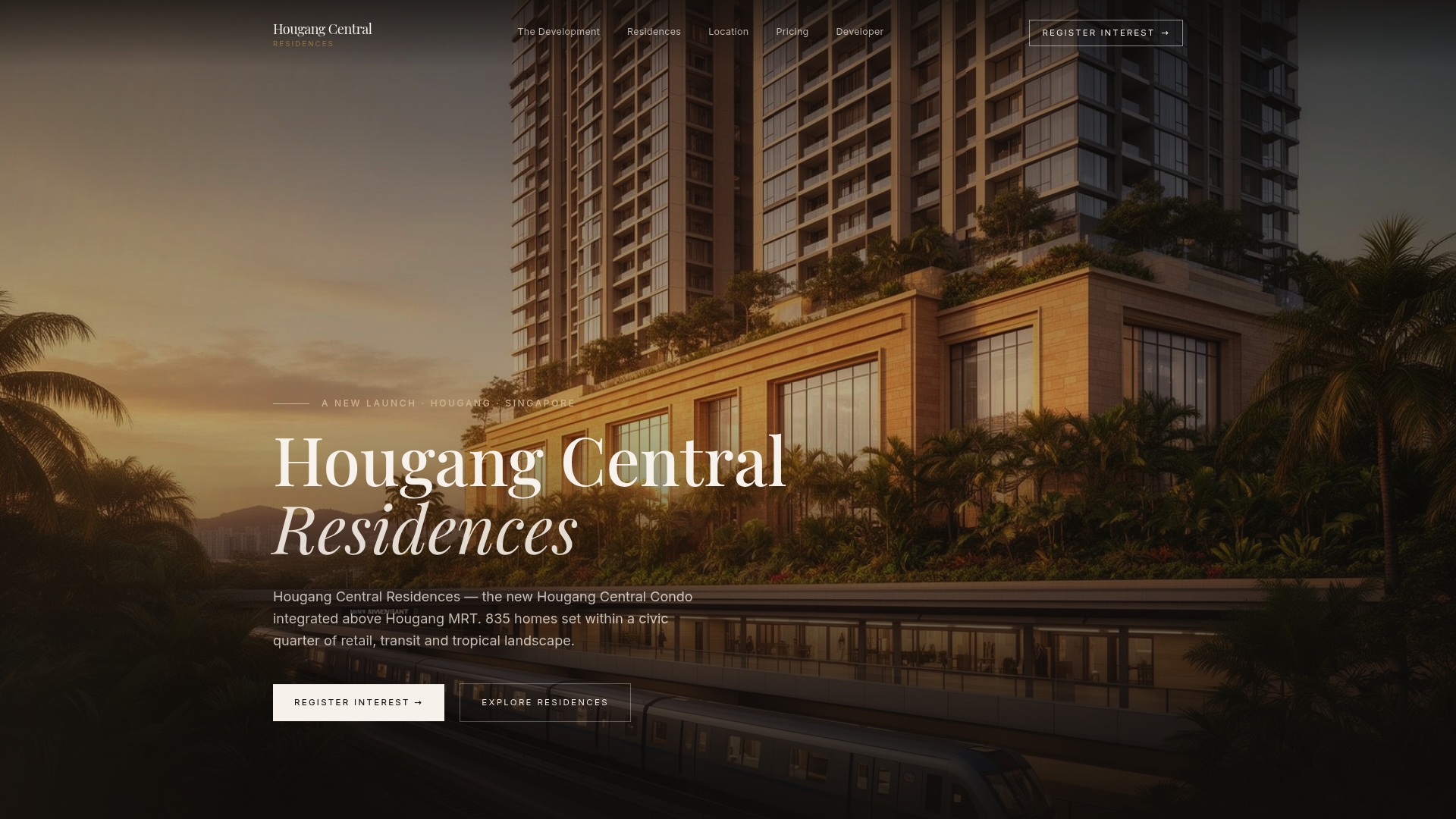
The principles in this article, transit adjacency, retail integration, amenity curation, and smart-building systems, are not abstract. Hougang Central Residences puts them into practice at Hougang Central Residences, a 835-unit condominium positioned directly above Hougang MRT station in Singapore, with an integrated retail mall and bus interchange below.
For investors studying what a well-executed mixed-use structure looks like in practice, Hougang Central Residences demonstrates the design features that support rent premiums and resident retention: direct MRT access including a future Cross Island Line interchange, premium European fittings, smart-home systems, and tropical landscaped communal spaces that support the kind of integrated retail condo lifestyle that drives daily foot traffic and long-term occupancy. Unit types range from 1-bedroom-plus-study to 5-bedroom penthouses, giving the project the residential depth to support a stable blended income profile.
To learn more or register interest, visit Hougang Central Residences for full project details, floor plans, and showflat registration.
FAQ
What is blended NOI in a mixed-use investment?
Blended NOI is the combined net operating income from all uses in a mixed-use property, calculated by summing residential and commercial NOI separately before adding them together. It is the primary metric lenders and investors use to evaluate overall asset performance.
How do lenders underwrite mixed-use properties differently?
Lenders typically apply lower LTV ceilings and higher DSCR requirements to mixed-use deals than to pure multifamily, reflecting the higher re-leasing costs and concentration risk of the commercial component.
What are the biggest risks in mixed-use investment?
The three most common risks are commercial tenant rollover costs (TI allowances and leasing commissions), management complexity from running multiple tenant types simultaneously, and zoning or entitlement issues that restrict intended uses.
How long does it take a mixed-use asset to stabilize?
Most new or repositioned mixed-use assets reach stabilization within a few months to a few years, depending on market conditions, lease-up pace for the commercial component, and the strength of the activation strategy.
Does activation really affect NOI in mixed-use buildings?
Yes. McKinsey's research on mixed-use delivery identifies intentional programming of communal spaces as a driver of higher retail renewal rates and stronger NOI growth compared with developments that rely on passive occupancy alone.