
Gross rental yield is the annual rent a property collects divided by its value, expressed as a percentage. The formula is simple: Gross Rental Yield (%) = Total Annual Rental Income ÷ Property Value × 100. If a unit rents for $30,000 a year and costs $600,000, the gross yield is shown as a percentage representing income relative to property value.
Investors use this number to screen properties fast, before spending time on inspections, financing, or expense breakdowns. It answers one question only: how much income does this asset generate relative to its price, before you subtract a single dollar of cost?
- Formula: Annual rent ÷ property value × 100
- Purpose: Quick comparison across multiple properties or markets
- Limitation: Ignores taxes, maintenance, vacancy, and financing costs entirely
Key Takeaways
Gross rental yield equals annual rent divided by property value, and it works only as a fast screening step before net yield and expense analysis confirm whether a deal actually holds up.
| Point | Details |
|---|---|
| Formula stays fixed | Annual rental income divided by property value, multiplied by 100, regardless of property type. |
| Denominator choice changes results | Using total acquisition cost instead of purchase price alone can shift yield by half a point or more. |
| Gross yield ignores expenses | Net yield subtracts costs that typically run 25% to 45% of gross rental income. |
| Consistent inputs prevent errors | Match currency, timeframe, and denominator definition across every property you compare. |
| Integrated developments affect achieved rent | Hougang Central Residences combines MRT access, retail adjacency, and smart-home features that are worth checking against local comparable rents when you run your own yield calculation. |
Table of Contents
- How to Calculate Gross Rental Yield Step by Step
- Two Worked Examples That Show the Math in Action
- Gross Yield vs Net Yield: Two Different Jobs
- What Moves the Number, and Where Calculations Go Wrong
- Using Gross Yield in Your Screening Workflow
- Applying This to Integrated Condo Developments
- Sources
- FAQ
How to Calculate Gross Rental Yield Step by Step
Start with annual rental income. If you only know the monthly rent, multiply by 12. If the unit generates other income, such as a parking bay or storage locker rented separately, add that to the total.
Next, settle on your denominator. Purchase price and market value are not always the same number. A property bought below market value produces a higher gross yield than the same unit valued at current market rates. Total acquisition cost goes further still, folding in stamp duties, legal fees, and renovation spend.
- Annualize the rent (monthly rent × 12, plus any ancillary income)
- Choose your denominator: purchase price, current market value, or total acquisition cost
- Divide annual rent by the denominator
- Multiply by 100 to get a percentage
A common shorthand skips the annualizing step: divide monthly rent by price, then multiply by 12. Same result, one less multiplication.
Pro Tip: Pick one denominator and use it for every property you compare. Mixing purchase price for one listing and market value for another will make weaker deals look stronger than they are.
Two Worked Examples That Show the Math in Action
Numbers make this concrete. Here's a straightforward residential case, followed by one that shows why your denominator choice changes the outcome.
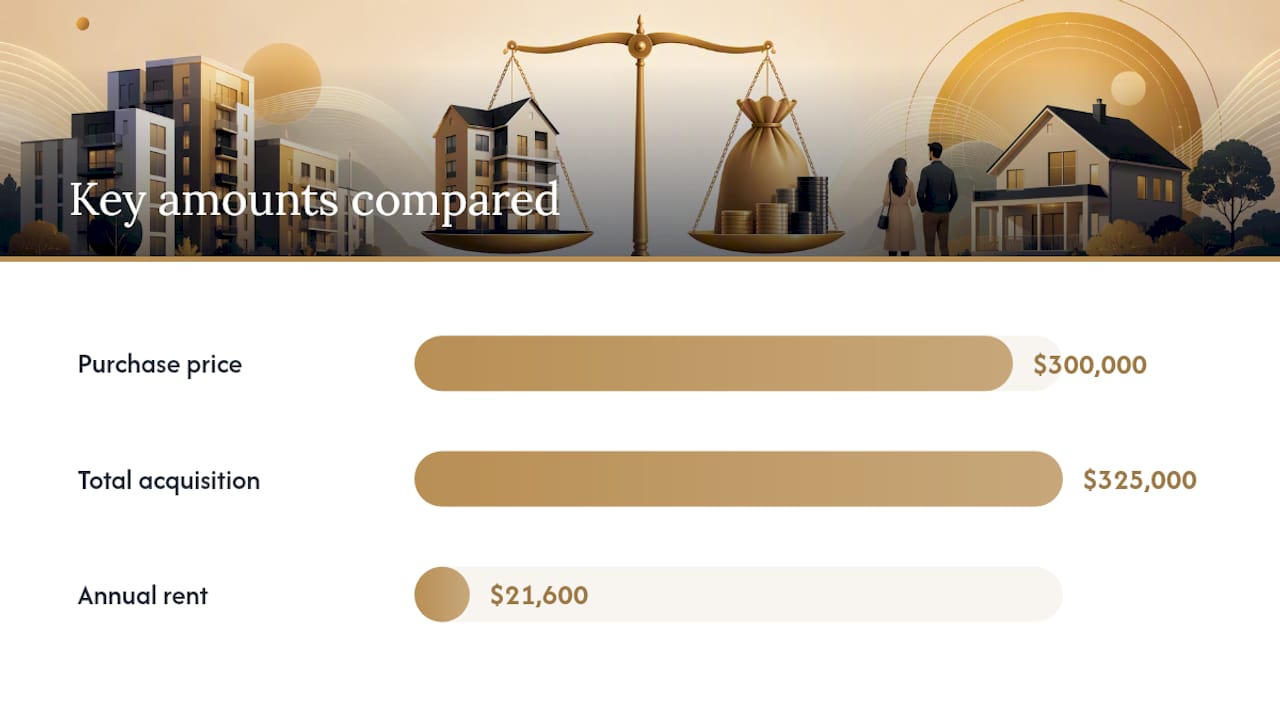
Example A: Simple calculation. A condo rents for $1,800 a month and sold for $300,000.
- Annual rent: $1,800 × 12 = $21,600
- Gross yield: $21,600 ÷ $300,000 × 100 = 7.2%
Example B: Same rent, higher acquisition cost. Same $1,800 monthly rent, but the buyer spent $15,000 on renovations and $10,000 on fees and stamp duty. Total acquisition cost: $325,000.
| Input | Example A | Example B |
|---|---|---|
| Monthly rent | $1,800 | $1,800 |
| Annual rent | $21,600 | $21,600 |
| Denominator | $300,000 (price only) | $325,000 (price + fees + renovation) |
| Gross yield | 7.2% | 6.65% |
Including acquisition costs gives a more conservative, realistic figure, especially useful if you plan to renovate before renting out the unit. Skip that step and you're comparing an idealized number against a competitor's real one.
Gross Yield vs Net Yield: Two Different Jobs
Gross yield tells you what a property earns before anything comes out. Net yield, sometimes called the cap rate, subtracts operating expenses first: property taxes, insurance, maintenance, management fees, and an allowance for vacancy.
Those costs typically run 25% to 45% of gross rental income, depending on the property type and how much management you outsource. That's the number a lender or serious underwriter actually cares about.
- Gross yield: fast, comparable across dozens of listings in a spreadsheet
- Net yield / cap rate: slower, but reflects what actually lands in your pocket
- Rule of thumb: use gross yield to build a shortlist, net yield to make the offer
A useful gap to remember: the difference between a property's gross and net yield often tells you more about its expense structure than either number alone. A high-maintenance older building can post a strong gross yield and a mediocre net yield, while a newer, low-fee unit does the opposite.
Gross yield is the return before taxes and expenses, and treating it as the final word on profitability is the single most common mistake first-time investors make.
What Moves the Number, and Where Calculations Go Wrong
Several factors push gross yield up or down independent of the property itself. Market rent versus achieved rent matters. Advertised asking rents in a listing are not always what a landlord actually collects after negotiation or vacancy periods. Ancillary income, like a rented parking space, can inflate the top of the equation if you're not careful about whether it's recurring.
Denominator mismatches cause the most confusion. Comparing one property's gross yield calculated on purchase price against another's calculated on current market value produces a false comparison, even when both numbers look reasonable on their own.
- Don't use last month's rent if the tenant just moved out and the unit is being relisted higher
- Match currency and time period exactly if you're comparing properties from different sources or dates
- Never count a one-off payment, like a lease break fee, as recurring annual income
- Don't exclude closing costs from the denominator just because they're inconvenient to add
Pro Tip: Keep a simple spreadsheet where every property uses the same denominator definition and the same rent timeframe. It takes ten extra minutes and prevents the kind of side-by-side comparison error that leads to a bad offer.
Using Gross Yield in Your Screening Workflow
Gross yield works best as a first filter, not a final answer. As a rough guide, and depending heavily on the local market: yields under 5% usually point to an appreciation-focused property in a high-demand area, 5% to 8% is a mixed zone where both income and appreciation play a role, and 8%-plus tends to show up in cash-flow-oriented markets with lower entry prices.
If a property clears your target threshold, move to the next layer of analysis:
- Calculate net yield by subtracting realistic operating expenses
- Run cash-on-cash return if you're financing the purchase
- Stress-test the numbers against a higher vacancy rate and unexpected repairs
- Confirm the rent assumption against actual comparable listings in the immediate area, not just the wider district average
Only after those checks does a strong gross yield turn into a real decision.
Applying This to Integrated Condo Developments
Location-driven rent premiums matter more in mixed-use, transit-linked buildings than in standalone blocks. Hougang Central Residences features 835 residences ranging from 1-bedroom to 5-bedroom units, designed to meet varied family needs with premium European fittings and tropical landscaped areas.
- Direct MRT access and retail adjacency tend to support steadier tenant demand, which affects the achieved-rent side of your calculation
- Smart-home features and a future Cross Island Line interchange are the kind of amenities worth checking against comparable rents nearby
- For deeper context on how transit-linked properties trade, see our guide to integrated developments
A Screening Tool, Not a Verdict
Gross yield earns its place as the fastest way to rule properties in or out before you spend real time on due diligence. My caution: never let a strong gross number substitute for checking net yield, actual comparable rents, and realistic vacancy. The metric is a filter, not a conclusion.
Calculate Your Own Yield Before You Buy
Hougang Central Residences gives you a concrete case study to run your own numbers on, not just a general framework. This is an integrated, transit-linked development, the kind of asset where station access and retail adjacency tend to support steadier achieved rents than a standalone block in the same district.

If you're weighing a 1-bedroom unit against a larger family layout, plug the project's published price ranges and realistic rent expectations straight into the formula above. Our 1-bedroom investment breakdown and notes on the progressive payment schedule will help you build a realistic all-in denominator rather than just the headline price. From there, request the e-brochure or register for the showflat to get current unit pricing and run the calculation with real figures instead of estimates.
Sources
- Gross Rental Yield | Formula + Calculator
- Gross Rental Yield Explained: A Fast Market Screen | REI Prime
- Gross yield definition - Investopedia
This article is general information, not a substitute for advice from a qualified financial advisor. Consult a qualified financial professional about your own circumstances before acting on anything here.
FAQ
What Is a Good Rental Yield?
There's no universal number, but as a rough guide, gross yields above 8% tend to show up in cash-flow-focused markets, while yields under 5% usually reflect properties in high-demand areas driven more by appreciation than income.
Is a 7.5% Gross Yield Good?
A 7.5% gross yield sits in a strong range for an income-focused property, but it needs to be checked against net yield since typical operating expenses of 25% to 45% can bring the real return down meaningfully.
How Do I Calculate Gross Rental Yield?
Divide the property's total annual rental income by its value or acquisition cost, then multiply by 100. For monthly rent figures, multiply by 12 first, or use the shorthand of monthly rent divided by price, multiplied by 12.
What's the Difference Between Gross and Net Rental Yield?
Gross yield divides annual rent by property value with no deductions. Net yield subtracts operating costs like taxes, insurance, maintenance, and management fees, giving a more accurate picture of actual profitability.

Does Gross Yield Account for Vacancy or Repairs?
No. Gross yield assumes the property is rented at the stated rate for the full year with no gaps or expenses, which is why it should always be followed by a net yield and cash-flow check before making an offer.