TL;DR:
- Singapore's luxury condo market in the Core Central Region is driven by capital preservation, with median prices around S$2,650 per square foot in 2026. Local buyers now dominate ultra-luxury purchases, while foreign participation remains limited due to high taxes, supporting market stability. Price growth is steady, and supply constraints keep prices stable despite slight demand fluctuations.
Singapore's luxury condo segment is defined by high-value residential properties concentrated in the Core Central Region (CCR), where median prices reached approximately S$2,650 per square foot in 2026. The Urban Redevelopment Authority (URA) classifies the CCR as districts 1, 2, 4, 6, 7, 9, 10, 11, and Sentosa Cove, the geographic heart of Singapore's luxury real estate market. Prices in this segment rose 2% in Q2 2026, a signal of steady demand rather than speculative heat. The Additional Buyer's Stamp Duty (ABSD) framework, buyer demographics, and supply constraints all shape how this market moves. If you are researching the Singapore luxury condo segment explained through data and real market behavior, this article delivers exactly that.
What geographic and price criteria define the Singapore luxury condo segment?
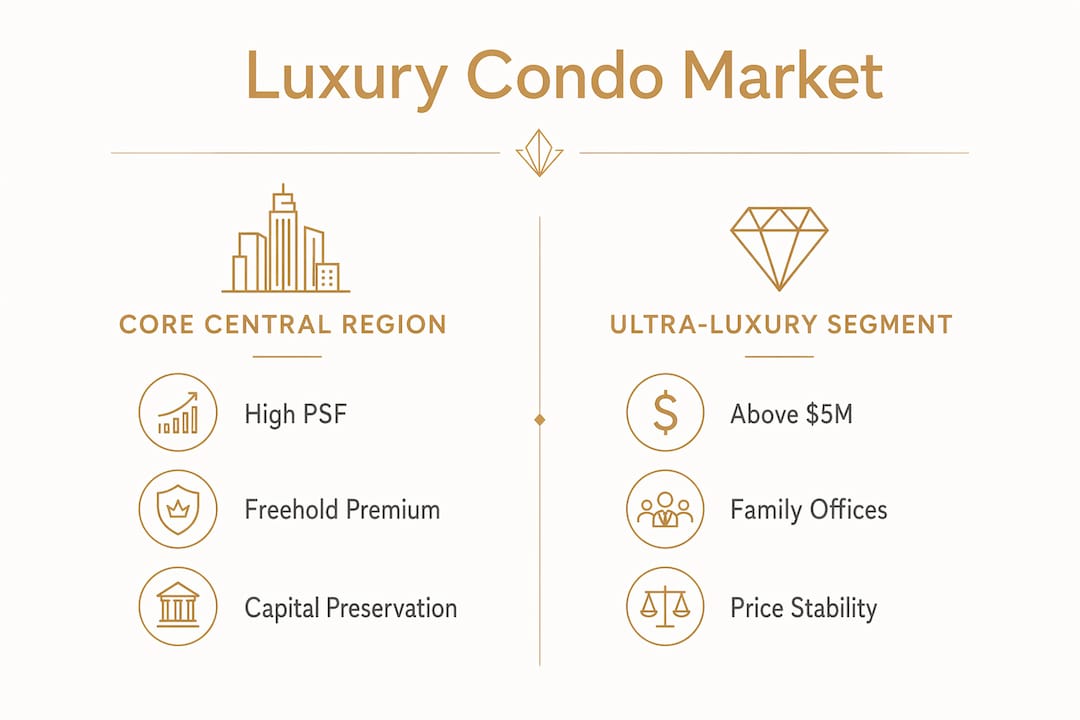
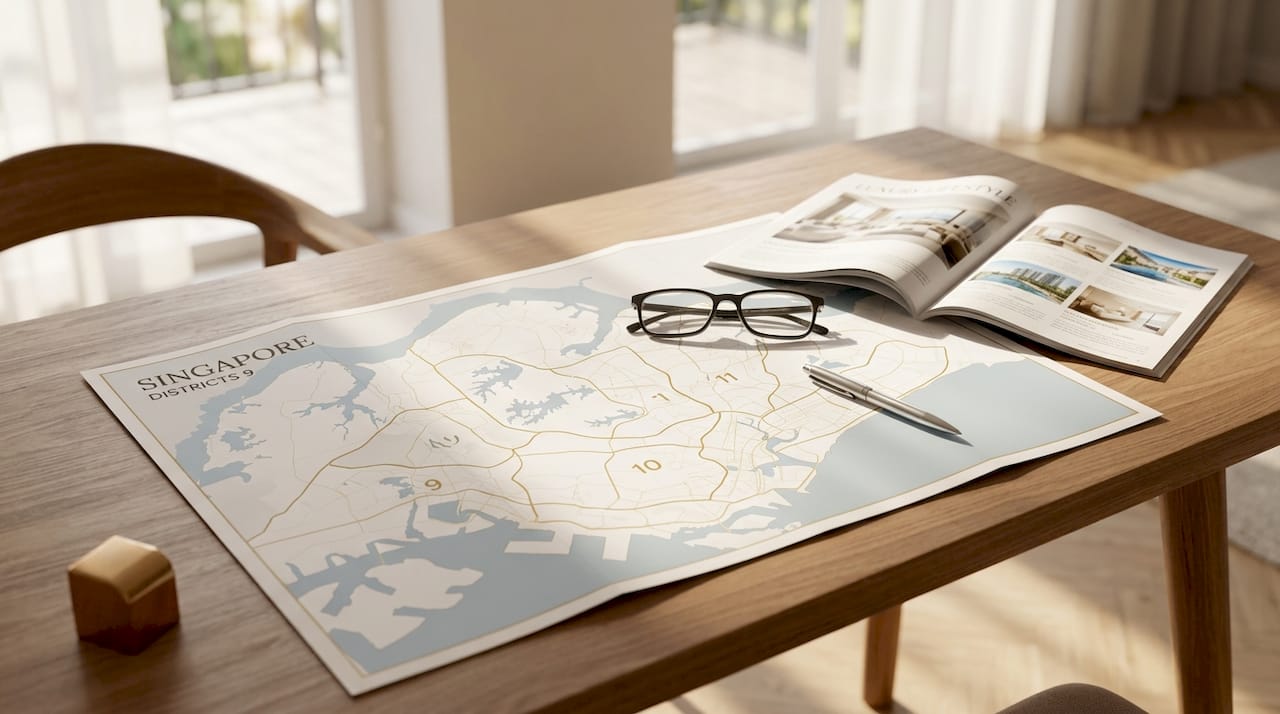
The CCR is the geographic anchor of luxury condo classification in Singapore. Districts 9, 10, and 11, covering Orchard Road, Holland Village, and Bukit Timah, represent the most recognized luxury addresses. Districts 1, 2, 6, and 7 cover the Central Business District and Marina Bay, while District 4 and Sentosa Cove attract buyers seeking waterfront living.
Price per square foot is the clearest dividing line. New launches in the CCR typically start above S$2,500 PSF, with ultra-luxury units in prime addresses exceeding S$4,000 PSF. Resale units offer slightly lower entry points, though freehold properties command a meaningful premium over leasehold equivalents. Freehold tenure carries lasting appeal because ownership does not expire, which matters for estate planning and long-term capital preservation.
Unit sizes in the luxury segment run larger than the Singapore average. Three-bedroom and four-bedroom configurations dominate, with many developments also offering penthouse units above 3,000 square feet. Bespoke amenities, including private lifts, concierge services, and smart-home features, are standard expectations rather than selling points in this tier.
The ultra-luxury sub-segment sits above S$5 million per unit. In Q1 2026, 75 transactions were recorded at or above that threshold in the CCR, including a single unit that transacted at S$37 million in january 2026. That volume represents the highest quarterly figure since 2023, confirming that demand at the top of the market remains active.
Pro Tip: When evaluating CCR properties, always compare freehold versus leasehold options at the same PSF price. A freehold unit priced 10–15% higher than a comparable 99-year leasehold unit often delivers better long-term value for estate planning purposes.
Who are the buyers driving Singapore's luxury condo market?
Singaporean buyers now dominate the ultra-luxury segment in a way that would have surprised observers five years ago. Their share of ultra-luxury condo purchases grew from 13.3% in 2021 to 30.5% in 2025, driven by family offices, intergenerational wealth transfers, and rising household incomes among high-net-worth professionals.
The ABSD framework explains much of this shift. Foreign buyers face a 60% ABSD rate, which effectively prices most international investors out of direct ownership. Singapore citizens pay no ABSD on their first property and a lower rate on subsequent purchases. Permanent residents occupy a middle position, paying ABSD on their first purchase but at rates well below the foreign tier.
The buyer profile in 2026 breaks down into three distinct groups:
- Singaporean high-net-worth individuals and families buying for lifestyle, estate planning, and capital preservation
- Permanent residents using luxury condos as a primary residence while building long-term equity
- Family offices acquiring properties as part of broader wealth management portfolios, often holding for a decade or longer
Foreign buyers have not disappeared entirely. Those who do purchase at the 60% ABSD rate are typically ultra-high-net-worth individuals for whom the tax is a manageable cost relative to the asset value. Their motivation is almost never rental yield. It is access to a stable, transparent, and well-regulated property market.
Pro Tip: If you hold Singapore permanent residency, buying your first CCR property before acquiring a second property elsewhere saves significant ABSD. Structure your purchase sequence carefully before signing any option to purchase.
How do rental yields and capital appreciation shape luxury condo investment?
Rental yield is not the primary reason to buy a luxury condo in Singapore's CCR. CCR luxury condos yield between 2.5% and 3.2% on average, compared to 3.5% to 4.6% in the Outside Central Region (OCR). That gap is real and buyers who enter the CCR expecting OCR-level income returns will be disappointed.
The investment case for CCR luxury condos rests on capital preservation and price stability. Stable land values and leasehold differences make CCR properties behave more like store-of-value assets than income-generating investments. Prices in prime districts have historically held their floor even during broader market corrections, which is why family offices treat them as balance sheet assets rather than yield plays.
Typical CCR tenants are senior corporate executives, diplomats, and expatriate professionals on company-sponsored housing allowances. These tenants prioritize location, building quality, and unit size over price. Vacancy rates in well-maintained CCR buildings remain low because the tenant pool is small and specific, not because supply is scarce.
| Investment factor | CCR luxury condos | OCR condos |
|---|---|---|
| Average rental yield | 2.5%–3.2% | 3.5%–4.6% |
| Primary investment driver | Capital preservation | Rental income |
| Typical tenant profile | Executives, diplomats | Mid-level professionals |
| Price floor stability | High | Moderate |
Capital appreciation in the CCR is measured in years, not quarters. Buyers who enter with a five to ten year horizon consistently outperform those chasing short-term gains. The 2% price rise recorded in Q2 2026 is modest by headline standards but reflects a market that has already absorbed significant policy tightening without cracking.
What are the latest market trends for high-end apartments in Singapore?
The most significant trend in 2026 is the narrowing price gap between the CCR and the Rest of Central Region (RCR). The shrinking price differential between these two zones gives buyers more value options and challenges the traditional assumption that CCR automatically commands a large premium. Some RCR developments now price within 10–15% of comparable CCR resale units, which forces CCR sellers to compete on quality and location specifics rather than address alone.
Supply constraints are shaping developer behavior. New luxury launches in the CCR are limited by land availability and government land sales timing. Developers are targeting sub-S$2.5 million price points for new launches to maintain broad local appeal and avoid pricing out the Singaporean upgrader market. That pricing discipline keeps the market stable but also limits the number of truly large-format luxury units entering the pipeline.
Key trends shaping the luxury segment through the rest of 2026:
- Integrated lifestyle developments combining residential, retail, and transit access are gaining buyer preference over standalone towers
- Ultra-luxury liquidity has improved, with quarterly sales volume at its highest since 2023, suggesting confident sellers and motivated buyers
- Resale listing times are lengthening as sellers hold firm on prices and buyers take longer to decide, a dynamic that reflects price-insensitive sellers rather than weak demand
- Smart-home integration and family-oriented amenities are now baseline expectations in new CCR launches
The macroeconomic backdrop supports continued stability. Singapore's position as a global financial hub, its transparent legal framework, and the government's track record of measured policy intervention all reduce the tail risk that deters buyers in less regulated markets. Investing in Singapore luxury condos carries political and currency risk profiles that most comparable global cities cannot match.
Key Takeaways
Singapore's luxury condo segment is defined by CCR geography, freehold tenure premiums, and capital preservation logic rather than rental yield, making it a distinct asset class that rewards patient, informed buyers.
| Point | Details |
|---|---|
| CCR defines luxury | Districts 9, 10, 11, and Sentosa anchor the luxury segment with median PSF around S$2,650. |
| Yield expectations matter | CCR rental yields average 2.5%–3.2%, well below OCR levels, so capital preservation drives the investment case. |
| Buyer demographics have shifted | Singaporean buyers now represent 30.5% of ultra-luxury purchases, up from 13.3% in 2021. |
| ABSD shapes participation | Foreign buyers face 60% ABSD, concentrating demand among citizens, PRs, and family offices. |
| Supply constraints support prices | Limited new CCR land supply and developer pricing discipline keep price floors stable through 2026. |
What I've learned watching Singapore's luxury condo market evolve
The most common mistake I see buyers make is treating CCR luxury condos like income properties. They run yield calculations, compare them to REITs or OCR condos, and conclude the numbers do not work. They are right on the yield math and wrong on the investment thesis. CCR luxury condos are not yield instruments. They are capital preservation vehicles with a residential use case attached.
The buyer demographic shift tells a more interesting story than the price data. The rise of Singaporean family offices buying CCR units is not about speculation. It is about intergenerational wealth transfer in a city where Good Class Bungalows are restricted to citizens and the next best permanent asset is a freehold CCR condo. That structural demand is not going away regardless of interest rate cycles.
Sellers in this segment are also widely misunderstood. Luxury condo sellers tend to be price-insensitive, often preferring to wait months or years for the right offer rather than discount. Buyers who enter expecting negotiating leverage because a unit has been listed for six months will often be disappointed. The long listing time is a feature of seller patience, not a signal of distress.
My honest advice for 2026: if your horizon is under five years, the CCR is the wrong segment. If your horizon is a decade or longer and you want an asset that holds value through policy cycles, currency shifts, and market corrections, the CCR luxury segment has few global peers. Size your purchase to what you can hold comfortably without relying on rental income to service the mortgage.
— Simon
Hougang-central-residences: where urban living meets long-term value
Buyers who want the convenience of integrated urban living without the CCR price floor will find Hougang-central-residences worth a serious look. Positioned directly above Hougang MRT station, the development brings together 835 residences spanning one-bedroom to five-bedroom configurations, tropical landscaped spaces, premium European fittings, and built-in smart-home systems.
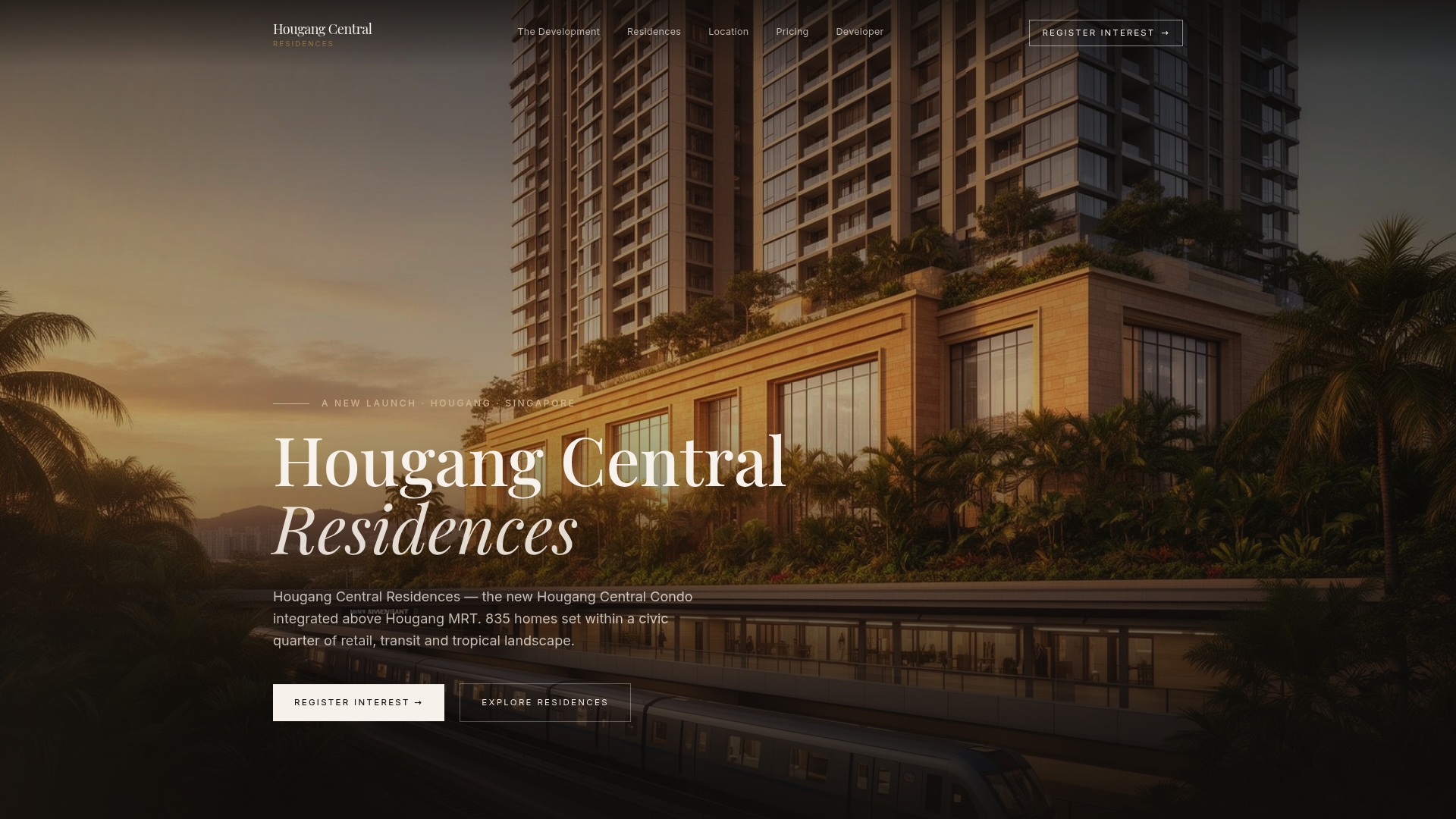
The location sits near future MRT interchange upgrades, which strengthens long-term connectivity and supports price stability over time. Retail and essential amenities are integrated into the development, reducing the daily friction that standalone residential towers create. For families evaluating condo selection criteria that balance lifestyle, transport access, and unit variety, Hougang-central-residences delivers a well-considered package. Visit Hougang-central-residences to view available units and current pricing.
FAQ
What is the Core Central Region in Singapore property?
The Core Central Region (CCR) covers districts 1, 2, 4, 6, 7, 9, 10, 11, and Sentosa Cove. It is the URA-designated zone that defines Singapore's luxury and prime residential market.
What PSF price qualifies as a luxury condo in Singapore?
Properties priced above S$2,500 PSF are generally classified as luxury condos in Singapore, with the CCR median sitting around S$2,650 PSF in 2026.
How much ABSD do foreign buyers pay on Singapore condos?
Foreign buyers pay 60% Additional Buyer's Stamp Duty on any residential property purchase in Singapore, which significantly limits foreign participation in the luxury segment.
Are rental yields strong in CCR luxury condos?
CCR luxury condos yield between 2.5% and 3.2% on average, lower than OCR yields of 3.5% to 4.6%. Capital preservation, not rental income, is the primary investment driver in this segment.
What is driving ultra-luxury condo sales in 2026?
Singaporean family offices and high-net-worth locals are the primary force behind ultra-luxury sales, with 75 transactions recorded above S$5 million in Q1 2026 alone, the strongest quarterly volume since 2023.