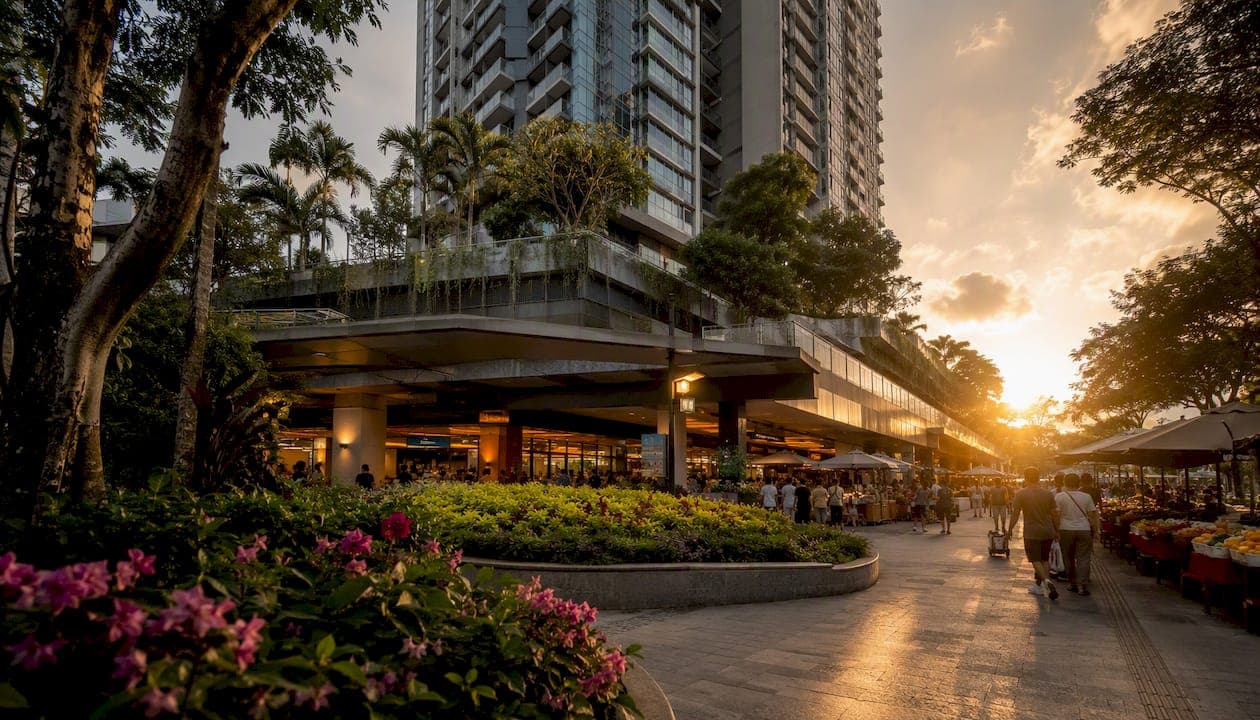
An integrated development in Singapore is a mixed-use project that combines residential units, a substantial retail hub, and direct connectivity to an MRT station or bus interchange under one roof. For buyers who prioritize convenience and rental resilience, they're often worth the premium. For privacy seekers or short-term flippers, the trade-offs can outweigh the upside.
Quick read before you dive in:
- Advantages: Doorstep MRT access, weather-shielded commutes, strong rental demand from expatriates and professionals, and amenity-rich living without leaving the building
- Disadvantages: Purchase prices typically run 10–25% above comparable standalone condos, higher service charges, and weekend mall crowds that bleed into residential common areas
- Next step: Jump to the buyer checklist below, then review the Hougang-central-residences case study for a concrete Singapore example you can act on
Key Takeaways
Integrated developments in Singapore command a 10–25% price premium over comparable standalone condos, justified by genuine supply scarcity, direct MRT connectivity, and rental demand that consistently outperforms non-integrated alternatives.
| Point | Details |
|---|---|
| Definition matters | A true integrated development requires direct MRT or bus interchange access, not just nearby retail. |
| Price premium is real | Market sources put the premium at 10–25% over comparable standalone condos, with 8–12% rental upside. |
| Supply stays limited | Fewer than 20 private integrated developments exist islandwide; new supply depends on government white-site tenders. |
| Checklist beats instinct | Verify strata separation, MCST fees, mall tenancy, and residential access control before booking. |
| Hougang-central-residences | 835 units above Hougang MRT with a future CRL interchange, retail mall, and bus interchange — a strong integrated option for long-term buyers and investors. |
Table of Contents
- What exactly counts as an integrated development in Singapore?
- How many integrated developments exist in Singapore, and why are they rare?
- What do residents and investors actually get from an integrated development?
- What are the main risks of buying an integrated development?
- Do integrated developments actually outperform standard condos on price and resale?
- What should you check before buying an integrated development?
- Hougang-central-residences: a practical case study for buyers
- Who should — and shouldn't — buy an integrated development?
- What the planning pipeline means for integrated development buyers
- Why integrated developments deserve more serious analysis than they usually get
- Hougang-central-residences: register your interest now
- Sources
- FAQ
What exactly counts as an integrated development in Singapore?
The term gets used loosely in property marketing, so a working definition matters. In Singapore's property context, an integrated development is a single project that combines private residential units, a significant retail or commercial component, and a direct physical link to an MRT station or bus interchange — not just a ground-floor convenience store or a pedestrian bridge to a nearby mall.
UNESCO frames integrated development as an approach that accounts for economic, social, and environmental dimensions together. In Singapore's urban planning context, that translates to projects where transport, commerce, and housing are designed as a single system rather than adjacent uses that happen to share a plot.
HDB's integrated developments go further, combining residential units with childcare, senior care, healthcare, hawker centres, community spaces, and sports facilities. Kampung Admiralty and Oasis Terraces are the most cited public-sector examples. Private-sector projects follow a similar logic but typically anchor around a retail mall and an MRT concourse rather than a full community-services stack.
The borderline cases worth knowing: A condo with a podium of shophouses or a small F&B strip does not qualify. The defining test is whether residents can step from their lift lobby directly into an MRT paid zone or a bus interchange concourse without going outdoors. If that direct link is absent, it's a mixed-use condo, not a true integrated development.
The Urban Redevelopment Authority (URA) enables these projects through white-site and mixed-use zoning designations, often tied to transport node tenders. The Land Transport Authority (LTA) governs the interchange component. Both agencies must sign off, which is one reason supply stays tight.
How many integrated developments exist in Singapore, and why are they rare?
Statistic: Market sources tracking Singapore's private residential pipeline count fewer than 20 completed private integrated developments islandwide, with a handful more under construction or in planning as of 2026.
That scarcity is structural, not accidental. White-site mixed-use tenders that include a transport interchange are released by the government infrequently, competition among developers is intense, and the planning complexity of coordinating residential, retail, and transport operations across multiple agencies makes these projects far harder to deliver than a standard condo launch.
Projects take several forms:
- Mall + MRT + private condo: The most common private-sector model. A retail galleria occupies the lower floors, the MRT concourse connects at basement or ground level, and residential towers sit above.
- Mall + MRT + public hub: Adds a bus interchange, hawker centre, or community club, often seen in HDB-led or government-partnered projects.
- Transport-first public integrated projects: HDB's Kampung Admiralty model, where the transport node anchors a full suite of community services with residential above.
Common supporting features across both public and private projects include hawker centres, polyclinics, libraries, bus interchanges, childcare centres, and community spaces. The Integrated Development Council at ULI Singapore tracks best practices across these project types, noting that cross-disciplinary governance and pre-launch tenant curation are among the most influential success factors.
Supply will not expand quickly. Each new integrated project requires a government land-sale decision, a transport authority partnership, and years of pre-construction coordination. Buyers who want one are competing for a genuinely limited pool.
What do residents and investors actually get from an integrated development?
The primary benefit for residents is time. A direct MRT link means no umbrella on a rainy morning, no ten-minute walk to the station, and no scramble for a bus. For dual-income households, that daily friction reduction is real money in recovered time.
Beyond the commute, residents typically get:
- Grocery supermarkets, pharmacies, and F&B options accessible from the lift lobby
- Childcare and enrichment centres within the same building or podium
- Weather-shielded access to community facilities and healthcare services
- A bus interchange that consolidates multiple routes in one covered location
For investors, the case rests on rental demand. Expatriate tenants and professionals consistently prioritize MRT proximity, and an integrated project delivers the strongest possible version of that. Market analysis from PropertyNet.SG notes that integrated developments can command rental premiums of 8–12% over nearby non-integrated launches, driven by scarcity and the convenience premium tenants are willing to pay.
Statistic: PropertyNet.SG's 2026 analysis puts the typical price premium for integrated developments at 10–25% above comparable standalone condos, with rental premiums of 8–12% cited as a key driver of investor interest.
Secondary benefits include placemaking quality. A well-curated mall with anchor tenants draws foot traffic that supports F&B and services, which in turn keeps the retail component healthy and the residential amenity value intact. The [mixed-use investment advantages](https://blog.hougang-central-residences.com/blog/mixed use development investment advantages list) of this model compound over time when the mall management is strong.
What are the main risks of buying an integrated development?
The top trade-offs are noise and crowding, privacy limitations, higher purchase costs, and structural constraints on future resale or redevelopment. None of these are dealbreakers for every buyer, but each deserves honest assessment before you commit.

Noise and footfall are the most common complaints. Mall operating hours, delivery vehicles, and weekend crowds generate ambient noise that penetrates lower floors. Units directly above the mall atrium or near ventilation shafts are the most exposed.
Privacy and residential separation vary significantly by project design. Some developments have a single lobby shared with mall visitors; others maintain fully separate residential access with independent security. The difference matters enormously for families with children and for buyers who value a clear boundary between home and commercial space.
Higher purchase price and service charges are structural. You're paying for the transport link and the retail infrastructure, and the management corporation strata title (MCST) fees reflect the cost of maintaining both. Service charges at integrated projects tend to run higher than at standard condos of comparable size.
Redevelopment and collective-sale constraints are the least-discussed risk. An integrated development with a transport interchange embedded in its structure faces significant legal and planning complexity in any en-bloc scenario. The transport authority's involvement means a standard collective-sale process doesn't apply cleanly.
Pro Tip: On your site visit, go on a Saturday afternoon between 1 PM and 4 PM. That's when mall footfall peaks. Walk the residential lobby, check the lift wait times, and listen for noise on the floors closest to the retail podium. Then request the MCST fee schedule and the strata by-laws to confirm how residential and commercial common areas are separated and managed.
For a structured approach to assessing lifestyle fit, the integrated retail condo lifestyle checklist covers the key questions in detail.
Do integrated developments actually outperform standard condos on price and resale?
The short answer: yes, but the premium is location-dependent and requires careful comparable adjustment before you draw conclusions.
LovelyHomes' 2026 guide reports that integrated projects typically command a 15–25% price premium over nearby non-integrated launches, while PropertyNet.SG's analysis puts the range at 10–25%. The spread reflects genuine variation across projects, not measurement error.
Statistic: Across market sources, the consensus price premium for integrated developments in Singapore sits in the 10–25% range over comparable non-integrated condos in the same submarket.
To interpret that premium correctly, you need to adjust for three variables:
- Tenure: A 99-year leasehold integrated project should be compared to other 99-year leaseholds nearby, not to freehold condos.
- Launch timing: Projects launched in different market cycles carry different base prices. A premium measured against a 2019 launch may reflect market movement more than integration value.
- Floor mix: Integrated projects often have a higher proportion of smaller units (1BR and 2BR), which skews average psf upward. Compare like-for-like unit types.
On resale, the scarcity argument holds up. Because new integrated supply is limited by government land-sale decisions, existing projects don't face the same pipeline competition that standard condos do. That supply constraint supports resale values over a long hold period. For deeper analysis on how integrated condos outperform the market, the evidence points consistently to scarcity and rental resilience as the two strongest drivers.
What should you check before buying an integrated development?
Core evaluation areas:
- Transport links: confirm the MRT concourse connection is direct and covered, not just nearby
- Retail tenant mix and mall management: who operates the mall, what anchors are confirmed, and what the vacancy rate looks like
- Ownership strata and encumbrances: how the residential and commercial strata are separated, and what easements exist for transport authority access
- Car-park access: separate residential parking from mall parking, and check ingress/egress during peak hours
- Noise mitigation: floor-to-ceiling heights, acoustic glazing specs, and unit positioning relative to the mall atrium
- Service charge profile: current MCST fees and the maintenance fund balance
- Utility plantrooms: location of gas and electrical infrastructure relative to residential floors
- Parking ingress/egress: traffic flow during school drop-off and weekend peak periods
Ten questions to ask the developer or sales team:
- What is the current monthly MCST fee per unit type, and what does it cover?
- Which anchor tenants are confirmed, and what are their lease terms?
- Is the residential lobby access fully independent from the mall entrance?
- How is the residential car park separated from mall visitor parking?
- What acoustic treatment has been applied to floors directly above the mall?
- What easements does the LTA hold over the development, and how do they affect future en-bloc eligibility?
- What is the timeline for the Cross Island Line interchange at Hougang, and how will construction affect residents?
- Can I see the strata subdivision plan showing the boundary between residential and commercial lots?
- What is the mall's current occupancy rate, and who manages leasing?
- Are there any restrictions on short-term rentals (Airbnb-style) in the residential strata?
Red flags that warrant walking away:
- No independent residential access control (residents share entry points with mall visitors)
- Unclear separation of retail and residential air-conditioning systems (shared plant means shared costs and noise)
- Persistent traffic bottlenecks at the car-park entrance during site visits
- Developer unable or unwilling to provide the strata subdivision plan before booking
Pro Tip: Pull the URA Master Plan and LTA's rail network map before your site visit. Check whether any new MRT interchanges, bus interchange upgrades, or white-site tenders are planned within 500 meters. A future interchange nearby can lift values; a competing integrated tender on an adjacent site can cap them.
Hougang-central-residences: a practical case study for buyers
Hougang-central-residences is a concrete example of what a well-positioned integrated development looks like in practice. Sitting directly above Hougang MRT on the North East Line, it offers 835 residences across a unit mix that runs from 1-bedroom-plus-study to 5-bedroom penthouses, making it one of the more complete unit-mix offerings among Singapore's integrated projects.
Project highlights:
- 835 units across 1BR+S, 2BR, 3BR, 4BR, and 5BR penthouse configurations
- Direct MRT access to Hougang station (North East Line)
- Integrated retail mall and bus interchange at podium level
- Smart-home systems across all units
- Premium European fittings throughout
- Tropical landscaped communal spaces, wellness facilities, and social amenity areas
Transport and connectivity:
| Connection | Detail |
|---|---|
| MRT (North East Line) | Direct access via Hougang station, no outdoor crossing required |
| Bus interchange | Integrated at podium level, covered connection from residential lobby |
| Cross Island Line | Future interchange at Hougang station planned under LTA's CRL pipeline |
| Pedestrian connectivity | Covered linkways to surrounding Hougang town amenities |
| Nearby schools | Within the Hougang residential precinct, multiple primary and secondary schools accessible |
Buyer action list for Hougang-central-residences:
- Visit the showflat on a weekend afternoon to assess mall footfall and noise levels firsthand
- Download the e-brochure to review the strata plan and unit layouts before committing to a viewing
- Ask the sales team specifically about the CRL interchange timeline and how construction phasing will affect residents
- Request the current MCST fee schedule and the mall's confirmed anchor tenant list
- Confirm the residential lobby access control arrangement and car-park separation from mall visitor parking
The Hougang-central-residences project page carries the full developer-provided specifications, e-brochure, and showflat registration details.
Who should — and shouldn't — buy an integrated development?
Buy only if convenience, the tenant profile, and a long-term hold horizon all align with your situation. If any one of those three is missing, a standard condo near an MRT station will likely serve you better at a lower price.
Profiles that fit well:
- Dual-income households who commute daily and value the time saved by a direct MRT link and doorstep groceries
- Investors targeting expatriate or professional tenants, where MRT proximity and amenity access are the primary rental drivers
- Downsizers and retirees who want walkable access to healthcare, F&B, and community facilities without maintaining a car
- Long-term holders (10+ years) who can ride out market cycles and benefit from the supply constraint on new integrated launches
Profiles that fit less well:
- Privacy-focused buyers who want a clear separation between home and commercial activity
- Buyers needing large private outdoor space, since integrated projects typically trade garden area for podium retail
- Short-term flippers, because the price premium you pay on entry compresses your margin on a quick exit
- Buyers sensitive to service charges, since MCST fees at integrated projects run structurally higher than at standard condos
For a detailed breakdown of how buyer profiles map to Singapore's premium condo segment, the Singapore luxury condo segment guide covers the positioning questions in depth.
What the planning pipeline means for integrated development buyers
Transport-led precinct upgrades tend to increase long-term value for existing integrated projects; new competing integrated tenders on adjacent sites can cap it. Both dynamics are worth tracking before you buy.

The URA Master Plan and LTA's rail network maps are public documents. Reading them takes about 20 minutes and tells you whether the area around your target project is designated for intensification, whether new white-site tenders are planned nearby, and whether any future MRT interchange upgrades will improve or complicate the existing transport node.
For Hougang, the Cross Island Line interchange is the most significant pipeline item. When operational, it will add a second MRT line to Hougang station, increasing the station's catchment and the residential demand around it. UNDP's synthesis report on integrated planning notes that institutional and governance capacity is a key challenge when implementing integrated approaches at scale, which is relevant here: multi-agency coordination between URA, LTA, and HDB shapes both the timeline and the eventual outcome of these infrastructure upgrades.
CSIS's analysis of integrated development makes a parallel point about governance and financing structures limiting effectiveness. For buyers, that translates to a practical caution: don't price in a future interchange as a certainty. Treat it as a positive optionality that supports the long-term case without being the sole reason to buy.
The policy risk for existing integrated projects is low. Once a transport interchange is built into a development's structure, the government has a strong interest in maintaining and upgrading that infrastructure. The opportunity risk is higher: buyers who wait for a new integrated launch may find that the next white-site tender in their preferred area is years away.
Why integrated developments deserve more serious analysis than they usually get
Most property commentary on integrated developments in Singapore stops at "convenient location, pay a premium." That framing misses the more interesting question: why the premium persists, and whether it's structurally justified or just a marketing story.
The structural case is stronger than the marketing version. Supply is genuinely constrained by government land-sale decisions, not by developer choice. The transport infrastructure embedded in these projects is permanent and government-maintained. And the rental demand from tenants who prioritize MRT proximity is not a trend — it's a function of Singapore's urban density and car-ownership costs.
What the marketing version overstates is the quality consistency. Not every integrated project delivers on the promise. A mall with high vacancy, a poorly managed bus interchange, or a residential lobby that doubles as a shortcut for mall visitors can erode the convenience premium quickly. FSG's work on integrated development emphasizes that intentional design and sustainable funding mechanisms are what separate successful integrated programs from ones that underperform. That applies directly to property: the governance of the mall and the MCST is as important as the MRT link.
The buyer who does the work — visits on a Saturday, reads the strata plan, checks the mall tenancy schedule, and models the service charge over a 10-year hold — is the one who captures the premium rather than paying for it without benefit.
Hougang-central-residences: register your interest now
If you've worked through this guide and an integrated development fits your profile, Hougang-central-residences is worth a serious look. It sits directly above Hougang MRT, offers 835 units across a full range of sizes, and comes with a confirmed retail mall, bus interchange, and a future Cross Island Line interchange that adds long-term upside to an already well-connected location.
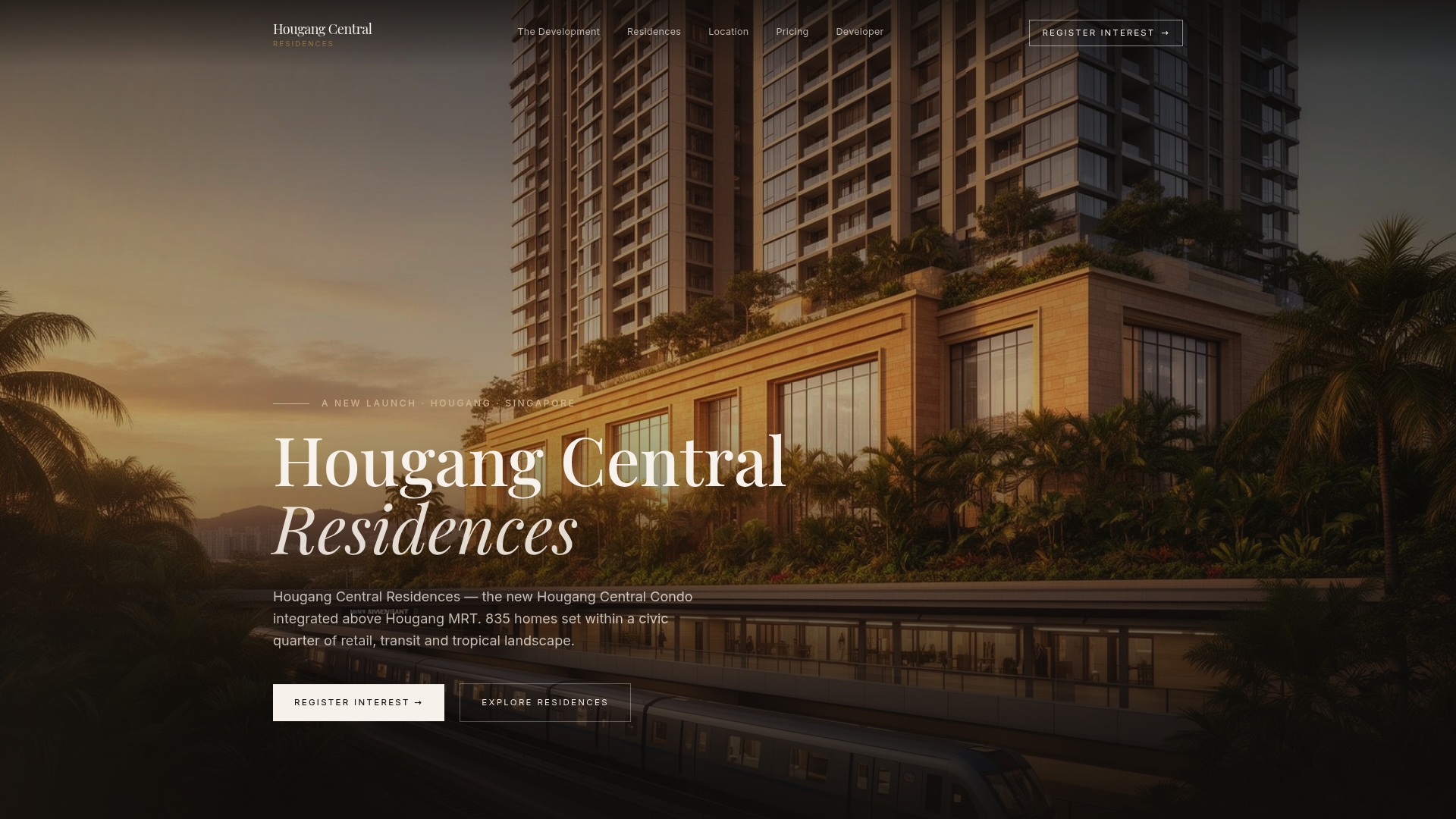
The project combines smart-home systems, premium European fittings, and tropical landscaped communal spaces with the kind of transport connectivity that drives both rental demand and resale resilience. Unit types run from 1-bedroom-plus-study to 5-bedroom penthouses, so the mix covers dual-income buyers, families, investors, and downsizers in one project.
Disclosure: this article is published by the developer of Hougang-central-residences. The analysis above reflects independent market sources and planning data; the case study section reflects developer-provided project facts.
Register for a showflat visit or download the e-brochure directly on the project page. The sales team can provide the current MCST fee schedule, confirmed tenancy details, and CRL timeline specifics on request.
Sources
The most authoritative starting points for verifying planning, transport, and policy context are official Singapore government sources and established industry bodies. Cross-reference any developer or media claims against these before making a purchase decision.
- Integrated Development Council | ULI Singapore
- PAGE_Integrated_Planning_and_SD_SynthesisReport.pdf
- Integrated development - UNESCO - Vocabularies
- Integrated Development | CSIS
- Integrated development: what it is and why we should care | FSG
This article is general information, not a substitute for advice from a qualified financial advisor. Consult a qualified financial professional about your own circumstances before acting on anything here.
FAQ
What is an integrated development in Singapore?
An integrated development in Singapore combines private residential units, a substantial retail or commercial component, and direct physical access to an MRT station or bus interchange in a single project. It differs from a mixed-use condo by requiring that direct transport link, not just proximity to a station.
How many integrated developments are there in Singapore?
Fewer than 20 completed private integrated developments exist islandwide as of 2026, with a small number under construction or in planning. Supply is constrained by the infrequent release of white-site mixed-use tenders that include a transport interchange component.
Do integrated developments command a price premium?
Yes. Adjusting for tenure, launch timing, and unit mix is necessary to interpret any specific project's premium accurately.
What is Hougang-central-residences, and is it an integrated development?
Hougang-central-residences is a 835-unit condominium situated directly above Hougang MRT station on the North East Line, with an integrated retail mall and bus interchange at podium level. It qualifies as a true integrated development by Singapore's property market definition, and a future Cross Island Line interchange at Hougang station adds long-term connectivity upside.
What happens to an integrated development's resale value over time?
Resale values at integrated projects tend to hold up well over long hold periods because new supply is structurally limited by government land-sale decisions. The permanent transport infrastructure embedded in these projects also supports demand from successive tenant and buyer cohorts, though individual project performance depends on mall management quality and the broader submarket cycle.