Singapore's private home market in 2026 is rising slowly, not racing. URA's Q3 2026 statistics show the overall private price index up 1.4% in the quarter, after 0.5% in Q2. The strongest growth came from the Outside Central Region (OCR), the suburban ring where mature towns like Hougang sit. For buyers, the practical reading is this: prices are climbing steadily, supply is large, and well-connected suburban homes near MRT stations are where the quarter's momentum showed up.
TL;DR
- Private home prices rose 1.4% in Q3 2026 (URA), with an average of 0.9% per quarter across the first three quarters of the year.
- Full-year forecasts from industry sources cluster around 2% to 4% price growth, with new-home sales well below 2025's level.
- Supply is the story: 9,320 units on the 2026 Government Land Sales Confirmed List, and a projected 2027 launch peak weighted toward the OCR.
- The OCR led Q3 price growth at 2.3%, which favors transit-integrated suburban projects such as Hougang Central Residences.
- Plan the purchase around your holding period and financing, not around a single quarter's headline.
Table of Contents
- Where prices stand in 2026
- Sales volumes slowed while prices held
- OCR, RCR and CCR: the regions moved differently
- The supply wave: 2026 and 2027
- Interest rates, HDB and policy: what changes the math
- What this means for each type of buyer
- Prices by 2030: how to think about it
- A view from our side
- See the numbers for yourself
- FAQ
- Sources
Where prices stand in 2026
The headline number is modest and steady. URA's release of 23 October 2026 put the Q3 private residential price index at 1.4% up on the previous quarter, up from 0.5% in Q2. Across the first three quarters, the average increase was 0.9% per quarter. Singapore Business Review reports the index reached 222.5, which is 3.4% higher than a year earlier.
The index is URA's measure of how much private home prices have moved, set against a base period. It is published quarterly: a flash estimate arrives on the first day of the quarter after, and the full statistics follow about three weeks later. Both are worth checking before any decision, because the figures above will be superseded by the next release.
Forecasts for the full year sit in a fairly tight band. Industry commentary reported by The Straits Times expects private home prices to rise 3% to 4% in 2026. Singapore Business Review carries a similar 3% to 4% projection, describing it as a third consecutive year of stabilised growth. With 2.8% growth already recorded over the first nine months by one consultancy's count, the lower-to-middle part of those ranges looks well supported.
The question many readers type is whether prices could fall. On the published data, the direction through three quarters has been upward, and the 2026 debate among analysts is about how much it rises, not whether.
Sales volumes slowed while prices held
The less obvious feature of 2026 is that prices rose while transactions thinned. The Business Times reports that new private home sales (excluding executive condominiums) fell to 1,183 units in Q3, down 44.7% from Q2, with 1,140 units launched, compared with 1,783 in Q2. Overall Q3 private home sales were 5,146 units, down 16.3% from 6,148 in Q2, according to Singapore Business Review.

That pattern says buyers are selective rather than absent. Fewer launches, and launches priced at higher levels, produce fewer sales in a given quarter. Forecasts for the whole year have been adjusted accordingly: new home sales are projected at 7,000 to 7,500 units, down from 10,815 in 2025, with total transactions easing to roughly 21,000 to 22,500 from 26,492.
For a buyer, thin volume has a useful side. Developers compete on unit mix, payment terms and finishes when launches are spaced out and buyers compare carefully. It rewards the buyer who arrives informed.
OCR, RCR and CCR: the regions moved differently
Singapore's private market is split into three regions for statistics: the Core Central Region (CCR, mostly the central districts), the Rest of Central Region (RCR, the city fringe) and the OCR (everything else). They rarely move in step.
URA's Q3 2026 figures for non-landed homes show the split clearly:
| Region | Q3 2026 price change (q-o-q) | Q2 2026 price change |
|---|---|---|
| CCR | +0.3% | +1.8% |
| RCR | 0.0% | -1.2% |
| OCR | +2.3% | -0.1% |
Source: URA, 23 October 2026.
The OCR swing from a small dip to a 2.3% gain is the standout. Rents moved the same way: non-landed rents rose 3.1% in the OCR and 1.5% in the RCR in Q3, while the CCR slipped 0.3%. Overall private rents rose 1.3% in Q3, up from 0.7% in Q2.
For families upgrading, young professionals buying a first private home, and investors who care about rental depth, the OCR is where fundamentals and momentum currently meet. Our own look at Hougang's price and MRT premium and the rental demand signals in the area go into the local detail.
The supply wave: 2026 and 2027
Supply is the biggest structural change in this outlook, and it is the part most relevant to the second query many readers have: how many condos are coming.
URA reports that 4,745 private units will launch under the Confirmed List of the Government Land Sales (GLS) programme in the second half of 2026. That brings the 2026 Confirmed List total to 9,320 units, more than 50% above the ten-year annual average. The Confirmed List is the set of government sites that are released for tender regardless of market conditions, so it is a firm number rather than a wish list.
URA also estimates that about 32,800 private units, executive condominiums included, could be made available for sale in the next one to two years. That is made up of 20,300 unsold units that already have planning approval and 12,508 unsold units still awaiting it.
Looking one year further, Lianhe Zaobao reports that a consultancy projects 30 projects launching in 2027, adding 16,800 private homes. About 14,800 of those exclude executive condominiums, the highest since 2013. The regional split matters:
- OCR: about 8,424 units, or 56.9% of the supply
- RCR: 3,434 units, or 23.2%
- CCR: roughly 2,943 units, or 19.9%
The same report expects overall new private home prices to rise 3% to 5% in 2027, driven by higher land costs, and expects only some OCR projects to reach $3,000 per sq ft, a minority over the next two years. A Huttons analyst quoted there points to higher freight, energy and manufacturing costs from the Middle East conflict feeding into construction costs and 2027 launch prices.
The takeaway for a 2026 buyer: the pipeline is heavy, but it is also priced off more expensive land. Projects launched now were generally planned on earlier land costs. That is the relative-value argument that Knight Frank has made for 2026 launches against future ones.

Interest rates, HDB and policy: what changes the math
Three forces shape affordability this year.
Interest rates. Mortgage rates were easing earlier in 2026, but Singapore Business Review notes the US Federal Reserve raised rates in September 2026, the first increase since July 2023. Mortgage rates in Singapore move with benchmark and bank-specific pricing, so a quote from your bank on the day you commit is the only number that counts for your budget.
HDB resale. The public housing market cooled while private prices held. On 28 July 2026, the government scrapped the 15-month wait-out period for private property owners who want to buy non-subsidised HDB resale flats, The Star reports. Consultancy commentary in The Straits Times suggests this could let older homeowners right-size from private homes to HDB flats, which may free up more private resale supply.
Cooling measures. Stamp duties for additional properties, loan limits and the holding-period rules for resale remain in place in 2026. Our guide to how the cooling measures reshaped 2026 prices explains what applies depending on whether you are a citizen, a permanent resident or a foreigner, and whether this is your first or second property. Check the figures with the official government sites before you sign, as these rules are revised by announcement.
For a new launch, the payment mechanics matter as much as the price. New condos sold under the developer's progressive payment scheme are paid in stages as construction advances, which spreads cash outlay. Our progressive payment schedule guide walks through the stages, and the early-bird pricing checklist covers the upfront cash a buyer should plan for.
What this means for each type of buyer
Urban families. Steady growth and a larger menu of new launches mean you can compare layouts, schools and commute times without a rush. Families need unit variety. Hougang Central Residences offers 835 homes, from 1-bedroom plus study units to 5-bedroom penthouses, so one project covers a growing household's different stages.
Young professionals. Commute time is the daily cost of any home. Living above an MRT station and a bus interchange removes the first and last mile from the journey.
Investors. The OCR's 3.1% non-landed rent growth in Q3 is the number to watch alongside entry price. Rental income depends on tenant demand near transit and amenities, which is why station-integrated projects attract attention.
Homebuyers wanting smart-home features. Smart-home systems are part of the Hougang Central Residences specification, alongside premium European fittings.
Retirees. A mall and transit hub at the doorstep, plus wellness and social facilities, suit a community-centered routine without needing a car.
Prices by 2030: how to think about it
People search for whether prices will double by 2030. No single forecast should be treated as a promise, and the numbers in this article cover 2026 and, in some cases, 2027. What the data does support is a framework: price growth in Singapore has come at a moderate yearly pace in recent years, land costs for future launches are rising, and transit-connected locations are scarce. A multi-year hold lets you ride out quarter-to-quarter noise, so match the purchase to how many years you can comfortably keep the home and service the loan.
A view from our side
We see 2026 as a year that rewards buyers who value location quality over timing games. The index is rising at a measured pace, supply is deep, and the OCR is where the latest quarter's momentum appeared.
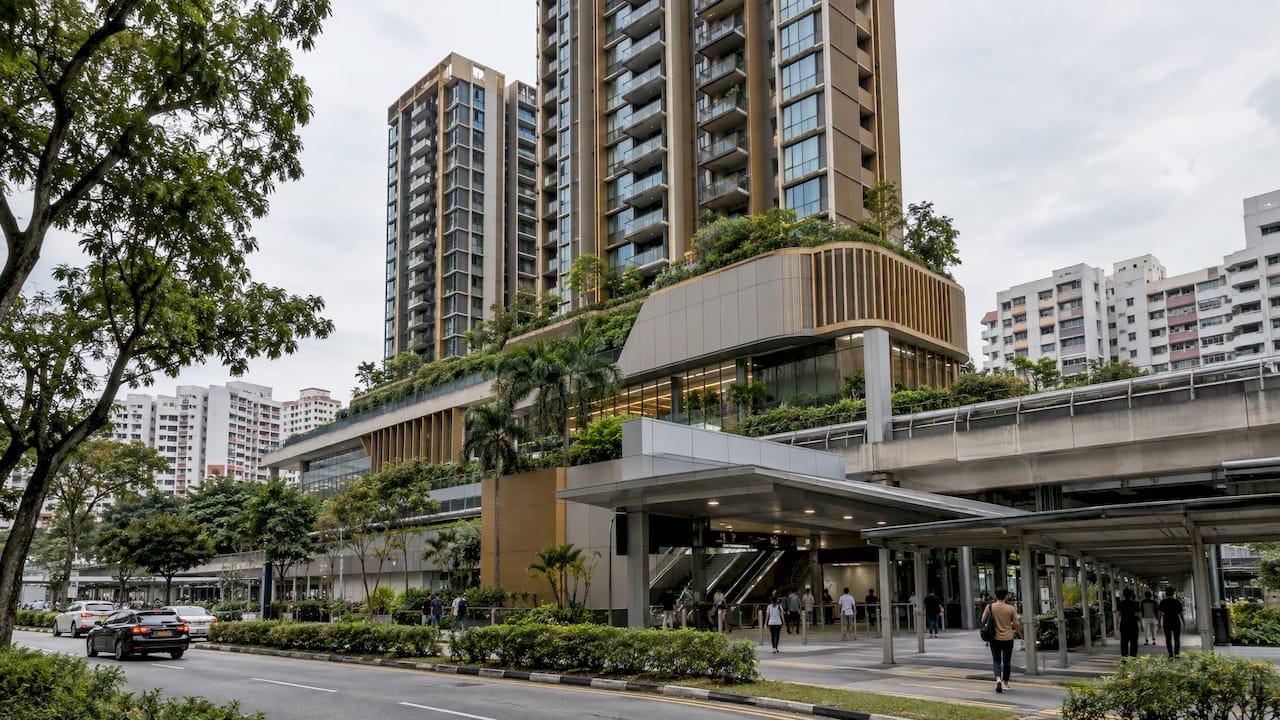
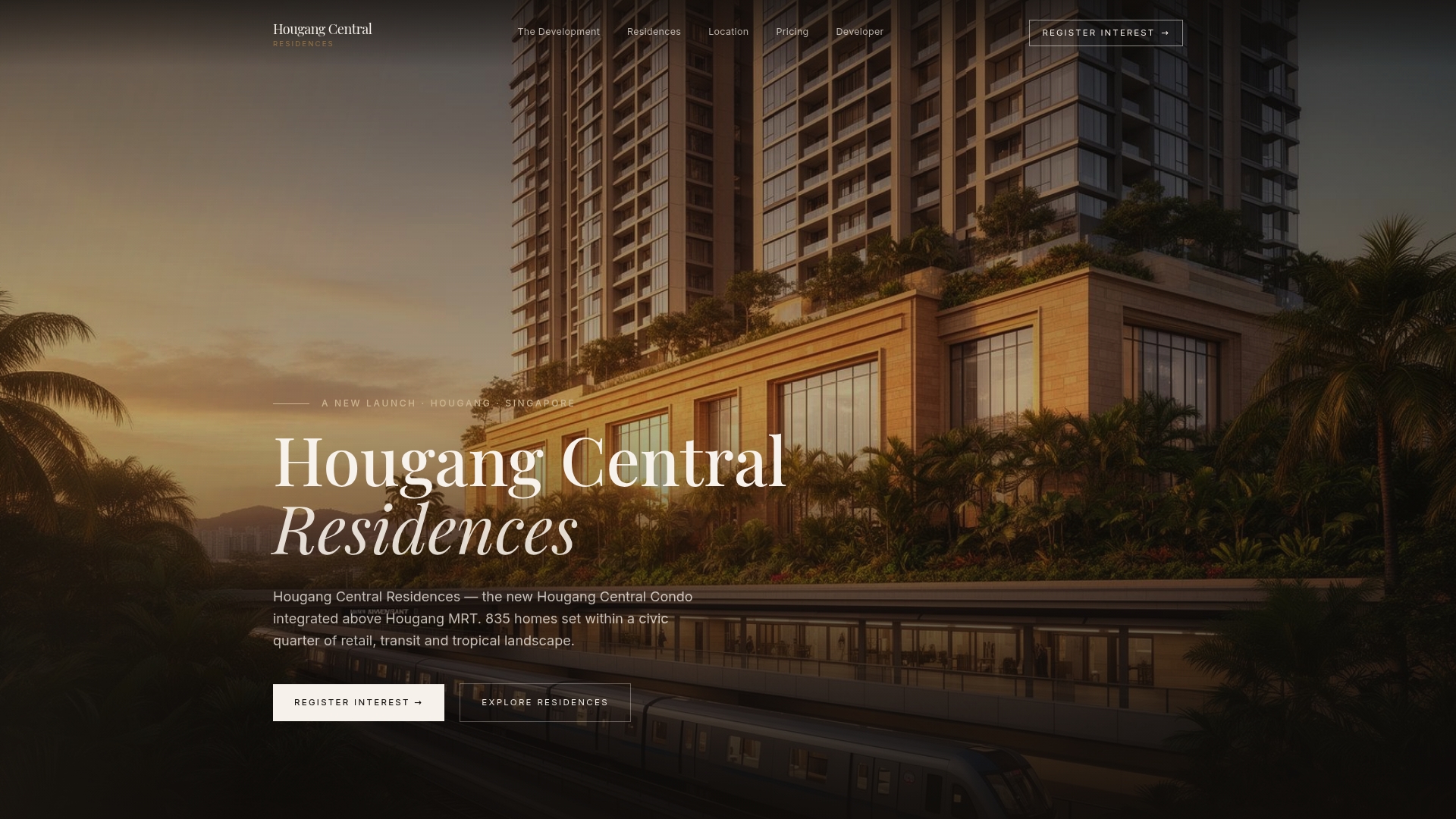
Hougang Central Residences was designed around what that kind of market asks for. It sits directly above Hougang MRT, with a retail mall and bus interchange integrated into the development, and a future Cross Island Line interchange nearby. Its 835 residences run from 1-bedroom plus study to 5-bedroom penthouses, so families, professionals, investors and retirees can find a layout that fits. Smart-home systems and premium European fittings come as part of the specification, and tropical landscaped communal spaces, wellness and social facilities sit within the development.
When prices are rising steadily and new land is costlier, a transit-integrated home in a mature town is the kind of asset we would put at the top of a shortlist.
Simon
See the numbers for yourself
Published pricing at Hougang Central Residences starts from S$2,800 per sq ft. The pricing page shows how that figure is presented, the residences page lists every unit type from 1-bedroom plus study to the 5-bedroom penthouse, and the launch date and latest updates page carries the current schedule. To look at layouts and ask about availability, register for the showflat through the Hougang Central Residences website.
FAQ
What are the expected property prices in Singapore in 2026?
Published forecasts for 2026 private home price growth range from about 2% to 4%. URA's data show a 1.4% rise in Q3 after 0.5% in Q2, with an average of 0.9% per quarter across the first three quarters. Check the next URA release for the latest index.
Will property prices drop in 2026?
Through the first three quarters of 2026 the private price index rose each quarter, and the OCR gained 2.3% in Q3. Forecasts are for continued growth, with the debate focused on the size of the gain. Rates, supply and policy changes can all alter the picture.
How many new condos will launch in Singapore in 2026?
URA states that the 2026 Government Land Sales Confirmed List totals 9,320 private units, with 4,745 in the second half. About 32,800 private homes, executive condominiums included, could come to market over the next one to two years. A larger wave is projected for 2027.
Is 2026 a good time to buy a condo in Singapore?
It depends on your holding period, financing and need. Prices are rising moderately, launches are spaced out so you can compare, and later projects face higher land costs. Buyers with a long horizon and stable income are best placed, and your bank's quote on the day you commit sets your real budget.
Sources
- URA: Release of 3rd Quarter 2026 real estate statistics
- Singapore Business Review: Private home prices rise 1.4% in Q3 despite slump in sales
- Singapore Business Review: Private home prices to rise 3% to 4% as sales shrink
- The Straits Times: Singapore property market outlook 2026
- The Business Times: Home sales set to recover in Q4
- Lianhe Zaobao: New private home supply to peak next year
- The Star: Singapore scraps 15-month wait for private homeowners buying HDB resale flats
- Knight Frank: Q3 2026 Residential Report