Hougang's rental demand held broadly stable through the first half of 2026, with modest upward pressure in the broader non-landed segment. URA's Q2 2026 release shows private residential rentals rose 0.7% for the quarter, even as rentals in the Outside Central Region, the zone covering Hougang, slipped 0.3%. For landlords, that split means pricing power now depends more on unit quality and connectivity than on broad market momentum.
TL;DR:
- Rental demand in Hougang remains stable, with private non-landed rentals increasing only slightly by 0.4% in Q2 2026, outside the overall citywide rise.
- Vacancy rates in Hougang stand at 6.4%, and signs of oversupply or low transaction volume could signal increased rental softness or difficulty in filling units.
- Longer lease terms, proximity to MRT, and matching asking rents to HDB or URA benchmarks are key strategies for landlords and tenants to navigate potential market shifts.
- Demand drivers such as new MRT lines, Northeast job growth, and integrated developments support rental resilience, even amid regional softening.
- Hougang Central Residences caters to current market needs with family-oriented layouts, transit access, and features aligned with tenant priorities.
Table of Contents
- 2026 market snapshot for Hougang and District 19
- Hougang-specific demand patterns and housing-type breakdown
- Primary demand drivers for Hougang rental market
- What the data means for landlords and renters in practical terms
- Client E-E-A-T: how Hougang Central Residences relates to Hougang demand
- Author perspective: how to interpret Hougang demand trends
- Why Hougang Central Residences fits where rental demand is headed
- FAQ
- Sources
2026 market snapshot for Hougang and District 19
Two datasets anchor any read on Hougang's rental market: HDB's rental statistics for public housing and URA's quarterly release for private residential stock. Together they show a market that is steady rather than hot.
HDB's published rental table for Hougang shows sample rent bands ranging from roughly $1,700 to $3,880 across unit types, from smaller flats up to larger executive layouts, giving renters and landlords a real benchmark instead of asking-price guesswork, according to HDB's rental statistics.
On the private side, URA's Q2 2026 data points to a two-speed market:
- Overall private residential rentals rose 0.7% in Q2 2026, a modest but positive signal for landlords across Singapore.
- Non-landed property rentals, the category most condos fall under, increased 0.4% for the quarter.
- Outside Central Region non-landed rentals, the segment Hougang sits in, actually fell 0.3%, diverging from the citywide trend.
- Completed private residential stock showed an overall vacancy rate of 6.4% as at the end of Q2 2026.
That vacancy figure matters because it signals how much completed, unoccupied supply is sitting on the market. A rate near 6.4% is not alarming on its own, but it is worth tracking alongside transaction volume. High transaction volume with stable rents suggests healthy churn and quick re-letting. Low volume paired with rising vacancy suggests landlords are struggling to fill units at asking prices, a distinction price data alone will not show you.
Hougang-specific demand patterns and housing-type breakdown
Hougang's renter base looks different from the central districts. Families anchoring school enrollments, long-tenure commuters working in the city or in nearby job clusters, and mid-term renters who value space over nightlife make up most of the tenant pool here, in contrast to the faster churn typical of Core Central Region studios and one-bedders.
That tenant mix shows up in the rent bands themselves:
- Smaller HDB flats in Hougang rent toward the lower end of the published band, closer to $1,700 to $2,200, based on HDB's sample data.
- Larger flat types command the upper range, up to roughly $3,880, reflecting demand from bigger households.
- Private non-landed units in the Outside Central Region generally rent at a premium to HDB flats but have softened slightly per URA's Q2 2026 figures.
Pro Tip: *Compare a unit's asking rent against HDB's published band for the same flat type before signing or listing.
Higher transaction volume in a district like Hougang tends to improve liquidity for both sides: landlords find tenants faster, and renters have more comparable listings to judge value against, which is harder to do in thinner, lower-volume pockets of the island.
Primary demand drivers for Hougang rental market
Several structural factors shape where Hougang's rental demand is headed over the next few years, independent of quarter-to-quarter price noise.
- Cross Island Line connectivity. New MRT lines historically improve rental appeal in the areas they serve, since commute time is one of the strongest factors renters weigh, though the exact scale of any future rent uplift in Hougang is not yet established.
- Northeast corridor job growth. Employment nodes such as Punggol Digital District add working residents to the broader Northeast region, which can support steady rental demand in neighboring towns like Hougang even without a direct, measurable link to any single building.
- Integrated MRT-and-mall developments. Projects that combine residences with transit and retail access tend to draw tenants who want fewer daily errands and shorter commutes, a group that typically stays longer than renters in standalone blocks.
None of these drivers moves rents overnight, but together they explain why Hougang's rental base has stayed resilient even as citywide figures diverge by region.
What the data means for landlords and renters in practical terms
The numbers translate into different playbooks depending on which side of the lease you sit on.
For landlords:
- Anchor your asking rent to the current HDB band or the relevant URA non-landed figure rather than last year's rate.
- Highlight commuter-friendly features, such as proximity to MRT access or bus interchanges, since that is what keeps tenants renewing.
- Consider 12 to 24 month leases where possible. Longer terms reduce vacancy risk in a market where Outside Central Region rents are softening slightly.
For renters:
- Use the published HDB and URA figures to tell whether an asking rent is in line with the district or inflated.
- Watch for new project completions nearby. A wave of newly handed-over units can briefly soften asking rents as landlords compete to fill vacancies.
- Weigh commute savings against rent premiums. A unit directly above an MRT interchange may cost more but cut real weekly transit time.
Pro Tip: If vacancy rates in the broader Outside Central Region keep climbing past the current 6.4% mark, that is usually your cue to negotiate harder on renewal rather than accept a standing rate.
The clearest risk signal to watch is a combination of falling transaction volume and rising vacancy together. Either one alone is normal market noise, but both moving the same direction points to genuine oversupply.

Client E-E-A-T: how Hougang Central Residences relates to Hougang demand
The demand patterns above help explain why a project's physical connections to transit and retail matter as much as its unit count. Hougang Central Residences is a condominium project located near Hougang MRT station, integrated with retail and transport facilities, offering various unit layouts.
Several features line up with what the data shows tenants actually prioritize:
- Convenient access to MRT and bus interchange, important factors for tenant retention in Outside Central Region housing.
- A range of unit types designed to cater to different household needs.
- Features such as smart-home systems and quality fittings that appeal to renters and owner-occupiers.
- Landscaped communal spaces designed to harmonize with the surrounding neighborhood.
Readers who want to see how these features map to specific layouts can check the floor plan and unit mix updates or the location and connectivity guide for a fuller picture of transit access.
Author perspective: how to interpret Hougang demand trends
Hougang's rental market right now rewards patience over speculation. The headline numbers are unremarkable on purpose: a slight regional softening in Outside Central Region rents, a citywide rise elsewhere, and vacancy sitting at a level worth monitoring rather than panicking over. If you are a landlord, price to the published bands and hold for longer leases. If you are a renter, use this relative softness to negotiate rather than rush. If you are weighing a purchase, read the raw HDB and URA releases yourself before any transaction, since quarterly swings can shift the picture by the time you act.
— Simon
Why Hougang Central Residences fits where rental demand is headed
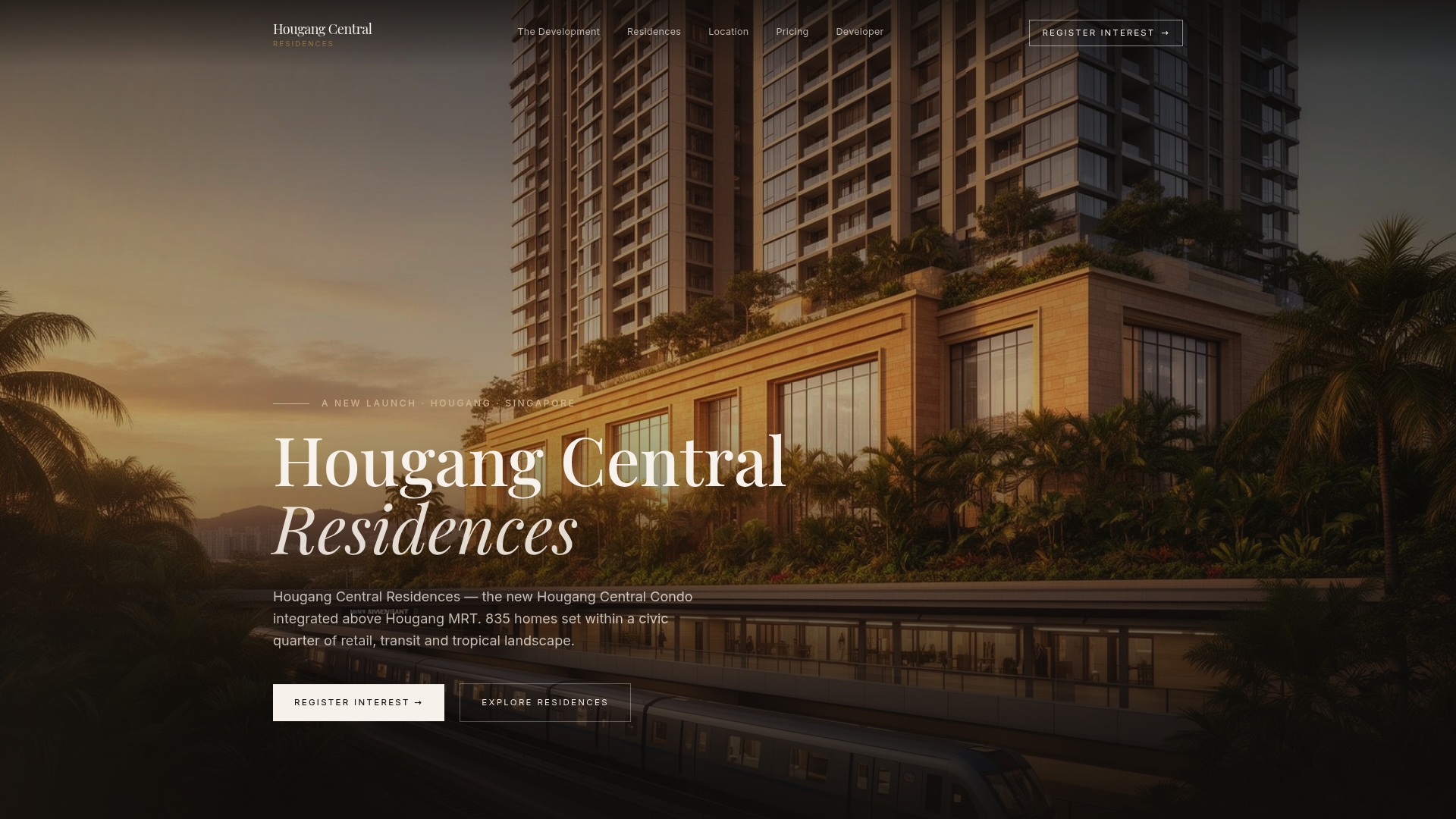
The same features driving steady Hougang rental demand, MRT access, family-sized layouts, and lower tenant turnover near integrated transit, are the ones we have built into Hougang Central Residences from the ground up. Our unit mix runs from 1-bedroom-plus-study to 5-bedroom penthouses, so whether you are buying to live in or to let out, there is a layout that matches the tenant profile this market favors.
- See the pricing page for current details on prices.
- Browse the full residences lineup across all seven unit types.
- Check the site plan to see how the layout connects to the MRT and retail podium.
Register for updates or book a showflat visit to walk through the layouts yourself.
FAQ
Which area in Singapore has the highest rental yield?
Rental yield varies by project and unit type rather than by a single district-wide figure, so there is no fixed answer that applies citywide. Checking HDB's rental statistics against a unit's purchase price is the most reliable way to estimate yield for a specific property.
Will rental prices go down in 2026 in Singapore?
Rental movement in 2026 has been mixed rather than uniformly falling. URA's Q2 2026 release shows overall private rentals rose 0.7% for the quarter, while Outside Central Region non-landed rentals fell 0.3%, so the direction depends heavily on location and property type.
Which area is the cheapest to rent in Singapore?
Rent levels differ by town, flat type, and proximity to transit rather than by one single cheapest location. HDB flats in mature but Outside Central Region towns, including parts of Hougang, tend to sit toward the lower end of rent bands compared with central districts, based on HDB's published data.
What should I check before signing a rental lease in Hougang?
Compare the asking rent against the current HDB rental bands or URA's quarterly figures for non-landed units to confirm it is in line with the district. It also helps to factor in commute time to MRT access, since that is one of the strongest drivers of tenant satisfaction and renewal.
How does rental income get taxed in Singapore?
Rental income earned from a Singapore property is subject to property tax rules set out by IRAS, which landlords should review before finalizing any lease terms. The applicable rate and filing requirements depend on factors like owner-occupation status, so checking the official guidance directly is the safest approach.
Sources
- Release of 2nd Quarter 2026 real estate statistics | Urban Redevelopment Authority (URA)
- IRAS — Property tax