
That premium is real but modest, and it moves month to month based on which flat types happen to transact. Before setting a budget, pull the actual transacted prices for your target flat type rather than anchoring on the town average alone.
TL;DR:
- Hougang resale prices are primarily influenced by flat type, remaining lease, and location, with median prices around $648,888 and a 3% premium over the Singapore median.
- Flat size, lease length, and proximity to MRT stations significantly affect actual purchase prices, with Executive flats often exceeding $700,000.
- Composition effects, such as higher sales of Executive and 5-room flats, can skew average prices upward without reflecting broad market appreciation.
- Upgraded integrated developments near Hougang MRT carry prices up to $2,800 PSF, nearly double the district resale median, driven by future connectivity benefits.
- Cooling measures tend to slow price growth gradually, with demand stability rooted in Hougang’s mature infrastructure, established amenities, and steady demand from a diverse demographic.
Table of Contents
- Hougang Property Prices: The 2026 Market Snapshot
- What You'll Pay by Flat Type: 2-Room to Executive
- Recent Hougang Resale Transactions Worth Knowing
- How to Read Hougang's Price Statistics Correctly
- Hougang Resale Prices vs. District 19 Condos and New Launches
- Your Hougang Property Budget Checklist
- Hougang's Price Trends and Market Cycles Over Time
- Comparing Hougang Prices with Neighboring Towns
- How Cooling Measures Have Shaped Hougang Prices
- Infrastructure and Urban Planning Effects on Future Prices
- Who Lives in Hougang and Why It Shapes Demand
- Rental Yields and Investment Potential in Hougang
- Why Connectivity Changes How I Think About Hougang
- Hougang Central Residences: What You Should Know Before Booking a Viewing
- Where to Verify Hougang Property Prices Yourself
- Sources
- FAQ
Hougang Property Prices: The 2026 Market Snapshot
The numbers tell a story of a mature estate holding steady rather than one running hot. In the latest reported month, Hougang logged resale transactions with average and median prices that show a notable gap, an important factor to understand before anything else.
Median PSF sat around $593, with average PSF slightly higher at roughly $612. The town's rolling median across the period tracked stood at $648,888, which put Hougang about 3% above the Singapore median of $630,000. That's not a runaway premium. It's the kind of gap you'd expect from a well-connected, established town with decent MRT coverage and a healthy mix of flat sizes, rather than a hot pocket commanding a steep markup.
A separate monthly digest for May 2026 recorded 114 resale transactions with an average price of $663,707, and the analysis behind that figure found something buyers should sit with: composition, not underlying price growth, accounted for most of the month's average rise. More Executive and 5-room flats simply changed hands than usual.
The average-versus-median divergence matters because a handful of high-value Executive or 5-room sales can pull the average up even when most transactions sit closer to the median. If you're budgeting off headlines, use the median as your anchor and treat the average as a signal of what's trading at the top end, not what you'll typically pay.
What You'll Pay by Flat Type: 2-Room to Executive
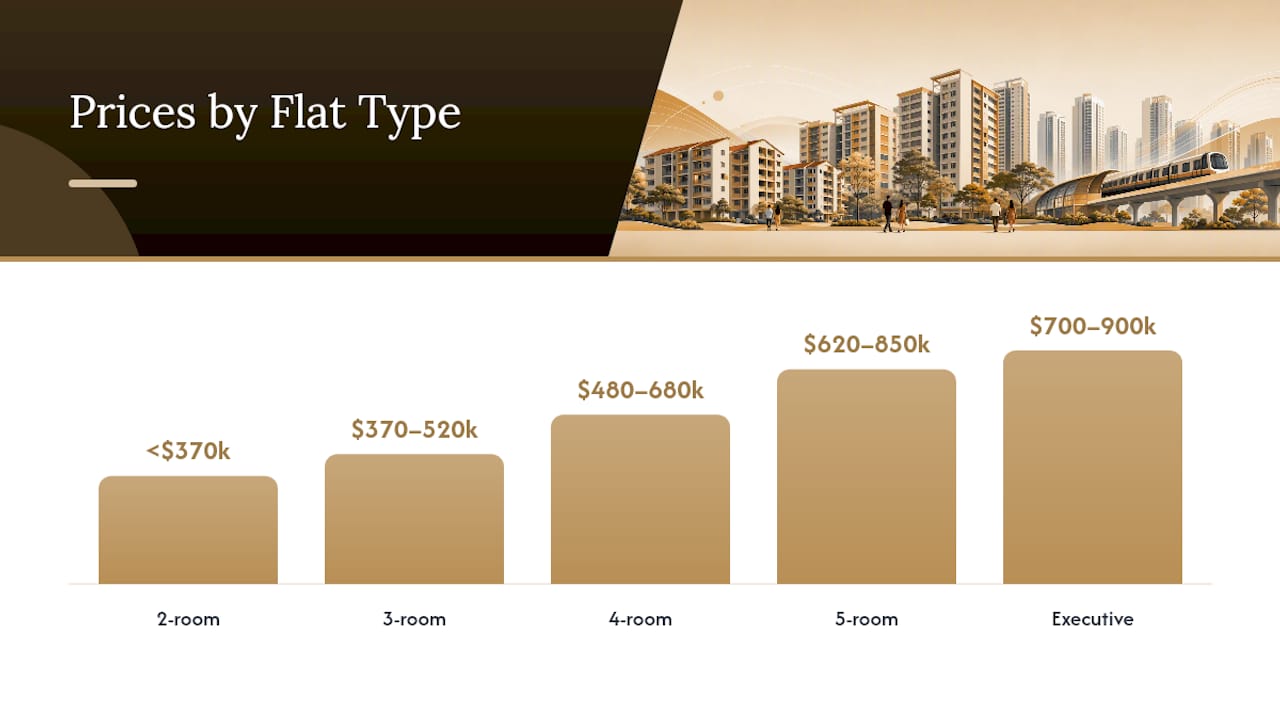
Your budget depends far more on flat type than on the town-wide average. Hougang covers a wide spread, from compact 2-room flats to Executive units that push past $800,000, and the variance inside each category can be just as wide as the gap between categories.
Q1 2026 price bands for Hougang put 3-room flats between $370,000 and $520,000, 4-room flats between $480,000 and $680,000, and 5-room flats between $620,000 and $850,000. Executive flats, the largest standard HDB type, typically sit above the 5-room band, often crossing $700,000 to $900,000 depending on lease remaining and estate.
| Flat Type | Typical Price Range | Notes |
|---|---|---|
| 2-room | Below $370,000 | Limited stock in Hougang, mostly older blocks |
| 3-room | $370,000 to $520,000 | Widest entry point for first-time buyers |
| 4-room | $480,000 to $680,000 | Largest transaction volume in the town |
| 5-room | $620,000 to $850,000 | Strong demand from upgraders |
| Executive | Above $700,000 | Fewer units, higher per-unit floor area |
Three factors drive the spread within each type. Remaining lease is the biggest one: a 3-room flat with 95 years left will fetch meaningfully more per square foot than one with 65 years remaining, because financing options shrink as lease runs down. Floor level adds another layer. Higher floors with unblocked views in Hougang's newer precincts near Kovan and Hougang Central routinely command $20 to $40 more per square foot than similar units on lower floors.
Block location within the town matters just as much. Flats closer to Hougang MRT, Hougang Mall, or the future Cross Island Line interchange tend to sit at the upper edge of their type's price band, while blocks further from transit and near the Punggol border trade closer to the lower bound.
A first-time buyer eyeing a 4-room resale flat should budget around $550,000 as a realistic median target, with room to stretch toward $620,000 for a unit near the MRT with a long lease. An upgrader chasing a 5-room unit should expect $700,000 to $750,000 to be the practical midpoint, not the advertised low end.
Recent Hougang Resale Transactions Worth Knowing
Headline averages only tell part of the story. Looking at actual closed deals shows how much a single street or block can shift the number.
- A 5-room flat near Hougang Central closed above $850,000, reflecting strong demand for units within walking distance of the MRT and mall.
- A 4-room unit in a mid-lease block (around 75 years remaining) transacted near the town median of $640,000, roughly $593 PSF.
- A 3-room flat further from transit, with a shorter lease under 70 years, sold closer to $400,000, sitting well under the town PSF average.
- An Executive flat near Hougang Avenue crossed $780,000, consistent with the upper end of the Executive band.
- Several 4-room transactions near Kovan Road clustered between $600,000 and $650,000, slightly above the town-wide median for that flat type.
- A handful of 5-room flats with fresh 99-year leases transacted above $800,000, pulling the monthly average upward even though most 5-room sales stayed closer to $700,000.
Blocks along Hougang Central and those closest to the MRT and bus interchange repeatedly show up at the top of the price range for their flat type. Older blocks toward the fringes, particularly those bordering Punggol and Sengkang, tend to anchor the lower end. Cross-referencing individual listings against live transaction data is the only reliable way to confirm whether a specific unit is priced fairly against its immediate neighbors, not just the town average.
How to Read Hougang's Price Statistics Correctly
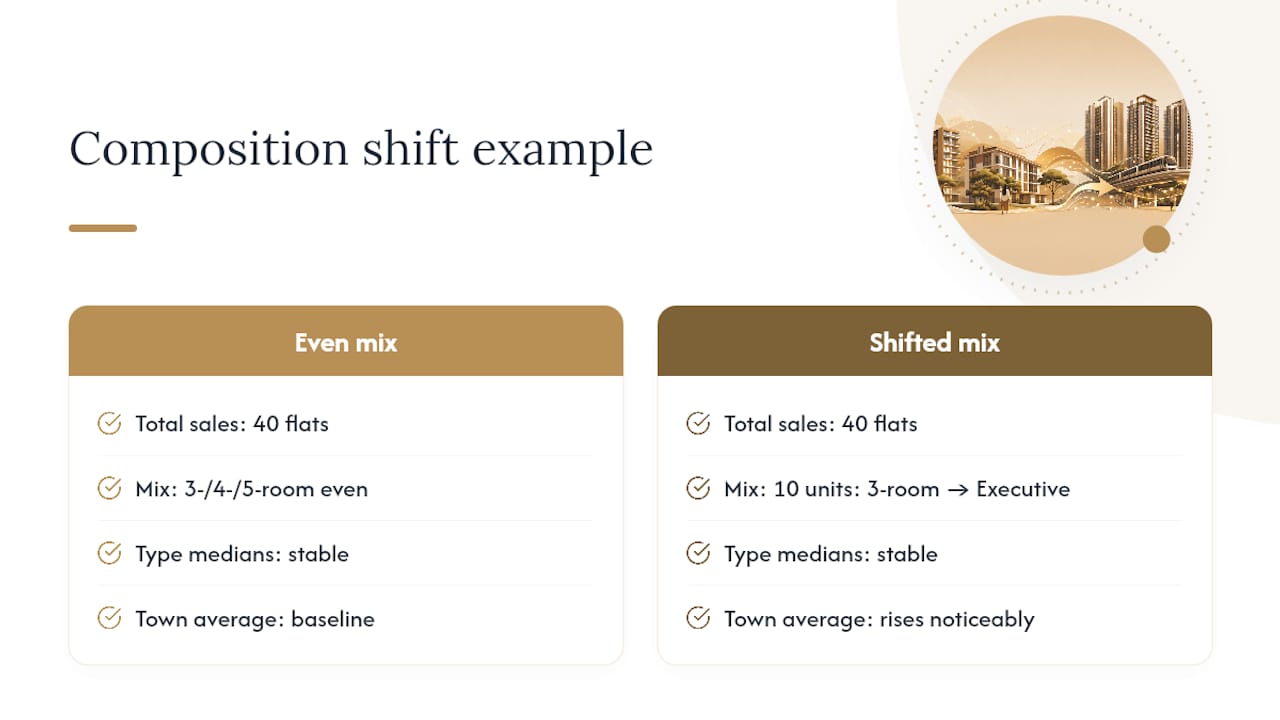
Averages lie, or at least they mislead if you don't know what's behind them. The single most useful skill for reading Hougang's numbers is understanding the mix effect: how the blend of flat types sold in a given month, not underlying price movement, drives most of the swing in headline averages.
Here's a simplified version of how that works. Imagine a month where 40 flats sell, evenly split across 3-room, 4-room, and 5-room types, each at its own stable median. Now imagine the next month, the same 40 flats sell, but 10 of them are Executive units instead of 3-room units. Even if no single flat type's price moved a dollar, the town average would rise noticeably, because you've swapped cheaper flats for pricier ones. Analysts working through the May 2026 Hougang data found exactly this pattern: composition changes, not broad appreciation, explained most of that month's average increase.
Remaining lease is the second variable that quietly reshapes what you can afford. Banks and the CPF Board apply stricter loan limits as a flat's lease shortens, particularly once it drops under 60 years remaining, which narrows your financing options and can push a shorter-lease flat's effective price down even when its headline price looks similar to a longer-lease unit. Flat size compounds this. A 5-room flat with 60 years left may carry a lower PSF than a 4-room flat with 90 years left, purely because buyers price in future resale friction.
PSF becomes essential once you start comparing HDB resale against condos, because unit sizes vary so much that a raw price comparison is meaningless. A 900 square foot condo at $1,400 PSF costs about the same as a 1,300 square foot HDB flat at $970 PSF, even though the sticker prices look wildly different. This is also where MRT proximity earns its premium: integrated developments built directly above or beside an MRT station, like the connectivity some integrated developments offer, consistently command higher PSF than comparable projects a 10-minute walk away, because the convenience compounds daily rather than being a one-time perk.
Pro Tip: Before comparing two flats' listed prices, convert both to PSF and check remaining lease side by side. A "cheaper" flat with 20 fewer years on the lease is often the more expensive option once financing limits and future resale value are factored in.
Hougang Resale Prices vs. District 19 Condos and New Launches
Hougang sits inside District 19, and understanding where resale HDB, resale condos, and new launches each land on the price spectrum helps you decide which lane actually fits your goals.
- District 19 resale condos carry a median PSF of roughly $1,416, which sets the baseline for what "condo living" costs across Serangoon and Hougang combined.
- New launches and integrated developments in the district are pricing well above that baseline, typically in the $1,800 to $2,800 PSF range depending on tenure and MRT proximity.
- Projects integrated directly with Hougang MRT are projected in the $2,500 to $2,800 PSF range, reflecting the premium buyers pay for direct transit and retail access rather than a short walk to it.
- The gap between an older resale condo pocket and a new integrated launch can exceed $1,000 PSF within the same district, which means "District 19 pricing" is not one number, it's a spread.
That internal spread is the real lesson here. An older, standalone resale condo a 10 to 15 minute walk from Hougang MRT sits in a completely different price bracket than a launch positioned above the station itself. If your priority is daily convenience and long-term capital preservation tied to transit access, the resale-versus-new-launch decision should hinge less on the sticker PSF and more on what that PSF is actually buying you. Buyers weighing an integrated development against a standalone condo should treat the extra PSF as a convenience cost, not just a price tag, and decide whether the daily time saved justifies it over their expected holding period.
Your Hougang Property Budget Checklist
Setting a realistic number before you start viewing units saves weeks of wasted time. Work through this in order.
- Calculate your all-in budget, not just the sale price. Add Buyer's Stamp Duty, legal fees (typically $2,500 to $3,000), valuation fees, and any renovation reserve on top of the unit price before you set a ceiling.
- Decide your flat-type band using the medians above, not the town average. A 4-room budget of $550,000 to $620,000 is realistic; anchoring on the $696,647 average will make you think the market is pricier than it actually is for your target type.
- Check remaining lease on every shortlisted unit. Anything under 60 years changes your CPF usage and loan eligibility, so confirm this before you fall in love with a floor plan.
- Verify PSF against comparable recent sales, not the listing agent's asking price, using live transaction data.
- Assess proximity to MRT, schools, and Hougang Mall. Each adds a measurable premium, and knowing the size of that premium helps you judge whether a listing is fairly priced.
- Confirm your eligibility on the HDB flat and grant eligibility page before making any offer, especially if you're using grants or buying as a second-timer.
- Get a mortgage in-principle approval from a bank before shortlisting, so your budget ceiling reflects what you can actually borrow, not just what you'd like to spend.
- Engage an agent or valuer for a second opinion on any unit above the median for its type, particularly if it's a high floor or premium block.
Pro Tip: Run the numbers on total lease decay over your expected holding period, not just today's price. A flat that looks like a bargain now can become harder to finance and resell in 10 years if the lease is already under 65 years.
Hougang's Price Trends and Market Cycles Over Time
Hougang's HDB market has moved through recognizable cycles rather than a straight climb. The town saw steady appreciation through the post-pandemic resale boom, when nationwide demand pushed against constrained new supply and drove flat prices, including in mature towns like Hougang, well above pre-2020 levels.
That surge has since cooled into a steadier pattern. Recent monthly data shows Hougang's median holding in a fairly tight band, with month-to-month swings driven more by which flat types transact than by a genuine shift in underlying value. That's a hallmark of a mature market: supply is limited because there's little new build-to-order activity left in the town, so resale flats dominate transaction volume and prices track broader demand rather than any single new development.
Independent commentary on the wider HDB resale market echoes this pattern, noting that established towns tend to see more moderate, mix-driven price movement compared to newer estates still absorbing fresh BTO completions. For Hougang specifically, that means big month-on-month average jumps are more often a signal of which flats sold than a signal of the market suddenly repricing. Watching the median over several months, rather than reacting to any single month's average, gives a far more honest read of where the town is actually heading.
Comparing Hougang Prices with Neighboring Towns
Hougang sits in a competitive cluster alongside Sengkang, Punggol, and Serangoon, and how it stacks up against each says a lot about what you're actually paying for.
Against Sengkang and Punggol, both younger towns with more BTO-era flats and shorter average leases remaining, Hougang tends to trade at a comparable or slightly higher median for equivalent flat types, largely because of its more established amenities, older but larger flat layouts, and direct MRT access that some newer Punggol precincts still lack. Serangoon, which shares District 19 with Hougang, generally commands a higher PSF for its resale flats and condos, reflecting its proximity to Serangoon Central and NEX mall.
What separates Hougang from its neighbors isn't dramatic price gaps, it's flat age and layout. Many Hougang blocks were built in the 1980s and 1990s, which means larger floor areas per flat type than you'll typically find in newer Sengkang or Punggol developments of the same nominal size. A Hougang 4-room flat often has more usable space than a Sengkang 4-room flat, even at a similar price, which is worth factoring in if you're comparing listings across town boundaries purely by price tag.
For buyers priced out of Serangoon's premium but unwilling to sacrifice MRT access and mature-estate amenities, Hougang consistently comes up as the practical middle ground. It's neither the cheapest nor the most expensive option in the immediate region, and that positioning is exactly why it draws steady, rather than speculative, demand.
How Cooling Measures Have Shaped Hougang Prices
Singapore's cooling measures apply nationwide, but their effect shows up differently depending on a town's flat mix and buyer profile, and Hougang's mature-estate status makes it a useful case study.
The tightened loan-to-value limits and Additional Buyer's Stamp Duty adjustments introduced in recent cooling rounds primarily target upgraders and investors buying multiple properties, which matters for a town like Hougang where 5-room and Executive flats attract a meaningful share of upgrader demand. When ABSD or loan limits tighten, that segment of buyers typically pulls back first, which shows up as softer demand at the top end of Hougang's price bands rather than across the entire market.
The Mortgage Servicing Ratio and Total Debt Servicing Ratio frameworks also constrain how much buyers can borrow relative to income, which has kept Hougang's price growth from mirroring the sharper swings seen in some private condo segments. Resale flats in mature towns tend to be more insulated from speculative flipping because HDB's Minimum Occupation Period requirement keeps most flats off the market for at least five years after purchase, smoothing out short-term volatility that cooling measures are partly designed to prevent.
The practical upshot for Hougang buyers is that policy shifts tend to move the town gradually rather than abruptly. A new cooling measure is far more likely to slow the pace of price growth over several months than to trigger an immediate correction, which is one reason Hougang's median has stayed relatively stable even as national headlines about cooling measures come and go.
Infrastructure and Urban Planning Effects on Future Prices
The single biggest structural change coming to Hougang is the future Cross Island Line interchange, which will convert Hougang MRT from a single-line station into a true interchange. Interchange stations historically carry a measurable price premium over single-line stations across Singapore, because they cut travel time to multiple parts of the island rather than just one.
That upgrade is a major reason integrated developments positioned directly above or beside Hougang MRT are commanding the higher PSF bands discussed earlier. Buyers aren't just paying for today's connectivity, they're pricing in the interchange status that arrives once the Cross Island Line completes, and that anticipation effect tends to show up in prices years before the actual line opens.
Beyond the MRT upgrade, ongoing enhancements to Hougang Mall, the bus interchange redevelopment, and continued upgrading of older HDB blocks under the Home Improvement Programme all contribute to keeping the estate competitive against newer towns. None of these are single dramatic events, they're incremental improvements that collectively support Hougang's position as a mature estate that isn't standing still.
For anyone weighing whether to buy now versus wait, the historical pattern in Singapore is fairly consistent: infrastructure premiums build in gradually as construction milestones are hit, rather than jumping all at once when a line opens. Buying ahead of interchange completion has, in comparable cases elsewhere in Singapore, tended to capture more of that appreciation than buying after.
Who Lives in Hougang and Why It Shapes Demand
Hougang's demographic profile is a big part of why its price trends look the way they do. It's a genuinely mixed estate, home to a broad range of household types, from long-time residents who bought their flats decades ago to younger families drawn by the combination of mature amenities and relatively accessible entry prices compared to Serangoon or the city fringe.
This mix matters for demand patterns. A large base of established residents means a steady stream of upgraders moving from 3-room to 4-room or 5-room flats within the same town, which supports consistent transaction volume rather than boom-bust demand swings tied to a single buyer segment. Families drawn by Hougang's schools and mature-estate amenities add another layer of steady demand, particularly for larger flat types near good primary schools.
The town also attracts buyers priced out of nearby Serangoon but unwilling to move further out to Punggol or Sengkang, which creates a kind of demand floor. Hougang's combination of affordability relative to its immediate neighbors, established infrastructure, and improving transit access gives it a resident base broad enough to support demand across nearly every flat type and price band, rather than concentrating demand narrowly at either the entry level or the luxury end.
Rental Yields and Investment Potential in Hougang
Rental demand in Hougang draws heavily from its transit access and proximity to established amenities, both of which matter more to tenants than to owner-occupiers in many cases. Tenants prioritize commute time and convenience, and a flat or unit within easy reach of Hougang MRT tends to lease faster and command steadier rental interest than one further from the station, mirroring the same connectivity premium that shows up in sale prices.
For HDB investors, rental yield potential is naturally capped by HDB's owner-occupation and subletting rules, which limit the pool to whole-flat rentals after the Minimum Occupation Period, rather than the flexible rental structures available to condo owners. That said, steady demand from tenants working in the northeast corridor, including those employed near Punggol's growing business parks, keeps occupancy relatively resilient for well-located Hougang flats.
Condo and integrated-development investors have more flexibility, and this is where the MRT-proximity premium becomes an investment thesis rather than just a lifestyle preference. A unit directly connected to transit and retail, the kind of positioning integrated projects offer, tends to hold rental appeal even as surrounding supply grows, because the convenience factor doesn't erode the way a purely speculative price premium might. Investors weighing Hougang against other District 19 pockets should treat MRT-interchange proximity as the single strongest indicator of sustained rental demand over a full market cycle, not just current asking rents.
Why Connectivity Changes How I Think About Hougang
The number that sticks with me most from this data isn't the $648,888 median. It's the fact that integrated, MRT-connected developments in this district are projected at $2,500 to $2,800 PSF, nearly double the district's resale condo median. That gap isn't noise. It's buyers telling you, with real money, what convenience is worth to them once they've lived through years of transfers, bus connections, and weather-dependent walks to a station.
Working through Hougang's numbers convinces me that most buyers underrate how much daily friction compounds over a decade of ownership. A five-minute difference in commute doesn't sound like much until you multiply it by two trips a day, five days a week, for years. That's the logic behind Hougang Central Residences sitting directly above the MRT and integrated with retail and a bus interchange: it's not a lifestyle flourish, it's a structural bet that connectivity holds its value better than almost any other feature in a unit.
The buyer profile I'd point toward this kind of project isn't the speculative flipper chasing a quick PSF gain. It's the dual-income household or retiree who wants one less daily decision to make, someone who values not having to think about how they'll get to work, the mall, or the MRT each morning.
— Simon
Hougang Central Residences: What You Should Know Before Booking a Viewing
An integrated development above Hougang MRT includes a retail mall and bus interchange, providing direct access to transit and shopping without street-level crossing. The development offers a wide mix of unit types, from compact layouts to larger homes, catering to varied buyer needs.
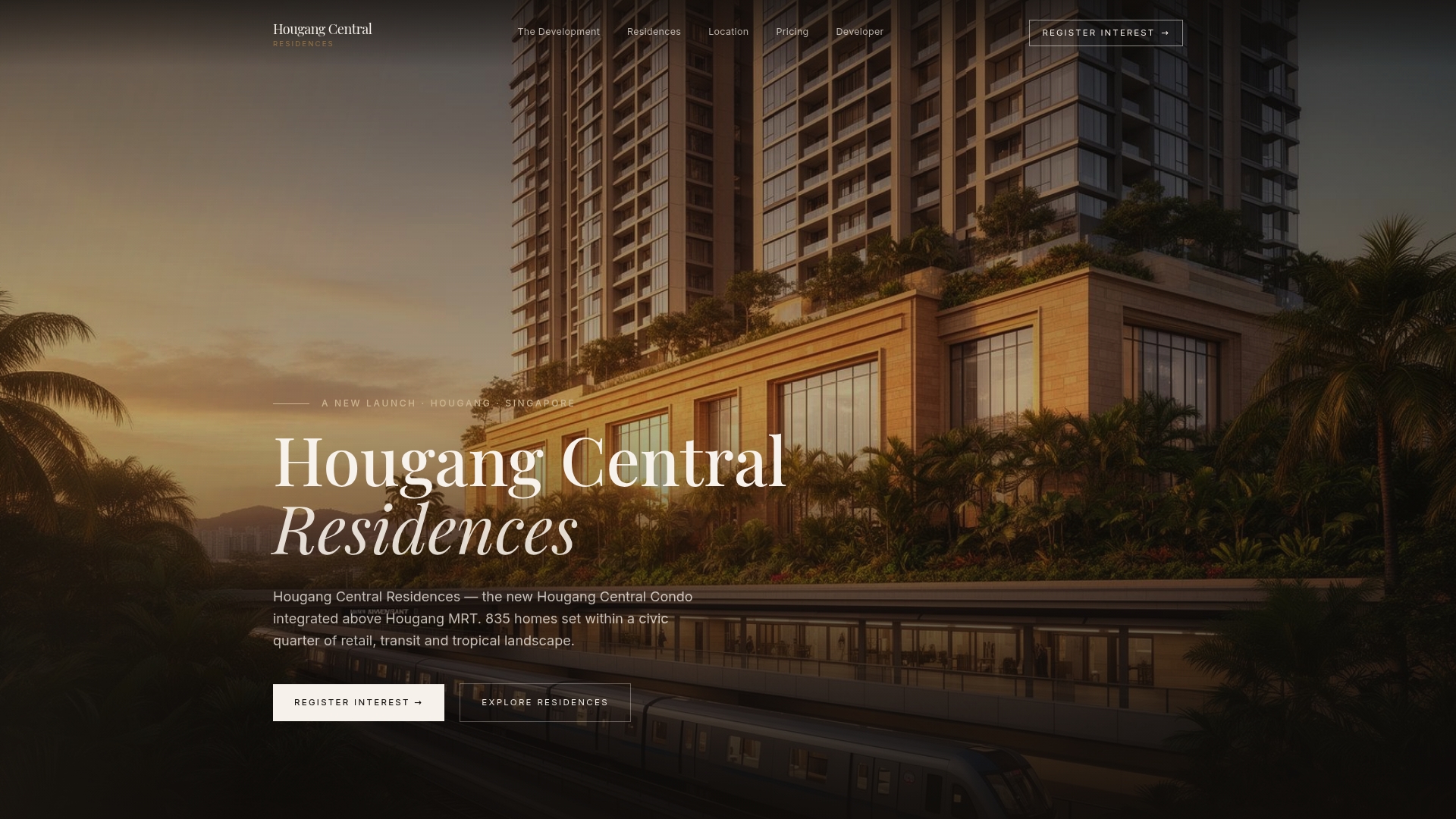
Units feature smart-home systems and quality fittings, set within tropical landscaped grounds designed to provide a calm environment. That's the trade-off worth understanding: buyers here are paying a premium PSF over older District 19 resale stock, but they're buying direct access to a future Cross Island Line interchange, a mall, and a bus terminal, all without leaving the building. For someone who has already run the numbers on commute time and convenience, that premium tends to look less like a cost and more like a fixed, permanent upgrade to daily life.
If Hougang's price data has you leaning toward an integrated, transit-connected home rather than an older resale unit, the next step is straightforward: request an e-brochure or book a showflat visit to see the unit mix and layouts in person before making a decision.
Where to Verify Hougang Property Prices Yourself
Every figure in this article should be treated as a starting point, not a substitute for checking the specific unit you're interested in. HDB's own eligibility and housing loan pages confirm whether you qualify for a given flat type or grant before you go further.
For transaction-level detail, PropertyDecide's Hougang page pulls live-fed resale data suitable for checking recent unit-level sales against your shortlist. HDB Insights publishes monthly town summaries worth following for updated medians, PSF trends, and million-dollar flat counts as new data comes in each month.
Sources
- Hougang HDB Resale Prices & Market Analysis - HDB Insights
- Shioknest
- Propertynet
- Hougang neighbourhood guide Singapore 2026: Prices, MRT & investment | LovelyHomes
- Hougang HDB Resale Prices 2026 - Median & Recent Sales | PropertyDecide
FAQ
Will Hougang Property Prices Drop in 2026?
Current data shows Hougang's median holding steady around $648,888, with month-to-month moves driven mostly by flat-type mix rather than broad price declines, so a sharp drop across the board looks unlikely barring a major policy shift.
Is Hougang a Mature Estate?
Yes, Hougang is classified as a mature estate, with most flats dating from the 1980s and 1990s, established amenities including Hougang Mall, and direct MRT access that continues to support steady resale demand.
Can a 70 Year Old Buy an HDB Flat?
Yes, there is no upper age limit for buying an HDB resale flat, though remaining lease requirements and CPF usage limits tighten for shorter leases, so it's worth checking the specific eligibility rules on HDB's official eligibility page before shortlisting a unit.