
Coworking integrated near or within a residential development directly improves daily convenience for residents, supports hybrid and remote workers, and raises the marketability of transit-connected condos when the space is well managed. Nearly 50% of professionals using coworking report measurable productivity gains, and Harvard Business Review found coworking members score 6 out of 7 on a "thriving" scale, roughly a full point above traditional office workers. For buyers and investors evaluating transit-integrated condos like Hougang-central-residences, the practical implication is clear: ask about the operating model, fee allocation, and activation timeline before you sign.
Table of Contents
- What role does coworking near residences play for residents?
- How does integrated coworking affect property value and investor returns?
- What operating models and costs should you expect?
- What design and location factors determine whether a space actually gets used?
- What are the real risks and how do you reduce them?
- How do you evaluate a development's coworking offering before buying?
- When can you realistically expect the coworking space to be fully operational?
- Key Takeaways
- Why transit-integrated coworking is the amenity that actually compounds
- Useful sources
- FAQ
What role does coworking near residences play for residents?
A coworking space within walking distance of home removes one of the biggest friction points of hybrid work: the wasted commute to a downtown office for a single focused session. Residents get a professional environment without leaving the neighborhood.
Harvard Business Review's research on why people thrive in coworking spaces found that members report higher autonomy, a stronger sense of community, and that 6/7 thriving score. Those aren't soft benefits. They translate into fewer sick days, better output, and lower turnover for employers who subsidize memberships.
Specific resident use cases where the value is clearest:
- Hybrid employees who need two or three focused days per week outside the home
- Freelancers and consultants who require reliable high-speed internet and a professional address for client calls
- Parents who need a predictable, distraction-free window during school hours
- Small-business owners who use on-site meeting rooms instead of renting external venues
"Coworking can reduce isolation, improve work-life balance, and provide better internet and shared resources than many home offices." — The Conversation
A systematic review from Politecnico di Milano confirms the pattern but adds an important caveat: outcomes vary by user base, layout, and management quality. A poorly run space with bad acoustics and no programming delivers almost none of these gains.
How does integrated coworking affect property value and investor returns?
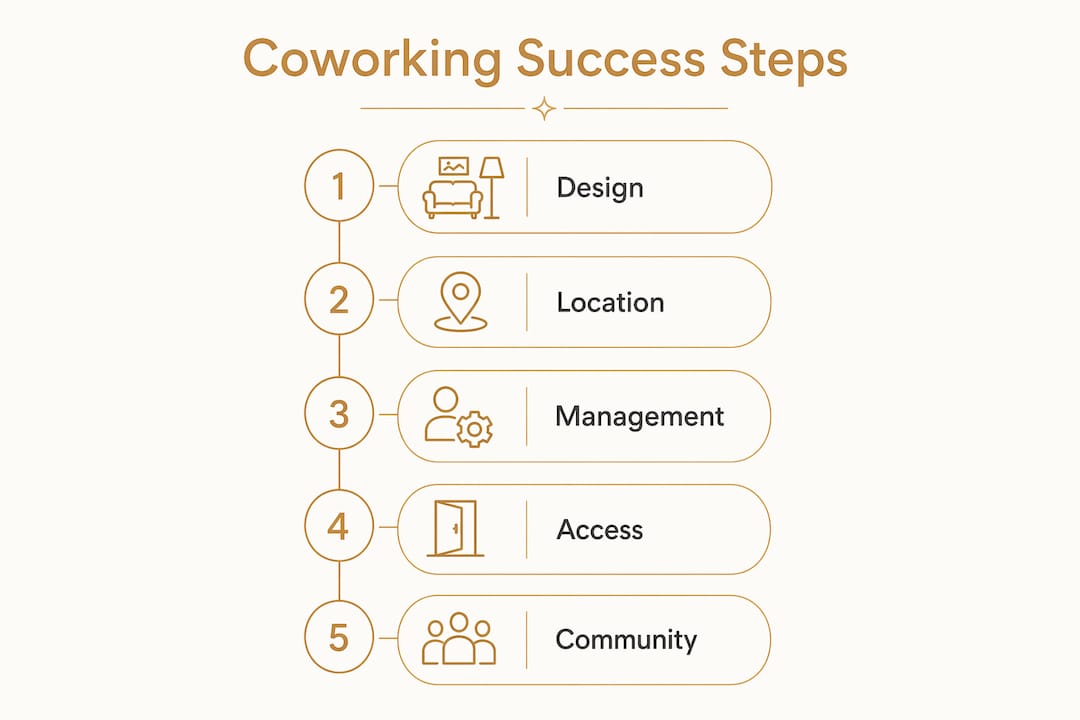
Well-executed residential coworking can accelerate lease-up, justify an amenity premium, and improve tenant retention. The demand side is real: residential coworking grew significantly in U.S. integrated residential projects between 2022 and 2026, driven by the structural shift to work-near-home models.

An MDPI study on transit-oriented developments found that coworking integrated into transit-connected locations drives higher local economic activity and retail spending compared to peripheral sites. That matters for investors because footfall from coworking users spills into adjacent retail, supporting the commercial component of mixed-use projects.
| Investor impact | Expected effect | Confidence |
|---|---|---|
| Occupancy rate | Higher demand from hybrid workers | Strong (demand-side data) |
| Amenity premium | Modest rent uplift when well managed | Moderate |
| Lease-up speed | Faster marketing to remote professionals | Moderate |
| Retail spillover | Increased daily footfall to adjacent retail | Strong (MDPI transit data) |
| Resale appeal | Broader buyer pool including remote workers | Moderate |
The limits matter too. Oversupply of desks relative to resident demand, poor management, and unclear fee structures all erode these gains. An underused coworking room costs the HOA money and signals poor planning to prospective buyers.
What operating models and costs should you expect?
Three models dominate residential coworking. Understanding which one a developer uses tells you a lot about long-term cost predictability.
- Developer-included amenity: Access is bundled into the maintenance or HOA fee. Capital and operating costs sit with the developer or building management. Predictable for residents, but quality depends entirely on the developer's commitment.
- Third-party operator with subscriptions: A specialist operator runs the space. Residents pay a separate monthly or day-pass fee. Higher service quality is possible, but uptake can be lower if the fee feels like a double charge on top of HOA dues.
- Hybrid revenue-sharing model: The developer provides the space; an operator manages it and shares revenue. Aligns incentives better than the other two, but governance can get complicated if the revenue-sharing agreement isn't documented clearly.
Practical guidance from The Hindu on residential coworking models confirms that buyers should verify whether access is included in maintenance fees or requires a separate subscription. That distinction materially affects cost-effectiveness over a five-year ownership horizon.
The Coworking Space Value Stack research from Taylor & Francis adds another layer: buy-in depends on physical environment, social dynamics, and growth opportunities together. Desk supply alone doesn't drive utilization. If the operator isn't programming the space and building community, even a well-funded amenity sits empty.
Pro Tip: Always ask whether coworking access is funded through HOA reserves or a separate subscription. A space funded through reserves is more stable long-term; a subscription model depends on resident uptake to remain financially viable.
What design and location factors determine whether a space actually gets used?
Proximity to transit and retail drives utilization more reliably than interior finishes. An MDPI analysis of coworking in transit-oriented developments confirms that location multiplies value: spaces with direct pedestrian access to transit and activated retail see meaningfully higher usage than comparable spaces in car-dependent locations.
"Integrating coworking into transit-oriented and retail-activated developments amplifies both economic and social benefits for neighborhoods." — RSA Regions
Critical design factors that separate high-use spaces from underused ones:
- Flexible zoning: a mix of open desks, private phone booths, and bookable meeting rooms
- High-speed internet with redundancy (at least two independent ISP connections)
- Acoustic separation between zones, not just soft furnishings
- Smart access control integrated with the building's app system
- Sightlines to or direct connection with retail activation
- Hospitality-grade reception or at minimum a staffed welcome presence during peak hours
Regular community programming, resident events, and integration with the broader condo calendar are what turn a coworking room into a genuine community asset. Without programming, even a well-designed space plateaus at low utilization within six months of opening. For buyers interested in how integrated retail and pedestrian flows affect amenity value, that connection between retail activation and coworking usage is worth examining closely.
What are the real risks and how do you reduce them?
Coworking fails to add value when it's mismanaged or mismatched to resident demand. The risks are specific and avoidable with the right due diligence.
- Noise and privacy complaints from open-plan layouts without acoustic zoning
- Security gaps if access control isn't integrated with the building's main system
- HOA cost overruns when operating expenses exceed what the maintenance budget allocated
- Underuse spiral where low uptake leads to reduced programming, which further reduces uptake
- Governance conflicts between the developer, operator, and HOA over who pays for repairs and upgrades
"Coworking space can be an inclusive choice if management carefully chooses the space considering its physical, social, and cultural aspects." — Springer Nature
Mitigations to verify before purchase: confirm that access control is integrated with the building's smart system, request a documented operating plan with staffing commitments, check that fee allocation is written into the offering documents, and ask whether there's a phased activation plan with defined KPIs. A developer who can't answer those questions hasn't thought through operations. For a broader look at how condo app-based features support coworking access and security, that's worth reviewing alongside the operating plan.
How do you evaluate a development's coworking offering before buying?
Prioritize operator model, fee structure, activation timeline, and governance rules as well as multifunctional furniture that maximizes small spaces. Everything else is secondary.
Questions to ask the developer or agent:
- Is coworking access included in the maintenance fee or a separate subscription?
- Who operates the space, and what is their track record at comparable developments?
- What is the projected operating budget, and who covers shortfalls?
- What technology infrastructure is installed (internet redundancy, smart access, booking system)?
- What is the activation timeline from handover to full operations?
Documents to request:
- Operating agreement or management memorandum
- Projected profit and loss for the coworking amenity
- Membership pricing schedule and guest-pass policy
- Access rules and security protocol
- References from other developments the operator manages
Pro Tip: Ask for a staged activation plan with resident-access service-level commitments. A developer with a real plan will have one ready. One without a plan is guessing.
Checking the amenities checklist for your unit type alongside these questions gives you a complete picture of what you're actually paying for.
When can you realistically expect the coworking space to be fully operational?
Activation typically runs from immediate handover for developer-built amenities to 6–18 months for a fully operational community with programming and steady membership.
- Design and fitout (pre-handover to 3 months post): furniture, tech infrastructure, access control installation
- Staffing and SOP setup (months 1–3): hire or contract operator, establish booking systems and house rules
- Soft opening and programming (months 3–6): resident-only access, initial events, feedback collection
- Membership ramp (months 6–12): open to external day-pass users if the model allows, increase programming frequency
- Steady-state operations (month 12 onward): utilization KPIs tracked, operating budget reviewed annually
Break-even indicators from the Coworking Space Value Stack research suggest that spaces reaching steady-state utilization need all three components in place: a quality physical environment, active community programming, and opportunities for personal or professional development. Miss any one of those and utilization plateaus well below break-even.
Key Takeaways
Coworking near residences adds measurable value for residents and investors only when the operating model, location, and management are all aligned.
| Point | Details |
|---|---|
| Productivity and wellbeing gains are real | Nearly 50% of users report productivity improvements; HBR members score 6/7 on thriving. |
| Location multiplies value | Transit-integrated coworking drives higher retail spillover and utilization than peripheral sites. |
| Operating model determines cost | Verify whether access is in the HOA budget or a separate subscription before purchasing. |
| Management matters more than finishes | Active programming and staffing drive utilization; a well-designed but unstaffed space underperforms. |
| Activation takes 6–18 months | Ask for a staged plan with KPIs; a developer without one hasn't planned operations seriously. |
Why transit-integrated coworking is the amenity that actually compounds
Most amenity debates in residential real estate circle around gyms, pools, and rooftop terraces. Those are consumption amenities. Coworking is a production amenity. It generates value for residents every working day, not just on weekends.
The evidence from HBR, the U.S. Chamber survey, and the MDPI transit-integration research all point in the same direction: when coworking is positioned at a transit node with activated retail, the benefits compound. Residents save commute time and gain productivity. Retail benefits from daily footfall. The development attracts a broader buyer pool. That's a different value proposition than a pool that sits empty on Tuesday mornings.
Hougang-central-residences is positioned directly above Hougang MRT, integrated with a retail mall and bus interchange, with 835 units ranging from 1-bedroom-plus-study to 5-bedroom penthouses. That combination of transit access, retail activation, and unit variety is exactly the context where coworking amenities perform best. The location does the heavy lifting; the operating model determines whether the amenity delivers on that potential.
The honest caution: no amenity is self-executing. A coworking space without a staffed operator, a programming calendar, and a clear fee structure is just an expensive room. Ask the hard questions before you buy.
Useful sources
The claims in this guide draw from peer-reviewed research, industry surveys, and practitioner reporting. Here are the key sources and what each one supports:
- Harvard Business Review (2015): The 6/7 thriving score and autonomy findings that underpin the resident wellbeing claims.
- U.S. Chamber of Commerce / Business.com survey: The nearly 50% productivity improvement statistic used throughout the benefits sections.
- MDPI sustainability study on transit-oriented coworking: Primary evidence for location multiplying value and retail spillover in transit-integrated developments.
- RSA Regions — coworking and regional development: Social capital and placemaking research supporting the community and investor-value arguments.
- Taylor & Francis / Tandfonline — Coworking Space Value Stack: The three-part framework (space, community, personal development) explaining why desk supply alone doesn't drive utilization.
- The Hindu — operational models and buyer cautions: Practitioner guidance on fee allocation and operating model due diligence.
- Springer Nature — coworking for remote workers: Academic review on work-life segmentation, isolation reduction, and management quality as success factors.
- Politecnico di Milano systematic review: Nuanced view of when coworking raises wellbeing and when design or management failures limit outcomes.
Strongest local evidence you can gather yourself: request the operator's projected P&L and activation plan for the specific development you're evaluating. Published research sets the baseline; project-specific data tells you whether this space will actually deliver.
FAQ
Does coworking near a residence actually improve productivity?
Nearly 50% of coworking users report improvements in skills, work quality, and productivity, and HBR found members score 6 out of 7 on a thriving scale. Outcomes depend on management quality and layout.
How does residential coworking affect property investment returns?
Well-managed coworking in transit-integrated developments can support faster lease-up, modest rent premiums, and stronger retail spillover, though impacts are modest when the space is poorly managed or oversupplied.
Is coworking access usually included in HOA or maintenance fees?
It depends on the operating model. Developer-included amenities bundle access into maintenance fees; third-party operators typically charge a separate subscription. Always verify the fee structure in the offering documents before purchasing.
How long does it take for a residential coworking space to become fully operational?
Activation typically runs 6–18 months from handover to steady-state operations, covering fitout, staffing, soft opening, and membership ramp. Ask the developer for a staged activation plan with defined KPIs.
What is the single most important factor in a coworking space's success?
Active, skilled on-site management is the most critical factor. Without staff to program and moderate the space, utilization and community benefits fall off quickly regardless of how well the space is designed.