
TL;DR:
- Living in a mixed-use development with direct MRT access offers significant time savings and community benefits. However, noise, traffic congestion, and retail management issues can reduce long-term satisfaction if not carefully assessed. Matching your daily habits and inspecting key features ensure the development meets your lifestyle needs.
Integrated retail condo lifestyle is defined as living in a mixed-use development that combines residential units, on-site retail, and direct public transport access within a single precinct. To assess integrated retail condo lifestyle effectively, you need to weigh convenience, community integration, unit positioning, and management quality before committing. The industry term for this property type is "integrated development," and Singapore's Urban Redevelopment Authority uses it specifically to describe projects with direct MRT connectivity as the defining feature. That distinction matters because it separates genuine integrated living from ordinary mixed-use buildings that simply include ground-floor shops.
What are the main lifestyle benefits of integrated retail condos?
The core benefit of integrated condo living is time. When your grocer, clinic, gym, and train station sit within the same building or directly below it, daily errands stop being trips and become incidental acts. Urban planning research describes this as the 15-minute community model, where residents access all essential services within a short walk. That model reduces car dependency, cuts commute stress, and gives families back hours every week.

Lentor Modern in Singapore illustrates this concretely. Its 96,000 sq ft retail mall houses more than 40 tenancies, including childcare centers, medical clinics, and fitness studios. A parent can drop a child at daycare, see a doctor, and board the MRT without stepping outside. That kind of precinct design converts what would be four separate trips into one continuous, covered walk.
Community integration is the second major benefit. Mixed-use developments create shared social spaces where residents interact with neighbors organically, at the coffee shop, the pharmacy queue, or the weekend market. That incidental contact builds a sense of neighborhood that standalone condos rarely replicate. Mixed-use developments reduce trips, improve walkability, and strengthen community engagement over time.
Key lifestyle benefits of integrated retail condos include:
- Transport access: Weather-protected, direct links to MRT or bus interchanges eliminate the last-mile problem entirely.
- Essential services on-site: Supermarkets, clinics, childcare, and food and beverage options within the precinct reduce errand frequency.
- Community touchpoints: Shared retail spaces create natural gathering zones that build neighbor familiarity.
- Price premium potential: Integrated developments command 10%–25% price premiums over comparable standalone condos in Singapore, reflecting genuine lifestyle demand.
Pro Tip: Visit the development on a weekday morning and a Saturday afternoon. The difference in foot traffic, noise, and parking availability tells you more than any brochure.
What are potential trade-offs or downsides to consider?
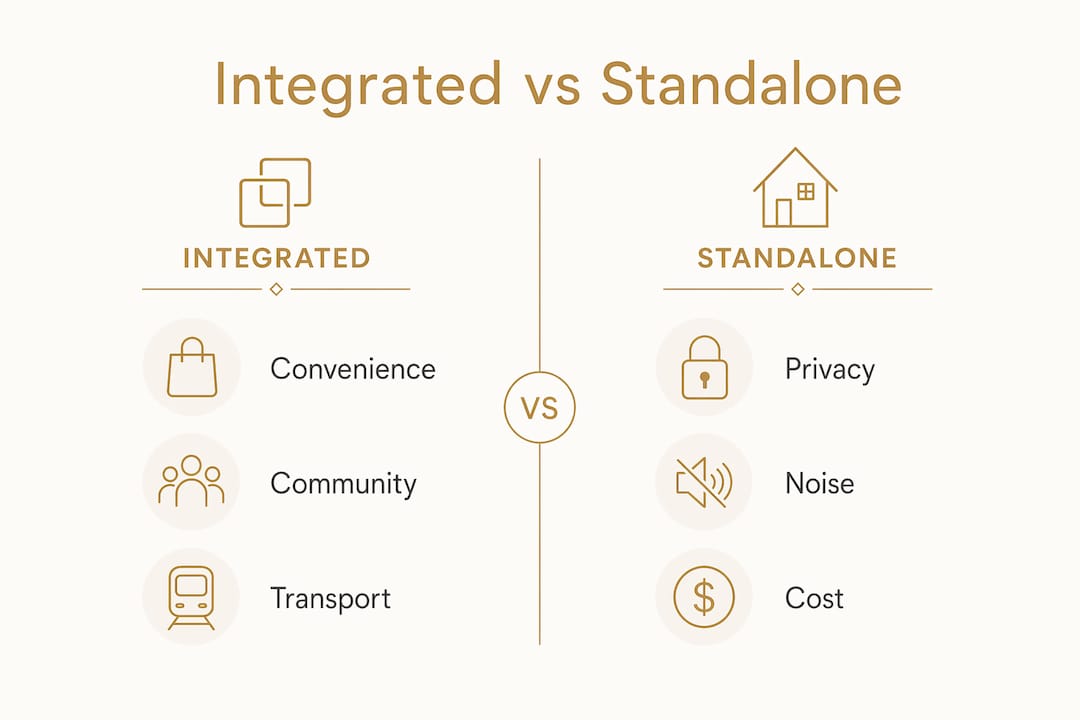
Convenience comes with real costs that buyers routinely underestimate. The most common is noise. Units positioned above retail loading bays, service corridors, or active commercial zones experience persistent noise and privacy loss that compounds over time. Delivery trucks, ventilation systems, and late-night restaurant activity are not temporary nuisances. They are structural features of the building's design.
Traffic congestion is the second underestimated trade-off. Residents in developments like Woodleigh Residences have reported parking entry delays and crowding during peak retail hours on weekends. When the retail component draws large crowds from outside the precinct, residents share infrastructure with thousands of shoppers. That friction erodes the convenience the development was designed to provide.
Retail management quality shapes the long-term experience more than most buyers realize. A development where retail space is sold in strata lots to individual owners produces fragmented tenancy. One unit becomes a nail salon, another sits vacant for months, and the overall tenant mix drifts away from what residents actually need. Professionally managed retail under a single operator maintains tenant quality and prevents the vacancies that degrade daily life.
Common trade-offs to evaluate before buying:
- Unit stack sensitivity: Lower floors and podium-facing units absorb the most noise and lose the most privacy.
- Weekend congestion: High retail footfall from outside the precinct strains parking and lift lobbies.
- Retail drift: Strata-titled retail ownership leads to inconsistent tenant quality over a 5–10 year horizon.
- Resale discount risk: Units with documented noise or privacy issues sell at a discount relative to better-positioned stacks in the same development.
Pro Tip: Ask the developer or agent whether the retail component is managed by a single professional operator or sold as strata lots. That single answer predicts long-term tenant quality better than any site visit.
How to practically assess if an integrated retail condo lifestyle suits your needs
Start with your daily routine, not the floor plan. Write down every errand, commute, and service you use in a typical week. Then map each item against what the development's retail podium actually offers. If you commute by MRT five days a week and buy groceries three times a week, a development with direct MRT access and a supermarket on-site delivers measurable daily value. If you drive everywhere and order groceries online, the integration premium buys you little.
Step-by-step assessment checklist
- Audit your lifestyle habits. List your weekly transport, grocery, childcare, medical, and dining patterns. Match each against the development's confirmed tenant mix, not the projected one.
- Inspect unit stack and orientation. Request the site plan and identify which stacks face the retail podium, service roads, or loading zones. Avoid units directly above active commercial corridors.
- Evaluate the retail tenant strategy. A well-profiled tenant mix targets resident demographics and life stages. Confirm that essential services, not entertainment anchors, dominate the ground floor.
- Assess transport node connectivity. Verify whether the MRT link is direct and weather-protected or requires an outdoor walk. True integrated developments provide covered, step-free access.
- Check management structure. Confirm whether retail is under a single professional operator. Ask for the retail management company's track record at other developments.
- Visit at peak and off-peak times. Observe parking availability, lift wait times, and noise levels on a weekday evening and a Saturday afternoon.
| Assessment Factor | What to Look For | Red Flag |
|---|---|---|
| Unit orientation | Stacks facing green space or residential roads | Units directly above loading bays |
| Retail tenant mix | Supermarket, clinic, childcare, food and beverage | Entertainment-heavy or high-turnover tenants |
| Transport link | Covered, direct MRT or bus interchange access | Outdoor walk of more than 200 meters |
| Retail management | Single professional operator with track record | Strata-titled retail with multiple owners |
| Weekend traffic | Manageable parking and lobby flow | Reported congestion from external shoppers |
What practical tools and criteria can help compare integrated vs standalone condo living?
The most useful comparison framework weighs five factors: convenience, community, privacy, noise exposure, and total cost of ownership. Standalone condos score higher on privacy and noise. Integrated developments score higher on convenience, community, and transport access. The right choice depends on which factors your household uses daily.
| Feature Category | Integrated Development | Standalone Condo |
|---|---|---|
| Transport access | Direct, covered MRT or interchange link | Street-level access, often requires a walk |
| Retail quality | Managed podium with curated tenant mix | Nearby malls or street retail, variable quality |
| Unit noise exposure | Higher risk for podium-facing stacks | Generally lower across all stacks |
| Community integration | Built-in through shared retail spaces | Relies on condo facilities and events |
| Price premium | 10%–25% above comparable standalone units | Lower entry price, lower lifestyle premium |
| Resale liquidity | Strong demand from transport-reliant buyers | Broader buyer pool, less lifestyle-specific |
Total cost of ownership includes more than the purchase price. Factor in the time saved by on-site services, the transport costs eliminated by direct MRT access, and the childcare or medical convenience that reduces scheduling friction. For families with young children or professionals who commute daily, convenience has measurable financial value that offsets a portion of the price premium.
Prioritize factors based on your household's life stage. Young professionals benefit most from transport connectivity and food and beverage access. Families with children prioritize childcare, medical services, and safe pedestrian access. Retirees value medical facilities and supermarket proximity most. Matching the development's tenant strategy to your life stage is the single most reliable predictor of long-term satisfaction.
Key Takeaways
Assessing an integrated retail condo lifestyle requires matching the development's transport links, retail tenant mix, unit orientation, and management structure to your actual daily habits before the purchase decision.
| Point | Details |
|---|---|
| Transport link is the defining feature | True integrated developments offer direct, covered MRT access, not just nearby transit. |
| Unit orientation determines noise risk | Avoid stacks facing loading bays or active commercial corridors to protect privacy and resale value. |
| Retail management predicts long-term quality | A single professional operator maintains tenant mix better than fragmented strata ownership. |
| Match tenant mix to your life stage | Families need childcare and clinics; professionals need food and beverage and transit. |
| Price premium reflects real lifestyle value | The 10%–25% premium is justified only when the development's services align with your daily routine. |
What I've learned about buyers who get this wrong
Most buyers who regret an integrated condo purchase made the same mistake. They assessed the lifestyle on a Saturday afternoon when the retail was buzzing, the MRT was convenient, and the whole precinct felt alive. They never visited on a Tuesday at 11:00 PM when the loading dock below their prospective unit was receiving a restaurant delivery.
The allure of convenience is real. But convenience is only valuable when it matches what you actually do. I've spoken with residents who paid a premium for a development with a childcare center they never used, a clinic they drove past to reach their preferred GP, and a supermarket they found too small for a weekly shop. The integration existed. The lifestyle fit did not.
The buyers who get this right treat the assessment like a job interview for the building. They ask hard questions about retail management contracts, request the confirmed tenant list rather than the projected one, and walk every stack orientation before shortlisting a unit. They also think five years ahead. Retail tenant mix shifts. A development that opens with a supermarket anchor can lose it to a higher-paying entertainment tenant if the management structure allows it.
My honest advice for families: weight the childcare and medical tenant quality above everything else. For professionals: the MRT link quality matters more than the number of food and beverage options. And for everyone: never buy a podium-facing lower-floor unit without standing in that unit during a weekday delivery window first.
— Simon
Hougang-central-residences: a real-world case for integrated living
Hougang-central-residences sits directly above Hougang MRT station, making it one of Singapore's clearest examples of true integrated development. The project offers 835 residences across unit types from one-bedroom to five-bedroom homes, covering the full range of family configurations.
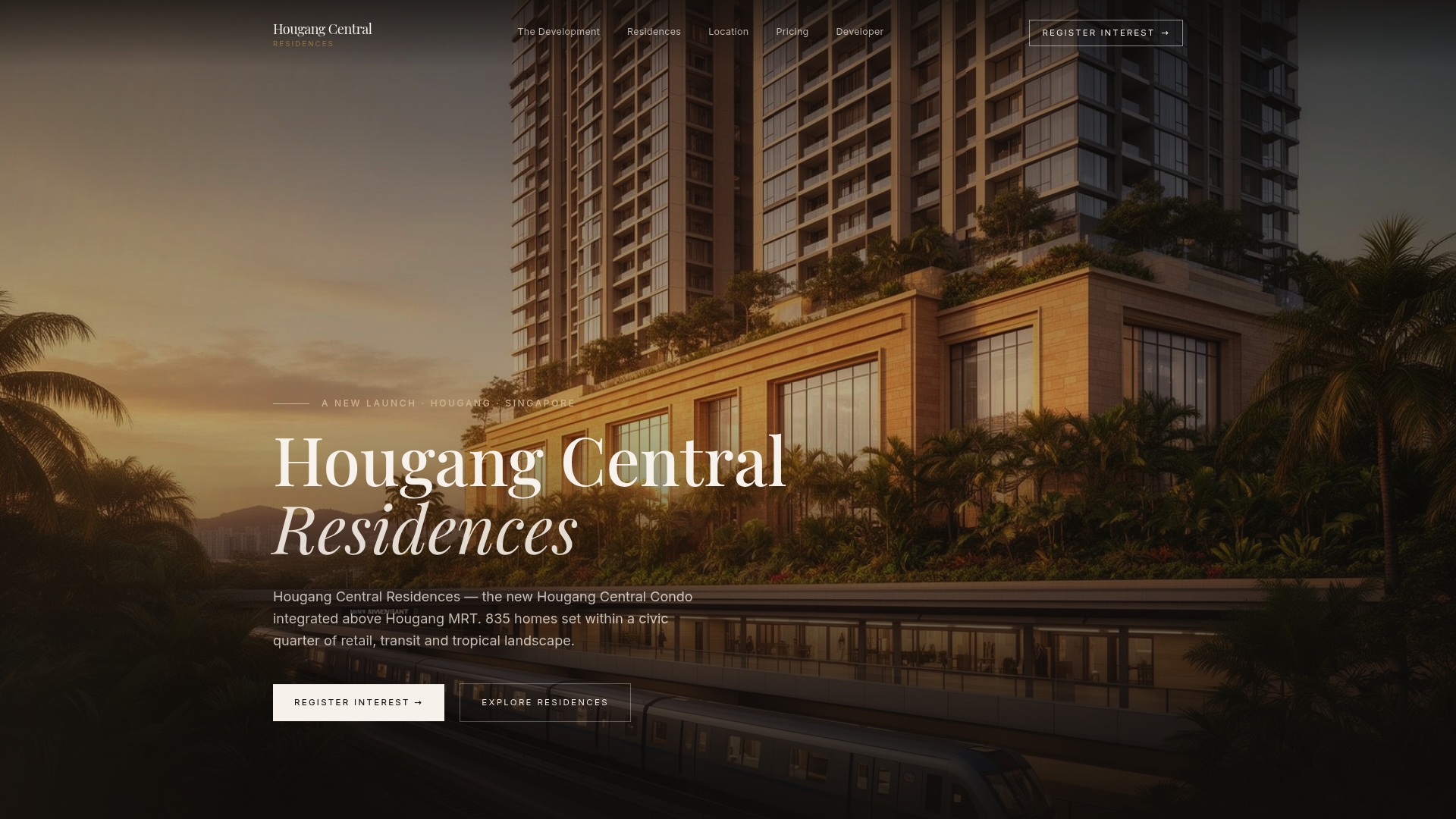
The development combines direct, covered MRT access with on-site retail amenities, tropical landscaped areas, and smart-home systems throughout. Residents reach the MRT without stepping outdoors, which is the defining feature that separates genuine integrated living from mixed-use buildings with ground-floor shops. For families and professionals evaluating integrated condo living in Singapore, Hougang-central-residences applies every criterion covered in this guide: professional retail management, transport node connectivity, and unit designs that minimize noise exposure from the retail podium below.
FAQ
What defines a true integrated retail condo development?
A true integrated development provides direct, weather-protected access to an MRT station or bus interchange within the same building or precinct. This connectivity is the primary driver of both lifestyle value and price premiums over standalone condos.
How much more do integrated condos cost than standalone units?
Integrated developments in Singapore command price premiums of 10%–25% over comparable standalone condos. The premium reflects transport convenience, on-site retail access, and stronger resale demand from transit-reliant buyers.
Which unit types should I avoid in an integrated retail condo?
Avoid units in stacks that face the retail podium, service roads, or loading zones. These positions expose residents to persistent noise and reduce privacy, which can also result in a resale discount compared to better-oriented stacks in the same development.
How do I evaluate the retail tenant mix before buying?
Request the confirmed tenant list, not the projected one, and check whether essential services such as supermarkets, clinics, and childcare dominate the mix. A well-targeted tenant strategy aligns with resident demographics rather than maximizing external foot traffic.
Does retail management structure affect condo living quality?
Yes. Developments with a single professional retail operator maintain consistent tenant quality over time. Strata-titled retail ownership fragments control and increases the risk of vacancies, inappropriate tenants, and declining amenity standards.