
How condo co-living and solo ownership actually compare
The core trade-off is straightforward: condo co-living gives you a furnished private room, shared amenities, and a single all-inclusive bill, but you build zero equity. Solo condo ownership gives you legal title, full privacy, and a long-term asset, but every cost lands squarely on you.
Here is what each model delivers across the dimensions that matter most:
- Social environment: Co-living spaces are built around community, with managed events, shared kitchens, and curated resident selection. Solo ownership is quiet and private by design, with social life entirely self-directed.
- Cost structure: Co-living bundles rent, utilities, Wi-Fi, and cleaning into one payment. Solo ownership separates every expense: mortgage, property taxes, HOA fees, utilities, and maintenance all bill independently.
- Privacy: Your private room in a co-living space is yours, but kitchens, lounges, and common areas are shared. A solo-owned condo gives you complete control over every square foot.
- Flexibility: Most co-living arrangements run month-to-month. Condo ownership is a long-term commitment requiring a mortgage, closing costs, and a formal sale process to exit.
- Equity: Co-living is a lease-based model with no ownership stake. Solo ownership builds equity with every mortgage payment.
Your decision hinges on two questions: How long are you staying? And do you want community or control?
What each model actually means, legally and financially
People routinely confuse co-living, co-ownership, and cooperative housing. They are three distinct arrangements.
Condo co-living is a rental model. You sign a lease, typically month-to-month, for a private bedroom in a professionally managed building. The operator handles furnishings, cleaning of common areas, utilities, and community programming. You pay one bundled fee and own nothing. When you leave, you take your belongings and that is it.
Solo condo ownership means you hold legal title to a specific residential unit. Your name is on the deed. You pay a mortgage, property taxes, HOA fees, and maintenance costs. You can renovate, rent it out, or sell it. The unit is an asset on your personal balance sheet.
Co-ownership is a third category that often gets conflated with co-living. In co-ownership, two or more buyers jointly hold legal title to a property, each with a defined ownership share, commonly ranging from one-eighth to one-half. Formal contracts govern use schedules, maintenance responsibilities, and exit procedures. It resembles a business partnership more than a rental arrangement.
Key distinctions at a glance:
- Co-living: lease only, no equity, managed by operator
- Solo ownership: full legal title, equity accumulation, owner-managed
- Co-ownership: shared legal title, proportional equity, contract-governed
Social dynamics: community versus privacy
Co-living residents report 71% less loneliness than solo living residents, driven by shared amenities and the intentional community infrastructure built into these spaces. That is not accidental. Operators actively program the social environment through regular events, community managers, and curated resident selection.
Typical co-living community features include:
- Shared kitchens and dining areas designed for interaction
- Coworking lounges and dedicated workspaces
- Organized events: dinners, workshops, and social outings
- A dedicated community manager for conflict resolution and programming
- Resident screening to match people by lifestyle and values
Solo ownership flips this entirely. Your condo is your private domain. Nobody schedules a Wednesday rooftop hangout for you. The social life you build is the social life you create, which suits people who recharge alone and prefer to choose their interactions deliberately.
The psychological research is clear on one point: mismatched expectations cause dissatisfaction in both directions. Someone who craves autonomy and ends up in co-living will find the shared spaces exhausting. Someone who needs connection and buys a solo condo in a quiet building may find the isolation harder than anticipated.

Financial comparison: what you actually pay in each model
The monthly cost picture looks simple on the surface and gets complicated fast.

Co-living charges one all-inclusive rent that bundles utilities, Wi-Fi, cleaning, and furnishings. Solo ownership separates every line item: mortgage principal and interest, property taxes, HOA fees, homeowner's insurance, utilities, and any maintenance or repair costs. Residents can save up to 40% monthly on housing costs by pooling expenses in a co-living model, though the exact savings depend heavily on the market and the specific property.
| Cost Category | Co-Living | Solo Condo Ownership |
|---|---|---|
| Monthly payment | One all-inclusive rent | Mortgage + taxes + HOA + insurance |
| Utilities | Included | Separate, variable |
| Furnishings | Included | Owner's responsibility |
| Maintenance | Managed by operator | Owner's responsibility (interior) |
| Setup costs | Minimal | Down payment + closing costs + furniture |
| Equity built | None | Yes, with each mortgage payment |
| Exit costs | None beyond notice period | Agent fees, closing costs, transfer taxes |
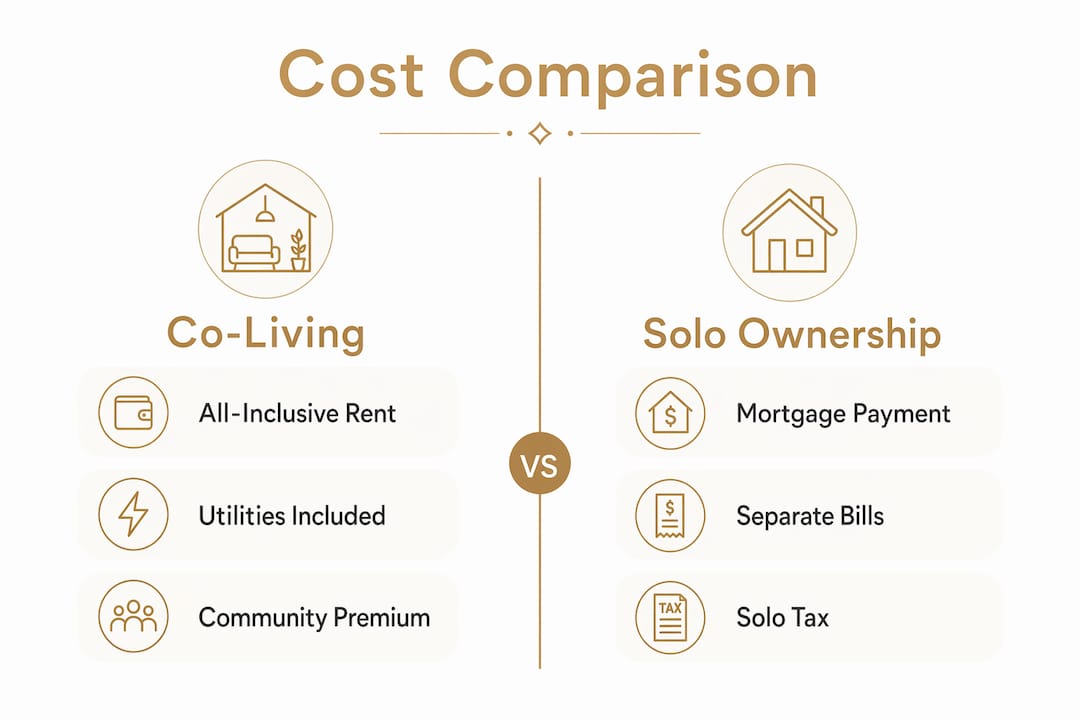
Solo ownership carries a hidden cost that rarely appears in budget comparisons: what some analysts call the "Solo Tax." Before you pay your first utility bill, you need a couch, a bed, kitchen gear, a desk, cleaning supplies, and enough basics to make the unit livable. A modest setup can run several thousand dollars upfront, all before a single mortgage payment clears.
Co-living's all-inclusive pricing solves the setup problem but embeds a community convenience premium beyond pure cost savings. When comparing the two models honestly, add the equivalent solo costs for amenities you would use: a gym membership, coworking access, and cleaning services can close the gap considerably.
Pro Tip: Before signing a co-living lease, price out what you would pay for equivalent amenities separately. The bundled fee often looks cheaper until you account for the community premium built into it.
Lifestyle fit: how long are you staying, and what do you need?
The single most reliable decision rule is stay duration. The "three-month rule" holds up consistently: co-living makes the most sense for stays under three months, where its flexibility and turnkey setup outweigh the cost premium. For anything longer, solo renting or ownership typically delivers better value per dollar.
Co-living suits you if:
- You are new to a city and want an instant social network
- Your stay is short or your timeline is uncertain
- You travel frequently and need month-to-month flexibility
- You prioritize community and networking over personal space
- You want zero setup friction: just arrive and live
Solo ownership suits you if:
- You plan to stay in one place for several years
- You want to build equity and treat housing as an investment
- Privacy and the ability to customize your space matter to you
- You are ready to take on the financial and management responsibilities of ownership
- Your life stage calls for stability over flexibility
The shift toward co-living is driven more by life stage and social priorities than by income level. Young professionals testing a new city, remote workers on project stints, and people between leases all find co-living genuinely useful. It is less about what you earn and more about where you are in life. For those thinking through a longer-term commitment, a condo lease vs purchase comparison can help clarify which path fits your specific situation.
What the research says about well-being and satisfaction
The 71% loneliness reduction figure cited earlier is the headline, but the behavioral research underneath it is more nuanced. Co-living works best when residents enter with a community-focused intention. When people choose co-living primarily to save money and treat the shared spaces as an inconvenience, satisfaction drops sharply.
"If you are looking to get into coliving as a resident, look at what the space offers in terms of community and wellbeing. Because from our experience, these two areas are very influential in making a positive resident experience." — Naima von Ritter Figueres, co-founder and Head of Community and Wellbeing at Conscious Coliving, via Sacramento Bee
Solo ownership carries its own psychological profile. The autonomy is real and meaningful: you decide the paint color, the furniture arrangement, the noise level, and who enters. For people who find shared spaces draining, that control is not a luxury. It is a daily quality-of-life factor.
The research on intentional community focus versus autonomy focus suggests that the living arrangement you choose should match your underlying motivation, not just your budget. Choosing co-living because it is cheaper, when you actually want privacy, tends to produce the same dissatisfaction as choosing solo ownership for status when you actually crave connection.
Pro Tip: Ask yourself honestly: do I want community, or do I want quiet? Your answer to that question is more predictive of housing satisfaction than any cost comparison.
Legal implications and ownership rights
The legal gap between co-living and solo ownership is wide, and it affects your rights in practical ways every day.
A solo condo owner holds a deed. That title gives you the right to sell, refinance, renovate within HOA rules, and pass the property to heirs. Your HOA governs shared building spaces through bylaws, but your unit is legally yours. State and local real estate laws protect your ownership interest, and any dispute over the property goes through established property law channels.
Co-living residents are tenants. Your rights are governed by your lease agreement and local tenant protection laws, which vary considerably by state and city. You have no claim to the property itself. The operator can change building rules, raise rates at renewal, or exit the market entirely. Some co-living operators have merged, downsized, or shut down, leaving residents scrambling for alternatives on short notice.
Co-ownership sits in its own legal category. Each co-owner holds a defined share of the title, typically structured as tenancy in common or through an LLC. Formal agreements must address how costs are split, how scheduling works, and what happens when one owner wants to sell. Without a clear exit agreement, a co-ownership arrangement can become contentious fast.
Resale value and investment potential
Solo condo ownership has a clear investment thesis: you build equity, and the property can appreciate over time. In established urban markets, well-located condos have historically held value and generated returns through both appreciation and rental income. The investment case for a 1-bedroom condo is particularly strong in transit-connected neighborhoods where demand stays consistent.
Co-living has no resale value for residents. You are a tenant. When you leave, you leave with nothing beyond your security deposit. The operator captures any value created by the property.
Co-ownership offers a middle path. Each owner holds a real equity stake that can be sold, though the market for fractional shares is thinner than for whole-unit sales. Selling a co-ownership share typically requires either finding a buyer approved by the other co-owners or triggering a buyout clause in the original agreement. It is more liquid than it used to be, but still less straightforward than selling a solo-owned unit.
For anyone thinking about housing as a long-term financial asset, solo ownership wins on investment potential. Co-living is a consumption expense, not an investment. That is not a criticism of the model. It is just an accurate description of what you are buying.
How each model shapes your personal freedom and daily decisions
Solo ownership gives you a level of control that co-living simply cannot match. You decide when to renovate, whether to get a pet, how loud your music plays at 9 PM, and whether to sublet a room. The HOA sets some limits, but within those boundaries, the unit is yours to run as you see fit.
Co-living trades that control for convenience. The operator sets house rules, manages cleaning schedules, and decides which amenities get added or removed. Community participation is encouraged, sometimes strongly. If the management changes or the building's culture shifts, your experience shifts with it, and your lease terms determine how easily you can leave.
The freedom question also extends to financial decisions. A condo owner can refinance, pull equity for other investments, or sell when the market is favorable. A co-living tenant has none of those options. The housing cost is fixed by the lease, and the only exit is moving out.
For people at a life stage where flexibility matters more than control, co-living's constraints feel light. For people who want to make their home truly their own, those same constraints feel significant. Smart condo features in modern developments have made solo ownership more convenient than ever, narrowing the lifestyle gap between the two models without sacrificing the ownership advantages.
Key Takeaways
Solo condo ownership builds equity and provides full legal control, while co-living offers flexibility and community at the cost of any ownership stake.
| Point | Details |
|---|---|
| Equity and ownership | Co-living is lease-based with no equity; solo ownership builds equity and grants legal title. |
| Cost structure | Co-living bundles all costs into one payment; solo ownership separates mortgage, taxes, HOA, and utilities. |
| Loneliness and community | Co-living residents report 71% less loneliness, driven by shared spaces and managed community programming. |
| Stay duration rule | Co-living suits stays under three months; solo ownership delivers better value for longer commitments. |
| Intention matters | Choosing a model that matches your actual social preference, not just your budget, predicts satisfaction. |
The model that fits your life stage, not just your budget
The conventional framing of this decision as "affordable co-living versus expensive ownership" misses the real question. Co-living is not cheap housing. It is a specific lifestyle product with a community premium priced in. Solo ownership is not just expensive housing. It is a long-term financial and personal commitment that rewards people who are ready for it.
What the behavioral research keeps surfacing is that intention drives satisfaction more than cost. People who choose co-living because they genuinely want community, flexibility, and a low-friction setup tend to thrive in it. People who choose it purely to save money and then resent the shared spaces tend to leave frustrated. The same dynamic runs in reverse for solo ownership: buyers who want control, stability, and an asset they can grow into are well-served by it. Buyers who purchase because they feel they "should" own, when their life stage calls for mobility, often find the commitment heavier than expected.
The hidden costs on both sides deserve honest accounting. Co-living's community premium is real. Solo ownership's Solo Tax, the furniture, setup costs, and duplicated household expenses, is equally real and often underestimated. Neither model is the obvious financial winner without knowing your specific market, stay duration, and lifestyle priorities.
Hougang-central-residences represents what thoughtful solo ownership looks like when it is done well: transit integration, smart-home systems, and a range of unit sizes from 1-bedroom to 5-bedroom, all designed around the practical realities of urban life. For residents who are ready to move beyond the flexibility of co-living and into a home they can genuinely call their own, that kind of development offers something co-living never can: a place that appreciates, adapts, and belongs to you. Explore Hougang Central Residences to see how modern condo living addresses the trade-offs this guide covers.

FAQ
What is the main difference between co-living and condo ownership?
Co-living is a lease-based rental model with shared amenities and no ownership stake. Condo ownership grants legal title, equity accumulation, and full control over a private unit.
What are the disadvantages of co-living compared to solo ownership?
Co-living builds no equity, limits personal space and control, and leaves residents subject to operator decisions on rules, pricing, and building management.
Is co-living actually cheaper than renting or owning a condo solo?
Co-living can reduce monthly housing costs by up to 40% through pooled expenses, but the all-inclusive price typically includes a community premium. For stays beyond three months, solo renting or ownership usually delivers better value.
What are the negatives of co-ownership compared to solo ownership?
Co-ownership requires formal contracts governing use schedules, maintenance splits, and exit procedures. Selling a fractional share is less straightforward than selling a whole unit, and disputes between co-owners can complicate decisions that a solo owner makes unilaterally.
Is it harder to sell a co-living interest than a condo?
Co-living residents have no ownership interest to sell. Condo owners sell through the standard real estate market. Co-ownership shares can be sold but require co-owner approval and a thinner buyer pool than whole-unit sales.