
For capital preserving, long hold Singapore investors, a well located freehold penthouse still earns its price tag, but only when tenure, floor plate, and holding costs check out. Yield seekers should look elsewhere first. The single condition that decides most outcomes is whether the asset sits on freehold or long leasehold land in the Core Central Region or a strong Rest of Central Region address, since that alone determines whether the ABSD and holding-cost drag gets offset by capital retention.
TL;DR:
- Freehold penthouses in Districts 9 and 10 traded near $32,000 per square foot, with ultra-prime deals surpassing $50,000 to $60,000 per square foot.
- The buyer pool has shifted heavily toward local high-net-worth individuals due to ABSD enforcement, reducing international demand and price volatility.
- Penthouses typically trade at a premium of 5% to 10% over lower-floor units in the same building, which affects liquidity and resale considerations.
- Due diligence should verify gross floor area, maintenance fund status, roof ownership, and view stability before purchase, as these factors are harder to confirm for penthouses.
- For long-term, capital-preserving investors, freehold CCR or strong RCR locations offer better price retention; yield-focused buyers should consider alternative, higher-yield property types.
Table of Contents
- Is Penthouse Investment in Singapore Worth It in 2026?
- Why Penthouses Behave Differently From Regular Units
- How Do You Assess a Singapore Penthouse Before Buying?
- How Do ABSD, BSD, and GFA Rules Affect Penthouse Buyers?
- What Should You Expect to Pay and Earn From a Penthouse?
- What Red Flags Should Kill a Penthouse Deal?
- Penthouse or Landed Property: Which Fits a Wealthy Buyer Better?
- Where Hougang Central Residences Fits the Investor Checklist
- Financing a Penthouse: Loans, Rates, and Eligibility
- Practical Buying Checklist and Exit Timeline
- How Do Interest Rates and Policy Shifts Affect Penthouse Returns?
- Legal Due Diligence: Strata Titles and Ownership Structures
- Penthouses vs Landed Property vs Standard Luxury Apartments
- What's the Outlook for Singapore Penthouses Over the Next Decade?
- Who Should Actually Buy a Penthouse in Singapore Right Now?
- Explore Hougang Central Residences
- Sources
- FAQ
Is Penthouse Investment in Singapore Worth It in 2026?
The Singapore penthouse market in 2026 is smaller, pricier, and more locally driven than it was five years ago. Non-landed luxury prices in the Core Central Region posted modest growth through the first quarter, according to URA's private property price index, which remains the benchmark for tracking district-level momentum before you commit capital.
Freehold penthouses in Districts 9 and 10 traded at a median near $32,000 per square foot in early 2026, with landmark ultra-prime deals clearing $50,000 to $60,000 per square foot, based on PrimeTour's penthouse price data. Rest of Central Region penthouses trade at a meaningful discount to that band, while Outside Central Region penthouses rarely carry a true "penthouse" premium at all since most are simply the top unit of a mass-market tower.
| Region | Typical penthouse price band (psf) | Buyer profile | Tenure mix |
|---|---|---|---|
| Core Central Region (CCR) | ~$32,000 median, up to $50,000–$60,000 for landmark units | Local HNW, family offices, select foreign buyers | Mostly freehold |
| Rest of Central Region (RCR) | Meaningful discount to CCR, wide range | Local upgraders, investors seeking lateral space | Mixed freehold and 99-year leasehold |
| Outside Central Region (OCR) | Limited premium over standard high-floor units | Owner-occupiers, yield-focused investors | Predominantly 99-year leasehold |
Buyer composition has shifted hard toward locals since Additional Buyer's Stamp Duty enforcement tightened. Foreign buyers now account for a small fraction of ultra-luxury penthouse transactions, PrimeTour's data shows, reflecting a narrowing of the historical bidder pool. That is good news for price stability. It is bad news if your exit plan depended on a deep international market showing up to bid.
Freehold status matters more here than in most Singapore property segments. A capital preserving buyer choosing between a leasehold RCR penthouse and a freehold CCR unit at a similar entry price should generally lean freehold, since land tenure is the one variable a renovation or a market cycle cannot fix.
Why Penthouses Behave Differently From Regular Units
A penthouse is not just a bigger, higher apartment. True single level penthouses with private lift access and full-floor lateral layouts are genuinely scarce. Most towers have one or two. That scarcity is exactly what creates both the premium and the liquidity problem.
The features that justify the asking price also narrow the buyer pool who can afford, or want, to pay for them:
- Private roof terraces or private pools, often 500 to 1,500 square feet of semi-outdoor space that doesn't always show up cleanly in per-square-foot comparisons.
- Private lift lobbies that add both cost and a genuine privacy premium for the right buyer.
- Lateral, single-level floor plates that eliminate internal staircases, unlike split-level penthouses which sacrifice some usable volume to circulation.
- Ceiling heights well above standard units, sometimes double volume in living areas.
Penthouses commonly trade 5% to 10% above comparable lower-floor units in the same building, and sometimes considerably more for the standout stack, per BrickUnderground's analysis. That premium is real money at exit, but it also means your buyer pool shrinks to whoever can justify paying above-market rates for a unit type that, by definition, has almost no direct comparable in the same building.
How Do You Assess a Singapore Penthouse Before Buying?
Due diligence on a penthouse takes more legwork than a standard resale unit, mostly because the things that make it special are also the things that are hardest to verify from a floor plan.
- Confirm gross floor area versus marketed area. GFA harmonisation rules changed how voids and certain vertical volumes get counted, so the brochure square footage and the strata title area can genuinely differ, per PrimeTour's regulatory guide. Cross-check the strata certificate, not just the sales chart.
- Pull comparable transacted penthouse prices, not comparable unit prices generally. Days-on-market for penthouses often runs longer than for standard units, and that gap tells you something about true demand depth.
- Review MCST accounts and the sinking fund balance. Ask specifically how the fund is budgeted for roof and terrace maintenance, since penthouses draw disproportionately on that line item.
- Get an insurance estimate before you commit, since larger private terraces and pools often carry higher premiums than standard-unit coverage.
- Model three exit scenarios, base, bear, and bull, with conservative time-to-sell assumptions. Penthouse buyer pools narrow quickly in a downturn, and time-on-market can stretch to 9 to 18 months in a soft cycle, according to UrbanSplatter's ROI analysis.
Running these checks against a layout efficiency framework built for Singapore buyers will catch most of the area-mismatch problems before they become negotiating leverage against you.
Pro Tip: Ask the agent for the exact GFA harmonisation adjustment applied at approval stage. If they can't produce it, assume the marketed area is optimistic and price accordingly.
How Do ABSD, BSD, and GFA Rules Affect Penthouse Buyers?
Singapore's tax and lending framework does more to shape the penthouse buyer pool than any design feature does. A handful of rules deserve specific attention before you sign an option to purchase.
- Additional Buyer's Stamp Duty rates scale sharply for entities, foreigners, and buyers holding multiple properties, which is why the ultra-luxury segment has become so locally concentrated in 2026.
- Buyer's Stamp Duty applies progressively on top of ABSD and becomes a meaningful line item once you're pricing an eight-figure purchase.
- GFA harmonisation means the floor area a developer markets and the floor area recognized on the strata title can diverge, which directly affects your effective price per square foot, per PrimeTour's guide to luxury penthouse regulations.
- Loan-to-value ratios tighten meaningfully for loans above $10 million. Banks routinely cap LTV lower than the standard residential ceiling and require full source-of-wealth documentation before underwriting, a pattern common across structured luxury financing in the market.
None of these rules are exotic, but they compound. A foreign buyer facing ABSD, a lower LTV cap, and a GFA-adjusted price per square foot can find the deal math looks materially different from the headline asking price. Run the full stack of costs before you fall in love with the terrace.
What Should You Expect to Pay and Earn From a Penthouse?
Price expectations need to be regional and tenure-specific, not a single national number.
| Metric | Core Central Region | Rest of Central Region |
|---|---|---|
| Typical price per sqft | ~$32,000 median, landmark deals to $50,000–$60,000 | Meaningful discount to CCR pricing |
| Gross rental yield | Generally lower than mid-market units | Slightly better than CCR, still below mass-market condos |
| Best-fit investor | Capital preservation, long hold | Yield-tilted with moderate hold period |
Penthouses typically deliver lower gross rental yields than mid-market apartments in the same district. The trade-off investors need to accept upfront is that penthouses are a capital-preservation play first, an income play second. Investors chasing rental yield percentages closer to those of a well-run one-bedroom unit will likely be disappointed. A comparison against smaller-unit investment math makes the yield gap obvious fast.
Where scarcity and freehold tenure line up, UrbanSplatter's analysis of penthouse ROI points to stronger capital preservation over a full cycle, even with the lower running yield. Tech-ready, ESG-compliant penthouses are also selling faster in 2026, commanding a per-square-foot premium and shorter absorption periods, per PrimeTour's tracking of the segment. Smart-home integration and sustainability credentials aren't cosmetic anymore. They're showing up in transaction speed.
What Red Flags Should Kill a Penthouse Deal?
Most penthouse regrets trace back to one of four issues, and all four are checkable before you sign.
- Lease decay on 99-year tenure. A penthouse on a leasehold site depreciates on a curve that accelerates past the 60-year mark, while a comparable freehold asset holds value far more predictably.
- An underfunded sinking fund. If the MCST accounts show a thin reserve relative to building age, expect a special assessment, and expect it to land disproportionately on the largest unit in the building, which is usually the penthouse.
- Ambiguous terrace or roof ownership. Waterproofing failures on a private terrace are a recurring, expensive dispute between "exclusive use" areas and common-element responsibility, according to BrickUnderground. Get the exact clause in writing before you buy.
- View encroachment risk. Check URA's planning portal for gazetted plots nearby before assuming your skyline view is permanent.
A quick pass through an MCST and renovation rules checklist before your option period expires will surface most of these issues while you still have room to renegotiate.
Penthouse or Landed Property: Which Fits a Wealthy Buyer Better?
The choice between a penthouse and landed housing comes down to liquidity tolerance and appetite for management.
- Liquidity: Penthouses generally have a smaller resale buyer pool than mid-tier condos, but landed housing (especially bungalows) can be even thinner, and foreigners face additional restrictions on landed purchases.
- Running costs: A penthouse pushes maintenance through the MCST and shares major cost items across owners; landed property puts every repair bill, including the roof, entirely on you.
- Legacy value: Landed property carries a stronger multi-generational holding tradition among Singapore families, while penthouses trade more actively as a wealth-preservation asset within a shorter hold horizon.
Neither option is objectively better. It depends on whether you want shared management or full control.
Where Hougang Central Residences Fits the Investor Checklist
Transit-linked integrated developments consistently support stronger liquidity and rental demand than standalone towers, since tenants and future buyers pay a premium for direct MRT access. Hougang Central Residences sits directly above Hougang MRT station, with 835 units spanning one-bedroom to five-bedroom penthouse-scale homes, integrated retail, and a bus interchange below.
For investors running the checklist above, a few features stand out:
- Smart-home systems and premium European fittings that align with the tech-readiness premium buyers are paying for in 2026.
- Tropical landscaped communal areas and wellness facilities that support rental appeal beyond the unit itself.
- Proximity to a future Cross Island Line interchange, a transit catalyst that tends to support price resilience over a full cycle.
An integrated development primer explains why transit-linked projects hold up better through downturns than isolated towers with weaker connectivity.
Financing a Penthouse: Loans, Rates, and Eligibility
Financing a penthouse purchase above $10 million rarely runs through a standard mortgage desk. Private banks and family-office lenders typically cap loan-to-value ratios lower than the residential norm and require full documentation of source of wealth before underwriting begins, a standard practice across structured luxury financing in Singapore.
Expect three realistic paths. A conventional bank loan works fine for penthouses under roughly $5 million, with documentation similar to any other condo purchase. Above that threshold, private banking relationships often unlock better terms, but they usually require you to park other assets under management with the same institution. Family-office bridge loans fill the gap when timing between a sale and a purchase does not line up, though they carry a rate premium for the short tenor.
Eligibility hinges less on income and more on demonstrable liquidity and a clean paper trail. Banks want to see where the down payment actually came from, not just that you have it. Foreign buyers face an added layer: ABSD financing itself, since the duty is due at completion regardless of loan structure, and it cannot be rolled into the mortgage.
Pro Tip: Get your source-of-wealth documentation pre-cleared with your bank before you start viewing units. It shortens the exercise period dramatically once you find the right stack.
Practical Buying Checklist and Exit Timeline
A penthouse purchase moves through the same legal stages as any Singapore condo, but the diligence window needs to be longer given the area verification and MCST review involved.
Budget four to six weeks between offer acceptance and exercising the option to purchase, factoring in time for a lawyer to review the GFA harmonisation adjustment and terrace ownership clauses. Completion typically follows eight to ten weeks after that for a resale unit, longer for a new launch tied to a construction timeline.
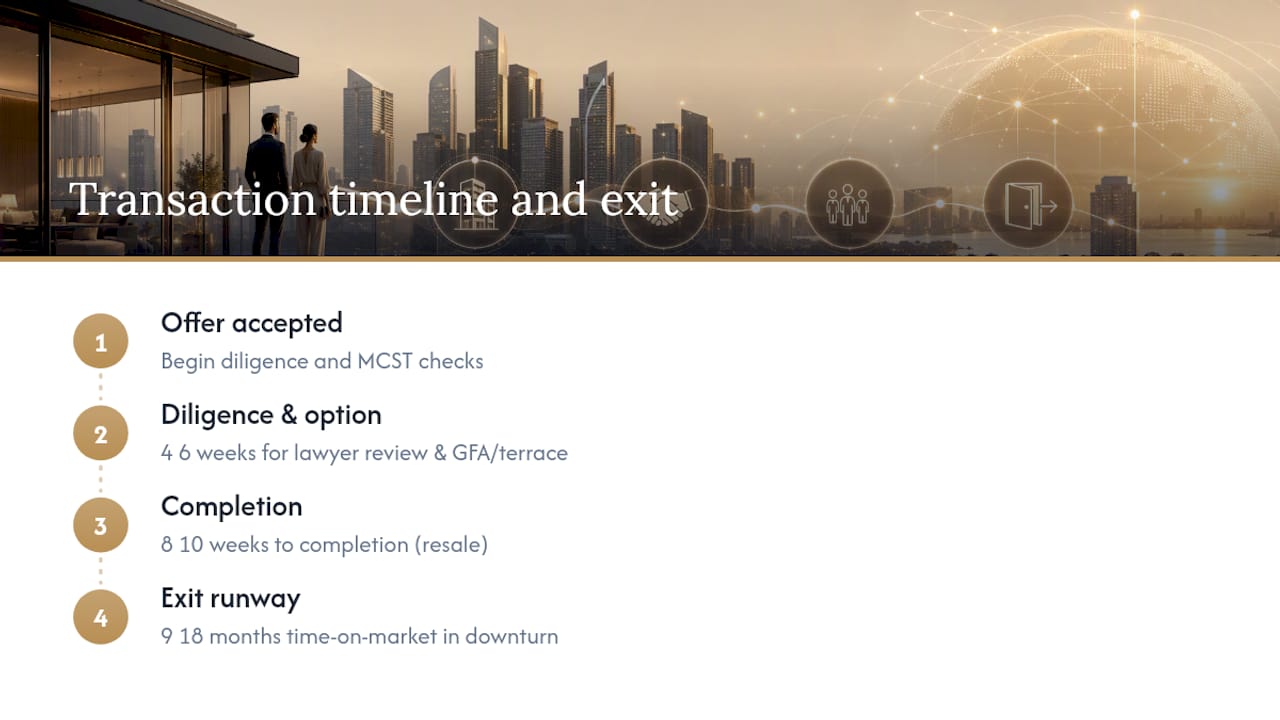
On the exit side, build in a realistic runway. Time-on-market for penthouses commonly extends well beyond standard units, and a downturn can stretch that to 9 to 18 months, per UrbanSplatter's analysis. Price your exit expectations against that horizon, not against how fast a mid-tier unit down the street sold last year.
How Do Interest Rates and Policy Shifts Affect Penthouse Returns?
Penthouse investment returns respond to macro conditions differently than mass-market property does, mostly because the buyer pool is thinner and more sensitive to financing costs.
Interest rate movements hit penthouse buyers harder in absolute dollar terms, since loan quantums are so much larger. A one percentage point rate move on a $15 million loan changes monthly financing costs by a figure that dwarfs the equivalent shift on a $1.5 million mass-market unit. That sensitivity is why cash-rich buyers increasingly dominate this segment.
GDP growth supports penthouse absorption mainly through its effect on business formation and wealth creation among the local HNW population that now makes up the bulk of buyers. Foreign investment policy, particularly ABSD settings, remains the single biggest swing factor. Any material change to foreign ABSD rates would reshape the buyer pool again, given how concentrated ultra-luxury demand already is among local buyers.
Legal Due Diligence: Strata Titles and Ownership Structures
Every penthouse in a strata-titled development comes with a share value that determines your MCST voting weight and proportional share of common-property costs. That share value should be checked against the unit's actual floor area. It is not always proportionate, particularly for penthouses with large exclusive-use terraces that don't count toward strata share the way you'd expect.
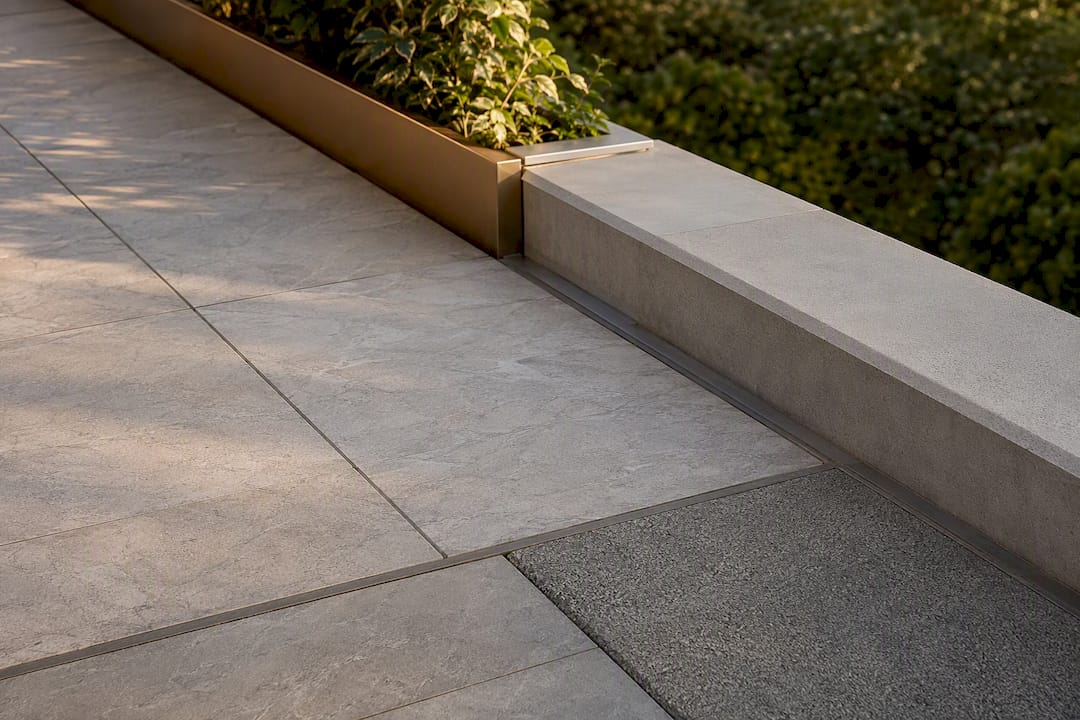
Confirm exactly what falls under exclusive use versus common property. Roof terraces, in particular, are frequently a gray zone where the strata plan and the sales brochure don't fully agree, a recurring source of disputes flagged by BrickUnderground. Buying through a corporate entity or trust structure adds another layer of ABSD exposure and documentation, so get your lawyer to confirm the ownership vehicle before signing the option, not after.
Penthouses vs Landed Property vs Standard Luxury Apartments
Judged purely as an asset class, penthouses sit between landed property and standard luxury apartments on almost every axis that matters to an investor.
Landed housing offers the strongest legacy appeal and full control, but the thinnest liquidity and, for foreigners, the most regulatory friction. Standard luxury apartments trade the most freely of the three, with a deep comparable pool and predictable yield, but they carry no scarcity premium. Penthouses sit in between: better liquidity than landed, weaker liquidity than a standard unit, and a scarcity premium that only pays off with the right tenure and location. For a family office splitting allocation across property types, that middle position is exactly the point, not a compromise.
What's the Outlook for Singapore Penthouses Over the Next Decade?
Expect continued bifurcation between freehold CCR/RCR penthouses and everything else. Scarcity of true single-level penthouse stock in prime districts is structural, not cyclical, since almost no new CCR land is being released at a pace that would meaningfully expand supply. That scarcity should keep supporting price resilience for the top tier even through rate cycles that soften the broader market.
The local-buyer concentration seen since ABSD tightening is likely to persist unless foreign ABSD settings change materially. Tech-readiness and ESG credentials will keep mattering more, not less, as newer stock with smart-home integration sets a new baseline that older penthouse stock will be compared against. Owners of older, non-tech-ready penthouses should expect a growing valuation gap against newer, integrated competition over the next five to ten years.
Who Should Actually Buy a Penthouse in Singapore Right Now?
This asset class rewards patience more than timing. If you're a local or long-term resident HNW investor with a ten-year-plus horizon and a genuine preference for freehold CCR or large RCR lateral units, the math generally works. If you're chasing yield or need liquidity within three to five years, this isn't your segment.
New launches suit buyers comfortable with construction risk in exchange for smart-home and ESG features baked in from day one. Resale suits buyers who want to see actual MCST accounts and building history before committing. Either way, get a tax and regulatory advisor to walk through your ABSD exposure before you sign anything.
— Simon
Explore Hougang Central Residences
Hougang Central Residences gives investors a transit-anchored alternative to chasing scarce CCR penthouse stock at $32,000-plus per square foot. Sitting directly above Hougang MRT, with a future Cross Island Line interchange, the development covers 835 units from one-bedroom to five-bedroom penthouse-scale homes, so you can match unit size to your investment thesis without leaving the integrated-development category that tends to hold liquidity better through downturns.
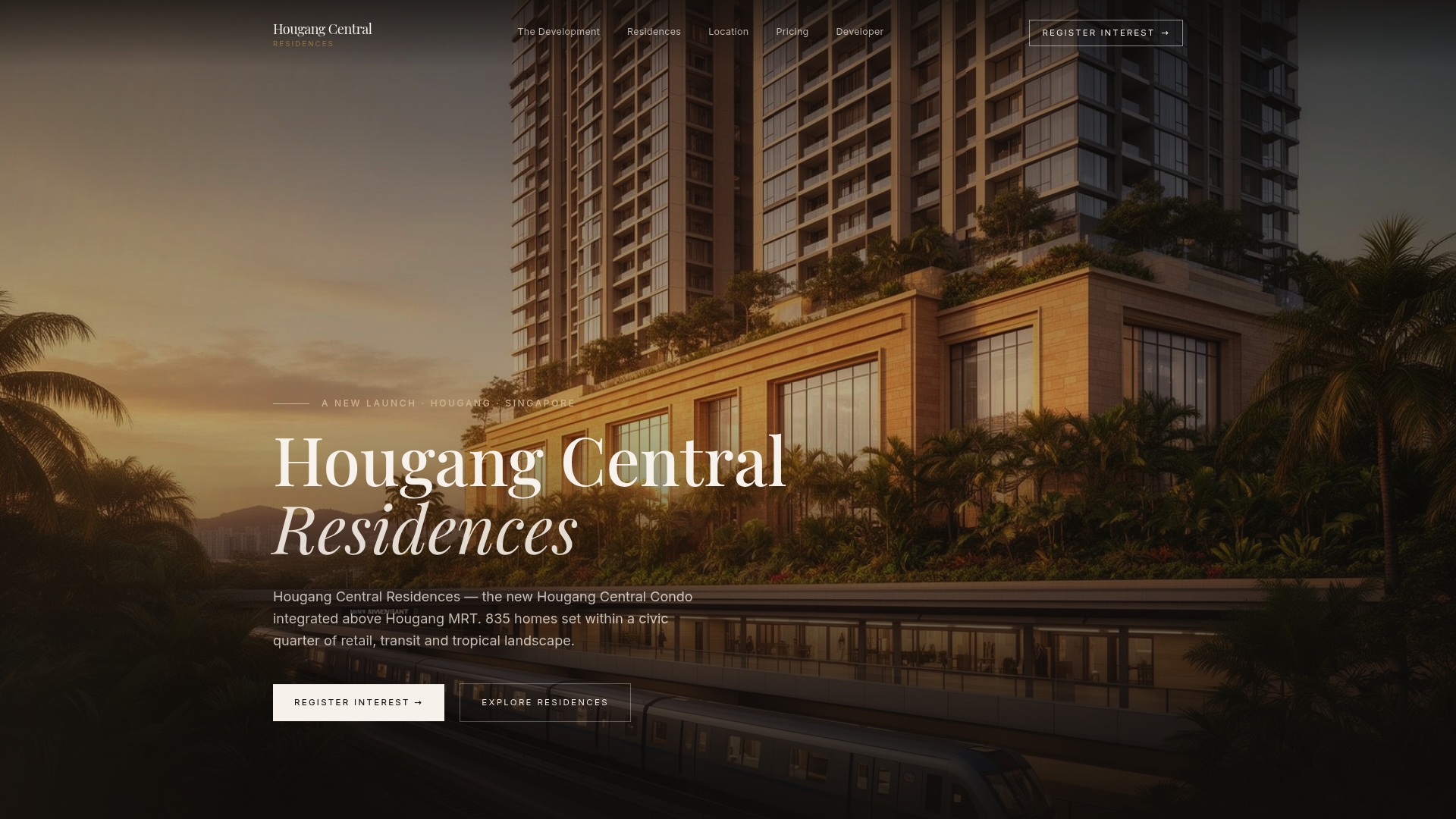
The development features smart-home systems and premium fittings, reflecting tech-readiness and design quality that appeal to luxury buyers in 2026. Landscaped grounds and wellness facilities provide amenity depth that supports rental demand beyond transit access. If a five-bedroom penthouse-scale home above an MRT interchange fits your allocation better than a thinner-liquidity CCR penthouse, book a showflat visit or request the e-brochure through the Hougang Central Residences landing page to see current availability and pricing.
Sources
Cross-check any penthouse listing against primary sources before relying on an agent's figures.
This article is general information, not a substitute for advice from a qualified financial advisor. Consult a qualified financial professional about your own circumstances before acting on anything here.
FAQ
Are Penthouses Worth It in Singapore?
For local, long-hold, capital-preserving investors buying freehold stock in the Core Central Region or a strong Rest of Central Region address, yes. For yield-focused or short-hold buyers, the lower gross rental yields typically make a mid-market unit a better fit.
How Much Do Penthouses Cost in Singapore?
Freehold penthouses in Districts 9 and 10 traded at a median near $32,000 per square foot in early 2026, with landmark ultra-prime sales exceeding $50,000 to $60,000 per square foot, according to PrimeTour's data.
What Is the Safest Property Investment With the Highest Return in Singapore?
Freehold penthouses and apartments in prime districts tend to show the strongest price retention over a full cycle, though they trade lower rental yields than mass-market units, making them better suited to capital preservation than income generation.
Which Condo Type in Singapore Is Most Profitable for Investors?
Profitability depends on your goal. Yield-focused investors typically do better with smaller mid-market units, while capital-preservation investors targeting long-term appreciation tend to favor freehold penthouses or units in transit-integrated developments like Hougang Central Residences, where connectivity supports both rental demand and resale liquidity.