TL;DR:
- Peaceful urban condo living relies on thoughtful interior design, shared community spaces, and active governance to create calm amidst city noise. Projects like Urban Green Edmonton and Stirling Residences exemplify how natural elements and communal amenities foster tranquility and social connection. Choosing a condo with strong insulation, green spaces, and involved residents ensures sustained peaceful living in dense urban environments.
Peaceful urban condo settings are intentional residences designed to combine minimalist design, shared community spaces, and natural elements to create calm living environments within busy cities. The best examples of peaceful urban condo settings prove that serenity is not a luxury reserved for rural retreats. Projects like Urban Green Edmonton, Stirling Residences, and Hougang-central-residences show that thoughtful architecture and community planning can deliver genuine tranquility inside dense urban areas. For families and urban dwellers, choosing a condo built around these principles directly supports mental wellbeing, daily convenience, and a stronger sense of belonging.
1. What makes a condo setting truly peaceful?
Peaceful condo living, known in design circles as "restorative residential design," rests on three pillars: sensory calm, spatial order, and social connection. A unit can be quiet without being serene. True serenity requires design choices that reduce mental load, not just noise.
Sensory calm comes from controlling light, sound, and visual complexity. Spatial order means every surface and storage solution has a purpose. Social connection means residents feel safe and supported by their neighbors, not isolated by concrete walls.
The most effective peaceful condos address all three pillars simultaneously. When one is missing, residents often describe the space as "nice but not restful."
2. Key design features in quiet urban condo designs
The strongest quiet urban condo designs share a clear set of interior strategies. Minimalist and Japandi principles lead the field. Japandi design combines Japanese wabi-sabi restraint with Scandinavian functionality, using organic shapes, neutral palettes, and layered lighting to regulate emotion and reduce visual clutter. The Linéa Aetas condo in Petaling Jaya, Malaysia, demonstrates this directly: Japandi design targets emotional balance through custom carpentry and ambient lighting rather than decoration.
Threshold spaces are equally critical. Darker entry materials like stone or warm wood at a condo's entrance create a psychological break from city noise before a resident even reaches the living room. This sensory transition is one of the most underused tools in urban residential design.
Custom millwork and built-in cabinetry eliminate the visual clutter that makes small urban units feel chaotic. BIM-planned millwork integration allows furniture and cabinetry to coexist without competing for visual attention, which is critical in units under 90 sqm.
Key design features that define serene city living spaces include:
- Neutral palettes with warm undertones (linen, sand, warm white) rather than stark whites
- Organic shapes in furniture and architectural details to soften hard urban geometry
- Layered lighting combining ambient, task, and accent sources for mood control
- Custom built-ins that eliminate freestanding furniture clutter
- Natural materials including wood, stone, rattan, and mineral paints
Pro Tip: Install dimmer switches on every lighting circuit before moving in. The ability to shift from bright task lighting to low ambient light in under 30 seconds changes how a space feels at the end of a workday.
3. Shared community amenities that promote peace
Shared spaces are the most underrated feature in peaceful condo community features. A well-designed communal area does two things at once: it reduces the burden on individual units and creates what designers call "accidental social hubs." Shared spaces drive spontaneous interaction that counters urban isolation without forcing social contact.
Rooftop gardens, communal kitchens, reading lounges, and shared laundry rooms all function as low-pressure gathering points. Residents who might never knock on a neighbor's door will naturally chat while tending a shared herb garden or waiting for a wash cycle to finish. This builds the social fabric that makes a building feel like a community rather than a collection of strangers.
Cohousing models take this further. Urban Green Edmonton offers 4,000 sq ft of shared space for 26 households. That scale gives residents access to facilities that no individual unit could accommodate, from workshop rooms to large communal dining areas, without sacrificing private living space.
| Shared amenity | Peace-promoting function |
|---|---|
| Rooftop garden | Provides nature access and quiet outdoor retreat |
| Communal kitchen | Reduces cooking stress and builds neighbor relationships |
| Reading lounge | Offers a quiet alternative to the home unit |
| Shared laundry | Creates low-pressure social interaction points |
| Children's play area | Gives families dedicated space, reducing unit noise |
Governance matters as much as the physical spaces. Cohousing management relies on consensus-based resident involvement rather than traditional property management. Monthly meetings where residents make collective decisions about shared spaces build accountability and a shared investment in keeping those spaces calm and well-maintained.
4. Examples of tranquil condos from around the world
The following developments represent the clearest real-world examples of tranquil condos that have achieved recognized peaceful living environments through design and community planning.
Urban Green Edmonton, Canada Urban Green is a cohousing development in Edmonton where 26 households share 4,000 sq ft of common space. Individual units sold for $450,000, with the shared facilities covering everything from communal dining to workshop areas. The model proves that privacy and community are not opposites. Residents design their own units while collectively managing shared spaces through monthly consensus meetings.
Stirling Residences, Singapore Stirling Residences demonstrates how professional renovation transforms a standard urban unit into a serene sanctuary. Renovation costs of approximately $17,000 covered custom joinery, built-in storage, and premium finishes that eliminated visual clutter entirely. The result is a unit that reads as spacious and calm despite its urban density context.
The Clouds, Taipei, Taiwan The Clouds is a 50 sqm award-winning condo that uses minimalist organic design with curves, soft neutrals, and nature-inspired textures to create a sense of space far beyond its footprint. The project won design recognition for proving that small urban units can deliver genuine tranquility when every design decision is intentional.
Nightingale Evergreen, Melbourne, Australia Nightingale Evergreen prioritizes sustainability and community. The building features green balconies, shared gardens, and a rooftop laundry that functions as a social hub. The development's philosophy holds that shared facilities are not amenities but necessities for combating the isolation that dense urban living can produce.
Linéa Aetas, Petaling Jaya, Malaysia Linéa Aetas applies Japandi minimalism to a Malaysian urban context. The design uses custom carpentry, warm wood tones, and layered lighting to create emotional balance in a city apartment. The project is a strong example of how cultural design philosophies translate into measurable residential calm.
Hougang-central-residences, Singapore Hougang-central-residences integrates 835 residences above the Hougang MRT station with tropical landscaped areas, premium European fittings, and smart-home systems. The development addresses urban living challenges by placing residents within direct reach of public transport and essential amenities, reducing the daily friction that erodes urban calm. Unit sizes range from 1-bedroom to 5-bedroom homes, making it one of the more complete examples of peaceful condo living for families in Singapore.
5. How to choose a quiet condo that fits your lifestyle
Choosing a quiet condo requires evaluating criteria beyond price per square foot. The family condo selection criteria that matter most for peaceful living include proximity to green spaces, acoustic insulation quality, spatial layout efficiency, and the depth of shared amenities.
Start with noise. Ask the developer or agent about the building's acoustic rating between units and between floors. Concrete slab construction performs significantly better than timber frame in urban noise control. Visit the unit on a weekday morning and a weekend evening to assess real-world sound levels.
Then assess the community infrastructure. A community amenities checklist should include shared green spaces, quiet lounges, and dedicated children's areas if you have a family. Buildings with active resident committees maintain shared spaces at a higher standard than those relying solely on property management companies.
Consider these criteria when evaluating any condo for peaceful living:
- Acoustic insulation between units and from external traffic
- Green space access within or immediately adjacent to the building
- Smart spatial layout that separates sleeping areas from living areas
- Active community governance with resident involvement in shared space decisions
- Customization potential for built-ins and lighting systems
Single dwellers and families weigh these criteria differently. Families prioritize dedicated children's play areas and unit size flexibility. Single dwellers often prioritize proximity to quiet communal lounges and the quality of the building's social fabric. Both groups benefit from smart-home features that give residents direct control over lighting, temperature, and security without relying on building management.
Pro Tip: Before signing any purchase agreement, attend one resident committee meeting as a guest. The tone of that meeting tells you more about the building's community culture than any brochure.
Key Takeaways
The most effective peaceful urban condo settings combine intentional interior design, shared community infrastructure, and active resident governance to deliver genuine calm inside dense cities.
| Point | Details |
|---|---|
| Design drives serenity | Japandi principles, threshold spaces, and custom millwork reduce visual and sensory load. |
| Shared spaces build community | Rooftop gardens and communal kitchens create social connection that counters urban isolation. |
| Real-world examples exist | Urban Green, Stirling Residences, and Hougang-central-residences prove peaceful urban condos are achievable. |
| Selection criteria matter | Acoustic insulation, green space access, and community governance are the top filters for quiet condo living. |
| Governance sustains peace | Resident-led consensus management maintains shared spaces at a higher standard than passive property management. |
What I've learned about peaceful urban condo living
Most people searching for a peaceful condo focus on the unit itself. That is the wrong starting point. After years of watching urban residential projects succeed and fail at delivering genuine calm, I am convinced that the building's community structure matters more than any single design feature.
The projects that hold their peaceful character over time, like Urban Green Edmonton and Nightingale Evergreen, share one trait: residents are invested in the shared spaces, not just their own units. When a building has active governance and communal areas that people actually use, the entire development maintains a different energy. Quiet becomes a shared value, not just an architectural accident.
The post-pandemic shift toward nature integration in urban design is real and it is accelerating. Developers who ignored green balconies and shared gardens five years ago are now treating them as baseline requirements. That is a meaningful change for families who want urban convenience without sacrificing access to natural light and outdoor space.
My honest advice: do not buy a condo based on the show unit. Visit the shared spaces on a regular weekday. Check whether the rooftop garden has dead plants or thriving ones. That detail tells you everything about how the community actually functions.
— Simon
Peaceful condo living at Hougang-central-residences
Hougang-central-residences brings together the design principles and community features that define the best urban apartment oasis developments in Singapore. The development sits directly above the Hougang MRT station, placing residents within reach of essential services while tropical landscaped areas and premium European fittings create a calm residential environment above the city's pace.
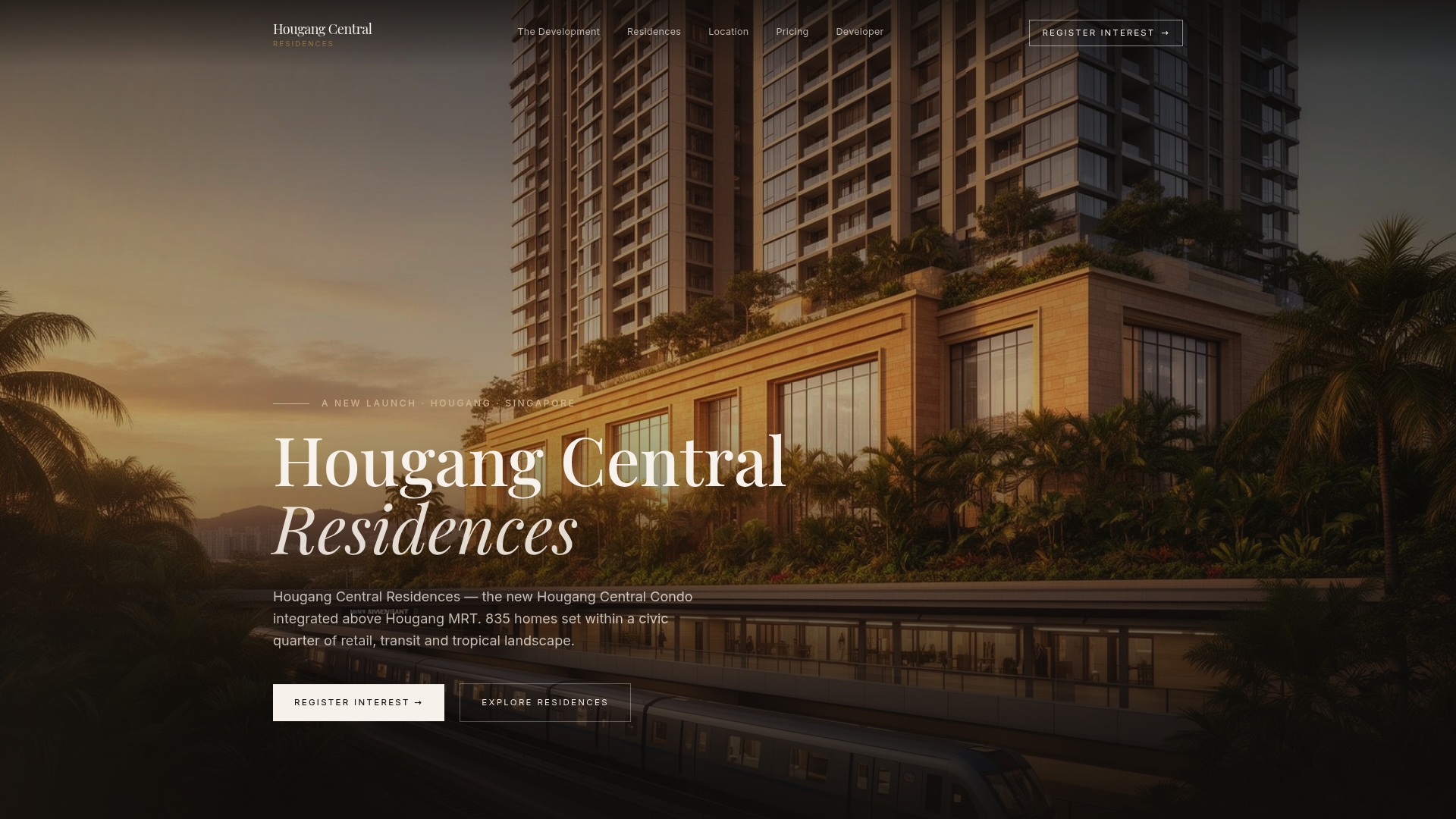
With 835 homes ranging from 1-bedroom to 5-bedroom configurations, Hougang-central-residences serves families and individuals who want condo living in calm environments without sacrificing urban connectivity. Smart-home systems give residents direct control over their living environment. Explore Hougang Central to review floor plans, community amenities, and the development's approach to tranquil urban living.
FAQ
What defines a peaceful urban condo setting?
A peaceful urban condo setting combines minimalist interior design, acoustic insulation, access to green spaces, and shared community amenities to reduce sensory and social stress for residents.
What shared amenities promote calm in urban condos?
Rooftop gardens, communal lounges, shared kitchens, and green balconies are the most effective shared amenities for building social connection and providing quiet retreat spaces within urban condo developments.
How much does it cost to create a serene condo interior?
Professional renovation focused on custom joinery and built-in storage averages approximately $17,000 at projects like Stirling Residences. That investment eliminates visual clutter and transforms a standard unit into a genuinely calm space.
What is the cohousing model and why does it support peaceful living?
Cohousing is a residential model where residents share large common spaces and govern them collectively through consensus meetings. Urban Green Edmonton's 4,000 sq ft shared area for 26 households shows how this model balances privacy with strong community bonds.
How do I evaluate a condo's noise levels before buying?
Visit the unit on both a weekday morning and a weekend evening to assess real-world sound levels. Ask the developer specifically about the building's acoustic rating between floors and units before committing.