
Yes, private condos fall under national pet limits, but the condo's own by-laws decide what actually happens in your building. The Animal & Veterinary Service (AVS) caps private premises at three cats and dogs combined, while HDB flats follow a separate, tighter limit. Your management corporation's by-laws can be stricter than that national cap, so request the current by-laws and any recent circulars before you sign anything.
TL;DR:
- Private condo pet limits are set at a maximum of three cats and dogs combined, but individual by-laws can impose stricter restrictions.
- MCST by-laws have the power to tighten pet rules, including breed and size restrictions, and can be changed through owner votes at general meetings.
- Operational restrictions like off-limits common areas, leash rules, and mandatory pet registration are common and may vary between developments.
- Verify all pet-related rules and permissions with written documentation before purchasing, including the latest by-laws and circulars, to prevent future disputes.
- Breed, size, and licensing conditions for dogs, especially for specified breeds, are strict, and emotional support animals are not automatically exempt from general regulations.
Table of Contents
- Do Condos Allow Pets? What AVS and HDB Limits Actually Mean
- Who Actually Controls Pet Rules in Your Building?
- What Restrictions Should You Expect Day to Day?
- Pre-Purchase Checklist: What to Ask for and Get in Writing
- If Something Goes Wrong: Dispute Steps and Escalation Routes
- Considerations for Service and Emotional Support Animals
- How Pet Rules Shape Resale Value and Buyer Demand
- Where Condo Pet Policies Are Heading
- How to Evaluate Pet-Friendliness Before You Buy
- What I'd Tell a Buyer Sitting Across From Me
- Confirm Hougang Central Residences' Pet Rules Before Your Visit
- Sources
- FAQ
Do Condos Allow Pets? What AVS and HDB Limits Actually Mean
A private condo unit can legally house up to three cats and dogs in any combination, according to AVS's ownership limits. HDB flats work differently: owners are capped at two cats and one approved small breed dog, and breaching that limit can trigger fines under HDB's pet rules.
Licensing is separate from these headcounts. Dog owners must register through AVS's e-services portal (PALS), and certain breeds classified as "Specified Dogs" carry extra conditions, including muzzling in public and restrictions on transfer of ownership.
The number that trips people up most: meeting the AVS national limit does not mean a condo will let you keep that many pets. National permission and condo permission are two separate approvals, and satisfying AVS does nothing to satisfy your MCST.
- Private condo cap: three cats/dogs combined
- HDB cap: two cats plus one approved small dog
- Licensing required through AVS/PALS for dogs
- Specified Dogs carry additional legal conditions
- MCST by-laws can be stricter than any of the above
Who Actually Controls Pet Rules in Your Building?
Every condo is run by a Management Corporation Strata Title (MCST), the legal body formed once a development is subdivided into strata lots. The MCST manages common property and enforces by-laws under the Building (Strata Management) Act, as outlined in BCA's guidance.
Three layers of rules matter, and they carry different legal weight:
- Prescribed by-laws set out in the Act itself, covering baseline obligations every strata development follows
- Additional by-laws a specific MCST adopts through a special resolution at an AGM or EGM, then lodges with the relevant authority. These are legally binding and often where pet restrictions live
- House rules issued by management for day-to-day operations. These are useful guidance but generally carry less legal force than lodged by-laws
Changing or adding a by-law requires a special resolution passed at a general meeting, then formal lodgment. That process matters to you as a buyer or tenant because a development's pet policy can shift after you move in if enough owners vote for it. BCA's guidance for condo owners recommends every resident understand this before assuming today's rules are permanent.
What Restrictions Should You Expect Day to Day?
Beyond headcounts, most Singapore condos layer on operational rules that shape daily life with a pet far more than the national limit ever will.
- Breed and size limits. Some MCSTs bar large breeds or cap pets by weight, separate from the AVS Specified Dogs list.
- Restricted common areas. Pools, gyms, function rooms, and sometimes ground-floor lawns are frequently off-limits to animals, a pattern CNA's reporting on condo rules documents across multiple developments.
- Lift and corridor etiquette. Some buildings require pets to be carried or kept off communal seating in lifts.
- Leash and cleanup rules. Near universal, with fines for breaches in many estates.
- Registration with management. Many MCSTs require you to formally register a pet, sometimes with photos and vet records on file.
- Written approval before move-in. Increasingly common for larger breeds or multiple-pet households.
Pro Tip: Ask specifically whether a rule is a lodged by-law or just a house rule. House rules can be changed by a management notice; by-laws generally need a formal vote. Knowing the difference tells you how stable that "no pets on the lawn" sign really is.
Pre-Purchase Checklist: What to Ask for and Get in Writing
A verbal assurance from a listing agent that a building is "pet friendly" is not evidence of anything. The only documents that matter are the ones lodged with the MCST, and BCA's ownership guidance backs that up directly.
Request these before you make an offer:
- Current MCST by-laws, including any additional by-laws specific to pets
- House rules currently in force
- Circulars issued in the past 12 to 24 months referencing pets or animals
- Minutes and resolutions from the last two AGMs or EGMs
- Written confirmation from the managing agent about your specific pet
Once you have the documents, ask pointed questions rather than general ones:
- Is my exact breed and size permitted, not just "pets in general"?
- Are there any pending by-law proposals about pets on the agenda for the next AGM?
- If an existing pet exceeds a new limit, is it grandfathered or subject to removal?
- Does the confirmation apply to the unit or to the current owner only?
Get every answer in writing and attach it to your sale or tenancy agreement. A thorough documentation checklist at purchase stage protects you long after the showflat visit is a memory.
If Something Goes Wrong: Dispute Steps and Escalation Routes
Most pet disputes in condos start with a noise complaint, a mess in a common area, or confusion over a rule nobody explained clearly. Start with the managing agent directly and put everything in writing, including dates, photos, and the specific by-law or house rule in question.
If that stalls, mediation is the next step. The Community Mediation Centre and Singapore Mediation Centre both handle neighbor and strata disputes, often faster and cheaper than formal proceedings.
When mediation fails, the Strata Titles Board hears formal disputes. Its ruling in the Astoria Park case confirmed that an MCST can lawfully make by-laws controlling pet ownership, and that enforcement can extend to removal orders where nuisance or property damage is proven.
Evidence that carries weight includes:
- Lodged by-laws and additional by-laws
- Written circulars from management
- Any prior written approval you received
- Dated photos or incident logs
Considerations for Service and Emotional Support Animals
Singapore's regulatory framework does not carve out a blanket exemption for emotional support animals the way some other countries do. AVS licensing requirements and MCST by-laws generally apply regardless of whether an animal provides support to its owner, though guide dogs for the visually impaired are widely accommodated in public spaces and many residential settings as a matter of practice.
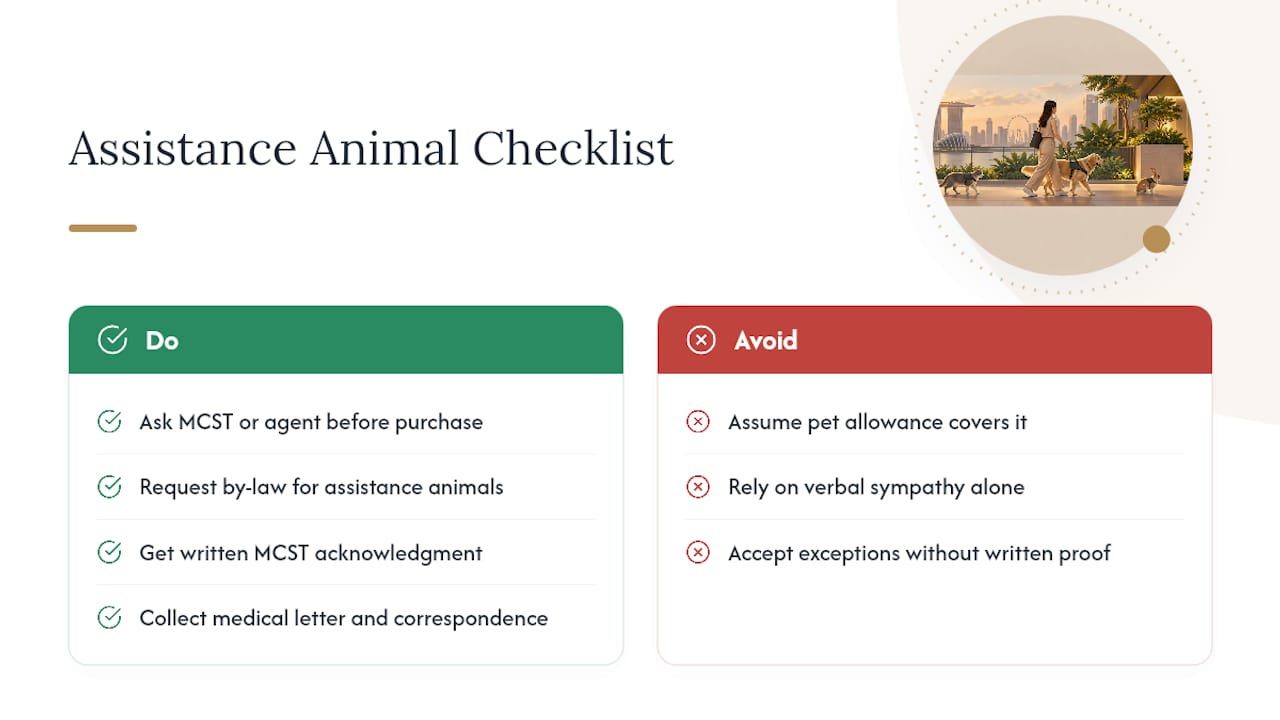
If you rely on a support animal, do not assume your situation is automatically covered by a condo's general pet allowance. Raise it directly with the MCST or managing agent before purchase, and ask whether any existing by-law addresses assistance animals separately from pets kept for companionship. Some managing agents are willing to grant case-by-case exceptions to headcount or breed restrictions, but that flexibility is discretionary, not guaranteed by law.
Document everything: any medical or professional letter supporting the need for the animal, correspondence with management, and the specific by-law clause you are asking to be read alongside your circumstances. Treat this the same way you would treat a pet-specific pre-purchase check. Verbal sympathy from a sales agent is not a legal safeguard. A written acknowledgment from the MCST council is.
How Pet Rules Shape Resale Value and Buyer Demand
A development known for reasonable, clearly documented pet policies tends to draw a wider buyer pool. Pet ownership across Singapore has grown steadily, and buyers with dogs or cats increasingly filter out listings where the rules are vague or unusually restrictive before they even book a viewing.
The flip side matters just as much. A condo with a reputation for aggressive enforcement, frequent fines, or contested by-law changes can quietly narrow its resale market, even if the unit itself is excellent. Agents rarely advertise this directly, but it shows up in how long a pet-owning buyer lingers on a listing versus how fast they move on.
Clear, stable, well-documented by-laws function almost like an amenity in their own right. They signal a well-run MCST, which tends to correlate with better-maintained common property generally. Buyers doing diligence on efficient layouts and building design would do well to fold pet-policy stability into that same evaluation, since both point to the same underlying question: how organized is this building's governance, really?
Where Condo Pet Policies Are Heading
Attitudes toward pets in Singapore's strata developments have shifted noticeably over the past several years. Newer developments increasingly design pet-specific amenities directly into common areas, including designated pet runs, washing stations near lobbies, and clearer signage about where animals are and are not permitted.

Part of this comes from demand. As more households in Singapore include a dog or cat, MCSTs face growing pressure from residents to update older, more restrictive by-laws that predate this shift. Some estates have moved additional by-law votes onto AGM agendas specifically to loosen breed or size restrictions that owners now consider outdated.
That said, the trend is not uniformly toward relaxation. CNA's reporting also documents estates tightening rules in response to specific incidents, like off-leash dogs in shared gardens or complaints about noise. The direction any single development takes depends heavily on who shows up to vote at its AGMs, which is exactly why by-laws should never be treated as fixed once you move in.
How to Evaluate Pet-Friendliness Before You Buy
Look past the marketing language and check the mechanics of the building itself. Ground-level pet access matters more than most buyers realize: a unit reachable without passing through a shared lobby full of "no pets" signage makes daily walks meaningfully easier.
Consider these factors together rather than in isolation:
- How pet owners physically move pets between the unit and outdoor areas
- Whether communal green spaces are pet-accessible or fenced off entirely
- How recently the by-laws were reviewed or amended
- Whether the MCST has a history of contested pet disputes, which you can sometimes gauge from past AGM minutes
A development built with wider corridors, sheltered walkways, and pet-friendly landscaping tends to age better for pet owners than one where pets were clearly an afterthought. Family-oriented developments in particular often think through these details alongside other family-focused amenities, since pet-owning households and young families frequently share the same practical needs around ground-floor access and green space.
What I'd Tell a Buyer Sitting Across From Me
The single habit that separates buyers who avoid pet disputes from those who end up in mediation: writing the pet's exact profile, species, breed, size, age, and licensing status, into the diligence request, then insisting on a dated written reply from the MCST council or managing agent. A verbal "should be fine" is worth nothing if a dispute lands in front of the Strata Titles Board.
Design matters more than most buyers expect. Sheltered walkways, ground-floor access, and well-placed exits reduce daily friction with a pet far more than the headline pet cap ever will. And if you care about how these rules evolve, show up to MCST meetings. By-laws get rewritten by whoever bothers to vote.
— Simon
Confirm Hougang Central Residences' Pet Rules Before Your Visit
If you're weighing a family-focused development against the diligence steps above, Hougang Central Residences is worth putting on your shortlist, and worth the same paperwork discipline. The project spans multiple units with various layouts, positioned directly above Hougang MRT with a future Cross Island Line interchange, tropical landscaped grounds, and premium fittings across unit types.

Before you book a showflat visit, request the current by-laws and any pet-related circulars in writing, exactly as you would for any strata development. Unit pricing at Hougang Central Residences starts from $2,800 per square foot, and full layouts across every configuration are listed on the residences page. Reach out to the sales team to confirm any pet clauses before you commit, so you walk into the showflat already knowing exactly what you're allowed to bring home.
Sources
Save or print whatever documentation a managing agent sends you. For everything else, go straight to the primary sources: AVS's ownership limits and PALS licensing portal, BCA's strata management guides, HDB's pet policy pages, and the Strata Titles Board's Astoria Park judgment. For a broader owner-obligations reference, this building compliance checklist covers related MCST duties in more technical detail.
FAQ
Are Condos in Singapore Pet Friendly?
Most private condos permit pets up to the AVS national limit of three cats and dogs combined, but individual developments can impose stricter by-laws. Whether a specific condo is genuinely pet friendly depends entirely on its lodged by-laws, not on general assumptions about condos as a category.
How Many Dogs Can Be Kept in a Condo?
Private condo units can keep up to three cats and dogs combined under AVS rules, though that figure assumes no dogs from the Specified Dogs list requiring extra conditions. Your specific MCST by-laws may set a lower cap, so always confirm with the management corporation directly.
What Are the Legal Restrictions on Pets in Singapore?
All dog owners must license their pets through AVS, and certain breeds classified as Specified Dogs face extra legal conditions, including public muzzling. HDB flats follow a separate cap of two cats and one approved small dog under HDB's rules, while private condos follow the AVS limit plus whatever their own MCST by-laws add.
Which Condo Is Pet Friendly?
There's no single citywide list, because pet friendliness comes down to each development's own by-laws and how actively its MCST enforces them. Family-oriented developments like Hougang Central Residences are worth asking about directly. Request the by-laws and any pet circulars before your showflat visit so you know exactly what applies to your unit.
What Documents Should I Request Before Buying a Condo With Pets?
Ask for the current MCST by-laws, any additional by-laws, house rules, recent circulars mentioning pets, and minutes from the last two AGMs or EGMs. Get written confirmation from the managing agent that names your specific pet's breed and size, since a general "pets allowed" statement offers no real protection later.