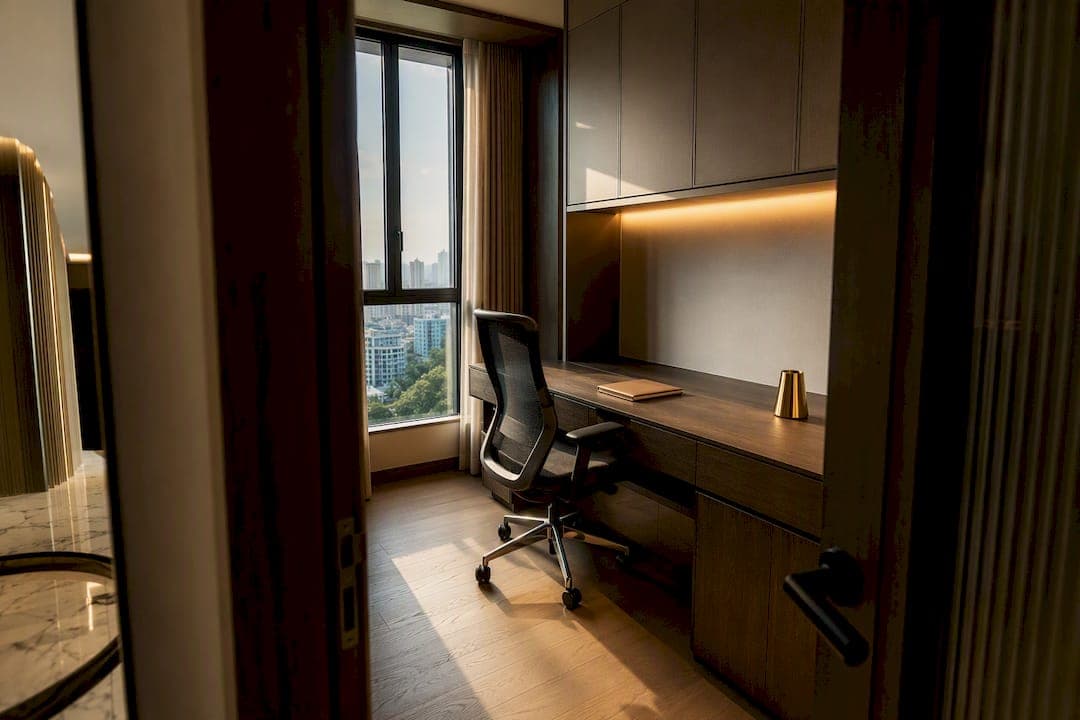
Yes, a condo unit works well as a home office if it has three things: a dedicated study or nook separate from the bedroom, enough power and data points near the desk, and a quiet orientation with amenity backup for calls. Miss any one of these and you're negotiating with your own layout every workday. Simon, who covers urban residential living, has walked enough units to know the difference shows up in the first ten minutes of a viewing, not after move-in.
TL;DR:
- A dedicated walled study room with a door is preferable to a corner nook or shared bedroom space for better focus and sleep separation.
- Power and data outlets should be located near the desk's position, not just along perimeter walls, to avoid costly retrofits.
- Inward-facing units with quiet orientations, higher floors, and soundproof amenities reduce noise disruptions during calls, especially if equipped with heavy curtains and acoustic panels.
- Desk size should typically range from 120 to 140 centimeters wide, with at least 110 centimeters clearance behind it, and pathways of 70 to 90 centimeters elsewhere.
- Building facilities like bookable meeting rooms, co-working lounges, and quiet communal spaces provide essential backup support for remote work needs.
Table of Contents
- What Makes a Unit Suitable for a Home Office in a Condo?
- How Big Should Your Desk and Chair Space Be in a Condo Study?
- What About Lighting and Noise in a Condo Office?
- How Do You Fit Storage Into a Small Condo Office?
- Which Condo Amenities Actually Support Working From Home?
- What Should You Check During a Viewing?
- A Straight Take on Condo Home Offices From Simon
- See What a Home-Office-Ready Unit Actually Looks Like
- Sources
- FAQ
What Makes a Unit Suitable for a Home Office in a Condo?
Before you fall for the finishes or the view, run the layout through a shortlist. A unit can look ready for remote work and still fail on the details that matter once you're on a 9 AM call five days a week.
Start with room type. A dedicated study room beats a "flexible nook" beats a desk squeezed into the living room, in that order, mostly because setting up a workstation in the bedroom tends to blur sleep and work boundaries. If the floor plan only offers a bedroom corner, treat that as a compromise, not a feature.
Here's what actually separates a workable unit from a frustrating one:
- Room type: a walled study room with a door beats an open nook, which beats a living-room desk exposed to household traffic.
- Power and data points: check whether outlets sit near where a desk would go, not just along the perimeter wall meant for a TV console.
- Orientation: units facing inward toward a courtyard or garden are quieter than those facing a road, a pool deck, or a function lawn.
- Amenity backup: a co-working lounge or bookable meeting room downstairs covers you on days the unit itself feels too noisy or too small for a video call.
None of these show up on a floor plan brochure. You have to ask, measure, and sometimes just stand in the room during a viewing and listen.
How Big Should Your Desk and Chair Space Be in a Condo Study?
Most Singapore condo study rooms are around typical small sizes that become significantly reduced in usable floor area after factoring in door swing and walking paths. That's tight, but it's enough, if you size the furniture correctly instead of guessing.
For a study of that size, a desk between 120 and 140 centimeters wide and 60 to 70 centimeters deep gives you enough surface for a monitor, laptop, and notebook without eating the room. If you're setting up dual monitors or sharing the desk with a partner on alternating shifts, size up to 140 to 160 centimeters. Anything wider in an 8 sqm room starts to fight the doorway.
Clearance matters more than desk size. Leave 110 to 120 centimeters from the desk edge to the nearest wall or obstruction so your chair can roll back fully without hitting a wardrobe or door. Walkways elsewhere in the room should stay at 70 to 90 centimeters minimum. Anything narrower and you'll be turning sideways to get past your own bookshelf.
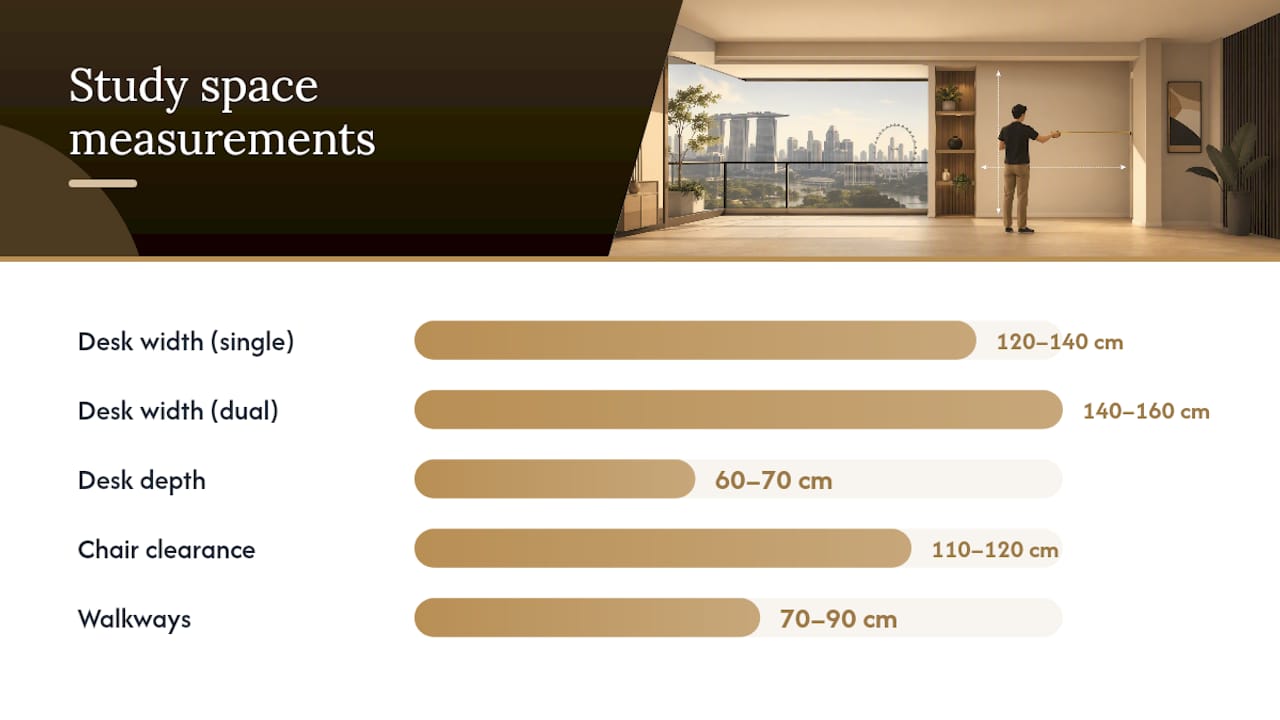
Placement inside the room counts too. Avoid positioning the desk directly under the air-con vent. Cold air blowing on your neck for eight hours a day gets old fast, and it's a common mistake in units where the AC unit sits centered over what was meant to be a workspace. Ideally, the desk sits perpendicular to the window, so daylight comes from the side rather than glaring off your monitor, and it faces the door rather than having your back to it, particularly if you're on camera often.
What About Lighting and Noise in a Condo Office?
Good lighting for a home office isn't one bright ceiling light. Designers recommend layering natural light, ambient room lighting, and a dedicated adjustable task light rather than relying on a single overhead fixture, which tends to cast shadows straight down onto your keyboard and leaves your face poorly lit on video calls.
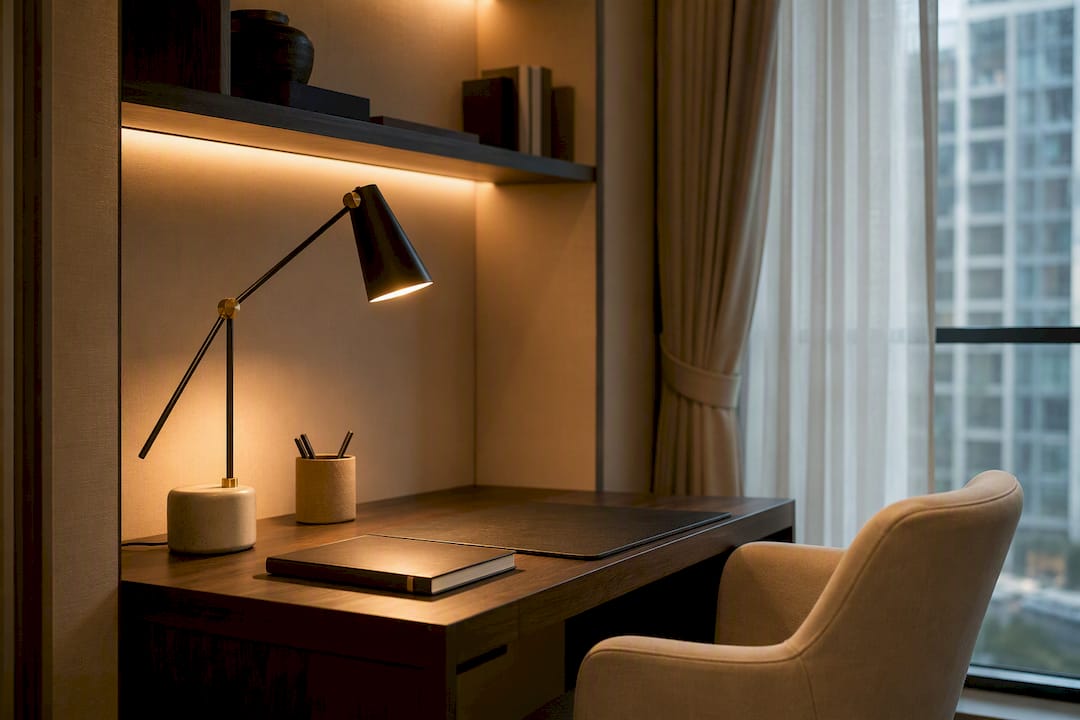
Orientation affects this directly. West-facing units catch strong afternoon sun that can wash out a screen or turn a study into a greenhouse by 3 PM. If you're viewing a west-facing unit, check the afternoon glare in person rather than trusting the floor plan's compass arrow.
Noise is the other variable buyers underrate. Picking higher floors, inward-facing stacks, or corner units meaningfully cuts down on traffic noise and amenity chatter bleeding into your calls. Heavy curtains, double glazing, and acoustic panels help after the fact, but starting with a quieter stack saves you the retrofit.
- Visit during a weekday work block (10 AM to 3 PM), not just weekend viewings.
- Stand in the study with the window closed and listen for traffic, MRT rumble, or pool-deck noise.
- Check where the sun hits the window at the time you'd actually be working.
- Ask whether the unit faces a function lawn, gym, or other amenity likely to generate afternoon noise.
Pro Tip: Bring your phone and record 30 seconds of ambient sound in the study during your viewing. Play it back at home before you decide. What sounds tolerable in person often sounds louder on a recording, which is closer to how it'll feel on a call.
How Do You Fit Storage Into a Small Condo Office?
Floor space in an 8 to 10 sqm study disappears fast once a desk, chair, and filing drawer go in. The fix is going vertical instead of wide.
Overhead cabinets and floating shelves keep documents and equipment off the desk without eating walking space. Combination wardrobe-study units, where a fold-down desk sits built into a wardrobe carcass, work well in tighter units or 1-bedroom-plus-study layouts, though they can slightly limit resale flexibility since not every buyer wants a fixed workstation.
- Mount the lowest shelf 40 to 50 centimeters above the desk so you can reach it seated, not standing.
- Use a mobile pedestal under the desk instead of a fixed drawer unit, so you can shift it when cleaning or rearranging.
- Choose a low-pile rug or none at all under a rolling chair. Thick pile drags on wheels and wears out fast.
- Route cables through a desk grommet or cable tray rather than letting them pool on the floor.
Condo units generally offer more renovation freedom and higher ceiling heights than HDB flats, which opens the door to built-in desks and overhead storage that a resale HDB unit's structural rules might not allow. Basic carpentry for a wardrobe-study combo typically needs its own quotation, since pricing depends heavily on materials and the fittings you want, so get at least two contractor quotes before committing.
Which Condo Amenities Actually Support Working From Home?
A small study room isn't the whole story. The building around it matters just as much, especially on days when the unit itself feels too cramped or too noisy for a call.
Newer developments increasingly build in co-working lounges, bookable meeting rooms, and soundproof pods, treating them as a functional extension of the unit rather than a lifestyle add-on. If you're shortlisting units, weigh these facilities the same way you'd weigh a gym or pool. They solve a real problem: taking a client call without your dog barking in the background.
- Bookable meeting rooms for calls you don't want happening at your kitchen table.
- Co-working lounges with desks and Wi-Fi for a change of scenery without leaving the building.
- Managed, building-wide Wi-Fi backbone, since relying solely on your own router in a smart-home-ready unit is a weak point if it goes down.
- Quiet communal gardens or reading corners for a change of scenery between calls.
Before you assume these amenities are simply available, confirm the booking rules with the MCST or the agent. Peak-hour demand and possible user fees vary by development, and a facility that's booked out every weekday afternoon isn't much of a backup plan. Some buyers dealing with especially high call volume look at dual-key units instead, which separate a near-full-time office from living space entirely and offer rental flexibility later if your needs change. For a broader look at how communal spaces factor into daily routine, this piece on work-life balance condo features is worth a look before you shortlist.
What Should You Check During a Viewing?
A viewing is your one real chance to catch problems before they become renovation line items. Bring a tape measure and a short list, and don't rely on memory once you're back home comparing three units in your head.
- Measure the study room's usable floor area after accounting for the door swing, not just the wall-to-wall dimension on the floor plan.
- Count the power and data points near where a desk would sit. Many layouts put outlets for a TV console, not a workstation, and you may need an electrical retrofit to add more.
- Note the window placement and which direction it faces, since this determines both natural light and afternoon glare.
- Check the ceiling height, particularly if you're planning built-in overhead storage.
- Ask about MCST renovation rules before you assume you can add carpentry or knock down a partition.
- Ask how amenities are booked, whether there's a fee, and what peak-hour demand looks like for meeting rooms or pods.
- Watch for red flags: an AC vent positioned directly over where the desk would go, west-facing glare with no window treatment, or a study wall backing directly onto a noisy amenity like a function lawn or gym.
If you're viewing with an agent, ask direct questions rather than accepting a general pitch. Agent guidance on what to highlight in a listing suggests sellers often lead with finishes and views, so you may need to steer the conversation toward outlet counts and noise exposure yourself.
A Straight Take on Condo Home Offices From Simon
Most home-office advice online treats every condo the same, which misses the point entirely. A 1-bedroom-plus-study unit works fine for a single remote worker who needs a closed door and not much else. A 3-bedroom unit with a proper study room supports two working adults or a family where someone takes calls during school hours. At Hougang Central Residences, the spread across 835 units, from 1-bedroom-plus-study through larger family layouts, exists precisely because "home office" means something different depending on who's asking. Smart-fittings and direct MRT access help too, since fewer commuting hours often means more flexibility to structure a workday around calls instead of trains.
— Simon
See What a Home-Office-Ready Unit Actually Looks Like
If you're picturing where a desk and bookshelf would fit, the fastest way to know is to see the floor plans directly. Some developments sit above MRT stations with units ranging from 1-bedroom-plus-study to 5-bedroom layouts, several of which include a dedicated study room sized for exactly the desk and clearance measurements covered above.

Beyond the unit itself, some developments include tropical landscaped communal areas and wellness facilities that give residents somewhere else to work or unwind when the study room needs a break, along with smart-home systems built in from day one rather than retrofitted later. For readers weighing amenity readiness more broadly, this amenities checklist for young professional buyers covers what else to look for beyond the unit walls. If a study-ready layout with transit access is on your shortlist, request the e-brochure or register for a showflat visit at Hougang Central Residences to see current unit types and availability.
FAQ
Do I Need a Dedicated Study Room for a Home Office in a Condo?
A dedicated study room is strongly preferred over a bedroom corner or open nook, since separating work from sleeping space protects both focus and sleep hygiene. A well-placed nook can work if it has a door or a clear visual break from the living area.
What Desk Size Fits a Typical Condo Study Room?
For an 8 to 10 square meter study, a desk 120 to 140 centimeters wide and 60 to 70 centimeters deep fits comfortably. Upsize to 140 to 160 centimeters if you're running dual monitors or sharing the desk.
How Much Clearance Do I Need Behind a Home Office Desk?
Leave 110 to 120 centimeters between the desk edge and the nearest wall or furniture so the chair can roll back fully, with walkways elsewhere staying at 70 to 90 centimeters. Tighter than that and you'll be squeezing past your own furniture daily.
Which Condo Amenities Actually Help With Working From Home?
Bookable meeting rooms, co-working lounges, and soundproof pods act as a practical backup when your unit feels too small or too noisy for a call. Confirm booking rules and any fees with the MCST before relying on them.
Should I Avoid West-Facing Units for a Home Office?
Not necessarily, but expect stronger afternoon glare that can wash out a monitor, and check it in person during a viewing since layered blinds, UV films, and task-lamp positioning can offset it.