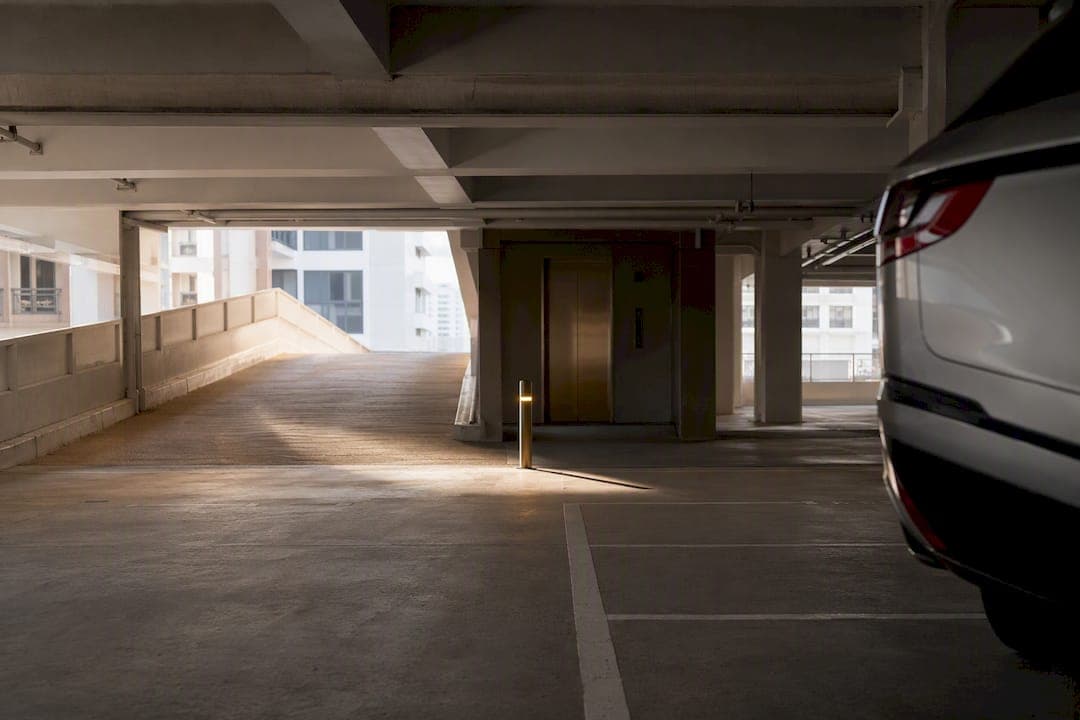
In Singapore, condo parking allocation now runs on Range-based Parking Provision Standards, not a guaranteed lot per unit, and most parking spaces are common property rather than something deeded to your home. If you're buying, that means one lot per unit is often not the default anymore, especially near an MRT station. Check the Option to Purchase, the strata plan, Form B, and the MCST bylaws before you sign anything.
TL;DR:
- Most developments now allocate fewer than one parking lot per unit, especially near MRT stations, and parking ratios can vary significantly within the same project.
- The classification of parking as assigned, limited common property, or strata-titled influences the transferability and legal rights when selling or renting out the lot.
- Visitor parking spaces are decreasing in most transit-oriented projects, often replaced with digital management systems and time-limited access, impacting guest accessibility.
- An "EV-ready" label refers only to infrastructure capacity, not the immediate ability to install or charge an electric vehicle without approval and possible electrical upgrades.
- The MCST can reassign or change parking allocations over time through formal processes, so verifying clear, detailed bylaws before purchase is essential.
Table of Contents
- What Is Condo Parking Allocation Under RPPS?
- How Parking Is Classified: Assigned, Limited Common Property, or Titled
- Visitor Parking: Fewer Bays, More Digital Controls
- EV Charging: Why "EV-Ready" Doesn't Mean Ready to Plug In
- Can the MCST Change Your Parking Allocation Later?
- Pre-Purchase Checklist: What to Verify Before You Commit
- Hougang Central Residences: Transit Access as a Trade-Off for Parking Ratios
- How Are Parking Disputes Between Residents Resolved?
- Does Parking Allocation Affect Resale Value?
- Accessibility: Parking for Residents With Disabilities
- What Does Extra Parking Cost in a Condo?
- What If There Isn't Enough Parking?
- An Editorial Take on Buying Into a Lower Parking Ratio
- Sources
- FAQ
What Is Condo Parking Allocation Under RPPS?
Range-based Parking Provision Standards, or RPPS, replaced the older Car Parking Standards in 2019 as part of Singapore's push toward a car-lite future. Instead of a fixed ratio, URA sets a range of acceptable parking counts for a project, and developers pick a number inside that band based on the site's connectivity, size, and unit mix.
Proximity to an MRT station tends to pull that number down. A development sitting directly above a station, like many recent launches, can justify a lower ratio than a similar project stuck fifteen minutes from the nearest line. LTA's 2019 Code of Practice gives developers the technical formulas for working out where in the range their project should land.
The practical result for buyers:
- Fewer than one parking lot per unit is now common in well-connected developments.
- Visitor bays may be reduced or restructured rather than guaranteed as a fixed count.
- Bicycle parking requirements have grown alongside the drop in car lots, reflecting the car-lite intent behind the policy.
Pro Tip: Never assume "1 lot per unit" just because that was standard a decade ago. Ask the sales team for the exact parking ratio approved for the specific block and stack you're considering, since ratios can vary within one development.
How Parking Is Classified: Assigned, Limited Common Property, or Titled
Not all condo parking works the same way legally, and the label matters more than most buyers realize. Three classifications show up in Singapore condos, each with different consequences for what happens when you sell or rent out your unit.
Assigned parking means the MCST allocates a specific lot to a unit at its discretion, usually recorded in an internal list rather than the strata plan itself. This kind of assignment can, in some cases, be changed later by the management council, which is why it carries more risk than it sounds.
Limited common property, often shortened to LCP, ties exclusive use of a lot to a specific unit through the strata plan itself. It's still common property owned collectively, but the right to use it attaches to your unit and generally transfers automatically when you sell.
Titled or strata-titled stalls are rare in residential condos, but when they exist, the lot is a separately owned strata lot you can sell or lease independently of the residential unit.
To confirm which category applies:
- Pull the strata plan and check for LCP notations against specific units.
- Review Form B, which lists the schedule of strata lots and shares.
- Ask for a copy of the MCST bylaws covering parking assignment.
- Get written confirmation from the developer, not just a verbal assurance from a sales agent.
Marketing brochures that say "parking included" are not a legal guarantee. Only the strata plan and Form B show what actually transfers with the unit.
Visitor Parking: Fewer Bays, More Digital Controls
Guest parking has gotten tighter in transit-oriented developments, and the trend is not reversing. When RPPS lets a developer build fewer total lots, visitor bays are often the first thing trimmed, since residents get priority. The PUDO design guide from URA and LTA pushes developments toward better pick-up and drop-off zones partly to offset this shrinkage, giving guests a place to be dropped without needing a parking lot at all.
Where visitor bays do exist, expect tighter management:
- Time-limited stays, often capped at a few hours before charges or towing apply.
- QR code or app-based digital registration replacing paper coupons.
- Permit systems for regular visitors, sometimes with a monthly fee.
- Active enforcement, since unregistered vehicles get flagged faster with digital systems than with the old honor system.
Before you buy, ask directly about overnight guest policies and whether there's a fee attached to visitor permits. A development with generous MRT access but skimpy guest parking might mean your dinner guests take the train instead, which for many households is a fair trade.
EV Charging: Why "EV-Ready" Doesn't Mean Ready to Plug In
An "EV-ready" label on a condo brochure usually refers to the building's cabling and switchroom capacity, not your personal right to install a charger tomorrow. There's a real gap between infrastructure readiness and individual approval, and it trips up plenty of new owners.
Getting an actual charger installed at your lot typically involves the MCST reviewing your application, agreeing on cost-sharing for any electrical upgrades, and confirming the distribution board has room for another circuit. Meter segregation, so your charging costs get billed to you rather than pooled into common expenses, is usually part of that process too.
Before assuming you can charge at your own lot, ask:
- Whether the building's electrical backbone already has spare capacity, or would need an upgrade.
- What the MCST's existing policy is on EV charger installation and cost-sharing.
- Whether any owners have already gone through the approval process, and how long it took.
Pro Tip: Ask to see the MCST's EV charging policy document, if one exists, rather than relying on a verbal "yes, we support EVs" from the agent.
Can the MCST Change Your Parking Allocation Later?
Yes, and this catches long-time residents off guard more often than new buyers. Once a development is handed over, the Management Corporation Strata Title (MCST) has real authority over how common-property parking, including most assigned and LCP lots, get managed and, in some cases, reassigned.
Changes typically follow a formal process: written notice to owners, discussion at an Annual General Meeting or Extraordinary General Meeting, and a vote requiring a specified majority under the bylaws. The exact threshold and notice period depend on the MCST's own bylaws, so two condos down the road from each other can have different rules.
Watch for these red flags before you buy:
- Bylaws that describe parking assignment vaguely, without a clear process or majority requirement.
- No documented record of who currently holds which lot.
- A history of frequent reassignments, which suggests the committee treats allocation as negotiable rather than settled.
If a dispute over bylaws interpretation ever gets serious, Singapore's Statutes Online is the primary reference for the Building Maintenance and Strata Management Act provisions that govern MCST authority.
Pre-Purchase Checklist: What to Verify Before You Commit
Parking allocation is easy to overlook when you're focused on layout and price, but it's worth a dedicated pass through the paperwork.
- Request the OTP or Sale and Purchase Agreement wording on parking. Look specifically for whether a lot is mentioned at all, and in what terms.
- Pull the strata plan. Confirm whether any lot carries an LCP notation tied to your unit number.
- Check Form B. This document lists the schedule of strata lots, including any separately titled parking.
- Read the MCST bylaws covering parking assignment, visitor bays, and EV charger policy.
- Ask the developer or agent directly: Are any stalls deeded or titled? Are visitor bays guaranteed or first-come? Has parking ever been reassigned before?
- Put material findings into your sale conditions or a subject-to clause if parking significantly affects your decision or the price you're willing to pay.
- Consult a conveyancing lawyer if the documentation is unclear or if parking rights are a deciding factor in your purchase.
Pro Tip: If you're going through a new-launch booking process, ask the sales team for the parking ratio in writing before booking a unit, not after. Verbal promises from a busy showflat floor rarely make it into the contract.
One more thing worth doing: cross-check any email or document you receive claiming to be from the developer or MCST against ScamShield's guidance on verifying official communications, particularly if you're asked to pay a fee for a "reserved" parking lot before signing anything formal.
Hougang Central Residences: Transit Access as a Trade-Off for Parking Ratios
Hougang Central Residences sits directly above Hougang MRT station, with 835 units ranging from one-bedroom-plus-study layouts to five-bedroom penthouses, integrated with a retail mall and bus interchange. That kind of connectivity, including future access to the Cross Island Line, is exactly the profile RPPS rewards with a lower parking ratio. The trade-off works because residents genuinely need a car less when the train platform is an elevator ride away.
The development pairs that transit access with smart-home systems, premium European fittings, and tropical landscaped communal spaces, so the reduced emphasis on car ownership comes with amenity space elsewhere rather than a bare-bones outcome. For specifics on the actual parking ratio, visitor bay count, and EV charging policy for this project, the sales team and showflat can walk you through the strata documents directly, and the MRT interchange connectivity guide covers how that access factors into daily life.
How Are Parking Disputes Between Residents Resolved?
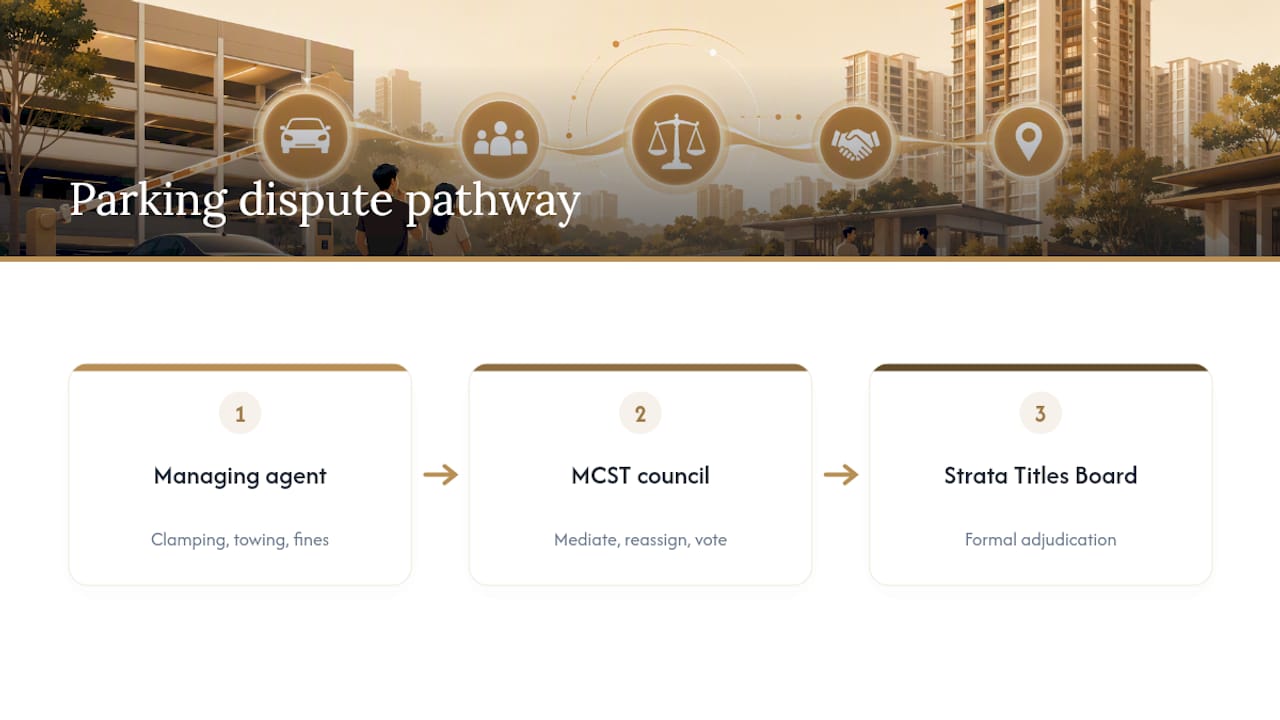
Most parking disputes in Singapore condos start small: someone parks in an assigned lot that isn't theirs, or a visitor overstays a time-limited bay. The MCST's managing agent typically handles first-line enforcement, often backed by clamping, towing arrangements, or fines specified in the bylaws.
When a dispute escalates beyond a warning letter, the process usually moves to the MCST council itself. Residents can raise the issue at a council meeting or, for a formal complaint, request it be tabled at the next general meeting. Councils generally have discretion to mediate between neighbors, reassign a disputed lot, or clarify ambiguous bylaws through a vote.
For disputes that can't be resolved internally, the Strata Titles Boards handle formal adjudication of matters under the Building Maintenance and Strata Management Act, including parking allocation disagreements that owners can't settle through the MCST's own channels. This is a more formal route than most day-to-day squabbles ever need, but it exists for cases where a bylaw's meaning is genuinely contested or a council has acted outside its authority.
The most common source of friction isn't malice. It's ambiguity. A bylaw that says "the council may allocate parking as it sees fit" without a documented process invites exactly the kind of dispute that drags on for months. Buyers who check for clear, specific bylaws during due diligence save themselves a future headache. Residents already living somewhere with vague rules have a genuine interest in pushing their council to formalize the allocation process in writing, ideally with a documented list matching lots to units that gets updated whenever a change happens.
Does Parking Allocation Affect Resale Value?
Parking allocation shows up in resale conversations more than most sellers expect, particularly for larger units where buyers assume a lot comes standard. A unit with a clearly assigned or LCP-designated parking lot, confirmed in writing, tends to move faster and command a cleaner price than one where the buyer has to chase down documentation to confirm parking status.
The effect is sharper in developments with a low parking ratio relative to unit count. When lots are scarce, having a confirmed, transferable lot attached to your unit becomes a genuine differentiator among otherwise similar listings in the same block. Buyers researching a resale unit increasingly ask agents to produce the strata plan or Form B extract showing parking classification before making an offer, rather than taking the listing description at face value.
Transit-oriented developments complicate this calculus in an interesting way. A project with a low parking ratio but excellent MRT access, like a station-linked condo, can still command strong resale interest because buyers are trading car dependency for commute convenience. The parking scarcity that might hurt a suburban, car-dependent project matters less when the front door opens onto a train platform.
For sellers, the practical lesson is straightforward: gather your parking documentation before listing, not after a buyer asks. A vague answer to "is parking guaranteed with this unit?" costs you negotiating leverage, while a strata plan extract in hand closes the question in seconds.
Accessibility: Parking for Residents With Disabilities
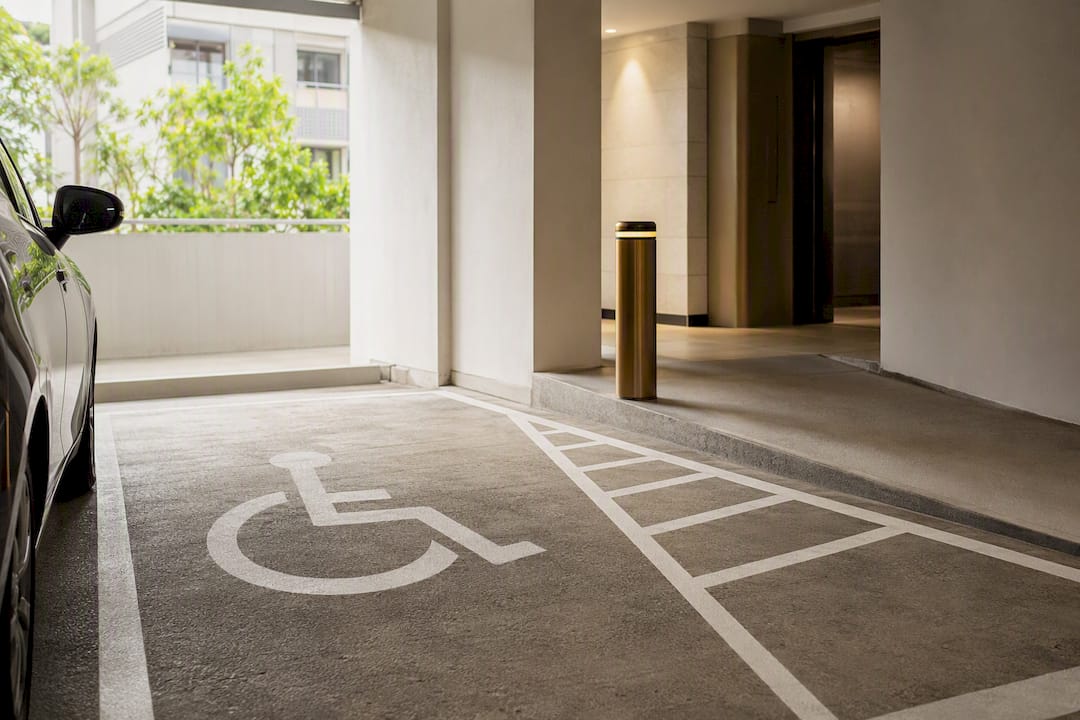
Accessible parking allocation in Singapore condos generally follows a needs-based approach rather than a fixed quota tied purely to unit count. MCSTs typically reserve accessible lots close to lift lobbies for residents who hold a valid accessible parking label, reallocating spots as the resident population changes over time rather than locking assignments in permanently.
Buyers or residents who need an accessible lot should raise this directly with the MCST or managing agent early, since these lots are often managed through a request process rather than automatic assignment at purchase. Documentation requirements usually include proof of the accessibility need, and the MCST bylaws should specify how these requests get prioritized when demand exceeds the accessible lots available.
Newer developments designed under current accessibility standards tend to build in accessible bays close to key entrances from the outset, rather than retrofitting them later. That's worth checking during due diligence if accessibility is a factor for your household: ask specifically how many accessible lots exist relative to total unit count, and whether the location of those lots suits your actual mobility needs rather than just meeting a code minimum.
If a development's accessible parking allocation feels inadequate or poorly located, raising it with the MCST council directly, ideally in writing, creates a paper trail that supports a future bylaw amendment if enough residents share the concern.
What Does Extra Parking Cost in a Condo?
Costs for additional parking inside a condo vary widely depending on the development's parking ratio and whether spare lots exist at all. In developments with a surplus of lots relative to demand, some MCSTs allow residents to rent a second lot on a monthly basis, with fees set by the council and typically reviewed annually alongside other maintenance charges.
Where supply is genuinely tight, and particularly in developments built under a lower RPPS ratio, a second lot may simply not be available at any price, since every existing lot is already assigned to a specific unit. In that scenario, some MCSTs maintain a waiting list for residents interested in a lot that becomes available when another owner moves out or gives up their assignment.
Fees for parking permits, when they exist, tend to be modest compared to overall maintenance costs, but they add up. Visitor parking permits for regular guests, if a development charges for them at all, are usually billed monthly or per use through the same digital registration system that governs guest bay access.
Before assuming you can simply pay for a second lot, ask the MCST directly whether any policy exists for renting additional parking, what the waiting list situation looks like, and whether fees are fixed by bylaw or subject to change at the council's discretion. This is exactly the kind of detail that varies enough between developments that assumptions based on a friend's condo elsewhere in Singapore won't hold.
What If There Isn't Enough Parking?
When a development's parking supply genuinely falls short of demand, residents have a few practical options beyond waiting for a lot to open up. Nearby commercial or public parking facilities, where available, offer monthly season parking arrangements that some residents use as a workaround, particularly in mixed-use developments where a retail podium or nearby mall has its own parking structure with separate rates.
Some larger developments or those near commercial hubs also see valet-style arrangements emerge informally, though this is far less common in Singapore's residential MCST structure than in some other markets, and it typically requires council approval rather than being something an individual resident can arrange unilaterally.
The more sustainable long-term solution, and the one RPPS is explicitly designed around, is reducing car dependency in the first place. Developments integrated with MRT access, bus interchanges, and retail within walking distance make a car genuinely optional for many households rather than a forced necessity, which is precisely the trade-off behind the lower parking ratios allowed near transit nodes.
For residents already living somewhere with insufficient parking, raising the issue with the MCST to explore formal season parking arrangements with nearby facilities, or to review whether the current allocation policy is being applied efficiently, is a more productive path than assuming nothing can change.
An Editorial Take on Buying Into a Lower Parking Ratio
The conventional advice on condo parking treats it as a checklist item, something to confirm exists and move on. That undersells what's actually happening. RPPS represents a deliberate policy bet that transit access can substitute for guaranteed car ownership, and whether that bet pays off for you personally depends entirely on your actual commute and lifestyle, not on what the brochure promises.
Where most buyers go wrong is treating "near MRT" and "has parking" as separate boxes to tick, when they're actually connected. A lower parking ratio next to a station isn't a compromise if you were never going to drive daily anyway. It's a genuine trade for lower shared costs and more amenity space. But if your household still needs two cars, that same ratio becomes a real constraint you should price into your offer.
Prioritize the documents over the pitch. A strata plan and Form B tell you what you're actually getting; a sales conversation tells you what sounds appealing. Get the paperwork first.
— Simon
Sources
- Parking — URA
- Code of practice on vehicle parking provision in development proposals — LTA (2019)
- ScamShield — Government of Singapore
FAQ
What Does Rule 3 of Parking Space Regulations Mean in Singapore?
There's no single universal "Rule 3" governing condo parking in Singapore; allocation instead follows the RPPS ranges set by URA and LTA's Code of Practice, plus each development's own MCST bylaws, so the specific rules vary by project.
What Is the Most Profitable Condo in Singapore?
Profitability depends on entry price, location, and holding period rather than any single fixed answer, and transit-linked developments with strong MRT connectivity, like projects integrated directly above a station, have historically shown resilient demand due to reduced car dependency.
What Are the Parking Regulations for Condos in Singapore?
Condo parking in Singapore is governed by URA's development control guidelines and LTA's Code of Practice, which set RPPS ranges rather than fixed ratios, with individual MCST bylaws governing day-to-day allocation and enforcement after handover.
What Are the Current Parking Fees in Singapore?
Parking fees within a specific condo, including any charges for visitor permits or renting a second lot, are set by each development's MCST and vary by project. There's no single nationwide rate, so check the bylaws or ask the managing agent for the current fee schedule.
Can I Rent Out My Assigned Parking Lot?
Whether you can rent out or transfer an assigned lot depends on its legal classification. Limited common property typically transfers with unit sale, while purely assigned lots may be subject to MCST discretion, so check your strata documents before assuming you can lease it independently.