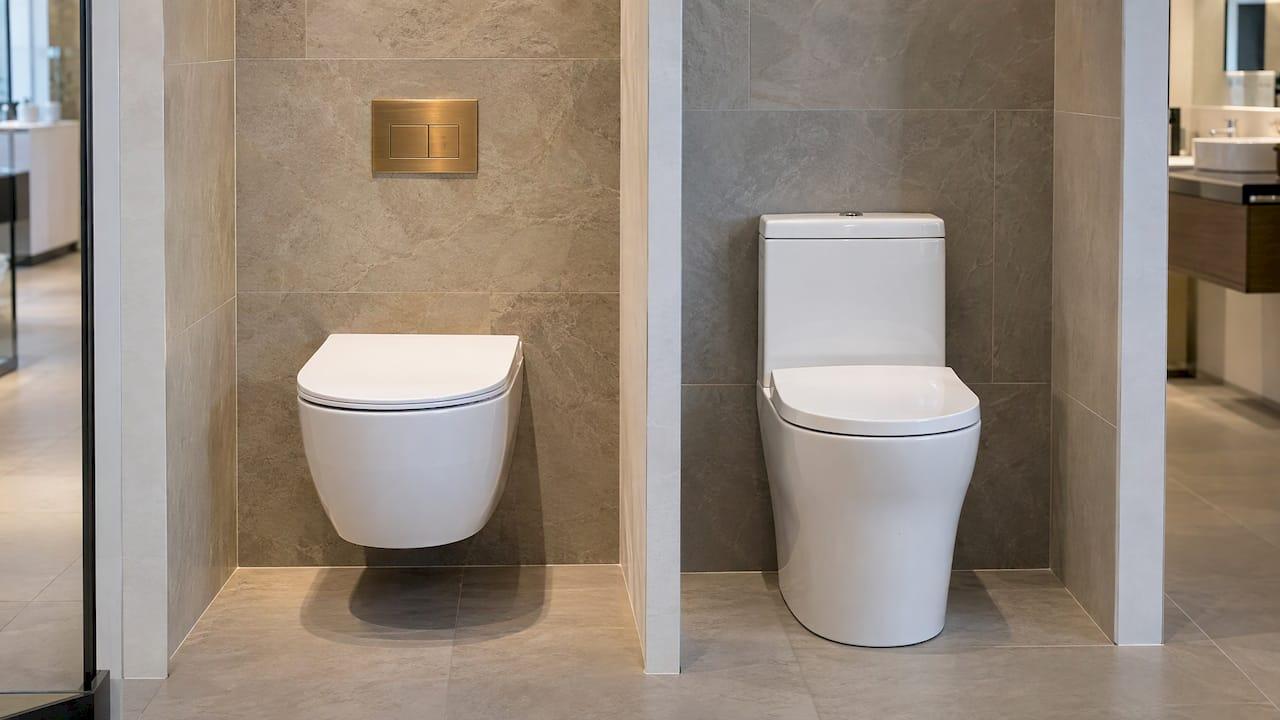
Choose a wall-hung toilet if you want the floor clear and easy to mop, and you can plan a concealed frame and false wall from the start. Choose a floor-mounted toilet if you want the simpler, cheaper, easier-to-repair option. In a new-launch condo like Hougang Central Residences, where the bathroom fittings are set before you move in, the decision is mostly about knowing what you are looking at in the showflat and what you may change later.
TL;DR
- A wall-hung toilet bolts to a steel frame hidden in the wall, with the cistern concealed and a push plate for flushing. A floor-mounted toilet sits on the floor with a visible or close-coupled cistern.
- Wall-hung wins on looks, floor space and cleaning. Floor-mounted wins on cost, simple replacement and cistern access.
- Singapore pricing varies widely: bowl-only replacement is quoted at S$120 to S$400, while concealed-cistern systems and premium wall-hung bowls cost much more.
- Frame strength is rarely the problem. How the frame is anchored into the wall is what matters.
- If you buy new, check the fitting type in the showflat. If you renovate later, check your condo's or HDB's rules before any hacking.
Table of Contents
- What is the actual difference?
- Pros and cons side by side
- Space and cleaning in a Singapore bathroom
- Installation and maintenance
- How much weight can a wall-hung toilet take?
- What does it cost in Singapore?
- Renovation rules to know first
- What to check when you view a new condo bathroom
- Our view
- See the bathrooms in person
- FAQ
- Sources
What is the actual difference?
The bowl is the visible part, but the real difference is behind it.
A wall-hung toilet is fixed to a carrier frame concealed behind a finished wall. The cistern sits inside that wall and the bowl is suspended above the floor. You flush by pressing a plate on the wall surface, as one Singapore guide describes.
A floor-mounted toilet rests directly on the floor. The cistern and more of the surrounding plumbing can usually be reached without opening a wall, according to a Singapore plumbing guide. Floor-mounted toilets often connect straight to a conventional floor-level outlet. Wall-hung systems need the discharge lined up with the concealed carrier and cistern.

That is why plumbers start with the existing waste outlet before they talk about style. The bowl, frame, cistern position, waste connection and fixing points have to work as one system.
Pros and cons side by side
| Factor | Wall-hung | Floor-mounted |
|---|---|---|
| Look | Minimalist, floor visible beneath | Traditional, base on the floor |
| Floor cleaning | Mop straight under the bowl | Dirt collects around the base and behind the bowl |
| Space | Frees floor area; false wall takes some depth | Base takes floor area; more size and design choices |
| Seat height | Adjustable at installation | Fixed by the model |
| Installation | Frame, false wall, more labor | Often a straight swap on the existing outlet |
| Cost | Higher | Lower, especially two-piece models |
| Cistern repairs | Through the flush plate opening | Lift the cistern lid |
The pattern in the Singapore comparison is consistent. Wall-hung wins on look, mopping access and adjustable height. Floor-mounted wins on simple installation, lower cost and easy repair access. A Singapore guide to pros and cons adds that wall-hung installation can involve wall reinforcement and structural changes, and that hidden cistern repairs are less accessible.
Space and cleaning in a Singapore bathroom
Most Singapore bathrooms are compact. A Singapore interior-design guide notes that HDB bathrooms are around 3.5 to 4 sqm, so a floor-clear bowl is a real spatial gain rather than a cosmetic one. It also points out that the humid climate means floors get cleaned often, and a bowl with no base removes the awkward corner.
There is a trade-off to understand. The bowl itself is slightly more compact, as Duravit's product guidance says, but the false wall that hides the frame takes depth. Standard installations add roughly 120 to 140 mm, per the same Singapore guide. Whether you gain or lose usable space depends on the layout, so measure the wall before you decide.
For reference, US building codes typically want at least 21 inches (about 53 cm) of clearance in front of a toilet. Consumer Reports notes the in-wall tank can save about 10 inches, and the seat can be set to the 17 to 19 inch accessible standard. Singapore has its own rules, but the logic carries over: moving the tank into the wall gives you room, and adjustable height helps taller users, children and older family members.
Installation and maintenance
Wall-hung. The frame, water inlet, waste outlet and anchoring go in before tiling. Installers advise confirming the rough-in timing, false wall depth, flush plate choice and service access behind the plate before work starts. A good system has an access panel behind the flush plate so maintenance does not mean hacking tiles. This is why wall-hung toilets are best planned during a full bathroom renovation.

Floor-mounted. It usually sits on the existing outlet with the right pan collar, so it suits a quick upgrade. The cistern lid lifts off for repairs, as a Singapore guide also notes.
One maintenance point deserves honesty for both types: a wall-mounted bowl can loosen over time from repeated pressure on the mount and may need adjusting, according to a US plumbing guide. That is why the installation quality matters more than the brand name on the bowl.
How much weight can a wall-hung toilet take?
This is the question most buyers worry about, and the answer is reassuring when the system is specified properly. GROHE's Singapore guide states its powder-coated steel concealed frames are TÜV-approved to support up to 400 kg. A Singapore guide reports that the widely used Geberit Duofix system is tested to a 400 kg static load, and can be set at 820 mm or 1000 mm from floor to finished tile.
The number is not universal. Horow's guide says capacity depends on the exact carrier, framing, anchoring and manufacturer rating, so read the published spec for the specific system.
The bigger point is the wall. sgbathroom.com explains that the frame carries the pan's dead weight, the live load of sitting and standing, and passes it into the wall. A well-rated frame still fails if anchored into a wall not built for it. Their checklist, done while the wall is open and before tiling: frame anchoring, pan fixing points, outlet height and angle, service-zone depth and flush plate alignment. A Singapore installation guide adds that the wall should be concrete or reinforced brick.
What does it cost in Singapore?
Published prices vary by fixture and scope, so treat them as ranges, not quotes.
- Bowl installation or replacement: S$120 to S$400 in one 2026 plumbing price guide. That is the floor-mounted swap scenario.
- Concealed-cistern products: S$430 to S$749 for one brand's range, before the bowl, labor and finishing.
- Premium wall-hung bowls with an integrated bidet seat: from S$2,454 up to S$6,498 at one retailer's listed prices.
- Wet-area waterproofing: S$60 to S$95 per sqm in a 2026 plumbing guide, which matters because a wall-hung job usually opens up the wall. Any work connecting to the PUB water supply must be done by a PUB-licensed plumber.
For scale, Consumer Reports reports US installation labor for wall-mounted toilets typically starting around $500, against $150 to $300 for a standard toilet. The direction is the same everywhere: the frame and wall work, not the bowl, drive the difference.
Renovation rules to know first
If you are moving from an HDB flat or planning to renovate any home, the rules shape your options before taste does.
For a newly built HDB flat, HDB's renovation guide says owners must wait three years before removing wall or floor finishes in toilets, to protect waterproofing. A permit is needed to change finishes or extend the bathroom afterwards. In that window a floor-mounted bowl is the practical choice. Before you open any bathroom wall, it also helps to understand how bathroom walls are waterproofed, since a false wall and new frame disturb that layer.
Condos have their own layer: management corporation (MCST) house rules and the defects liability period after a new launch. Our guide to condo renovation rules and the new-launch defects period covers what to confirm before any work begins.
What to check when you view a new condo bathroom
In a new launch, you are usually choosing a unit, not a toilet. So use the showflat to read the bathroom:
- Note the fitting type. Is the bowl wall-hung or floor-mounted, and where is the flush plate or cistern?
- Look at the floor. Imagine mopping around the bowl. Can you see clear floor under it?
- Check the depth. If there is a false wall, how much room is left for you to move?
- Think about height. Family members of different ages use the same bathroom. Adjustable height is a plus for children and older users, and our piece on elderly-friendly condo features goes further.
- Think about finishes. Tile choice affects cleaning as much as the toilet does, see marble vs porcelain tiles.
- Look at smart features. Many buyers pair a toilet choice with bathroom technology. Our smart bathroom features guide explains what to look for.
Which should you pick? If you rent out, move often or want a quick bowl swap, floor-mounted is the simple answer. A one-piece rimless floor-mounted bowl is also a good middle path, as a Singapore guide suggests: easier to clean than a two-piece, with none of the structural work. If you are building a bathroom from scratch and want an open floor, wall-hung is the stronger pick.
Our view
We see the toilet as a small decision that tells you a lot about how a home is planned. In a new unit, the question is not only wall-hung or floor-mounted. It is whether the bathroom was designed as one system: the waterproofing, the tiles, the fittings, the layout around them.
That is why we put premium European fittings and smart-home systems into how Hougang Central Residences is designed, rather than leaving every bathroom decision to a later renovation. When fittings come with the home, you avoid opening finished walls, the cost of a frame and false wall, and the wait for approvals.
Our advice to families, young professionals and retirees is the same: view the bathroom in the showflat, picture the daily routine, and pick the unit layout that suits it. The right toilet is the one that fits the space you will actually live in.
Simon
See the bathrooms in person
Hougang Central Residences offers 835 homes above Hougang MRT, from 1-bedroom plus study units to 5-bedroom penthouses, with premium European fittings and smart-home systems. Prices start from S$2,800 per sq ft, as shown on our pricing page.

Browse the residences and unit types or compare layouts on the floor plan page, then register for a showflat visit to see the bathrooms for yourself.
FAQ
Are wall-hung toilets worth it?
They are worth it when you are doing a full bathroom renovation or moving into a new home, and you value an open floor and easy cleaning. You pay more for the frame, the false wall and the labor. For a quick bowl-only swap, a floor-mounted toilet is more practical.
What are the main pros and cons of a wall-mounted toilet?
The pros are a modern look, easy mopping underneath, adjustable height and a more open feel in small bathrooms. The cons are higher installation cost, more complex work and more limited access to the concealed cistern. Good planning of the service access behind the flush plate removes most of the repair worry.
How much weight can a wall-hung toilet hold?
Frames from major makers are rated to around 400 kg, but the figure depends on the exact system and on the wall it is anchored to. Read the published rating for the specific carrier and have the anchoring confirmed while the wall is open.
Can I install a wall-hung toilet in an HDB flat?
Only within HDB's rules. For a newly built flat, toilet wall and floor finishes cannot be removed for three years, and later changes can need an HDB permit and a listed renovation contractor. Check HDB's renovation guide before planning any hacking.
What do plumbers look at first?
They start with the existing waste outlet, because it decides how easily each type can connect. Then they check that the frame, cistern position and fixing points work together.
Sources
- Wall-hung toilet vs floor-mounted comparison, Singapore
- Wall-hung vs floor-mounted toilet bowls, plumber considerations
- Guide to floor-mounted and wall-hung toilet bowls in Singapore
- Pros and cons of wall-mounted toilets, Consumer Reports
- Toilets overview, Duravit
- Concealed cistern guide for Singapore interiors
- Wall-hung vs floor-mounted toilet bowl guide, Singapore
- Pros and cons of a wall-mounted toilet, US plumbing guide
- Installation systems guide for toilets, GROHE
- Wall-hung toilets pros and cons, Horow
- Wall-hung frames and load rating
- Wall-mounted toilet bowl installation in Singapore
- Plumbing cost guide in Singapore 2026
- Concealed cistern price list
- Wall-hung toilet bowl price list
- Plumbing services and costs, Singapore
- HDB renovation guide, MyNiceHome
- How to waterproof bathroom walls