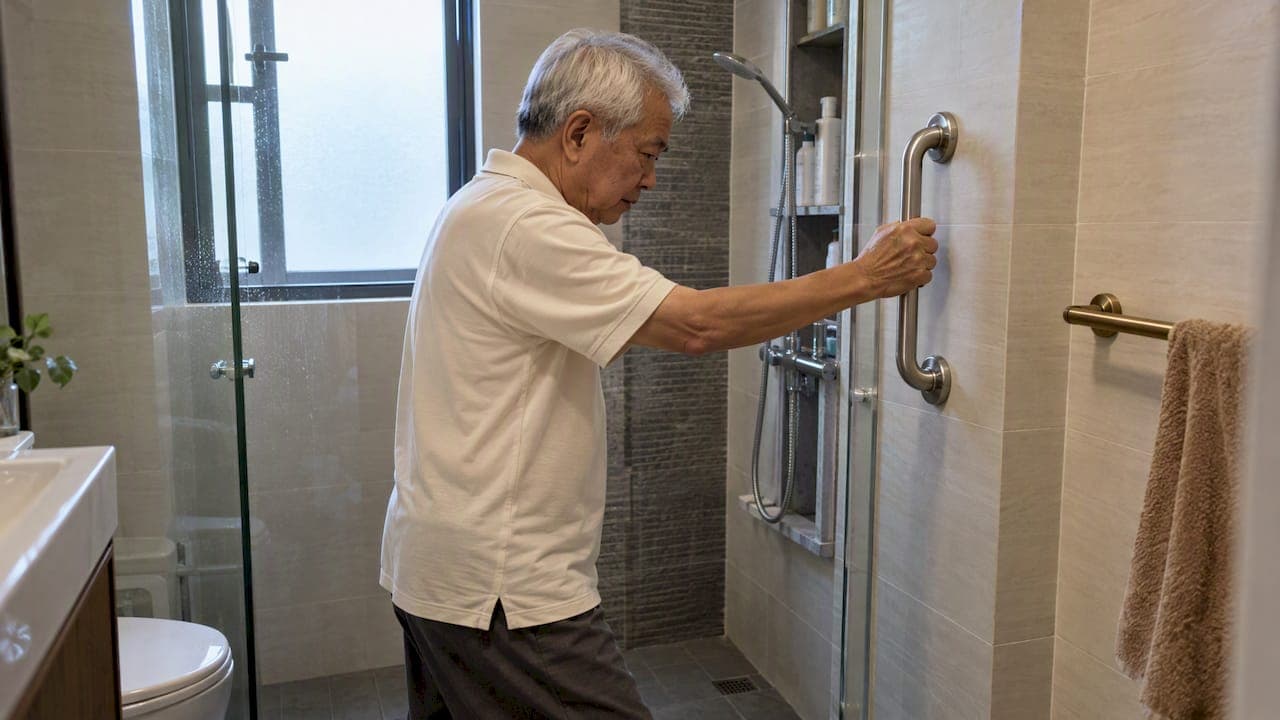
Prioritize step-free entry, a safe bathroom, wide doorways with clear circulation, layered lighting with reachable switches, and simple emergency tech; these five areas deliver the most safety and independence for elderly condo residents. Singapore's BCA accessibility code and SS 605:2015 set the benchmarks, and the EASE programme now subsidizes many of these upgrades for private homeowners too.
TL;DR:
- Level entry thresholds and wide doorways should meet the 50mm and 900mm standards to ensure smooth mobility for seniors using walkers or wheelchairs.
- Bathroom upgrades like grab bars, slip-resistant flooring, and foldable seats qualify for subsidies through the EASE program, which extends to private homeowners in 2026.
- Interior layout should reserve space for future modifications, reinforce wall backing for grab bars, and consider textured tiles and accessible storage to adapt easily over time.
- Smart safety devices such as fall sensors and remote-controlled climate systems can enhance independence but should be added gradually starting with basic emergency call buttons.
- Accessible estate features, including barrier-free routes, larger lifts, and covered walkways, are crucial for overall home safety and should be checked before purchasing a condo.
Table of Contents
- 1. Prioritized checklist of elderly-friendly condo features
- 2. Bathroom and wet-area upgrades for safer ageing in place
- 3. How much doorway width and threshold height actually matter
- 4. Lighting, switches and finishes that reduce fall risk
- 5. Smart safety tech worth adding to a condo for elderly residents
- 6. Estate-level accessibility checks before buying a condo
- 7. Materials and layout choices that avoid future renovation
- 8. Kitchen modifications that keep cooking safe and independent
- 9. Bedroom safety features that prevent night-time falls
- 10. HVAC choices that support comfort and health for older residents
- 11. Noise control that protects rest and concentration
- 12. Maintenance that keeps elderly-friendly fittings working long term
- How we think about age-friendly design at Hougang Central Residences
- Explore accessibility-ready layouts at Hougang Central Residences
- FAQ
- Sources
1. Prioritized checklist of elderly-friendly condo features
Not every upgrade carries equal weight. Some changes prevent falls outright, others add convenience on top of a safe base. This order reflects what actually keeps an older resident independent and injury-free in a Singapore condo.
- Step-free bathroom access: grab bars near the toilet and shower, a roll-in or low-threshold shower, and slip-resistant flooring cut the single biggest source of home falls.
- Level entry thresholds: the BCA Code on Accessibility caps entrance level differences at 50mm, a rule worth checking in any unit before signing.
- Wide doorways and turning space: corridors and doorways wide enough for a walker or wheelchair matter more once a resident's mobility changes, even if nobody uses a mobility aid on moving-in day.
- Non-slip flooring in wet and dry zones: textured tiles outperform polished stone, which turns hazardous the moment it gets wet.
- Layered lighting and reachable switches: brighter task lighting plus switches mounted within easy reach reduce the fumbling that leads to night-time falls.
- Lever-style door and tap handles: easier to operate for arthritic hands than round knobs or twist taps.
- Simple emergency tech: a call button or pendant alarm gives both the resident and family a fast way to summon help.
- Estate-level accessibility: barrier-free routes from carpark to lift lobby, and lifts sized for wheelchairs, decide whether the building itself works for an ageing resident.
Several of these items now qualify for subsidy. The EASE programme lists grab bars, slip-resistant floor treatments, foldable shower seats and ramps as eligible fittings, and its 2026 rollout extends these subsidies to private homeowners for the first time, with phased eligibility by age. Retrofitting an existing condo costs more than building these features in from the start, since pipes, tiling and wall reinforcement often need to be redone. Buyers evaluating a new launch should ask directly whether walls near future grab-bar locations are pre-reinforced, and whether bathroom layouts already allow a roll-in shower without demolition.
2. Bathroom and wet-area upgrades for safer ageing in place
The bathroom is where most home injuries happen among older residents, and it is also the room with the most retrofit options. A roll-in shower with a fold-down seat generally works better than adapting an existing bathtub, since stepping over a tub rim is itself a fall risk; where a tub cannot be removed, a transfer bench and a non-slip mat reduce that risk without a full renovation.
- Place grab bars near the toilet, inside the shower, and along any step, following SS 605:2015 guidance on bathroom retrofitting.
- Ask contractors to reinforce wall backing behind future grab-bar zones even before a bar is installed, so later additions avoid cutting into finished tile.
- Fit anti-scald mixer taps and a fold-away shower seat rather than a fixed bench, which frees up space for a caregiver.
Our guide to smart bathroom features for condos walks through additional fittings worth considering at renovation stage.
Pro Tip: Ask your contractor to install grab-bar backing during first fit-out, even if you don't need bars yet; adding reinforcement later usually means re-tiling the whole wall.
3. How much doorway width and threshold height actually matter
A condo that looks accessible on a floor plan can still fail in practice if a doorway is 10mm too narrow for a walker frame. The BCA Code on Accessibility sets entrance level differences at no more than 50mm and recommends generous manoeuvring space at doorways, and most accessibility planners target doorways around 900mm wide with a 1.5m turning circle in front of them wherever the layout allows.

A portable ramp suits a small step and a tight budget; a custom-built ramp suits a permanent kerb that a household expects to live with for years. Where a kerb cannot be lowered without structural work, reserving floor space near the entry for a future ramp or platform lift avoids a bigger renovation later.
Before buying or signing off a renovation, check:
- Entrance and bathroom threshold heights, measured directly rather than taken from marketing material.
- Doorway clear widths at the main entry, bedroom and bathroom.
- Turning space in front of doors and beside the toilet and shower.
4. Lighting, switches and finishes that reduce fall risk
Poor lighting and awkward switches cause more falls than most homeowners expect, especially on night trips to the bathroom. Layered lighting, meaning separate ambient, task and night-path lighting rather than one ceiling light, gives older eyes enough contrast to judge steps and furniture edges.
- Add motion-sensor night lights along the path from bedroom to bathroom so nobody needs to find a switch in the dark.
- Mount switches and sockets between 450mm and 1,200mm from the floor, matching BCA guidance, and favor large rocker switches over small toggles.
- Choose lever-style door and tap handles throughout, not just in the bathroom.
- Avoid polished marble or granite in wet zones; textured tiles stay grippy once wet and need no reapplied anti-slip coating over time.
Design experts recommend textured, slip-resistant surfaces chosen at the construction stage rather than aftermarket fixes, since adhesive anti-slip strips wear down and need regular replacement.
5. Smart safety tech worth adding to a condo for elderly residents
Technology works best in layers: start with something simple, then add more only if a genuine need appears. An emergency pendant or wall-mounted call button is the cheapest and most reliable first layer, since it needs no app and no learning curve.
- Emergency pendants or call buttons for immediate help, with no technical setup required.
- Fall-detection sensors or wearables that alert a family member automatically if a fall is suspected.
- Door and bed sensors that flag unusual inactivity without constant video monitoring.
- Smart lighting and locks that let family members check or adjust settings remotely during a hospital stay or recovery period.
Plug-and-play gadgets suit renters and smaller budgets, while an integrated system suits a long-term owner who wants everything on one app; either way, check the vendor's after-sales support in Singapore before buying, since warranty service varies widely between brands. Our smart-home features checklist and this overview of layered condo security both cover practical starting points.
Pro Tip: Install the emergency call button first and treat continuous monitoring as a later addition, not a day-one requirement.
6. Estate-level accessibility checks before buying a condo
Unit-level upgrades only work if the building around them is accessible too. A perfectly adapted apartment is still a problem if the lift lobby has steps, or if the gym and pool have no accessible entry point.
- Confirm barrier-free access from the carpark and drop-off point straight through to the lift lobby, with no unramped steps along the way.
- Check lift car size and whether controls sit at a reachable height for a wheelchair user.
- Look for covered walkways linking the block to the mall, bus interchange or MRT entrance, since weather protection matters for residents with limited mobility.
- Ask about accessible entries to the gym, pool deck and function rooms, not just the main lobby.
MCST committees and MND are reviewing funding for accessibility upgrades at private developments, which may extend co-funding to senior-friendly features at the estate level over time. Our community amenities checklist for retirement condos covers more of these estate-level factors, which also tend to matter at resale.
7. Materials and layout choices that avoid future renovation
Small decisions made at purchase or first fit-out save larger, more disruptive renovations years later. Hard-wearing textured tiles, raised appliance plinths that avoid deep bending, and reach-friendly pull-out storage all cost little extra when specified early.
- Choose lightweight, movable partitions over fixed walls where a room's use might change as needs evolve.
- Pre-reinforce walls in bathrooms and near beds for future grab bars, even before anyone in the household needs them.
- Reserve space, such as an airwell roughly 1.6m by 1.6m, for a future platform lift if the unit spans more than one level.
Design guidance on ageing-in-place homes favors flexible, evolving layouts over one-off clinical modifications, and a flexi room, a spare space that can become a caregiver's room, a home office or a bedroom later, tends to hold its usability and resale value better than a fixed-purpose layout.
Pro Tip: Ask your architect or contractor to mark reinforced wall sections on the floor plan at handover, so future renovators know exactly where grab bars can go without extra structural checks.
8. Kitchen modifications that keep cooking safe and independent
A kitchen built for a 30-year-old's reach often fails an older resident long before the rest of the home does. Upper cabinets that need a step stool, deep base drawers that require bending, and round taps that strain stiff fingers all add daily friction that a few targeted changes can remove.
Lowering a section of countertop, even just one run near the sink or stove, gives a seated or shorter resident a workable prep zone without rebuilding the whole kitchen. Pull-out shelves and drawers in place of fixed cabinets put pots and ingredients at waist height instead of floor level, cutting the number of times someone bends or reaches overhead in a day.
Lever-style or single-lever mixer taps replace twist handles that become difficult with arthritis, and an anti-scald valve adds a layer of safety for residents with reduced heat sensitivity in their hands. Induction cooktops are worth considering over open-flame gas hobs, since they cool quickly and reduce burn risk if a pot is left unattended.

Storage placement matters as much as the fittings themselves: keeping everyday items, plates, mugs, frequently used pots, between knee and shoulder height means less climbing and less bending during ordinary cooking. None of these changes require a full kitchen gut; most can be phased in during a normal renovation cycle, starting with the items used most often.
9. Bedroom safety features that prevent night-time falls
Bedrooms deserve the same attention as bathrooms, since many falls happen during the transition from bed to floor in low light. A clear, obstacle-free path from bed to bathroom door, with nothing to trip over in the dark, matters more than any single gadget in the room.

An adjustable bed, one that raises the head or foot electrically, makes getting in and out far easier for a resident with joint pain or limited core strength than a fixed-height frame, and it removes the need to push up from a low mattress. Bed height itself matters too: a mattress and base combination that puts the seated height around knee level usually works best for standing up without strain.
Placing a bedside emergency call button or pendant alarm within arm's reach of the pillow, rather than across the room, closes a gap many households overlook until an actual fall happens. Night-path lighting that triggers automatically when feet touch the floor, covered in more detail in the lighting section above, pairs naturally with this setup.
Furniture arrangement should leave at least a clear, walker-width path to the door at all times, which sometimes means resisting the instinct to add a second bedside table or an extra armchair. A fitted, low-pile rug or no rug at all beats a loose mat that can slide or bunch underfoot.
10. HVAC choices that support comfort and health for older residents
Singapore's humidity and heat make air conditioning close to essential, but the way a system is set up matters more for older residents than for younger ones. Sudden temperature swings between a cold bedroom and a warm living room can aggravate joint pain and circulation issues, so a system that allows gentler, zoned temperature control across rooms tends to suit elderly residents better than one aggressive unit cooling the whole space.
Humidity control matters as much as temperature. Overly dry air from constant air conditioning can aggravate respiratory conditions and dry skin, both common concerns for older residents, so a unit with adjustable humidity settings or a standalone dehumidifier for damp periods helps maintain a more comfortable baseline.
Air filtration is worth prioritizing for residents with asthma or other respiratory sensitivities. A unit with a washable or replaceable filter, positioned where it is easy to access without climbing, keeps maintenance realistic rather than something that gets postponed. Ceiling fans paired with air conditioning reduce the need to run units at full blast, which also cuts running costs over a long retirement.
Remote or app-based thermostat control, flagged earlier under smart-home tech, lets a family member adjust temperature for a resident who finds physical controls difficult to operate, particularly after a fall or during recovery from a procedure.
11. Noise control that protects rest and concentration
Noise affects older residents differently than it does younger ones, partly because sleep becomes lighter and more easily disrupted with age, and partly because hearing changes can make certain frequencies, like traffic rumble or a neighbor's television, more intrusive rather than less.
Unit selection plays a bigger role here than most buyers expect. A unit facing away from a main road, a bus interchange or a mechanical plant room tends to stay quieter without any acoustic retrofitting at all, which is usually cheaper than fixing noise after the fact. Double-glazed windows, where available, cut external traffic and construction noise noticeably compared to single-pane glass.
Internally, soft furnishings, rugs, curtains, upholstered furniture, absorb sound that would otherwise bounce between hard surfaces like tile floors and bare walls, and this matters particularly in open-plan living areas where television noise and conversation can echo. Solid-core internal doors between a bedroom and the rest of the unit block more sound than the hollow-core doors common in budget fit-outs, which helps when one resident wants to sleep while the household stays active elsewhere.
Quiet-running appliances, particularly air conditioning compressors and exhaust fans, matter more in a home where someone spends most of the day indoors. Checking a unit's noise rating before purchase, rather than after move-in, avoids a difficult retrofit later.
12. Maintenance that keeps elderly-friendly fittings working long term
Accessibility fittings only help if they keep working, and some require more upkeep than homeowners expect at installation. Grab bars need periodic checks on wall anchoring, since the fixing can loosen over years of use even when the bar itself looks fine.
Durability should guide material choice from the start. Hard-wearing, textured tiles resist wear better than softer finishes and avoid the slow degradation that turns a once slip-resistant surface hazardous again. Choosing fittings with widely available spare parts, rather than a niche imported brand, makes repairs faster and cheaper when something does fail.
Smart devices, sensors, pendants, smart locks, need batteries changed and firmware updated, so households relying on them benefit from choosing vendors with reliable after-sales support in Singapore rather than the cheapest option online. A yearly walk-through checking grab-bar stability, lighting function, door hardware and smart device battery levels catches small issues before they become safety problems.
Ease of repair matters as much as initial durability: a shower seat or ramp that can be serviced by a general handyman beats one that requires a specialist flown in or parts shipped from overseas.
How we think about age-friendly design at Hougang Central Residences
We design smart-home readiness, premium fittings and direct transit access into our residences with long-term livability in mind, not just move-in day. Combining those fittings with the retrofit principles above gives older residents and their families a stronger starting point for ageing in place.
— Simon
Explore accessibility-ready layouts at Hougang Central Residences
If the checklist above has you thinking about which floor plan actually fits a parent or an ageing household member, our residences page lays out unit types from a 1-Bedroom + Study through to a 5-Bedroom Penthouse, including flexi-room options worth considering for future adaptability. Pricing starts from $2,800 per square foot, as listed on our pricing page.
Request an e-brochure or book a showflat visit to ask the team directly about accessibility-ready layouts, smart-home systems and unit availability.
FAQ
Can a 70 year old buy an HDB flat?
Yes, a 70-year-old can buy an HDB flat, subject to the usual eligibility rules such as citizenship status and the specific scheme applied for. Age itself is not a barrier, though loan tenure and financing options may differ for older buyers.
How old is considered elderly in Singapore?
Singapore's EASE programme phases private-home eligibility by age, starting with residents aged 80 and above, then 70 and above, then 65 and above, under the 2026 rollout. This phased approach suggests policy generally treats 65 as the starting threshold for senior-specific support.
What are some suitable activities for elderly people?
Low-impact activities that support mobility and social connection, such as walking groups, light gym sessions and community classes, tend to suit older residents best. Condos with accessible common facilities and nearby walkable amenities make these activities easier to sustain day to day.
What HDB program can I use to make my flat more elderly friendly?
The EASE programme subsidizes fittings like grab bars, slip-resistant floor treatments, foldable shower seats and ramps. Its 2026 rollout extends similar vouchers, worth $1,200 and offsetting up to 75% of installation costs, to eligible private homeowners in phases through the year.
Sources
- BCA Code on Accessibility in the Built Environment
- SS 605:2015 Age-friendly home environment (Singapore Standard)
- What goes into a home designed for ageing in place | EdgeProp Singapore