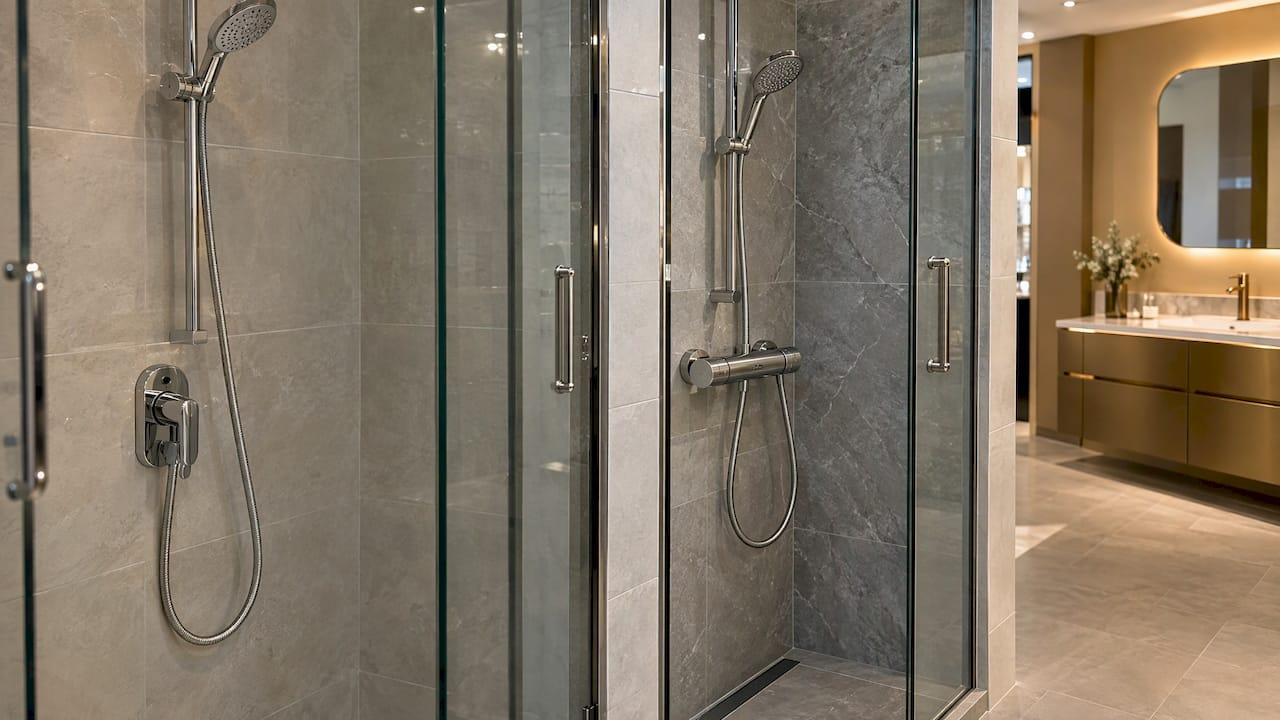
A thermostatic mixer holds the water temperature you set, even when pressure or supply temperature changes. A single-lever mixer sets temperature and flow with one handle, so you adjust it by hand whenever conditions shift. For a family with children, elderly parents or anyone who dislikes surprise bursts of hot or cold water, the thermostatic mixer is the steadier, safer choice. For a simple, quick-to-use guest bathroom, a single lever is perfectly workable. The sections below explain why, how heater type changes the answer, and what to look at when you buy a new home and its bathroom fittings come as part of the package.
TL;DR
- A single-lever mixer controls flow and temperature with one handle. A thermostatic mixer lets you set the temperature on its own and keeps it there.
- A thermostatic mixer reads and corrects the mix when supply pressure or temperature changes. A pressure-balance valve reacts mainly to pressure differences between hot and cold lines.
- Choose thermostatic for children, seniors and shared bathrooms. Choose a single lever for simplicity and for lightly used bathrooms.
- Your water heater matters: an instant heater suits one shower point, while a storage heater suits rain showers and several outlets.
- In Singapore, thermostatic mixing valves sold and installed must meet PUB's stipulated standards, and some tap and shower work needs a Licensed Plumber.
Table of Contents
- How the two mixers work
- Temperature control, comfort and safety compared
- Where pressure-balance valves fit in
- What Singapore homes need to know
- Your water heater changes the choice
- Common thermostatic valve problems and what causes them
- How to choose: a quick decision guide
- Why this matters when you buy a new home
- Seeing the homes for yourself
- Our perspective
- FAQ
- Sources
How the two mixers work
Both mixers blend hot and cold water before it reaches the showerhead. The difference is who does the blending work.
A single-lever mixer uses one handle for everything. Lift it for more flow, swing it sideways for hotter or colder water. Hansgrohe describes it as one lever controlling both temperature and flow, with no automatic shut-off if the hot or cold supply fails, which can carry a scalding risk if used carelessly.
A thermostatic mixer separates the two jobs. One control sets the temperature, usually on a dial with a marked scale. Another controls how much water comes out. Inside, a temperature-sensitive element continually adjusts the hot and cold proportions. According to the same manufacturer, the valve senses changes in supply pressure or temperature and readjusts the mix. It also shuts the water off automatically if the cold supply fails, so you are not left under a stream of hot water.

That separation is the practical heart of the comparison. With a single lever, finding your temperature is a small ritual each time: nudge, wait, nudge again. With a thermostatic mixer, you set it once, and from then on you only turn the water on and off.
Temperature control, comfort and safety compared
| Factor | Single-lever mixer | Thermostatic mixer |
|---|---|---|
| Controls | One handle for flow and temperature | Separate temperature and flow controls |
| Reaction to pressure or temperature change | You correct it by hand | Valve corrects the mix automatically |
| Cold-water failure | No automatic shut-off | Shuts off automatically |
| Setting your preferred temperature | Adjust every shower | Set once, reuse |
| Best for | Simple bathrooms, quick showers | Families, children, seniors, shared use |
Comfort
The comfort gain shows up in everyday moments. Someone flushes a toilet or runs a kitchen tap while you are showering. On a single lever, the mix can swing suddenly. A thermostatic valve is built to absorb those changes and keep the water where you put it.
Safety
Safety is the stronger argument for a household with young children or elderly members, because scalding is a risk for people who react slowly or cannot move away quickly. A fixed temperature scale on a thermostatic dial also lets an adult set a safe level before a child steps in. Many thermostatic models add a stop at a lower temperature that must be deliberately overridden, which is worth looking for on the product sheet.
Ease of use
A single lever is simple to understand and easy to operate with wet hands. Two controls mean one extra step for the first-time user, though most people adapt within a few showers. For retirees with weaker grip, a large dial with a clear scale can be easier than a lever that needs fine positioning.
Where pressure-balance valves fit in
Many people searching this topic also meet a third type: the pressure-balance valve. It looks like a single-lever mixer from the outside, which causes plenty of confusion.
Kohler's buying guide describes pressure-balancing valves as one-handle valves that control on/off and temperature, typically used in basic bath and shower setups. Its thermostatic manual valves, by contrast, maintain a set temperature and can use separate volume controls when several shower components run together, such as an overhead rain shower plus a hand shower.
The practical difference:
- A pressure-balance valve keeps the hot and cold pressures in step. If cold pressure drops because someone opens another tap, the valve reduces hot pressure to match. The mix stays close, but flow can dip for a moment.
- A thermostatic valve responds to the temperature of the mixed water itself. If the incoming hot water becomes cooler, it adjusts the proportions to compensate.
Neither type creates extra pressure. If your shower feels weak, a different valve will not fix it. For a multi-outlet shower set, the thermostatic type is the more natural fit because it manages temperature while you control each outlet separately.
What Singapore homes need to know
Standards for thermostatic valves
Singapore regulates what water fittings may be sold and installed. PUB's requirements state that thermostatic mixing valves must pass tests covering leakage tightness, flow rate, sensitivity, safety on cold-water failure and temperature stability under changing inlet pressure and temperature. The document names BS EN 1111 and AS 4032.1 as applicable standards. The same document states that valves tested to BS EN 1111:2017 may be displayed, advertised, sold, supplied and installed in Singapore potable-water systems from 1 April 2020, subject to its stated requirements.
In plain terms: the test for cold-water failure and temperature stability is exactly what you are paying a thermostatic mixer for, and Singapore's rules give it a formal benchmark.
Who may fit a mixer
Regulated water-service and sanitary plumbing works must be done by Licensed Plumbers. PUB's plumbing works page also lists some simple works a handyman may do, including replacing or removing a tap or mixer, a shower hose or showerhead, and the pipe between a stop valve and an instantaneous water heater. Anything beyond that, such as re-routing pipes behind a wall for a concealed valve, belongs with a Licensed Plumber. If you plan wider bathroom changes, understanding plumbing in home renovations helps you sequence the work sensibly.
Your water heater changes the choice
The mixer and the heater work as a pair, so the decision is really about the whole hot-water setup.
An instant (tankless) heater heats water as it flows and does not store it. A storage heater holds heated water in an insulated tank and supplies it on demand, according to a Singapore home guide on Houzz. The same guide says storage heaters suit shared bathrooms and rain showers, while instant heaters generally support one shower point.
What that means for your mixer:
- Instant heater with a handheld shower. Compact and simple. Either mixer type can work. A thermostatic mixer helps keep output steady, but the heater's flow must be adequate: manufacturers list inadequate tankless-heater flow among the causes of temperature swings on thermostatic valves.
- Storage heater with rain shower or bathtub. A thermostatic mixer with separate flow controls suits the multi-outlet layout and a tank that serves more than one bathroom.
- Closely timed family showers. A stored supply and a thermostatic valve together give a steadier experience across back-to-back showers.
For electrical safety, a fixed water heater is connected as fixed wiring, so use a Licensed Electrical Worker for the installation and choose a heater that carries a valid Safety Mark.
Common thermostatic valve problems and what causes them
Thermostatic mixers are more sophisticated than a single lever, so it helps to know the usual culprits when something feels off:
- Limescale and debris. Burlington Bathrooms lists limescale, unbalanced water pressure, a faulty cartridge and blocked inlet filters as common causes of fluctuating temperature.
- Dirty or failed cartridge, or debris in check valves. Signature Hardware's troubleshooting notes these, along with reversed hot and cold supply lines after installation.
- Low hot-water temperature or supply pressure. Hansgrohe's installation instructions include inadequate supply pressure, an uncalibrated thermostat and blocked filters as causes of low flow or wrong temperature.
Most of these are routine upkeep issues: cleaning filters, descaling and having a Licensed Plumber check the cartridge or supply lines. A correctly installed valve on a clean supply tends to be trouble-free.
How to choose: a quick decision guide
- Who showers? Children, seniors or anyone sensitive to sudden temperature change: thermostatic.
- How many outlets? A rain shower plus a handheld, or a bathtub: thermostatic with separate flow controls.
- How often is the bathroom used? A guest or helper's bathroom used lightly: a single lever is fine.
- What heater do you have? One shower point on an instant heater: either mixer, provided flow is adequate. Several outlets on a storage heater: thermostatic.
- Is it compliant? Choose a thermostatic valve that meets the standards PUB stipulates, and use a Licensed Plumber for anything beyond a simple swap.
Why this matters when you buy a new home
In a new launch, bathroom fittings arrive chosen for you, so the quality of what you inherit matters. Fittings are used several times a day for years, and replacing concealed valves later means opening walls. That makes the fittings specification a real part of comparing homes, alongside location and layout.
At Hougang Central Residences, the 835 homes range from 1-bedroom plus study units to 5-bedroom penthouses, and premium European fittings are part of the design. Residents also get smart-home systems, tropical landscaped communal spaces, and direct MRT access above Hougang station with a retail mall and bus interchange alongside. For a family, that mix means comfort inside the home and convenience outside it. The residences page sets out the unit types, from 1-bedroom plus study to 5-bedroom penthouse, so you can match bathroom count and household size to your needs, including how many showers run at once on busy mornings.

Seeing the homes for yourself
Pricing starts from S$2,800 per sq ft, as published on the Hougang Central Residences pricing page. Registering for a showflat visit lets you walk through a unit and see how the bathrooms are laid out, how many showers each home has and what the finishes feel like in person.
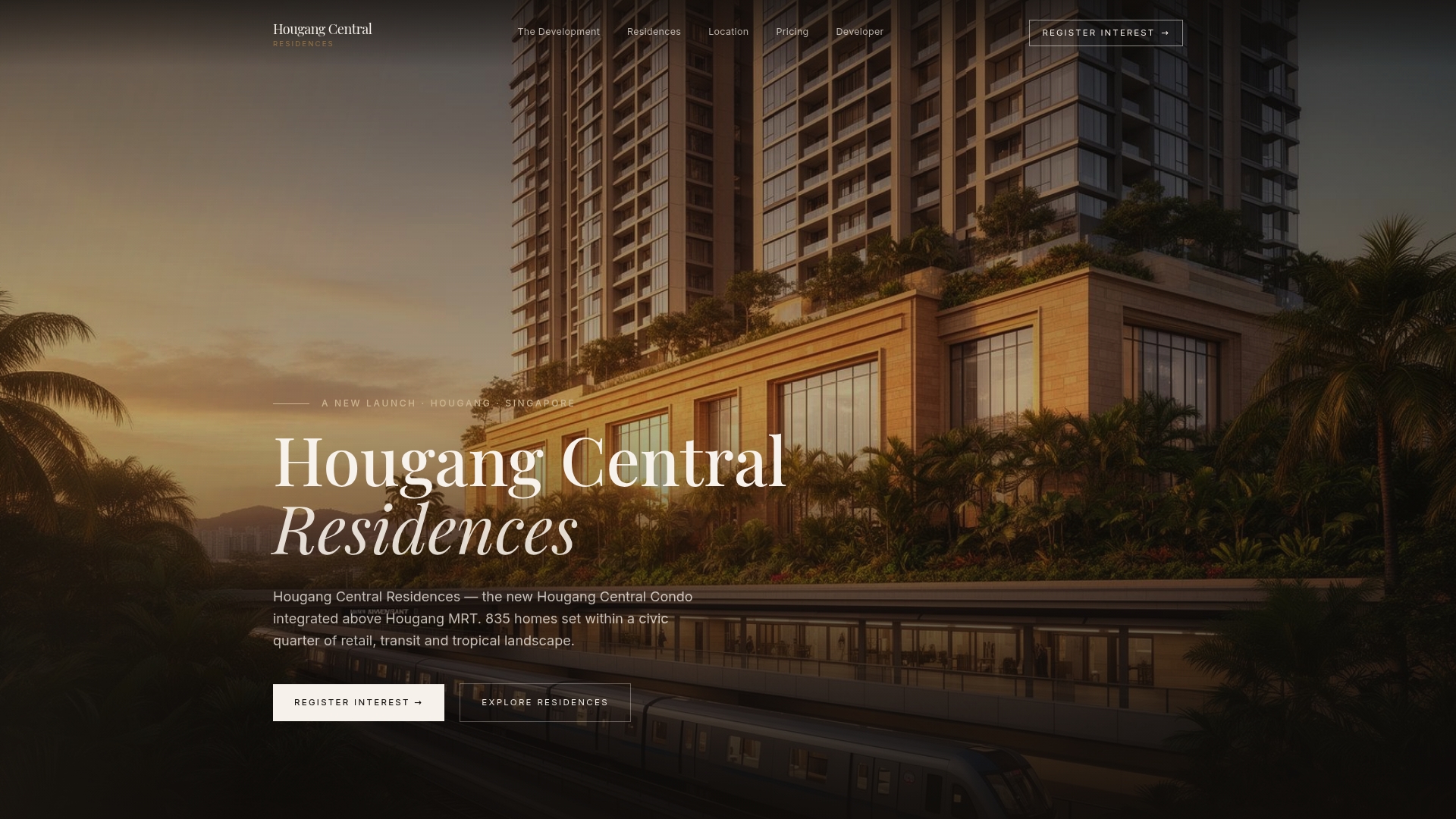
If you are comparing unit types for a growing family, a retiree downsizing close to community amenities, or an investment near a future Cross Island Line interchange, the residences page is the place to start.
Our perspective
A bathroom is judged by the first minute of the morning. If the water is steady and the controls are easy, the home feels well made. If it swings between hot and cold, nothing else in the flat makes up for it.
That is why we think about a home as a daily routine, not a list of features. A family with a toddler and a grandparent needs steady, predictable water. A young professional needs a bathroom that works quickly before the train. A retiree wants controls that are easy to read and use.
Hougang Central Residences is designed around that routine: premium European fittings, smart-home systems, and a location where the MRT, the mall and the bus interchange are within the same building. We believe a home should take small frictions out of the day, from the shower to the commute.
When you view a unit, look at the bathroom as you would use it: how many people share it, what the controls are like to handle, and how it fits your household.
Simon
FAQ
Is a thermostatic mixer worth it over a single lever?
For households with children, elderly members or several people showering in sequence, yes. It holds the temperature you set and shuts off if the cold supply fails, which a single lever does not. For a rarely used bathroom, a single lever is simpler and adequate.
What is the difference between thermostatic and pressure-balance valves?
A pressure-balance valve keeps hot and cold pressures matched, so the mix stays close when another tap opens. A thermostatic valve reacts to the temperature of the mixed water and adjusts the proportions. Neither adds household water pressure.
Instant or storage water heater for a Singapore flat?
An instant heater is compact and suits one shower point with a handheld head. A storage heater takes more space but suits rain showers, bathtubs and more than one outlet, according to Singapore home guides. Match the heater to how many outlets and people you have.
Can I replace a shower mixer myself in Singapore?
PUB lists replacing a tap or mixer, shower hose or showerhead as simple works a handyman may perform. Regulated plumbing works, such as altering concealed pipes, must be done by a Licensed Plumber. Water heater wiring needs a Licensed Electrical Worker.
Why does my thermostatic shower fluctuate?
Common causes are limescale, a blocked inlet filter, a dirty or worn cartridge, reversed supply lines, or an instant heater that cannot deliver enough flow. Cleaning filters and descaling often helps, and a Licensed Plumber can check the rest.
Sources
- Thermostatic and Manual Showers, Hansgrohe
- PUB Stipulation of Standards and Requirements for Water Fittings
- Plumbing Works, PUB
- How to Choose a Water Heater for Your Home, Houzz Singapore
- Thermostatic Valve Troubleshooting, Signature Hardware
- Shower runs cold or temperature fluctuates, Burlington Bathrooms
- Installation Instructions, Hansgrohe
- Plumbing in Renovations: 2026 Guide