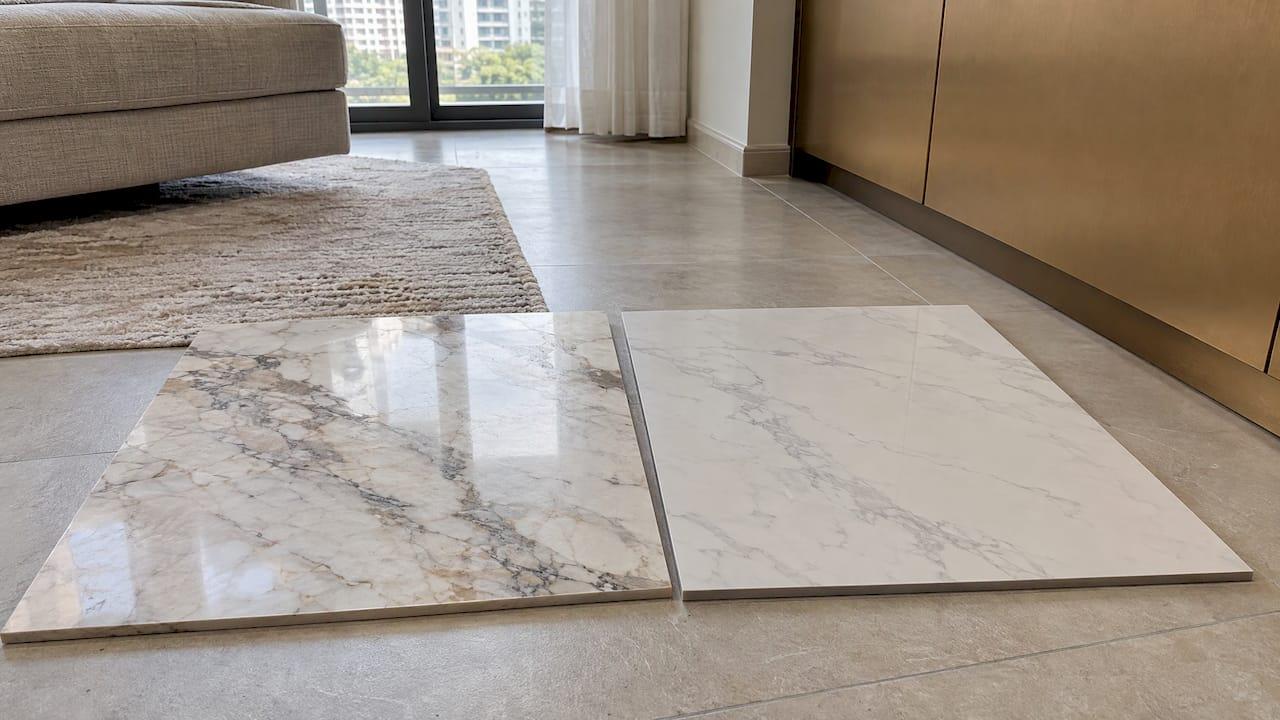
For most Singapore floors, porcelain is the better choice. It costs a fraction of marble, shrugs off humidity and spills, and needs almost no upkeep. Real marble earns its place in a few low-traffic feature areas, where its veining and cool feel are worth the sealing and the budget. If you are weighing a new home, such as the 835 residences above Hougang MRT at Hougang Central Residences, the flooring decision comes right after the purchase decision. This guide gives you the numbers and the room-by-room logic.
TL;DR
- Porcelain is dense enough to count as near-waterproof, and it is the practical default for kitchens, bathrooms, balconies and living areas.
- Installed in Singapore in 2026, porcelain runs about S$10–S$22 psf, marble about S$40–S$70 psf, so marble can cost several times more.
- Marble is softer and porous: it stains, scratches and etches from acids, and it needs regular sealing.
- Marble-look porcelain gives you most of the look without the upkeep; real marble suits a feature wall or a rarely walked area.
- For wet floors, choose a matte or textured finish and ask for the slip rating.
Table of Contents
- What actually separates marble from porcelain
- Porcelain vs ceramic: a quick distinction
- Cost in Singapore: what the numbers say
- Upkeep: where marble asks the most of you
- Wet areas: bathrooms, shower floors and balconies
- Marble-look porcelain: the middle path
- Room-by-room: what to choose
- Marble vs ceramic, briefly
- What to check before you order
- Choosing your finish when you buy a new home
- Where Hougang Central Residences fits
- Our perspective
- FAQ
- Sources
What actually separates marble from porcelain
Marble is natural stone, quarried, cut and polished. Porcelain is manufactured: fine clay, fired at very high temperatures into a hard, dense tile. That difference in origin explains almost everything else.
The standards body ANSI explains that, under the ANSI A137.1 tile standard, porcelain is ceramic tile with water absorption of 0.5% or less. Natural marble is far more porous, which is why liquids can work their way in. Marble's pores are also why it needs to be sealed in the first place.

The other half of the story is hardness. Marble is a relatively soft stone, so it scratches more easily and reacts to acidic substances. A Singapore tile guide describes marble as susceptible to scratches, etching from acids and staining if it is not properly sealed and maintained. Porcelain, by comparison, is described there as significantly less porous and more resistant to water absorption, staining and wear.
What marble has that porcelain cannot fully copy is the real thing: unique veining and visual depth. Manufactured tiles can imitate it but not fully reproduce it. Every slab is different, and that is exactly what some buyers are paying for.
Porcelain vs ceramic: a quick distinction
Many searchers also wonder how porcelain differs from ceramic. Both are clay-based and kiln-fired. Porcelain uses white clay and additives and is fired at a higher temperature, making it harder, denser and more water-resistant. Ceramic is generally easier to cut and less expensive.
A designer quoted in Houzz Singapore adds a practical point: in porcelain the colour runs through the whole tile, so chips are less visible. In ceramic the colour does not continue all the way through, so chips show more. For that reason ceramic is best kept for walls, backsplashes and lighter-traffic areas, and porcelain handles the floors.
Cost in Singapore: what the numbers say
Published prices vary by source, tile origin, size and finish, so treat every figure as indicative and ask for a written quote. The ranges are still consistent about the order of magnitude.
| Material | Supply only (psf) | Supply and lay (psf) | Source |
|---|---|---|---|
| Ceramic | S$1.50–S$3.50 | S$4–S$7 | Singapore tile-market guide, 2026 |
| Porcelain | S$3–S$8 (glazed) | S$6–S$12 | Same guide |
| Natural stone, including marble | S$10–S$30 | S$18–S$45 | Same guide |
| Porcelain, installed | S$2–S$6 | S$10–S$22 installed | Smart Calculator, July 2026 |
| Marble, installed | S$25–S$45 | S$40–S$70 installed | Smart Calculator, July 2026 |
One more reference point: a 2022 Singapore home-renovation article lists marble flooring at S$40–S$70 per square foot and ceramic or porcelain tile at S$3–S$6, which fits the same pattern. The higher marble figure tends to include the specialist laying, since marble is heavy, valuable and easy to crack if installed badly.
A worked example
Take 1,000 sq ft of floor. Using the 2026 installed ranges above, porcelain comes to roughly S$10,000 to S$22,000. Marble comes to roughly S$40,000 to S$70,000. The gap is anywhere from S$18,000 to S$60,000, depending on where in each range your quote lands.
That gap is before resealing and polishing. If the choice is marble throughout, you are paying a premium for a surface that you then maintain. If it is marble in one entrance foyer or one bathroom wall, the premium is a few thousand dollars and easier to justify.
The same logic applies when you buy a home. A purchase price quoted per square foot, such as the S$2,800 psf starting point on the Hougang Central Residences pricing page, is a big number already. The flooring decision then needs to be one that does not add avoidable cost or upkeep on top.
Upkeep: where marble asks the most of you
This is where the two materials differ most day to day.
Cleaning
Porcelain is simple. A regular wipe with warm soapy water is enough for marble-look porcelain, according to a Singapore tile supplier, and the same applies to plain porcelain. Use a neutral, non-acidic detergent diluted per the manufacturer's directions.
Marble needs more care. Houzz Singapore advises against vinegar, lemon juice and acid-containing cleaners, bleach included, because acid reacts with the calcium carbonate in marble and leaves permanent etch marks. Mild soap, water and a non-abrasive cloth are what it recommends instead. In a kitchen, one dropped lime or a splash of cleaning product is enough to mark a polished surface.
Sealing and polishing
Sealing fills marble's pores so liquids sit on the surface long enough to wipe away. Sources differ on how often to reseal. A Singapore renovation article says at least once a year. A Singapore bathroom guide puts natural stone at roughly every 12 to 18 months. So plan on an annual routine, with the cost and the disruption that comes with it.
There is one more catch. Even a sealed marble surface is not immune. A designer in the Houzz Singapore feature warns that marble is very susceptible to stains even with sealing, can scratch, and can chip, especially during installation. Stains from oils and acidic cleaners need to be treated immediately to avoid permanent discoloration.
Porcelain has no equivalent routine. Because it absorbs almost no water, there is nothing to seal. Grout is the one part of a porcelain floor that needs occasional attention.
Lifespan
Both last a long time. Smart Calculator's 2026 figures give porcelain and ceramic a 25 to 50 year lifespan and marble 30 to 100 years. Marble can last longest, but only if it is maintained, and it can be re-polished. For a household that will renovate in 10 to 15 years anyway, that extra longevity may never be used.
Wet areas: bathrooms, shower floors and balconies
Singapore is humid and bathrooms are wet daily, so this is the room where the choice matters most.
For shower floors, porcelain is generally the lower-maintenance choice because of its low absorption and durability. Marble is possible, but it needs a honed or textured finish, sealing and continuing care, since polished stone can be slippery and porous.
Slip resistance is the safety point worth acting on. A Singapore floor-tile comparison recommends prioritising slip resistance and choosing matte or textured finishes rather than high-gloss for bathrooms. Another guide advises asking for a slip rating for bathrooms and balconies, because glossy floors turn hazardous when wet. This matters most for children and older family members.

So in a bathroom or on a balcony: porcelain with a matte or textured surface, and a written slip rating for the exact tile. If you love marble in a bathroom, keep it on walls, where slipping is not a risk and splashes are less frequent.
Marble-look porcelain: the middle path
The porcelain that most people compare with marble is the printed, marble-look kind. A Singapore supplier describes it as nonporous with negligible water absorption, while real marble needs regular maintenance and polishing to seal off pores.
That gives you the large veined slabs, the pale Carrara tone and the clean, continuous look, with the performance of porcelain. A designer in the Houzz feature notes that paler marbles such as Carrara suit flooring and make small rooms feel lighter and more spacious, and that large slabs of at least 80 x 80 cm, even in small bathrooms, help give the illusion of more space. Large-format porcelain can deliver the same effect, with fewer grout lines.
If you want to see how manufactured finishes compare with the natural variation of stone, a stone and porcelain comparison covers the trade-off between character and upkeep. Real stone shows variation that no print repeats. Porcelain shows consistency, which many buyers find easier to live with.
Room-by-room: what to choose
| Room | Best pick | Why |
|---|---|---|
| Kitchen | Porcelain | Resists stains, heat and acidic spills |
| Bathroom floor and shower | Matte or textured porcelain | Low absorption and better grip when wet |
| Bathroom walls | Porcelain, ceramic or marble | Lower slip risk, so marble is workable if sealed |
| Living and dining | Porcelain, large format or marble-look | Handles foot traffic with little upkeep |
| Bedrooms | Porcelain or marble | Light traffic, so marble is less demanding here |
| Balcony | Matte porcelain with a slip rating | Exposed to rain and humidity |
| Feature wall or foyer | Real marble | Visual impact where wear is low |
The Singapore supplier comparison reaches the same conclusion: porcelain for wet and high-traffic floors, ceramic for walls, backsplashes and lighter-traffic areas, and marble for feature areas if you accept periodic sealing and gentler cleaning.
Marble vs ceramic, briefly
Ceramic is the cheapest of the three and is well suited to walls. It is non-porous with good stain and moisture resistance, though more prone to chipping than porcelain. Against marble, it wins on price and upkeep and loses on character. Against porcelain, it loses on hardness. For floors, it is usually a step down from porcelain for a small saving.
What to check before you order
- Ask for the slip rating of the exact tile for any wet area, and choose matte or textured.
- Get supply and laying quoted separately. Size, finish, origin, surface preparation and levelling all change the final figure.
- Confirm the installer has handled the material. Marble is valuable and can crack if laid by someone inexperienced.
- Decide on the maintenance routine first. If annual sealing sounds like a chore, that answers the marble question.
- Check sample pieces in your own lighting. Pale marble and marble-look porcelain read differently under warm and cool light.
Choosing your finish when you buy a new home
A new home changes the order of decisions. You pick the unit first, then look at how the finishes serve the way you live. Families with young children will value a durable, easy-wipe floor. Young professionals who are out most of the week will not want an annual sealing job. Investors want finishes that stay presentable between tenants. Retirees benefit from a floor that is not slippery when wet. In all four cases the practical choice leans toward porcelain, with marble reserved for the places where you want a moment of luxury.
Where Hougang Central Residences fits
If you are comparing finishes because you are choosing a home, the project is worth a visit. Hougang Central Residences offers 835 residences above Hougang MRT, from 1-bedroom plus study to 5-bedroom penthouses, with premium European fittings, smart-home systems and tropical landscaped communal spaces. It is integrated with a retail mall and a bus interchange, and it has direct MRT access, including the future Cross Island Line interchange. Pricing starts from S$2,800 psf on the pricing page, and the full range of layouts is on the residences page.

You can register for a showflat to see the finishes and layouts in person and match them to your own plans.
Our perspective
When people compare marble and porcelain, they are usually really asking how they want to live in the space. A home above a major transit hub is built for a busy, connected life: short commutes, groceries downstairs, a household that is out and about. That kind of life rewards materials that look good without asking for weekends of maintenance.
That is how we think about the home as a whole. Premium European fittings, smart-home systems and generous communal spaces are there to make daily routines easier, and the same standard is worth applying to your own choices inside. Keep the showpiece materials for the places you will see and enjoy most, and let hard-wearing, low-upkeep surfaces carry the rest.
If you are choosing a home across life stages, from a first 1-bedroom plus study to a 5-bedroom penthouse, the question is the same: what will still feel good in ten years? Our advice is to visit, walk through the layouts and decide with the real space in front of you.
Simon
FAQ
Is porcelain or marble better for shower floors?
Porcelain is generally the better choice because of its low water absorption and low upkeep. Pick a matte or textured finish and ask for the slip rating. Marble can work in a shower only with a honed or textured surface, sealing and ongoing care, since polished stone can be slippery and porous.
Which is better, porcelain or ceramic floor tile?
Porcelain is the better floor tile. It is harder, denser and more water-resistant, and the colour runs through the tile so chips show less. Ceramic is cheaper and easier to cut, which makes it a good fit for walls and backsplashes.
How often does marble need sealing?
Singapore sources suggest at least once a year, or about every 12 to 18 months for natural stone in bathrooms. Sealing slows staining but does not stop it, so spills still need wiping up straight away and acidic cleaners should be avoided.
Can marble-look porcelain pass for real marble?
From a normal standing height, large-format marble-look porcelain can look very close to the real thing. Real marble has natural veining and depth that manufactured tiles can imitate but not fully reproduce. The practical gains are lower cost and almost no maintenance.
Sources
- ANSI: porcelain tile and the ANSI A137.1 definition
- Homebuilding: porcelain vs ceramic tiles
- Houzz Singapore: which flooring for your bathroom
- Houzz Singapore: how to select bathroom tiles
- Singapore floor tiles compared: homogeneous, porcelain, ceramic and marble
- 10 types of tiles for any interior aesthetic
- Real marble stone or marble lookalike porcelain tiles
- Marble vs ceramic or porcelain tiles
- Flooring cost in Singapore (2026)
- Vinyl vs ceramic tiles vs porcelain tiles
- Singapore tile-market guide, August 2026
- HDB bathroom tiles in Singapore
- What are the best shower flooring options
- Natural stone vs porcelain for homeowners