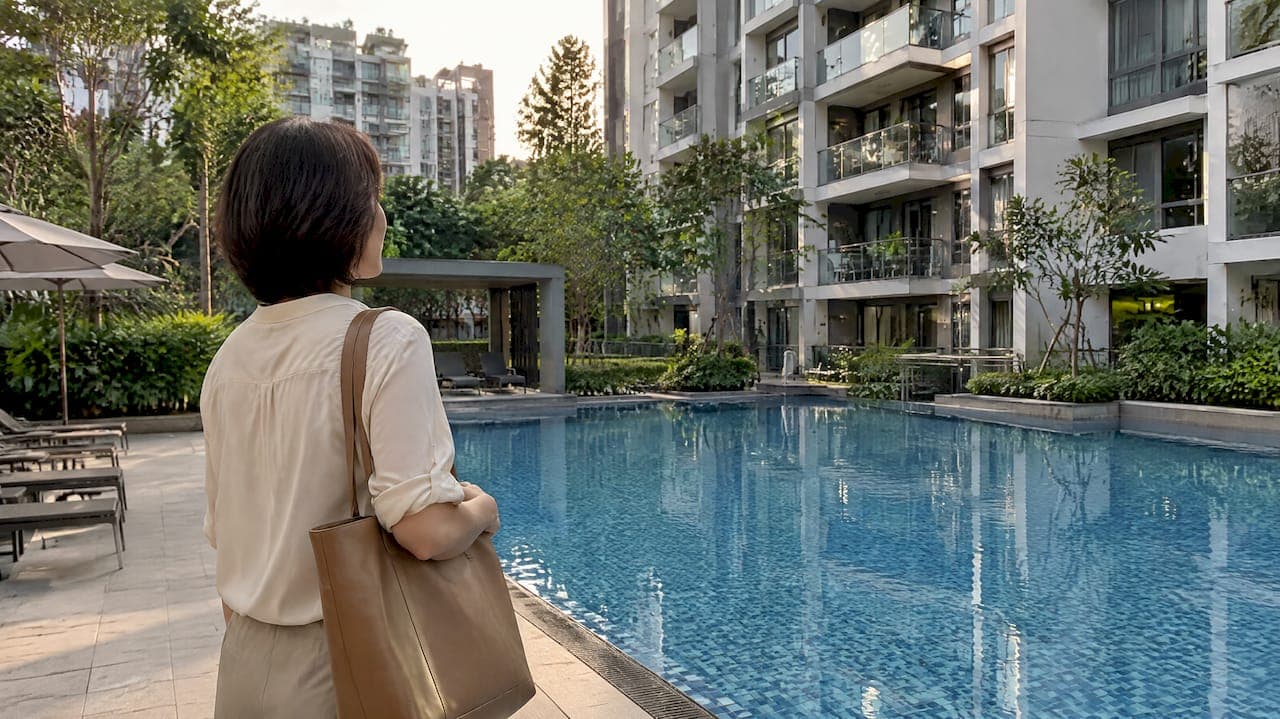
A pool-facing unit usually buys you lifestyle, not a guaranteed resale edge. Market commentary points to a modest launch premium, often cited around 1 to 3 percent, though it varies widely by project. Before paying it, check the site plan, the MCST maintenance estimates and the actual floor and layout of the stack, since those three factors determine whether the view holds its value. Hougang Central Residences is one project where buyers can review these details directly.
TL;DR:
- The actual premium for a pool-facing unit in Singapore typically ranges from 1 to 3 percent, but it depends heavily on the project's layout and view prominence.
- A higher floor reduces noise and disturbance from pool activities, while lower floors are more exposed to splash, announcements, and privacy issues.
- Verified data shows that pool views do not guarantee better resale performance once factors like layout, floor, and maintenance fees are controlled for.
- Buyers should request detailed site plans, maintenance estimates, and MCST rules to ensure the view's value justifies the extra cost.
- The decision to pay more for a pool-facing unit should be based on matching comparable units and assessing actual lifestyle benefits rather than marketing impressions.
Table of Contents
- Pros and cons: lived experience of pool-facing units
- How much premium to expect and what resale evidence shows in Singapore
- Practical pre-purchase checks: MCST, maintenance fees, pool rules, and S&P/site-plan review
- Floor, layout and privacy: what makes a pool-facing stack work
- Which buyer profiles benefit most from a pool-facing unit
- How to value a pool-facing unit versus alternatives: a practical mini-framework
- Applying the checklist: what Hougang Central Residences shows buyers to verify
- Impact on safety and security considerations for pool-facing units
- Potential issues with humidity or moisture due to proximity to the pool
- Noise insulation recommendations and mitigation strategies
- Impact on rental demand and tenant preferences for pool-facing units
- Legal restrictions or HOA rules specifically affecting pool-facing units
- Author's perspective: balancing lifestyle desires and prudent valuation
- How Hougang Central Residences fits buyers who value pool-facing living
- Sources
- FAQ
Pros and cons: lived experience of pool-facing units
A unit facing pool gives you a resort view every morning and lets parents keep an eye on kids swimming below without walking down. That convenience is real, but it comes with trade-offs that photos never show.
Low floors near the pool deck often deal with splash noise, pool announcements, and less privacy when the blinds are open. High floors get the view without most of the noise, but lose the "walk down in two minutes" convenience that families prize. Pool design matters too: a 50-meter lap pool draws a different crowd and noise pattern than a children's wading pool or a quiet ornamental water feature tucked into landscaping.
- Families who swim often value easy access and sightlines over the pool for supervision.
- Low-floor units face more noise and privacy exposure from pool-deck activity and lighting.
- High-floor pool-facing units often deliver the view with less day-to-day disturbance.
- A lap pool, kids' pool, or leisure pool each create a different ambient noise and traffic pattern.
Renters have mixed reactions. Some tenants, particularly young families and expatriates relocating with children, will pay more to secure a pool view. Others, especially professionals who value quiet, treat the same unit as a liability rather than a selling point.
How much premium to expect and what resale evidence shows in Singapore
Buyers often hear that pool-facing units carry a small premium at launch, something market pieces commonly peg at around 1 to 3 percent, though the actual figure depends heavily on the project, the pool's prominence in the site plan, and the broader stack mix.
Transaction analysis from StackedHomes found that a "good view" does not automatically translate into stronger resale returns. The comparison only holds when buyers control for matched variables: the same unit type, similar floor band, comparable tenure remaining, and similar holding periods. A pool-facing unit purchased at a steep premium can underperform an otherwise identical stack facing a garden, simply because the initial gap was too wide to close through market appreciation alone.
This is the trap buyers fall into. They compare a pool-facing transaction against a generic "average" resale price for the project, rather than against a matched comparable on a similar floor with a similar layout. Once you strip out floor premium, tenure differences, and renovation condition, the pure view premium is often smaller than advertised and sometimes negative after holding costs. Before treating a pool view as an investment thesis, run the comparison against units in the same stack range, not the project average.
Practical pre-purchase checks: MCST, maintenance fees, pool rules, and S&P/site-plan review
A pool view is only worth paying for once you have confirmed the paperwork behind it. Start with these documents before signing anything.
- Request the official site plan and unit-facing diagram to confirm which stacks genuinely face the pool rather than a side angle or partial view.
- Ask for a maintenance-fee estimate and compare it against similar-sized units in non-pool-facing stacks to see what premium you are paying monthly, not just upfront.
- Review the draft Sale and Purchase Agreement for defect-liability terms and any developer commitments on pool maintenance during the early years.
- Ask the developer or marketing team for the MCST's planned by-laws on pool hours, guest policies, and any limited common property designations tied to specific units.
- Check whether the sinking fund is adequately funded for future major works, since pool resurfacing and filtration upgrades are among the costlier items an MCST faces over time.
Under Singapore's strata framework, a condominium pool is managed as common property, and owners become subsidiary proprietors bound by MCST by-laws that can regulate facility use and behavior. The Building (Strata Management) Act sets out the rules for how maintenance charges and sinking funds are collected and gives the Commissioner powers to intervene when an MCST mismanages these funds.
Pro Tip: Ask to see the last two years of MCST maintenance-fee statements, not just the developer's projected estimate, since actual pool upkeep costs tend to run higher once the development matures.
Floor, layout and privacy: what makes a pool-facing stack work
Not every pool-facing stack delivers the same experience, and floor level is the first variable to check. A third-floor unit sits close enough to hear splashing and announcements clearly, while a fifteenth-floor unit in the same stack gets a clean view with almost none of that noise.
Layout matters as much as floor level. A balcony with a direct, unobstructed sightline to the pool is worth more than a unit where only the kitchen window catches a sliver of blue water. Bedroom placement also affects how much pool noise actually reaches living spaces, since a bedroom facing away from the pool buffers sound better than one with a window directly over the deck.
- Confirm whether the balcony or main living area has a clear, unobstructed view of the pool, not just a partial angle.
- Check bedroom orientation, since units with bedrooms facing away from the pool deck generally sleep quieter.
- Ask the MCST what screening, planting, or balcony modifications are permitted before assuming you can add privacy later.
Renovation and screening options are governed by MCST rules, and structural changes to common property typically require approval before work begins. Confirm this before counting on a louver screen or planter box to solve a privacy concern after you move in.
Which buyer profiles benefit most from a pool-facing unit
The pool-facing premium makes the most sense for buyers whose daily routine actually uses the pool. Everyone else should weigh the extra cost against a feature they may rarely touch.
- Families with young children who swim regularly get genuine day-to-day value from supervision access and short walks to the pool deck.
- Investors should match the unit to tenant demand in the district, since expatriate families and young couples tend to value pool views more than single professionals who prioritize quiet.
- Retirees and downsizers should weigh the convenience of a ground-level or low-floor pool-facing unit against the noise and reduced privacy that come with that same proximity.
How to value a pool-facing unit versus alternatives: a practical mini-framework
Quantifying the premium takes a few deliberate steps rather than a gut feeling about the view.
- Find matched-stack comparables: the same unit type, a similar floor band, and similar orientation within the same project or a nearby comparable development.
- Adjust for layout efficiency, remaining tenure, and any maintenance-fee differential between the pool-facing stack and your comparable, since these can offset part of the apparent premium.
- Calculate the net lifestyle premium by subtracting expected extra fees and resale-discount risk from the premium you are being asked to pay, then decide if what remains is worth it to you.
- Set a maximum price you will not exceed before you start viewing units, so a well-staged showflat or a sales pitch cannot push you past your own number.
This sequence keeps the decision grounded in comparable data rather than the emotional pull of a resort-style render. A clear cap, decided before you walk into a showflat, is the simplest defense against overpaying for a view.
Applying the checklist: what Hougang Central Residences shows buyers to verify
Hougang Central Residences publishes its site plan and floor plans directly, which gives buyers a concrete way to apply the checklist above rather than relying on marketing photos alone.
- Review the site plan to confirm exactly which stacks face the pool and landscaped areas versus the surrounding streetscape.
- Check the floor plan pages to compare layout efficiency between pool-facing units and alternative stacks before deciding if the premium is justified.
- Read the project's guide on lap pool length standards to understand whether the pool is designed for serious laps or leisure use, since that affects both noise patterns and maintenance needs.
- Ask the sales team directly for maintenance-fee estimates and draft MCST by-laws covering pool hours and guest policies during your showflat visit.
Applying this same document-first approach to any project, not just this one, is what separates an informed pool-facing purchase from a decision made on view alone.
Impact on safety and security considerations for pool-facing units
A pool-facing unit introduces a few safety considerations that buyers often overlook until they move in. Ground-floor and low-floor units with direct balcony access to the pool deck can make it easier for young children to wander toward water unsupervised, so families with toddlers should check whether balcony gates or additional fencing are part of the unit or need to be added, subject to MCST approval for any structural change.
Security also works differently for pool-facing stacks. A unit with clear sightlines into the pool area often means the reverse is true as well: pool users can see directly into ground-floor units or low balconies, which raises privacy and security exposure during evening hours when the pool deck is lit and the unit interior may not be.
Most developments position security patrols and CCTV coverage around common facilities like pools as standard practice, but the specifics vary by project and are worth confirming during the sales briefing rather than assumed. Ask whether the pool deck has dedicated lighting, whether gates lock after hours, and whether the MCST has a lifeguard or supervision policy, since none of this is guaranteed just because a unit faces the water.
Potential issues with humidity or moisture due to proximity to the pool
Units close to a pool deck, particularly on lower floors, tend to experience higher ambient humidity than units facing away from water features. This is partly a function of evaporation from the pool surface and partly a function of landscaping and water features common in tropical condo developments, which can trap moisture near ground-level units more than higher floors catch.
Over time, elevated humidity can accelerate issues like mold on balcony surfaces, peeling paint on exterior walls, and corrosion on metal fittings such as railings or air-conditioning units if they are not properly treated or maintained. Buyers viewing lower-floor pool-facing units should check the condition of external fittings closely and ask whether the developer specifies corrosion-resistant materials for balconies and railings in that stack.

Ventilation design also matters more for these units. A unit with good cross ventilation disperses moisture faster than one that relies solely on air conditioning, so checking window placement and airflow during a site visit is worth the extra few minutes. This is a detail that rarely comes up in a showflat tour but becomes relevant within the first year or two of ownership.
Noise insulation recommendations and mitigation strategies
Pool noise follows a predictable pattern: it peaks during weekend afternoons, school holidays, and any organized pool events the MCST allows, and it carries more on lower floors than higher ones. Buyers who are sensitive to noise should treat floor level as the single biggest lever they control before purchase, since no amount of after-purchase fixing fully replicates the distance advantage of a higher floor.
For units already facing the pool, a few mitigation steps help. Double-glazed windows reduce sound transfer more effectively than standard glass, and heavier curtains or acoustic blinds on the balcony door can dampen some ambient noise without requiring structural changes. Positioning bedrooms away from the pool-facing side of the unit, where the layout allows it, is one of the more effective passive strategies since it does not require any MCST approval.
Any structural change, such as installing acoustic panels on an external wall or altering window glazing, typically requires MCST sign-off since it affects common property or the building's external appearance. Confirm what is permitted before budgeting for soundproofing as part of your purchase decision, and ask the sales team or MCST for prior examples of approved renovations in similar stacks.
Impact on rental demand and tenant preferences for pool-facing units
Rental demand for pool-facing units splits fairly clearly by tenant profile. Expatriate families relocating with children, along with young couples who entertain guests, tend to view a pool-facing unit as a genuine selling point and are often willing to pay a modest premium in rent for it. Professionals working long hours who prioritize quiet, by contrast, frequently see the same feature as a downside rather than a benefit.
This means the rental premium a pool-facing unit commands depends heavily on the tenant pool a district attracts. A development near schools, international offices, or family-oriented amenities will see stronger demand for pool-facing units than one that mainly draws single professionals or short-term corporate tenants. Investors should research the typical tenant demographic in the surrounding area before assuming a pool view automatically commands higher rent.
Staging also plays a role in how quickly a pool-facing unit lets. Furnishing the balcony as a usable outdoor space and highlighting the view in listing photos tends to shorten vacancy periods, a practice covered in more detail by guidance on staging condos for rental appeal. Investors weighing a pool-facing unit should factor this into their total return calculation, not just the headline rent figure.
Legal restrictions or HOA rules specifically affecting pool-facing units
In Singapore, there is no separate homeowners' association structure the way some other markets use the term. Instead, common property including the pool is governed by the Management Corporation Strata Title, commonly called the MCST, under rules set out in the Building (Strata Management) Act. This framework gives the MCST authority to set by-laws covering pool hours, guest access, noise behavior, and penalties for violations, and these by-laws apply to every owner regardless of whether their unit faces the pool.
Pool-facing units sometimes carry additional restrictions tied to limited common property designations, where a specific stack has exclusive use of an adjoining area such as a private garden or terrace near the pool. These designations should be confirmed in the site plan and the draft deed of mutual covenant before purchase, since they affect both your rights and your share of related maintenance costs.
Any renovation that touches common property, including balcony enclosures, external screening, or changes to window glazing facing the pool, requires MCST approval under the BCA's condo ownership guidance. Buyers should also check structural approval requirements for any pool-adjacent modification, a process explained in more detail through technical guidance on structural approvals for homeowners considering changes near water features.

Author's perspective: balancing lifestyle desires and prudent valuation
Marketing renders sell a feeling, not a floor plan. A pool view is worth paying for only when the layout, the MCST's transparency on fees, and the size of the premium all hold up under scrutiny, not when a glossy photo makes the decision for you. Treat the site plan and maintenance statements as the real evidence, and let the view be the bonus, not the basis, for your offer.
— Simon
How Hougang Central Residences fits buyers who value pool-facing living
Hougang Central Residences offers buyers a direct way to apply this checklist rather than take marketing claims at face value. The project sits above Hougang MRT station with 835 units ranging from one-bedroom-plus-study to five-bedroom penthouses, and its communal areas include tropical landscaping alongside a lap pool designed to standard lengths, a detail covered in the project's own lap pool length guide.
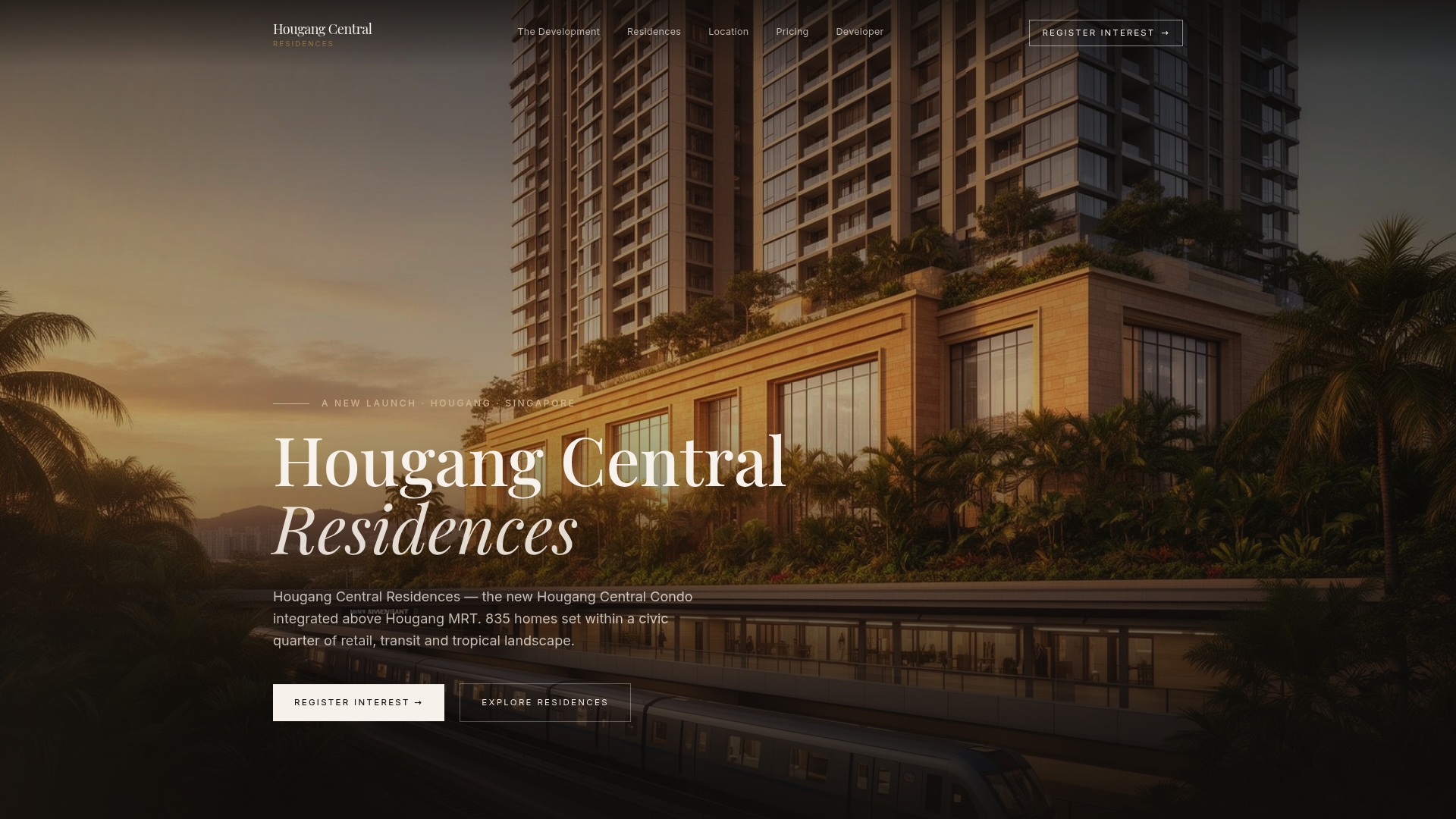
Buyers can verify exactly which stacks face the pool before committing to anything.
- Review the site plan to confirm pool orientation and stack placement for any unit you are considering.
- Check unit types and layouts to compare a pool-facing option against alternatives in the same development.
- Visit the pricing page, where units start from $2,800 SGD per square foot, to see how a pool-facing premium compares against the project's base pricing.
If a pool-facing unit at Hougang Central Residences fits your checklist, request the maintenance-fee estimate and site plan directly from the sales team before making an offer.
Sources
Buyers verifying the claims in this guide should go directly to the primary sources rather than rely on secondhand summaries.
- Building and Construction Authority — Condo living: be condo savvy
- StackedHomes — Should you pay more for a good view? A case study
- Building (Strata Management) Act 2004 — Singapore Statutes Online
This article is general information, not a substitute for advice from a qualified financial advisor. Consult a qualified financial professional about your own circumstances before acting on anything here.
FAQ
Which condo in Singapore has the best swimming pools?
Pool quality varies widely across Singapore condos depending on lap length, design, and landscaping, and no single development holds an official "best pool" ranking. Buyers comparing pools should check published specifications, such as lap length and pool type, directly with each project rather than relying on general reputation.
Is there a pool suspended between two buildings?
Some high-profile Singapore developments have built pools that visually appear suspended between towers, a distinctive architectural feature rather than a common design. This is not a feature found across most condominiums, so buyers interested in this specific design should confirm it directly with the project in question rather than assume it applies broadly.
What happens after 50 years living in a condominium?
Singapore condominiums are typically built on either freehold or leasehold land, and leasehold developments have a set tenure of a fixed number of years, after which the land reverts to the state unless the lease is extended or the development undergoes collective sale. The specific outcome depends on the lease terms and any government policies in effect at that time, so buyers should check a project's tenure type before purchase.
Can apartments have swimming pools?
Yes, apartments and condominiums in Singapore commonly include swimming pools as part of their shared facilities, managed as common property under the MCST structure. Access, hours, and guest policies for these pools are set by each development's by-laws rather than being standardized across all buildings.
How much more do pool-facing units typically cost?
Market commentary commonly cites a premium of around 1 to 3 percent at launch for pool-facing units, though the actual figure varies significantly by project and stack. Buyers should confirm the specific premium against matched comparables in the same development rather than relying on this as a universal rate.