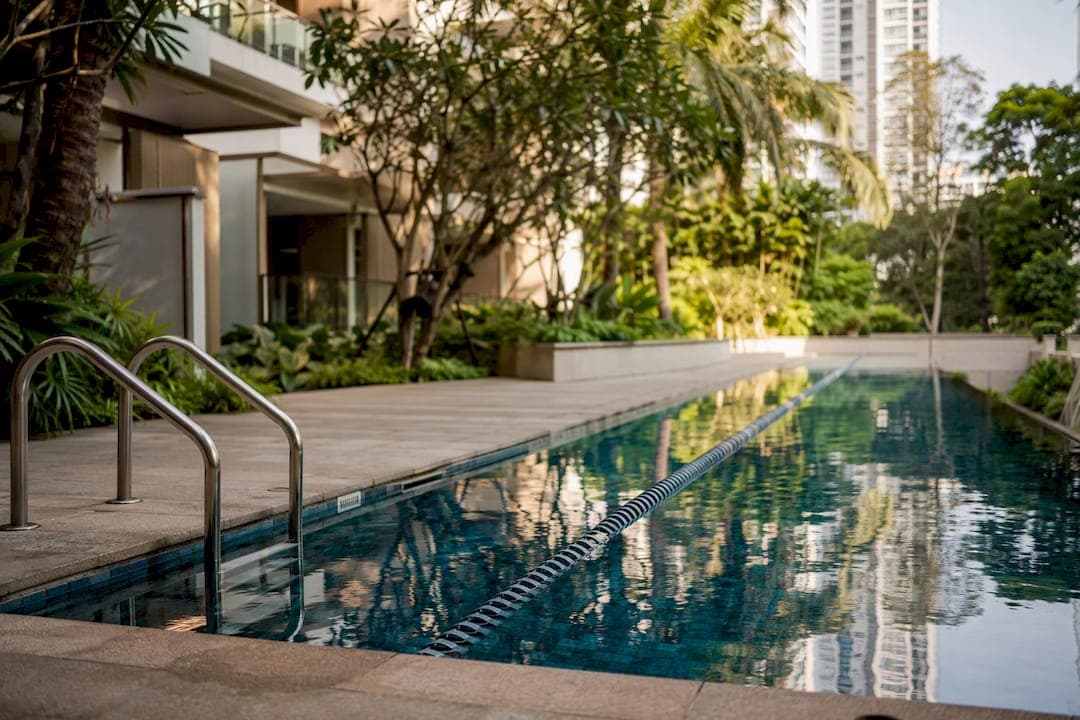
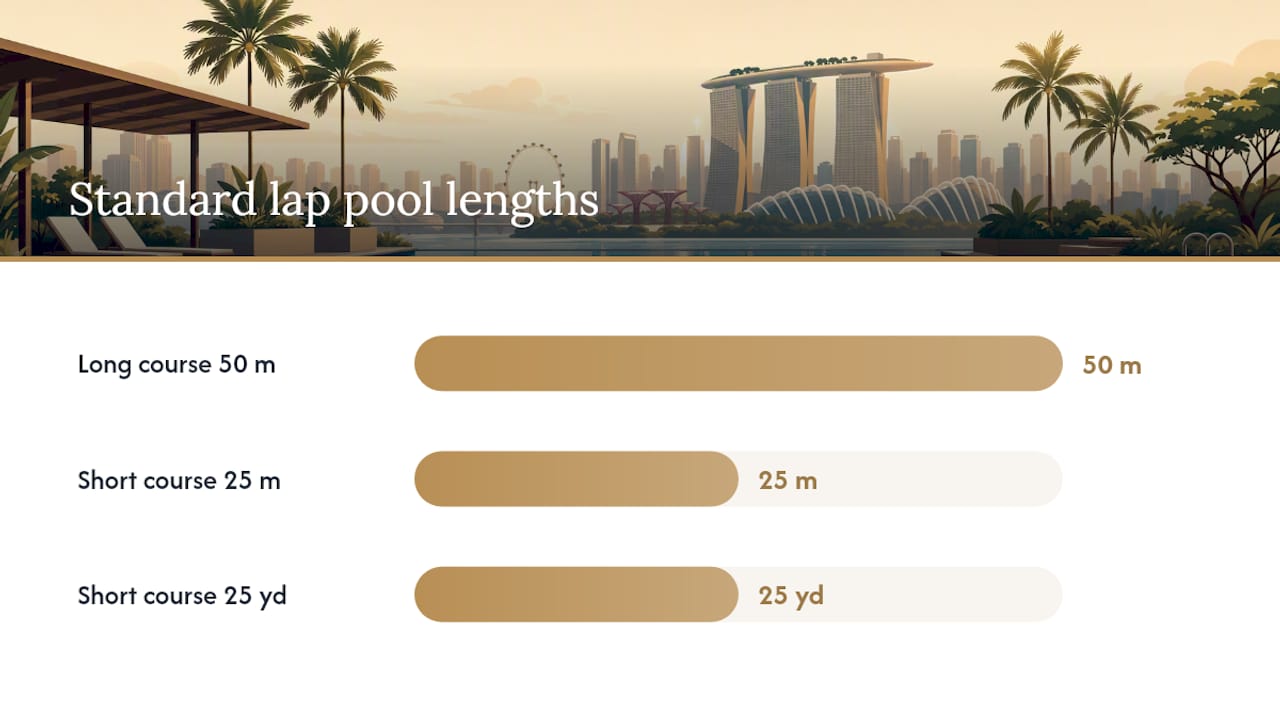
The standard lap-pool lengths are 50 meters (long course, the Olympic standard), 25 meters (short course metric), and 25 yards (used in some non-metric systems). For a private or condo lap pool, the realistic design range runs 12 to 23 meters, roughly 40 to 75 feet.
- 50 m — long course, found at ActiveSG competition pools across Singapore
- 25 m — short course, the metric standard for training pools
- 25 yd — short course yards, less common locally but standard in some countries
- 12 to 23 m (40 to 75 ft) — the practical residential range for condos and landed homes
- Competition lanes run about 2.5 meters wide; a pool needs at least roughly 12 meters to feel like real lap swimming rather than a splash pool
Key Takeaways
Standard lap pool lengths are 50 meters, 25 meters, and 25 yards, while residential lap pools realistically range from 12 to 23 meters depending on lot size and budget.
| Point | Details |
|---|---|
| Standard lengths | Competition pools run 50 m (long course) or 25 m/25 yd (short course). |
| Residential minimum | About 12 m (40 ft) is the smallest length that still feels like real lap swimming. |
| Construction choice | Fiberglass shells cap out near 40 ft; gunite allows any custom length. |
| Public access | ActiveSG complexes typically pair a 50 m competition pool with wading and teaching pools. |
| Ask before you buy | Hougang Central Residences buyers should request exact pool length, lane width, and depth during a showflat visit. |
Table of Contents
- What Counts as a Standard Lap Pool Length?
- Is a Lap One Length or Two?
- How Big Should a Residential Lap Pool Be?
- Where Can You Find a 50-Meter Pool in Singapore?
- What Should Condo Buyers Ask About Pool Length?
- How Does Singapore's Climate Affect Pool Length Choices?
- Do Lap Pools Vary by Region in Singapore?
- What's the Smartest Way to Pick a Lap Pool Length?
- See the Pool and Amenity Specs at Hougang Central Residences
- Sources
- FAQ
What Counts as a Standard Lap Pool Length?
Three numbers define almost every lap pool you'll ever swim in, and each one exists for a specific reason rather than an arbitrary tradition. A 50-meter pool is long course, the format used at the Olympics and at major international meets. A 25-meter pool is short course metric, the size you'll find at most training facilities and community centers worldwide. Then there are 25 yards, short course yards, which show up mainly in American collegiate and high school swimming rather than in Singapore.
Short course and long course pools serve different purposes: long course events emphasize sustained pace and turn efficiency over greater distance, while short course racing rewards frequent, fast turns. If you've ever felt like your times looked better at a smaller pool, that's not your imagination. More wall contact per 100 meters genuinely helps most swimmers' splits.
Competition lane width sits at roughly 2.5 meters, and regulation depth for competitive pools runs a minimum of about 2 meters to reduce wave rebound and keep starts fair. Singapore's public complexes, run through ActiveSG and Sport Singapore, generally follow this long-course model for their flagship lap pools.
50 meters equals 164 feet — the exact length of an Olympic pool wall to wall, and the benchmark every other lap-pool size gets measured against.
- Long course (50 m): used for major competitions and elite training
- Short course metric (25 m): the common training and public-pool standard
- Short course yards (25 yd): rare in Singapore, standard in the US collegiate system
Is a Lap One Length or Two?
Here's where a lot of casual swimmers get tripped up. A "length" is one trip from wall to wall. A "lap" in everyday conversation usually means down and back, two lengths, though plenty of swimmers and even some coaches use the words interchangeably. For counting purposes, pick "lengths" as your unit and stick with it. It removes the ambiguity entirely.
This matters most when you're translating a workout between pools of different sizes. A 1,500-meter swim, the classic metric mile, takes 60 lengths in a 25-meter pool but only 30 lengths in a 50-meter pool. A 1,650-yard swim, the imperial mile, takes 66 lengths in a 25-yard pool.
Say you're used to a 25-meter condo pool and swim 40 lengths for a workout, that's 1,000 meters. Drop into a 50-meter ActiveSG pool and you'd only need 20 lengths for the same distance. Knowing the conversion up front means you're not left recounting mid-set trying to remember if you're on lap 12 or lap 24.
How Big Should a Residential Lap Pool Be?
For a condo or landed lap pool, 12 meters, about 40 feet, is the practical floor for anything you'd call real lap swimming rather than a plunge pool with delusions of grandeur. The comfortable sweet spot for most Singapore homeowners sits between 14 and 23 meters, or roughly 45 to 75 feet, depending on lot size and budget.
Width and depth matter just as much as length. A single-lane residential pool typically runs 2.4 to 3 meters wide, enough for comfortable stroke clearance without wasting expensive land. Depth usually stays uniform at around 1 to 1.5 meters, deep enough for a proper stroke but shallow enough to simplify filtration, heating, and maintenance costs.
- Minimum useful length: ~12 m (40 ft)
- Comfortable residential range: 14 to 23 m (45 to 75 ft)
- Single-lane width: 2.4 to 3 m
- Uniform depth: roughly 1 to 1.5 m, chosen for stroke clearance and lower upkeep
Construction method shapes what lengths are even possible. Fiberglass shells arrive pre-molded, which keeps costs and build time down, but they max out around 40 feet because of shipping and manufacturing limits. Gunite, poured concrete, has no such ceiling. You can build any length your lot allows, at a higher price and a longer construction timeline. For genuinely tight footprints, a swim-jet or current system can deliver real training resistance in a pool as short as 4 to 5 meters, swapping distance for resistance.
Pro Tip: If your lot comfortably fits 40 feet or less, a fiberglass shell will save you time and money. If you want anything longer, or an irregular shape to fit an awkward plot, go straight to gunite and skip the shell conversation entirely.
Where Can You Find a 50-Meter Pool in Singapore?
Most public swimming complexes in Singapore follow a consistent three-pool layout: a wading pool for toddlers, a teaching pool for lessons, and a full 50-meter competition lap pool for serious swimming, with depths in that main pool commonly ranging from 1.2 to 1.8 meters. If you're training for distance or just want the mental clarity of fewer turns, this is the pool you're looking for.
- Check the facility page first. ActiveSG and Sport Singapore both publish dimensions, opening hours, and lane counts for each complex, so confirm the pool size before you travel across the island for a swim.
- Book through ActiveSG. Lane bookings and swim passes run through the ActiveSG portal, and popular time slots at 50-meter pools fill up fast on weekday evenings.
- Use a facility finder if you're new to an area. Sites like SpeedIswim's interactive guide list which complexes carry competition lanes region by region.
- Mind lap-swimming etiquette. Stick to the right side of your lane, let faster swimmers pass at the wall, and check posted lane designations since public pools rotate lanes between lap swimmers, lessons, and open recreation throughout the day.
What Should Condo Buyers Ask About Pool Length?
Amenity brochures rarely spell out exact pool dimensions, so it pays to ask directly rather than assume. A "lap pool" label on a floor plan can mean anything from a genuine 25-meter training lane to a 15-meter feature pool with a long, narrow shape.
- Ask for the exact length in meters, not just the marketing description
- Confirm lane width, since a narrow single lane feels very different from a shared multi-lane space
- Ask about the depth profile, uniform or sloped, since this affects who the pool actually suits
- Find out if a swim-jet or current system is installed for shorter pools
A serious swimmer training for fitness needs real length and consistent depth. A family wants shallower water and safe edges. A casual user might not care about length at all beyond having somewhere to cool off. When you tour a project like Hougang Central Residences or any other development, walk the pool deck yourself and pace it out. It takes thirty seconds and tells you more than any brochure render. For a broader sense of how amenities factor into a purchase decision, this family amenities condo checklist covers what else to verify beyond the pool.
How Does Singapore's Climate Affect Pool Length Choices?
Singapore's heat and humidity run year round, which changes the maintenance math compared to temperate climates where pools sit unused half the year. Longer pools hold more water, and more water means more chemical dosing, more filtration run time, and a bigger electricity bill for pumps that often run near continuously here rather than seasonally.
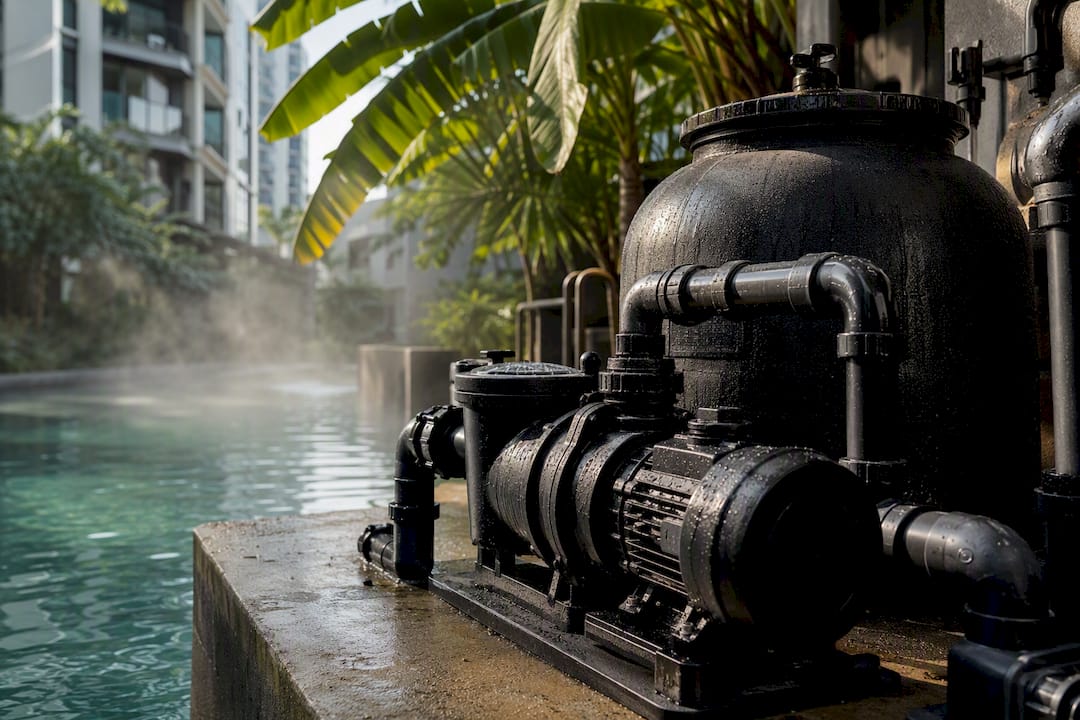
Evaporation is the quiet cost. A 50-meter competition pool loses meaningfully more surface water to Singapore's heat than a compact 15-meter residential lap pool, which translates into more frequent top-ups and more careful chlorine balancing to avoid swings in water chemistry. Algae growth also accelerates in tropical heat, so pools of any length need more frequent brushing and filter checks than the same pool would in a cooler climate.
Longer pools do have one practical advantage in this climate: more surface area helps water lose heat overnight, which keeps tropical pools from feeling like warm baths by midday. Shorter plunge-style lap pools, especially shaded ones between buildings, tend to run warmer and murkier faster if maintenance lapses even briefly.
For condo owners, this maintenance burden usually sits with the management corporation rather than the individual resident, which is one real advantage of a shared facility over a private backyard pool. A 50-meter shared ActiveSG-style pool spreads upkeep cost and effort across an entire community; a private 18-meter condo lap pool spreads it across a few hundred households instead of one family. Either way, ask how often the pool gets serviced and whether the facility uses saltwater or traditional chlorine systems, since that affects both comfort and long-term maintenance cost.
Do Lap Pools Vary by Region in Singapore?
Access to a proper 50-meter pool isn't evenly spread across the island. Mature estates with long-established ActiveSG complexes, think older towns with decades-old sports facilities, tend to have more competition-length pools per capita than newer growth corridors still catching up on public infrastructure.
Newer condo developments have partly filled that gap on the private side. Recent launches increasingly include lap pools as a headline amenity, though the actual lengths vary widely from a genuine 25-meter lane to a much shorter feature pool dressed up with lap-pool branding. This is exactly why checking specific dimensions matters more than trusting a floor plan label.
Public pool density also affects how crowded lanes get. A well-served region with two or three nearby ActiveSG complexes spreads lap swimmers out across more lane hours than a region relying on a single facility, where peak evening slots book out fast. If you're relocating within Singapore and lap swimming matters to your routine, it's worth checking a facility finder for your target neighborhood before you commit to an address, the same way you'd check school zones or MRT access.
For residents near transit-linked developments, the calculus shifts again. Easy MRT access to multiple pool complexes across town means you're not limited to whatever's within walking distance, which loosens the pressure on any single condo's own pool to be everything to everyone.
What's the Smartest Way to Pick a Lap Pool Length?
Most of the debate over lap pool length dissolves once you're honest about how you'll actually use it. Three rough heuristics cover almost everyone: go for 50 meters if you train competitively and need long-course pacing, 25 meters if you want structured training without dedicating your entire lot to water, and 12 meters or more with a swim-jet system if steady cardio is the goal and space is tight.
The mistake I see buyers make most often is trusting a brochure's word "lap pool" without asking for the number behind it. A 15-meter feature pool and a 25-meter training lane get marketed with identical language, but they serve completely different swimmers. If lap swimming genuinely matters to your routine, ask for exact length, lane width, and depth before you fall in love with a rendering.
— Simon
See the Pool and Amenity Specs at Hougang Central Residences
If you've read this far, you already know that "lap pool" on a brochure means very little without the actual numbers behind it. Hougang Central Residences approaches amenity planning the same way this article encourages buyers to think: with specific, considered design rather than a vague feature list. The development's tropical landscaped grounds and pool facilities sit alongside smart-home systems and premium European fittings, all built around direct MRT access above Hougang station.
Before booking a showflat visit, request three specifics from the sales team: exact pool length, lane width, and depth profile. That's the same checklist this article just walked you through, and it applies whether you're a serious swimmer, a parent, or someone who just wants a decent evening swim after work. You can review amenity details and register for updates on the Hougang Central Residences landing page, and if you're comparing amenity approaches across projects, this roundup of condos with a pool offers a wider market view. Reach out to arrange your showflat visit and get the exact specs in writing.
Sources
- What is the difference between long course and short course swimming? — ActiveSG Circle
- Lap pool ideas: designs, dimensions & real costs — PoolPad
- Swimming Pool Dimensions — SwimOutlet
- Swimming Pools in Singapore: Complete Interactive Guide & Facility Finder — SpeedIswim
FAQ
What Are the Pool Lengths at ActiveSG Complexes?
Most ActiveSG complexes offer a 50-meter competition lap pool alongside a shallower teaching pool and a wading pool for young children, with the main pool's depth typically ranging from 1.2 to 1.8 meters.
Is a Lap One Length or Two?
A "length" is one trip across the pool, while "lap" commonly means down and back, or two lengths, though the terms get used interchangeably in casual conversation. Counting in lengths avoids the confusion entirely.
Can You Swim Real Laps in a 25-Foot Pool?
A 25-foot pool is below the practical minimum for structured lap swimming since most guidance puts the useful floor closer to 40 feet, but a 25-foot pool paired with a swim-jet system can still deliver a genuine workout.
Is 30 Feet Long Enough for a Lap Pool?
Thirty feet sits below the commonly recommended 40-foot minimum for continuous lap swimming, though it can still work for basic fitness laps or, better, as a swim-jet training pool where resistance replaces distance.
What Pool Length Should I Look for at a Condo Like Hougang Central Residences?
Ask for the exact length, lane width, and depth rather than relying on the term "lap pool" alone, since amenity brochures for developments like Hougang Central Residences and others rarely spell out precise dimensions upfront.