
The total debt servicing ratio caps how much of your gross monthly income can go toward debt repayments, including the mortgage you're applying for, at 55%. The Monetary Authority of Singapore enforces this ceiling on every bank lending against property here, and it's stress-tested against interest rate floors, not your current low rate. Miss the math and you don't get a smaller loan. You get told to find a cheaper unit.
TL;DR:
- Borrowers should include all relevant debt obligations, such as existing loans, credit card payments, and guaranteed debts, using stress-test interest rates, not current promotional rates.
- Variable income like bonuses or commissions faces at least a 30% haircut, and rental or pledged assets are amortized over 48 months before they count toward income.
- If the TDSR exceeds 55%, lenders will reduce the loan amount to meet the threshold, but internal risk policies may be more conservative, affecting approval chances.
- The TDSR primarily impacts private condo buyers, while HDB and executive condominiums are also subject to the stricter Mortgage Servicing Ratio cap of 30%.
- Running TDSR calculations early with actual income documents helps set realistic expectations before selecting property size and price, especially when considering unit types with different loan implications.
Table of Contents
- What TDSR Measures and Why MAS Requires It
- How to Calculate TDSR: Formula, Haircuts, and Interest Rate Floors
- How TDSR Limits Your Loan Amount and Interacts With MSR
- Documentation and Lender Checks: What to Prepare
- Worked Examples: Single Applicant and Joint Application
- Applying TDSR to Condo Buying Decisions
- TDSR Exemptions and Special Cases
- Regulatory Purpose and Rationale Behind the TDSR Framework
- Impact of TDSR on Different Borrower Profiles
- Limitations and Criticisms of TDSR as a Borrowing Constraint
- Comparison of TDSR With Other Debt Ratios Like DTIR
- A Planning Tool, Not a Verdict
- Where to Verify the Rules Yourself
- Sources
- FAQ
What TDSR Measures and Why MAS Requires It
MAS rolled out the total debt servicing ratio framework to stop borrowers from stretching into mortgages they can only afford while rates stay low and income stays steady. Before TDSR, some buyers qualified for loans based on introductory rates or bonus-heavy income that later dried up. The framework forces lenders to check affordability under harsher, more realistic conditions.
The calculation itself is simple to state, harder to satisfy: your total monthly debt obligations divided by your gross monthly income, expressed as a percentage. That figure must sit at or below 55%, per MAS rules for new housing loans.
What counts on each side:
- Numerator (debt obligations): the new mortgage instalment, existing home loans, car loans, student loans, credit card balances, personal loans, and any guaranteed debt.
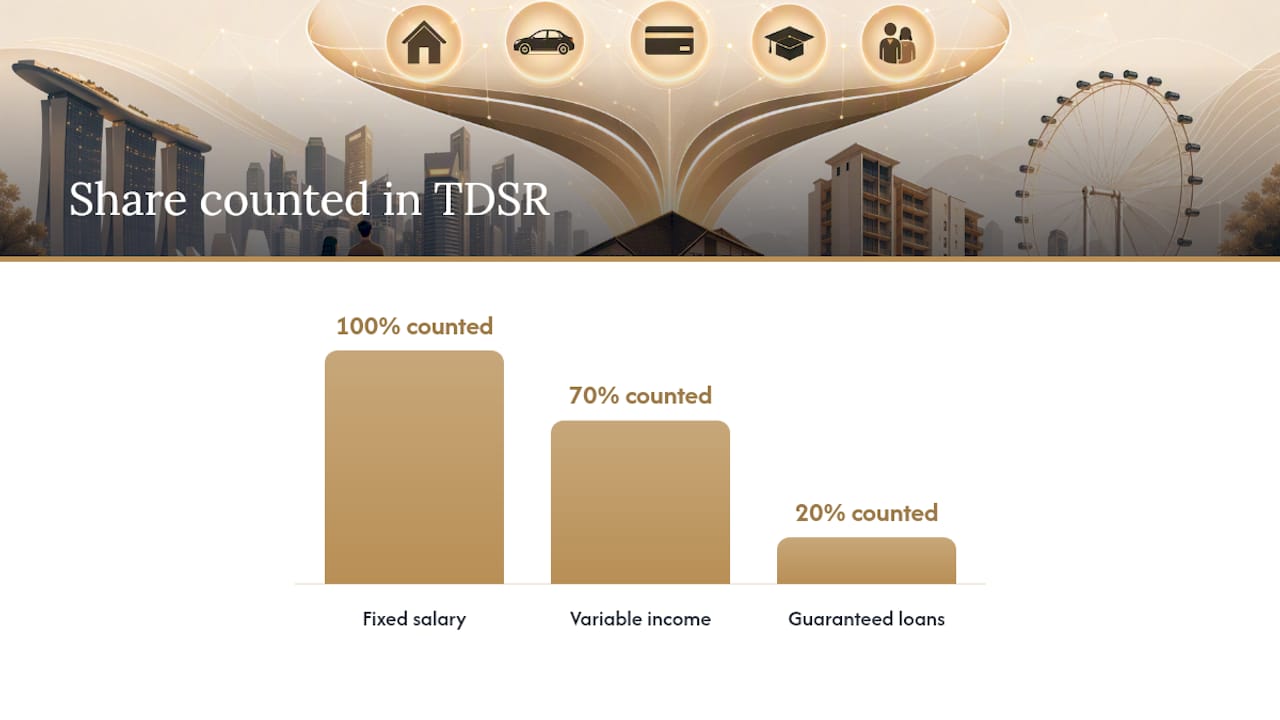
- Denominator (gross income): base salary plus allowances, with variable components like bonuses and commissions haircut before they count.
TDSR isn't the only ratio in play. The Mortgage Servicing Ratio (MSR) applies specifically to HDB flats and executive condominiums, capping mortgage repayments at 30% of gross income. Buy a private condo like most new launches in Singapore, and TDSR alone governs your borrowing. Buy an EC, and both ratios apply together.
How to Calculate TDSR: Formula, Haircuts, and Interest Rate Floors
The formula is: TDSR = (Total Monthly Debt Obligations ÷ Gross Monthly Income) × 100%
Getting the numerator right is where most applicants trip up, because MAS doesn't let you use your actual bank-quoted interest rate for the property loan you're stress-testing.
What counts as a monthly debt obligation:
- Instalments on the new home loan, calculated using a medium-term interest rate floor rather than your promotional rate
- Existing mortgage repayments on other properties
- Car loans, renovation loans, and personal loans
- Minimum monthly repayment on credit cards, even if you pay the full balance every month
- At least 20% of the instalment amount for any loan you've guaranteed, even if you're not the primary borrower
Revolving credit lines like credit cards get special treatment. If you can't produce a statement showing the outstanding balance, lenders will apply the prevailing interest rate to your full credit limit or use the minimum payment due, whichever the bank's policy defaults to, according to MAS's calculation guidance. That can inflate your assessed debt obligations well beyond what you actually owe.
For the property loan instalment itself, MAS requires banks to use a medium-term interest rate floor or the loan's thereafter interest rate, whichever is higher, when computing the instalment for TDSR purposes. This stress test protects you from qualifying for a loan you can only service while rates stay unusually low.
Income gets haircut too. Variable income such as commissions, bonuses, and rental income faces a minimum 30% haircut before it enters the calculation. Eligible financial assets like stocks, bonds, and fixed deposits can be converted into an income stream, but only after a haircut and amortization over 48 months, with pledged assets receiving more favorable treatment than unpledged ones.
| Income or asset type | Treatment under TDSR |
|---|---|
| Fixed salary | Counted in full |
| Variable income (bonus, commission) | Minimum 30% haircut applied |
| Rental income | Haircut applied, subject to lease documentation |
| Pledged financial assets | Lower haircut, amortized over 48 months |
| Unpledged financial assets | Higher haircut, amortized over 48 months |
Pro Tip: If your income leans heavily on commissions or bonuses, ask your banker to run the TDSR math using your last two years of variable income averaged, not your best year. That's closer to what the bank will actually use, and it saves you from anchoring on a loan quantum you won't qualify for.
How TDSR Limits Your Loan Amount and Interacts With MSR
When your calculated TDSR exceeds 55%, the bank doesn't reject you outright in most cases. It reduces the loan quantum until the ratio falls back within bounds, which means a smaller mortgage, a bigger downpayment requirement, or both.
The interaction with MSR matters if you're eyeing an executive condominium rather than a private condo:
- Private condos (including new launches): TDSR is the only ratio that applies. There's no separate MSR cap.
- HDB flats and ECs: Both MSR (30% cap) and TDSR (55% cap) apply. Whichever ratio produces the lower loan quantum wins, so satisfying TDSR alone isn't enough if MSR is tighter.
- Refinancing an existing property loan: TDSR still applies, though MAS allows some flexibility for owner-occupied properties refinanced without cash-out.
Banks also layer their own caution on top of the regulatory floor. DBS notes that meeting the MAS threshold doesn't guarantee identical loan offers across lenders, since internal risk policies can be more conservative than the 55% MAS ceiling. One bank might approve a loan quantum that another bank, running the same numbers through stricter internal buffers, would trim further. Shopping your application across two or three banks isn't just about rate comparison. It's about finding who reads your income profile most favorably.
Documentation and Lender Checks: What to Prepare
Lenders don't take your word on income or existing debt. They pull your credit bureau report and cross-check it against the documents you submit, so gaps or mismatches slow down approval or shrink your loan quantum.
- Latest payslips and CPF contribution history to verify base salary.
- Two years of income tax statements (Notice of Assessment) if variable income forms a meaningful share of your pay.
- Bank statements for the past three to six months across all accounts, to confirm cash flow and catch undeclared obligations.
- Statements for all existing loans including car loans, personal loans, and other mortgages.
- Credit card statements, especially for revolving balances, since a missing statement lets the bank default to a worst-case assumption on your credit limit.
- Stamped tenancy agreement, if you're counting rental income toward your gross monthly income.
- Proof of ownership and valuation for pledged financial assets, such as brokerage statements for stocks or fixed deposit certificates, if you want those assets counted as income.
Pro Tip: Pull your own credit bureau report before you apply. It costs a small fee and takes minutes, and it lets you catch an old credit line you forgot about, the kind that quietly wrecks your total debt servicing ratio calculation, before a loan officer finds it for you.
Worked Examples: Single Applicant and Joint Application
Single applicant. Say your gross monthly income is $8,000, all fixed salary. You have a car loan instalment of $700 and minimum credit card payments totaling $150. Your new home loan instalment, calculated at the medium-term interest rate floor, comes to $3,200.
- Total monthly debt obligations: $700 + $150 + $3,200 = $4,050
- TDSR = $4,050 ÷ $8,000 × 100% = 50.6%
Joint application. Two applicants combine incomes: $6,000 and $5,000, for a gross monthly income of $11,000. One partner carries a $500 car loan instalment; the other has a revolving credit card balance with no recent statement, so the bank applies the credit limit's interest rate, adding $280 to obligations. The new home loan instalment at the stress-tested rate is $4,600.
- Total monthly debt obligations: $500 + $280 + $4,600 = $5,380
- TDSR = $5,380 ÷ $11,000 × 100% = 48.9%
Small revolving balances without documentation can cost more room than the balance itself would suggest.
Applying TDSR to Condo Buying Decisions
Your TDSR outcome should shape which unit you shortlist, not the other way around. If your calculated ratio leaves thin headroom, a smaller layout or a different tenure structure at a project like Hougang Central Residences, positioned directly above Hougang MRT with unit types from one-bedroom to five-bedroom penthouses, may fit your borrowing capacity better than a larger unit that pushes you toward the ceiling.
A few practical moves before you commit to a price band:
- Run your TDSR against the actual instalment for the unit size you want, not a rough estimate.
- Check how downpayment timing interacts with your loan quantum if TDSR trims what the bank will lend.
- Review the progressive payment schedule for new launches, since your cash flow needs shift as construction milestones hit.
- Compare price bands across the luxury condo segment if you're deciding between a bigger unit now versus upgrading later.
TDSR Exemptions and Special Cases
Refinancing gets one meaningful concession. If you're refinancing an existing owner-occupied home loan without withdrawing extra equity, MAS allows some flexibility so borrowers, particularly retirees or those with reduced income since their original loan, aren't forced to sell simply because a stricter TDSR calculation would fail them today. The exemption isn't unconditional. Banks still assess it case by case, and cash-out refinancing (pulling equity out beyond the existing loan balance) typically triggers a full TDSR reassessment at current rules.
Joint applications don't get an exemption, but they do change the math meaningfully. Incomes and debts aggregate across all borrowers named on the loan, which usually helps, since two incomes typically create more headroom than one, even after variable-income haircuts apply individually to each applicant's bonus or commission.
Guarantors face a specific rule that catches people off guard: if you guarantee someone else's loan, at least 20% of that loan's instalment counts against your own TDSR, even though you're not the one making payments. Parents who guarantee a child's car loan or personal loan sometimes discover this the hard way when applying for their own mortgage years later.
There's no blanket exemption for first-time buyers, seniors, or self-employed applicants.
Regulatory Purpose and Rationale Behind the TDSR Framework
MAS introduced TDSR in 2013 to address a specific risk: households taking on mortgage debt that looked affordable under temporary conditions but wouldn't hold up once rates normalized or income fluctuated. Singapore's property market had seen rapid price appreciation, and low interest rates were letting buyers qualify for loans that assumed those rates would last indefinitely.
The framework's core insight is that affordability should be tested against a borrower's capacity in a worse scenario, not their best-case cash flow. That's why the medium-term interest rate floor exists: it forces every property loan calculation to assume rates higher than whatever promotional rate the bank is currently offering. It's also why variable income gets haircut rather than counted at face value. A bonus-heavy income stream is real money, but it's not guaranteed money, and MAS wants lenders pricing in that uncertainty rather than assuming it forever.
There's a systemic angle too. When individual households overextend on mortgage debt at scale, the ripple effects hit banks, the broader financial system, and eventually taxpayers if defaults cascade during a downturn. TDSR functions as a macroprudential tool, protecting the financial system's stability, not just any single borrower's personal finances. That framing explains why MAS applies the rule uniformly rather than case by case: consistent rules across all lenders prevent a race to the bottom where one bank loosens standards to win market share.
Impact of TDSR on Different Borrower Profiles
First-time homebuyers with straightforward fixed salaries generally have the easiest path through TDSR. A single, verifiable income stream with minimal existing debt tends to produce a clean, predictable ratio, and the main risk is underestimating how much of their income ceiling gets consumed once the mortgage instalment is stress-tested at the interest rate floor rather than the advertised rate.
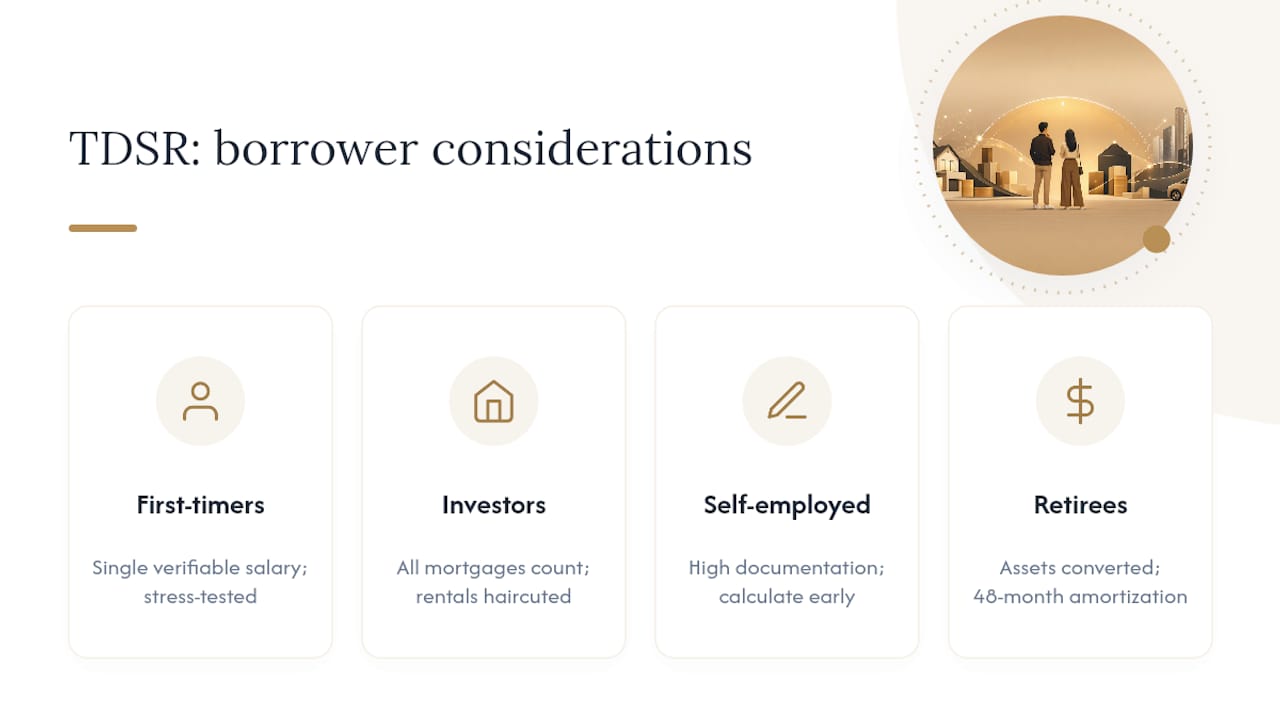
Investors and buyers with multiple properties face a tougher road. Every existing mortgage instalment counts against the new application, and rental income from existing units only partially offsets that, since it's haircut before it enters the gross income side.
Self-employed applicants and commission-based earners sit in the most documentation-heavy category. This group benefits most from running the calculation early, before falling in love with a unit that the bank's version of their income can't support.
Retirees or older buyers relying on eligible financial assets rather than salary face a different set of rules entirely, with those assets converted into an income stream through haircuts and 48-month amortization. It's workable, but it usually produces a smaller assessed income than the asset's actual value would suggest.
Limitations and Criticisms of TDSR as a Borrowing Constraint
TDSR treats income conservatively by design, and that conservatism is also its most common criticism. The rule doesn't distinguish between a freelancer with three years of steady contracts and one with unpredictable gig income; both get haircut the same way.
The medium-term interest rate floor creates a related friction. It protects borrowers from betting on permanently low rates, but it also means qualifying calculations can feel disconnected from the rate you're actually paying today, especially when your bank's promotional rate sits well below the floor used for stress testing. Borrowers sometimes feel like they're being assessed against a scenario that doesn't reflect their real monthly cash flow, even though that's precisely the point of the stress test.
TDSR also can't account for lifestyle spending outside formal debt. Two households with identical income and identical debt obligations can have wildly different discretionary spending, but TDSR only measures the fixed obligation side. A household with expensive but voluntary spending habits and no formal debt can pass TDSR easily while genuinely struggling to service a new mortgage once it's added.
Finally, the framework doesn't override bank discretion, and that cuts both ways.
Comparison of TDSR With Other Debt Ratios Like DTIR
TDSR and the debt-to-income ratio (DTIR) measure similar territory but serve different purposes. DTIR, more common in general lending and credit assessments outside property, typically looks at total debt obligations against income without the property-specific stress testing that TDSR applies. Investopedia's explanation of total debt service ratios shows how lenders internationally use similar debt-to-income frameworks, though the specific haircuts, interest rate floors, and asset amortization rules in Singapore's TDSR are MAS-specific and don't have an exact international equivalent.
MSR, discussed earlier, is really a narrower sibling of TDSR rather than a competing ratio. Think of MSR as a tighter subset check that runs alongside TDSR for public housing, not a replacement for it.
The complementary relationship matters practically: TDSR catches overall debt burden across every loan type, while MSR specifically prevents housing costs alone from consuming too much income, even if a borrower has no other debt. For private condo buyers, this distinction mostly falls away since MSR doesn't apply, leaving TDSR as the sole gatekeeper.
For a broader read on how these affordability signals shape buyer confidence in Singapore's property market, MOSAIC Eco-construction Solutions' analysis of property value trends offers useful context on how financing constraints intersect with broader market sentiment.
A Planning Tool, Not a Verdict
Run your TDSR affordability check months before you shortlist units, and verify variable income against your actual tax filings, not optimistic projections. Talk to a banker early, with full documents in hand, so the number you plan around is the number that survives underwriting.
— Simon
Where to Verify the Rules Yourself
Start with MAS's TDSR calculation guidance and MSR/TDSR threshold rules for the primary regulatory text, then cross-check practical application against DBS's consumer TDSR guide and PropertyGuru's TDSR walkthrough.
Sources
- Calculating TDSR for property loans — Monetary Authority of Singapore
- What you need to know about TDSR — DBS
FAQ
What Is the Total Debt Servicing Ratio?
TDSR is the percentage of your gross monthly income that goes toward all debt repayments combined, including the mortgage you're applying for, capped at 55% under MAS rules.
What Does a Debt Service Coverage Ratio of 1.5 Mean?
A debt service coverage ratio typically applies to commercial or business lending rather than personal property loans in Singapore, and it means income available for debt repayment exceeds the debt obligation, indicating comfortable repayment capacity in that lending context.