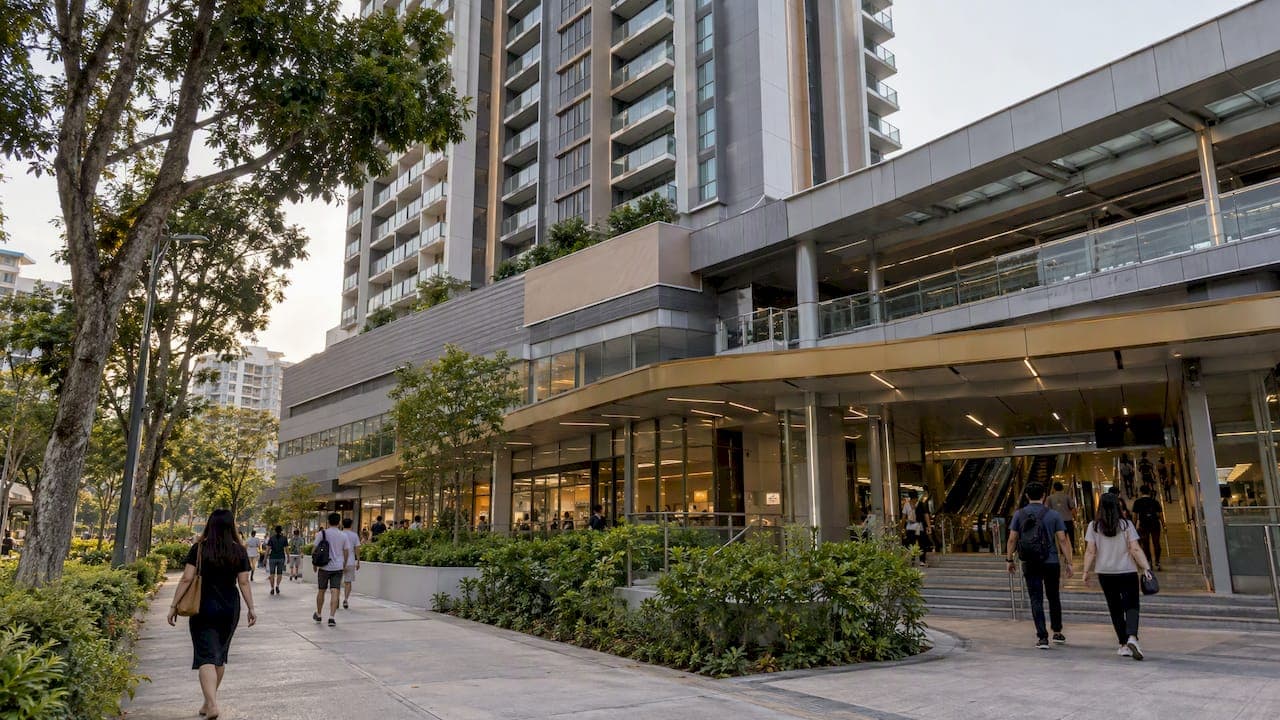
Yes, living near an MRT station typically adds a measurable premium to a Singapore property, but how much depends on exact distance, whether the station is an interchange, and how much noise or disruption the track brings. NTU research puts a number on the effect, while NUS IREUS flags the disamenities that can erode it. Before you commit to a premium, check URA's transaction data and walk the actual route yourself.
TL;DR:
- Moving 100 meters closer to an MRT station can increase property prices by approximately S$15,131 on average, based on historic data from 1995 to 2018.
- Proximity benefits are higher for integrated developments with sheltered, direct access to stations, especially underground stations that avoid noise issues.
- Walking distances are often overestimated; actual convenience depends on shelter, route, and peak-hour travel time, not just straight-line distance.
- Properties near aboveground tracks without noise mitigation can sell at a discount, while mitigation features can preserve or enhance their value.
- Future MRT interchanges tend to boost surrounding property premiums more significantly, but construction impacts and phased openings can temporarily offset benefits.
Table of Contents
- How much proximity is worth: Singapore evidence and measurement caveats
- What "near" actually means: walking distance and sheltered access
- Trade-offs: noise, vibration, and how mitigation changes the price effect
- How planned MRT lines and interchanges change the investment outlook
- How to check valuations and transaction evidence in Singapore
- Hougang Central Residences as a case of integrated transit living
- MRT catchment areas and who they attract
- Case studies: when MRT proximity helped and when it didn't
- Historical trends: proximity effects over time
- MRT proximity, rental yields, and tenant demand
- Author's short take for buyers and investors
- Hougang Central Residences: a transit-integrated option worth comparing
- FAQ
- Sources
How much proximity is worth: Singapore evidence and measurement caveats
The clearest number comes from a hedonic-model study out of NTU, which analyzed private property transactions from 1995 to 2018. It found that moving 100 meters closer to an MRT station from the mean distance point corresponded to an increase of about S$15,131 in transacted price. That figure is an average effect pulled from two decades of data, not a guarantee for any single unit, and it reflects conditions across multiple property cycles rather than today's market alone.
Moving 100 meters closer to an MRT station raised transacted prices by roughly S$15,131 on average, based on NTU's hedonic analysis of 1995 to 2018 private transactions. That premium is not evenly distributed across the market, though.
A few patterns matter when you're sizing up a specific property:
- Integrated developments with direct, sheltered connections to an MRT concourse tend to command a larger premium than units that are simply within walking distance.
- NUS IREUS research finds that proximity to aboveground tracks can reduce resale prices, since noise and vibration offset the accessibility gain.
- Underground stations generally avoid the above-track noise penalty, so their proximity premium tends to hold up better.
- HDB flats, private condominiums, and landed homes respond differently to the same distance, since landed buyers often prioritize privacy and quiet over a shorter walk.
The biggest caveat is timing. A premium calculated from a dataset spanning multiple property cycles will not perfectly predict next quarter's prices, and macro conditions like interest rates and cooling measures shift the baseline independently of transit access. Treat these figures as a starting point for negotiation, not a fixed formula.
What "near" actually means: walking distance and sheltered access
Most Singapore studies and listings use 400 meters, or roughly a 5 to 10 minute walk, as the threshold for "near an MRT." That distance sounds precise, but it usually measures a straight line from the unit to the station entrance, not the route you would actually walk. A development that looks 350 meters away on a map can feel much farther if you have to cross two signalized junctions or detours around a construction site.
Before you trust an advertised distance, run through a short check:
- Walk the route yourself at the time of day you would normally commute, not just during a weekend viewing.
- Note how much of the path is sheltered, since Singapore's rain and heat make an exposed 400-meter walk feel far less convenient than a sheltered one.
- Time the route during both peak and off-peak hours, since traffic signals and crowding at interchange stations can add several minutes.
Pro Tip: Ask the sales team for the exact walking distance used in marketing materials, then verify it yourself with a mapping app's walking directions rather than the straight-line measurement.
Developments with direct basement or sheltered links to the station concourse largely sidestep this problem, which is one reason interchange connectivity shapes resale value more than raw distance alone.
Trade-offs: noise, vibration, and how mitigation changes the price effect
Proximity cuts both ways. NUS IREUS regression findings show that resale prices near aboveground tracks tend to rise as distance from the track increases, meaning units closer to exposed rail lines often sell at a discount.
Look for these features when a unit sits close to an aboveground line:
- Noise barriers or acoustic fencing along the track-facing boundary.
- Building orientation that angles bedrooms and living areas away from the rail corridor.
- Buffer landscaping or setback distance between the tower and the track.
- Double-glazed windows on units facing the line directly.
A premium location next to an underground station or a well-mitigated aboveground one is usually worth paying for. A unit facing an exposed elevated track with none of these mitigations is a case where the convenience may not offset the daily noise, and it's worth walking away or negotiating the price down accordingly.
How planned MRT lines and interchanges change the investment outlook
A station that becomes an interchange almost always sees its surrounding accessibility premium rise, since residents gain direct access to a second line without transferring through additional stops. LTA's announcement that Circle Line Stage 6 opens for public preview in July 2026 is a concrete example of how a new line segment changes travel times and connectivity for neighborhoods along the route.
The Cross Island Line is a longer-term case worth watching, since its phased stations are planned to create new interchange points, including serving areas like Hougang, that currently rely on a single line.
A few things to weigh before pricing in a future line:
- Construction near a future station can bring years of noise and dust before any uplift materializes.
- Phased openings mean some stations arrive years after others on the same line, so check the specific station's timeline rather than the line's overall completion date.
- A planned interchange is not a certainty until construction is well underway, so treat early-stage announcements with more caution than confirmed opening dates.
How to check valuations and transaction evidence in Singapore
Verifying whether a quoted price reflects a genuine MRT premium takes a few concrete steps rather than guesswork.
- Search recent transacted prices per square foot on URA's private residential property data, filtering by project or subzone to find comparable units.
- Cross-check those figures against caveats lodged through the PMI transaction search, which records transaction dates and helps confirm the deal actually closed at the listed price.
- Look up the property's Annual Value through IRAS to estimate rental yield potential and understand the tax base you'd be working from.
- Adjust your comparables for floor level, unit size, age, and proximity, since two units in the same project can carry very different premiums depending on these factors.
| Tool | What it tells you | Where to check |
|---|---|---|
| URA transaction data | Recent transacted PSF by project and subzone | URA property data |
| PMI caveat search | Transaction dates and deal confirmation | PMI transaction search |
| IRAS Annual Value | Rental yield estimate and tax base | IRAS Annual Value service |
Hougang Central Residences as a case of integrated transit living
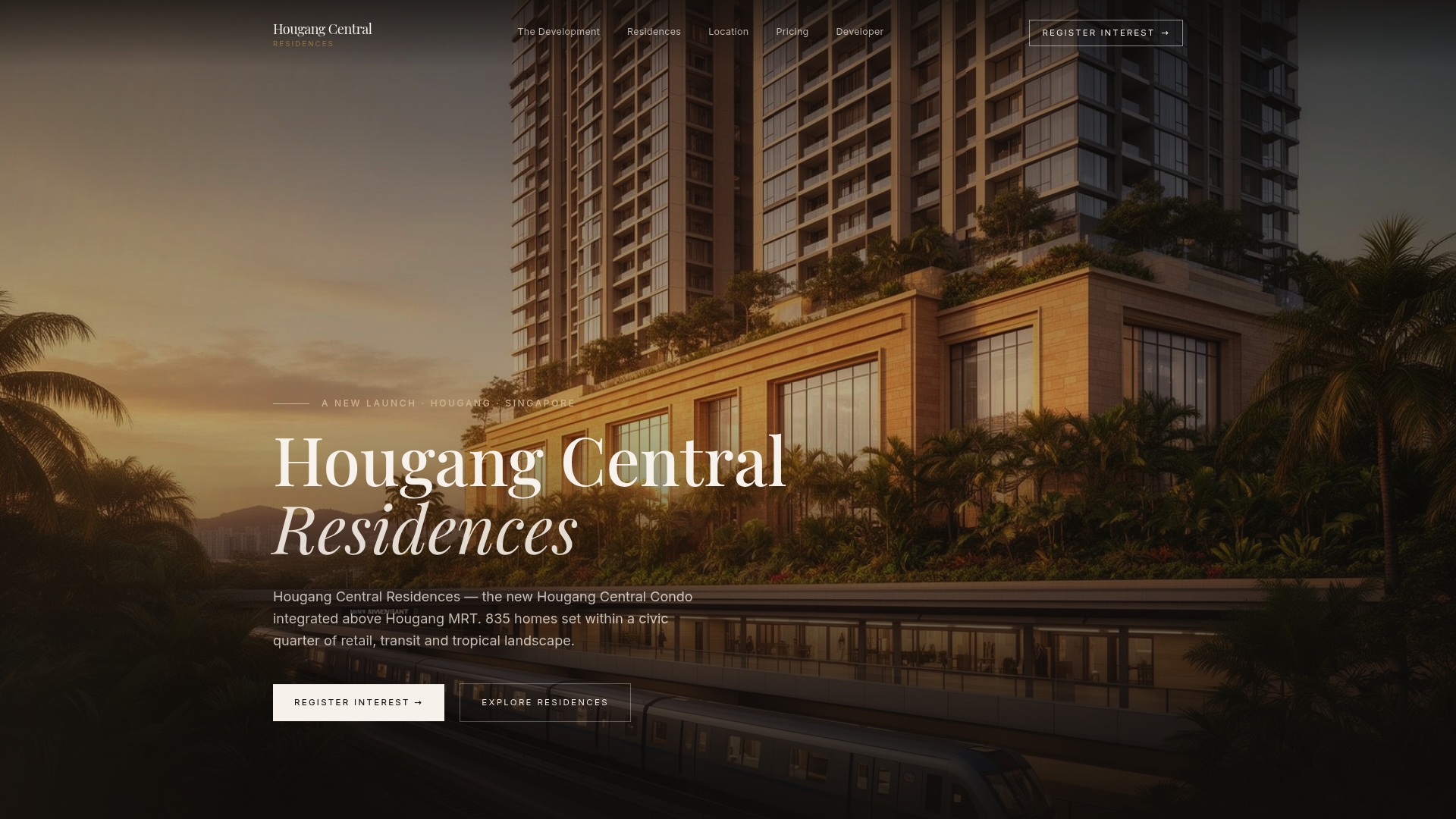
A development sitting directly above an MRT station with integration of retail and bus interchange, and offering a range of units from 1-bedroom plus study layouts to larger penthouses. This kind of direct, sheltered connection to a transit node is the structural feature that research consistently associates with a stronger proximity premium than a merely nearby, unconnected block.
Before taking any brochure claim at face value, verify a few things on site:
- Confirm the sheltered access route from the residence to the MRT concourse actually exists as described, rather than requiring an outdoor crossing.
- Check the project's interchange status and whether future lines like the Cross Island Line are confirmed or still in planning.
- Review the site plan for noise mitigation measures if any part of the development faces an elevated track or busy road.
Pro Tip: Compare the per-square-foot price for an integrated unit against a nearby non-integrated block using URA transaction data. The gap tells you how much the market is actually paying for the direct connection.
Integrated projects typically command a premium over nearby blocks that require an outdoor walk, since they remove weather exposure and shorten the effective commute.
MRT catchment areas and who they attract
Each MRT station draws a different demographic mix based on what sits within its walking catchment, and that mix shapes demand just as much as raw distance does. A station near business parks and schools tends to attract young professionals and families prioritizing commute time, while one surrounded mainly by mature HDB estates draws a higher share of retirees and long-term residents less sensitive to transit speed.
Hougang's surrounding catchment includes established neighborhood amenities, schools, and a mix of HDB and private housing, which supports steady owner-occupier demand alongside rental interest from working professionals. A comparative look at connectivity for young professionals highlights why this group in particular tends to pay up for a short, sheltered commute.
Catchment analysis matters for investors because a station serving a dense residential core with limited office space nearby will likely see stronger rental demand from commuters heading elsewhere, while a station near a business district draws tenants who work locally and want to minimize travel time in both directions. Understanding who actually lives and works within 400 meters of a station tells you more about long-term demand stability than the distance figure alone.

Case studies: when MRT proximity helped and when it didn't
Singapore's own data shows proximity effects are not uniform. NTU's hedonic analysis found a consistent positive premium for units closer to stations across the 1995 to 2018 dataset, supporting the general case for buying near transit. At the same time, NUS IREUS findings on aboveground tracks show the opposite pattern in a narrower set of cases: resale prices for units directly adjacent to exposed elevated lines were lower than comparable units set back from the track, until noise barriers closed part of that gap.
Evidence from other transit markets reinforces that proximity is not an automatic win. A study of transportation investment in Jakarta found that a new MRT line reduced nearby office rents and had limited impact on residential prices, a reminder that local context, not just the presence of a station, determines the outcome. Singapore's dense network and strong transit ridership make a positive effect more likely than in that example, but the lesson holds: a station's impact depends on what else surrounds it, including competing transport options, noise exposure, and the type of development built around it.
Historical trends: proximity effects over time
The relationship between MRT access and property value in Singapore is not new. NTU's dataset spans transactions from 1995 to 2018, a period that captured multiple rail expansions, two major financial downturns, and several rounds of cooling measures, and the proximity premium held up as a significant factor throughout.
That consistency matters for long-term buyers. Even as absolute prices rose and fell with broader market cycles, the relative advantage of being closer to a station persisted across the dataset, suggesting the effect is structural rather than tied to a single market phase. New lines opening over that period, each extending the network's reach, also tended to lift accessibility premiums in previously underserved neighborhoods as soon as construction completed and services began.
The practical takeaway for today's buyers is that a proximity premium is unlikely to disappear even if short-term prices dip during a downturn. What changes more is the size of the premium relative to the overall price level, which is why checking current transaction data through URA remains more useful than relying on historical averages alone.
MRT proximity, rental yields, and tenant demand
Tenants in Singapore consistently value a short, sheltered commute, and that preference shows up directly in rental demand near MRT stations. Units within easy walking distance of a station typically see faster leasing and fewer vacant periods, since tenants, particularly those without a car, weight commute convenience heavily when comparing listings.
Checking a property's rental yield potential starts with its IRAS Annual Value, which gives a baseline for estimating achievable rent and the tax implications of owning the unit. Cross-referencing that figure against actual rental listings and recent transactions for comparable units near the same station gives a more realistic yield estimate than relying on the Annual Value alone.
Integrated developments with direct MRT access tend to hold an edge on yield resilience, since tenant demand for that convenience tends to persist even when broader rental markets soften. Landed properties, by contrast, are less sensitive to MRT distance for rental purposes, since landed tenants typically prioritize space and privacy over a short commute, which is one reason the proximity effect on yields is strongest in the private condominium and HDB segments.

Author's short take for buyers and investors
If you take one thing from the data, prioritize integration over raw distance: a sheltered, direct link to the station beats a shorter but exposed walk every time. Before you bid on anything, verify the Annual Value and recent transacted PSF yourself rather than trusting the brochure, and physically time your walk during a weekday peak hour before you decide the convenience is worth the price.
— Simon
Hougang Central Residences: a transit-integrated option worth comparing
For readers weighing the trade-offs discussed above, consider an example of a development sitting directly above an MRT station with an integrated retail mall and bus interchange, offering a wide range of units, and featuring smart-home systems and quality fittings.
If you're comparing this kind of integrated project against a standalone block a short walk from the station, a few resources help with due diligence:
- Review current pricing and PSF against URA's transacted comparables for the subzone.
- Browse the full unit mix to find a layout matching your household size.
- Check the site plan for the sheltered route to the MRT concourse and interchange access.
Whatever you decide, verify valuations independently and walk the site yourself before committing.
This article is general information, not a substitute for advice from a qualified financial advisor. Consult a qualified financial professional about your own circumstances before acting on anything here.
FAQ
How to check property valuation in Singapore?
Start with URA's private residential property data for recent transacted prices by project, then cross-check against caveats lodged through the PMI transaction search. For a tax-based reference point, look up the property's Annual Value through IRAS.
Which MRT stations are opening in 2026?
LTA has announced that Circle Line Stage 6 opens for public preview on July 4, 2026, adding new stations along that route. Check LTA's official announcements directly for the full list of stations and opening dates, since phased rail projects can shift.
What is the future outlook for landed property in Singapore?
Landed property tends to respond less to MRT proximity than condominiums or HDB flats, since landed buyers generally prioritize space, privacy, and land ownership over a short commute. Future transit expansions like the Cross Island Line may still improve accessibility for landed enclaves near new stations, but the effect is typically smaller than for private condominiums in the same area.
Can a foreigner buy property in Singapore?
Foreigners can buy most private condominium units in Singapore without special approval, though landed property purchases generally require approval from the Singapore Land Authority. Rules vary by property type and depend on the buyer's residency status, so it's worth confirming eligibility for a specific property before making an offer.
Does being near an MRT always increase property value?
Not always. Proximity to an underground station or a well-integrated development tends to raise value, but units directly next to an exposed aboveground track can see lower resale prices due to noise, even after accounting for the convenience of a short walk.
Sources
- Should you live near an MRT station? : A comparative study on Singapore private property market using hedonic and machine learning models
- A closer look at the connection between MRT and property value – NUS Institute of Real Estate and Urban Studies
- Private Residential Properties | Urban Redevelopment Authority (URA)
- Circle Line Stage 6 to open for public preview on 4 July 2026 (LTA)
- IRAS | Find out Annual Values