
Sheltered connectivity in a Singapore condo is achievable, but it rarely happens by accident. It depends on developers building an internal covered route into the design from day one and on whether that project qualifies under URA's Gross Floor Area exemptions or LTA's Walk2Ride criteria. Responsibility splits between the developer at planning stage and the Management Corporation Strata Title (MCST) afterward. Hougang Central Residences, built above Hougang MRT with direct mall and interchange access, shows what this looks like when it works from the start.
TL;DR:
- Developers often build sheltered walkways that qualify for GFA exemptions and cost them little, but external coverage depends on internal route existence and agency approval.
- Retrofitting sheltered linkways after residents move in is slow, uncertain, and frequently blocked by jurisdictional disagreements between agencies.
- Buyers need to verify if the walkway is continuous, internally owned, and built to standards, especially during rain or with mobility aids, to ensure genuine sheltered access.
- Hougang Central Residences offers built-in sheltered, direct access to Hougang MRT, making it a model of integrated connectivity from design stage.
- The key to sheltered connectivity lies in early planning, with GFA incentives set to motivate developers to incorporate protected routes before project completion.
Table of Contents
- What URA and LTA Rules Mean for Sheltered Linkways
- How Sheltered Access Gets Built In or Added Later
- The Buyer Checklist for Verifying Sheltered Connectivity
- Hougang Central Residences: A Working Example of Integrated Access
- Why Sheltered Connectivity Should Be a Design-Stage Default
- A Development Built Around Direct MRT Access
- Where to Verify the Rules Yourself
- Sources
- FAQ
What URA and LTA Rules Mean for Sheltered Linkways
Two agencies decide whether you get a dry walk from your lobby to the train, and neither one leaves it to chance.
URA excludes qualifying covered walkways and pedestrian linkages from a development's Gross Floor Area when they meet specified design requirements. That is not a minor technicality. GFA is the currency developers build their entire financial model around, so any square footage that does not count against it is square footage they get for free. A sheltered linkway that qualifies for exemption costs a developer almost nothing in lost saleable area, which is exactly why the policy works as an incentive rather than a mandate.
LTA's Walk2Ride approach adds a second condition. Ministerial replies on the program confirm that condominiums typically need an internal sheltered route from residential blocks to the development boundary before any external, agency-funded covered link gets considered. In practice, LTA will not extend a public sheltered walkway to your gate if your own compound has left you standing in the rain to reach it.
Here is what actually governs whether you get sheltered access:
- URA's GFA exclusion applies only when the linkway meets specified structural and routing criteria at the planning submission stage.
- LTA generally requires the internal route to exist first before evaluating external, publicly funded coverage.
- Distance from the nearest MRT entrance or bus interchange, and whether the route crosses an LTA-managed road, both affect eligibility.
Pro Tip: If a sales brochure shows a sheltered walkway ending abruptly at the development's boundary line, that gap is often the exact point where developer responsibility ends, and public infrastructure hasn't caught up yet.
Parliament has already flagged this as a structural weakness. A speech by Dennis Tan Lip Fong raised the "no-man's-land" problem directly, arguing that sheltered connectivity should be locked in at the design stage rather than negotiated after residents move in and start complaining about getting soaked on the way to work.
How Sheltered Access Gets Built In or Added Later
There are really only two ways a condo ends up with proper sheltered connectivity: the developer plans it before the first pile is driven, or residents fight for it after the fact.
- Design-stage integration. Developers submit linkway plans as part of their planning permission application, structuring the route to qualify for URA's GFA exclusion from the outset.
- Resident-led retrofitting. Residents or the MCST petition for a covered extension, and LTA and URA run a feasibility check against distance thresholds and road jurisdiction.
- Agency coordination. Where the proposed route crosses land managed by LTA, PUB, or a Town Council, approvals require sign-off from each agency involved, which slows things down considerably.
The Parc Vera case, referenced in Dennis Tan's parliamentary speech, is a useful illustration of the second path. Residents pushed for a covered link, only to run into jurisdictional back-and-forth between agencies that each cited a different reason the request fell outside their remit. Retrofitting is possible. It's also slower, less certain, and dependent on political will in a way that design-stage planning simply is not.
The Buyer Checklist for Verifying Sheltered Connectivity
Sales brochures show glossy renderings of covered walkways. What they don't always show is where that cover actually stops. Bring this checklist to your next showflat visit.
- Walk the internal sheltered route yourself if possible, noting where the roof ends relative to the MRT gate or bus interchange.
- Check whether the covered path is continuous, with no open gaps at road crossings, drop offs, or transitions between buildings.
- Confirm whether any mall or MRT link is genuinely internal to the development or simply a public walkway the marketing material is borrowing credit for.
- Ask the sales team directly whether the linkway qualified for URA's GFA exemption or required a separate easement agreement with an agency, since the answer tells you how permanent the arrangement is.
- Find out who owns and maintains the link: the developer, the MCST, or a public agency, because that determines who pays when it needs repair.
- Test the route mentally for a parent with a stroller or an elderly resident with a wheelchair. Step-free access and unbroken cover matter more during a downpour than they do on a dry showflat afternoon.
A route that looks fine on a sunny site visit can fall apart the first time it rains during peak-hour foot traffic. Ask about drainage and wind exposure at open sections, not just whether a roof exists.
Hougang Central Residences: A Working Example of Integrated Access
Hougang Central Residences sits directly above Hougang MRT station, with its units connected to an integrated retail mall and bus interchange within the same development footprint. That layout addresses the core buyer question from the checklist above almost by design: the transfer distance between your unit and the train platform runs through covered, internal space rather than across an open public road.
The project pairs that connectivity with various unit types and fittings across layouts ranging from one-bedroom-plus-study to larger penthouses. It also sits near planned future interchange expansion tied to the Cross Island Line, which matters for the same reason distance thresholds matter in LTA's Walk2Ride assessments: shorter, sheltered, and permanent beats a public linkway added years later. Buyers should still confirm project-specific documentation on linkway ownership and maintenance directly with the developer before making a purchase decision.
Why Sheltered Connectivity Should Be a Design-Stage Default
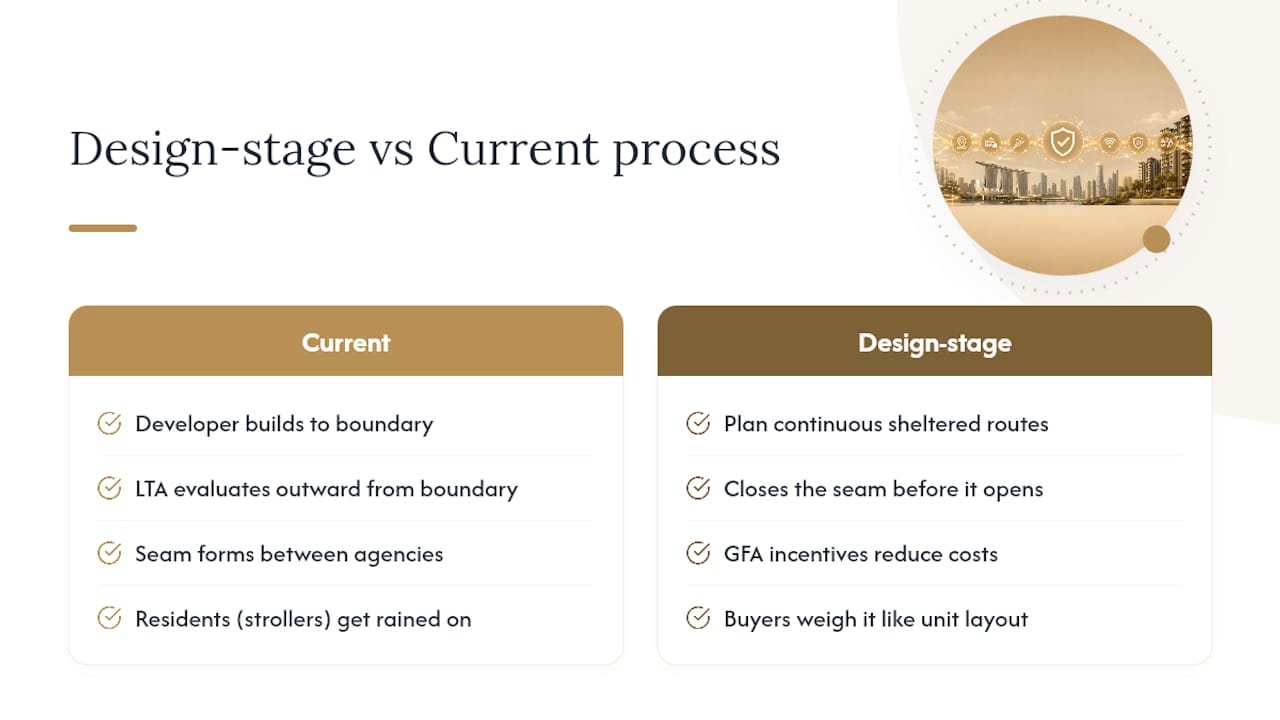
The gap in Singapore's covered-walkway system isn't a lack of good intentions from any single agency. It's the seam between them. A developer builds to the boundary, LTA evaluates from the boundary outward, and somewhere in between a resident with a stroller gets rained on.
Design-stage planning closes that seam before it opens. GFA incentives already exist to make it financially painless for developers to build sheltered routes rather than argue about them years later. Buyers should weight this as heavily as unit layout or facilities when choosing where to put down a deposit.
— Simon
A Development Built Around Direct MRT Access
If sheltered connectivity is near the top of your buying criteria, Hougang Central Residences offers something most resale condos in the area simply cannot retrofit: a residence built directly above Hougang MRT, with retail and bus interchange access woven into the same structure rather than added on afterward.
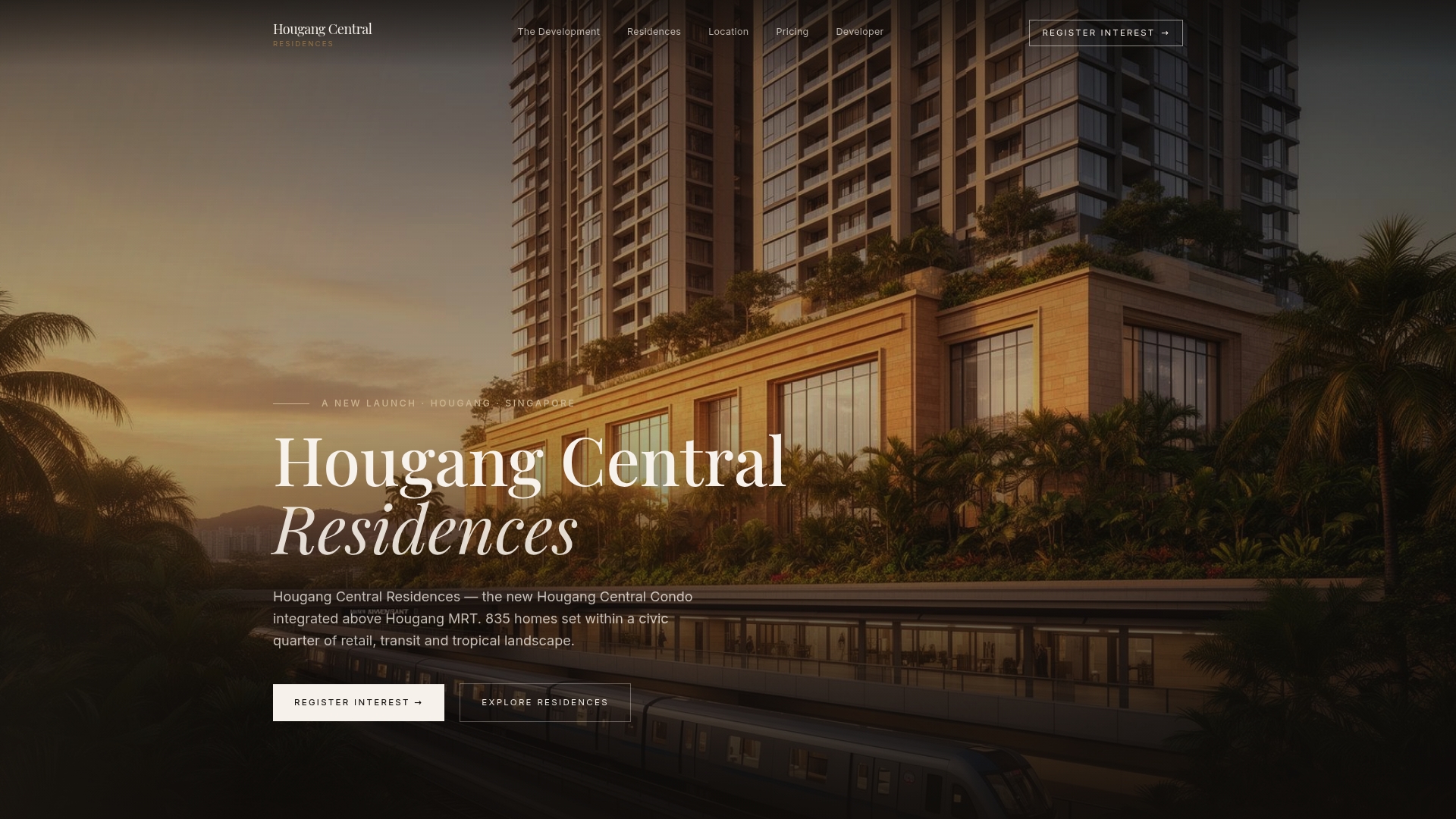
That above-station integration means your daily commute runs through covered, internal space from the moment you step out of your lift. Combined with various unit types and fittings, it's a project designed around the exact convenience factors buyers should be checking anyway. During a showflat visit, ask specifically about linkway ownership, maintenance responsibility, and how the retail and interchange connections tie into the development boundary. You can review project details or register for a showflat viewing to see the layout firsthand and get answers on unit availability.
Where to Verify the Rules Yourself
Sales staff can describe a linkway. Only the source documents confirm whether it meets the standard that actually matters.
- URA's Covered Walkway and Linkages handbook sets out the GFA exemption criteria developers must meet.
- The Ministry of Transport's written reply on Walk2Ride covered linkways explains the internal-route prerequisite for external funding.
- For project-specific questions, contact the developer, your MCST, or the relevant agency directly rather than relying on secondhand summaries.
This article is general information, not a substitute for advice from a qualified financial advisor. Consult a qualified financial professional about your own circumstances before acting on anything here.
Sources
- Covered Walkway and Linkages — URA
- Written reply by Minister for Transport Ong Ye Kung on covered linkways — MOT
- Speech by Dennis Tan Lip Fong on covered linkways for condominiums — Workers' Party
FAQ
What Is the Longest Sheltered Walkway in Singapore?
Singapore's covered linkway network includes long public stretches connecting HDB towns to MRT stations, but exact rankings shift as new linkways get built under URA and LTA programs; check current URA planning records for the latest figures rather than relying on outdated lists.
Which Condo Will Top the Market in 2026?
No single metric determines which condo "tops" the market, since performance depends on location, unit mix, and transport access, but developments with direct MRT integration, like those built above interchange stations, tend to hold buyer interest better than projects requiring an unsheltered walk to transit.
Which Condos in Singapore Are Considered Undervalued?
Condos near upcoming MRT interchanges or unfinished connectivity upgrades sometimes trade below comparable projects with existing sheltered access, since buyers often underprice future transport improvements until the linkway is actually built and usable.
Who Pays for a Sheltered Linkway After Move-In?
Ownership determines cost: a linkway inside the development boundary usually falls to the developer initially and the MCST afterward, while any portion crossing into public land is typically maintained by LTA or the relevant government agency.
Does Hougang Central Residences Have Direct MRT Access?
Yes, Hougang Central Residences is built directly above Hougang MRT station, with units connected to an integrated retail mall and bus interchange within the same development.