
TL;DR:
- Living near an MRT station within 200 to 400 meters saves time, boosts property value, and increases resale liquidity. Reliable fiber broadband and walkable daily amenities are essential for hybrid or remote workers. Proximity to transit significantly influences Singapore property prices, with integrated developments above stations commanding the highest premiums.
Transport and amenity connectivity is the single most consequential location factor for young professionals who commute daily or want low-friction urban living. A home within 200–400 meters of an MRT station (roughly a 5–10 minute walk) and within a 45-minute door-to-desk commute to your primary workplace hits the practical sweet spot most buyers should target. Beyond physical transit, fiber broadband availability matters too, especially if you work hybrid or from home even one day a week.
Two quick rules to carry into every viewing:
- Walking distance: Target under 400 meters to the nearest MRT. Beyond 800 meters, the daily friction compounds fast.
- Commute time: A door-to-desk time under 45 minutes preserves meaningful personal time. Every 10 minutes shaved off a daily round-trip returns roughly 40 hours a year.
- Digital access: Confirm fiber broadband availability before signing anything. A well-connected address with slow internet defeats the purpose for hybrid workers.
With roughly 70% of Singapore journeys made by public transport, MRT proximity is not a lifestyle preference. For most young professionals without a car, it is the infrastructure their daily schedule runs on.
Table of Contents
- How good connectivity reshapes your daily life
- What transit proximity does to property prices
- How to evaluate a property's connectivity before you commit
- Trade-offs you should price in honestly
- Your quick connectivity checklist for viewings
- How Hougang-central-residences maps to the checklist
- Key Takeaways
- The case for transit-integrated living is stronger than most buyers realize
- Hougang-central-residences: transit-integrated living above Hougang MRT
- FAQ
How good connectivity reshapes your daily life
The most immediate payoff of living near an MRT is time, and time compounds. A 5-minute walk to the station versus a 15-minute walk saves roughly 100 hours a year on commuting alone, the equivalent of more than two full workweeks. That figure comes from NexDoor's analysis of MRT proximity and time savings, which also shows that well-connected units face lower vacancy risk and faster rental take-up.
Practical daily impacts go beyond the commute itself:
- Fewer transfers means fewer missed connections and more predictable arrival times.
- Integrated retail at or near the station cuts grocery runs from a 20-minute errand to a 5-minute detour.
- Covered walkways eliminate the umbrella calculation on rainy mornings.
- Proximity to F&B, clinics, and gyms within a 10-minute walk reduces the number of trips you need to plan.
- Surveys show buyers rank supermarket access and affordable food as top-tier amenities, often equal to or above central location.
Consider two scenarios. A professional living 300 meters from Tanjong Pagar MRT reaches the CBD in under 20 minutes, door-to-desk, with no transfers. A professional living 1.2 kilometers from a suburban station on a line requiring a transfer to reach the CBD might spend 55–65 minutes on the same trip. The raw distance difference is modest; the time difference is not.
Integrated developments add another layer: retail and MRT access under one roof proved especially resilient during periods of disruption, when residents could meet most daily needs without leaving the building. For hybrid workers, reliable home fiber broadband completes the picture, turning a well-located unit into a genuinely flexible base.
What transit proximity does to property prices
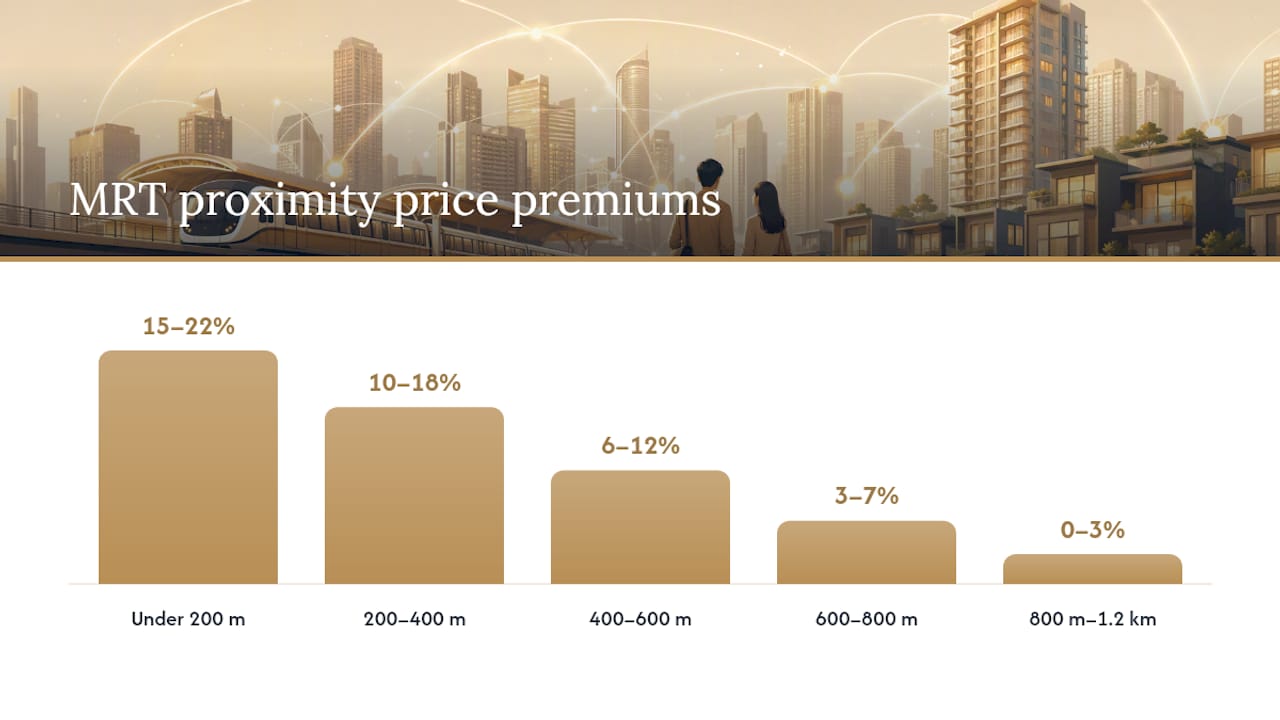
MRT proximity produces measurable price premiums, and the relationship is consistent across Singapore's private residential market. Distance-band data shows the following typical ranges:
| Distance from MRT | Typical price premium |
|---|---|
| Under 200 m | 15–22% |
| 200–400 m | 10–18% |
| 400–600 m | 6–12% |
| 600–800 m | 3–7% |
| 800 m–1.2 km | 0–3% |
The premium is not just about convenience at purchase. Research on the North East Line expansion found that pre-connected apartments gained roughly 1.5–2% in value when the network expanded around them, while newly connected apartments saw 2–3.2% uplift. Network expansions lift values even for homes that were already connected, because the broader network becomes more useful to everyone on it.
Integrated developments sit at the top of this premium stack. Units directly above an MRT station, with retail and bus interchange access, carry an additional 20–25% launch premium over comparable non-integrated condos. Their structural scarcity, only a small share of Singapore's private stock is built this way, supports that premium over time.
For buyers with a 7–10 year hold horizon, the combination of base MRT premium plus network-expansion uplift plus integrated-development scarcity creates a compounding case. Newer lines like the Cross Island Line are still in appreciation wave territory, meaning premiums near future interchange stations have not fully priced in.
How to evaluate a property's connectivity before you commit
Prioritize directness to your main destinations and realistic walking time over raw station count. A home with one direct line to your office beats a home with three nearby stations that all require transfers.
Checklist for every viewing:
- Walk the actual route to the MRT, not the crow-flies distance. Time it on a weekday morning.
- Check bus frequency and first/last train times on the LTA Journey Planner or Google Maps.
- Count transfers to your primary workplace. Zero or one is the target.
- Confirm covered walkway access. An uncovered 400-meter walk in Singapore's climate is a different experience than a sheltered one.
- Check supermarket, clinic, and F&B options within a 10-minute walk.
- Confirm fiber broadband availability at the unit address.
- Note any foreseeable construction nearby that could affect noise or access for 2–5 years.
For shortlisting condos near business hubs, run the door-to-desk commute on Google Maps at 8:30 AM on a Tuesday, not on a Sunday afternoon. The difference can be 15–20 minutes.
Pro Tip: Test the last-mile at night. Walk from the station to the property after 9 PM and assess street lighting, crossing safety, and how comfortable the route feels. A well-lit, sheltered path adds real daily value that no floor plan shows.
Trade-offs you should price in honestly
Connectivity costs real money and often reduces the living space your budget buys. The principal trade-offs deserve a clear look.
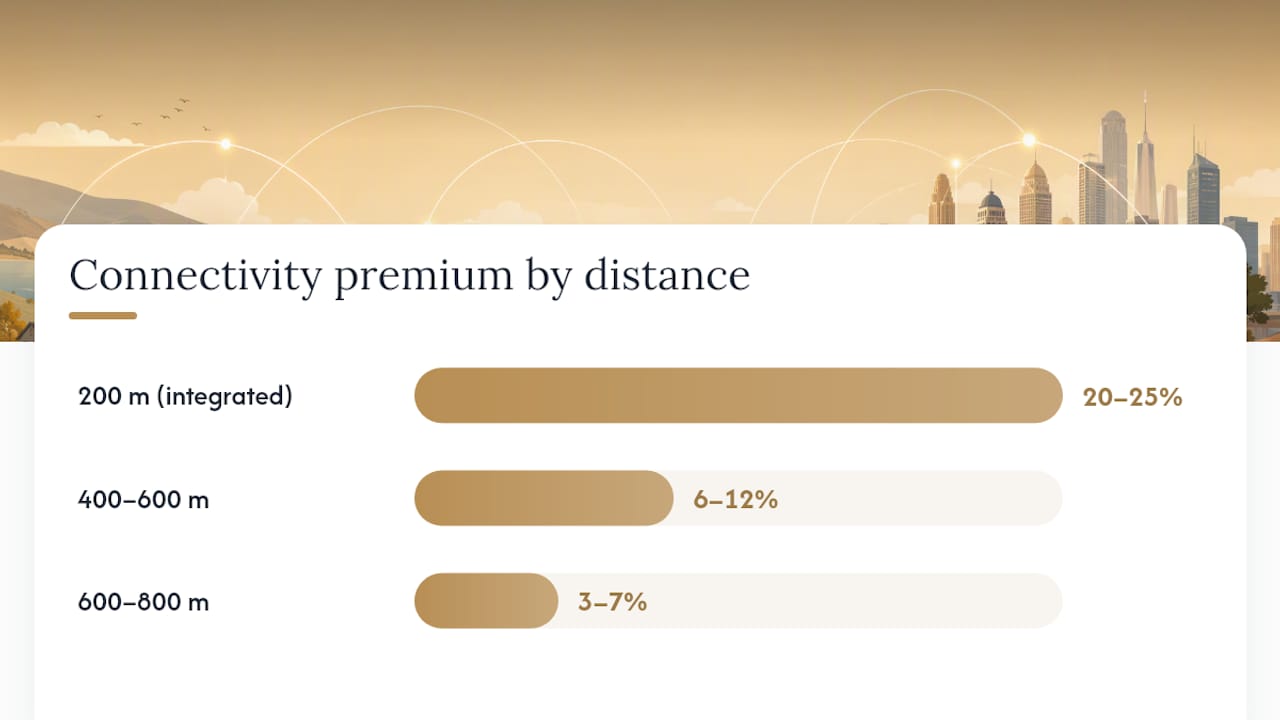
Price premium vs. square footage. On a S$1.5 million budget, a 15% MRT premium means roughly S$225,000 goes to location rather than unit size. At S$2,000 per square foot, that is about 112 square feet foregone. Whether that trade is worth it depends entirely on how often you commute and whether you own a car.
Noise and footfall. Integrated developments above MRT stations and bus interchanges have higher ambient noise, especially on lower floors. Retail podiums bring foot traffic and delivery activity that quieter suburban blocks do not.
Maintenance costs. Integrated developments with larger common facilities, retail podiums, and smart-home infrastructure typically carry higher MCST fees. Budget for this before comparing psf prices alone.
Parking and traffic. Ironically, the most transit-connected addresses often have the least convenient car access. If your household owns a vehicle, weigh parking costs and road access against the MRT benefit.
| Scenario | Connectivity premium | Space trade-off at S$2,000 psf |
|---|---|---|
| 200 m from MRT (integrated) | 20–25% | ~112 square feet on a S$1.5M budget |
| 400–600 m from MRT | 6–12% | — |
| 600–800 m from MRT | 3–7% | — |
The premium is less likely to pay off for households that work from home most of the week, own a car, or need significantly more space immediately. For everyone else commuting five days a week, the math usually favors proximity.
Your quick connectivity checklist for viewings
Bring this to every property visit or use it while shortlisting online:
- Walking time to MRT (actual timed walk): ___ minutes
- Door-to-desk commute time (tested on Google Maps, 8:30 AM weekday): ___ minutes
- Number of transfers to primary workplace: ___
- Covered walkway to MRT? Yes / No
- Supermarket within 10 minutes on foot? Yes / No
- Fiber broadband available at unit? Yes / No
- Foreseeable construction nearby (check URA Master Plan)? Yes / No
- Estimated connectivity premium (use distance band table above): ___%
Quick premium estimate: Under 200 m = budget 15–22% above a comparable non-MRT unit. 200–400 m = budget 10–18%. 400–600 m = budget 6–12%. Integrated development directly above MRT station = budget 20–25%. Use a rental cashflow calculator to model whether the premium pays back through rental yield if you plan to lease the unit later.
Take photos of the walking route, including any road crossings or uncovered stretches. You will forget the details after three viewings.
For a more detailed amenities checklist tailored for young professionals, the full version covers gyms, coworking proximity, and healthcare access alongside transit.
How Hougang-central-residences maps to the checklist
Hougang-central-residences sits directly above Hougang MRT station on the North East Line, with an integrated retail mall and bus interchange at the base of the development. That is not a marketing description; it is the checklist answer for the first four items on the list above.
| Checklist item | Hougang-central-residences answer |
|---|---|
| Covered walkway | Yes, fully integrated |
| Retail/supermarket within 10 min | Yes, integrated retail podium |
| Bus interchange access | Yes, directly integrated |
| Smart-home / fiber readiness | Yes, smart-home systems included |
| Future interchange access | Cross Island Line interchange planned |
The project offers 835 units across a 1-bedroom-plus-study to 5-bedroom penthouse range, with premium European fittings and tropical landscaped communal spaces. For a young professional running the checklist above, the walking-time and transfer-count questions answer themselves. The Cross Island Line interchange, when complete, will add a second direct line; this historically triggers a further appreciation wave for pre-connected units.
Readers who want to see the floor plans or register for a showflat visit can find details at Hougang Central Residences.
Key Takeaways
For young professionals, transport connectivity is both a daily quality-of-life factor and a measurable driver of property value and resale liquidity.
| Point | Details |
|---|---|
| Connectivity is measurable | MRT distance bands produce 0–22% price premiums, with under 200 m at 15–22%, 200–400 m at 10–18%, 400–600 m at 6–12%, 600–800 m at 3–7%, and 800 m–1.2 km at 0–3%; under 400 m is the practical sweet spot. |
| Network expansions add value | The NEL expansion lifted pre-connected apartments by 1.5–2%, showing future lines benefit existing owners. |
| Test real commute times | Door-to-desk time at 8:30 AM on a weekday is the only commute figure that matters. |
| Price premium has a space cost | A 15% MRT premium on a S$1.5M budget trades roughly 112 sq ft at S$2,000 psf. |
| Hougang-central-residences | Sits directly above Hougang MRT with integrated retail, bus interchange, and Cross Island Line interchange planned. |
The case for transit-integrated living is stronger than most buyers realize
Most buyers treat MRT proximity as a nice-to-have and negotiate on it when the budget gets tight. That is usually a mistake. The time savings alone, 55–100 hours a year depending on how far you shave the walk, are worth more than most buyers price them at. Add the network-expansion uplift, the rental liquidity advantage, and the daily friction reduction from integrated retail, and the premium starts looking less like a cost and more like a return.
The honest caveat: if you work from home four days a week and own a car, the calculus shifts. Space may genuinely matter more than station proximity for your household. But for a young professional commuting five days a week in a city where integrated developments retain consistent demand, buying away from transit to get more square footage is a trade that often looks worse in year five than it did at signing.
Hougang-central-residences: transit-integrated living above Hougang MRT
For young professionals who want to skip the checklist exercise entirely, Hougang-central-residences answers the hardest connectivity questions before you even book a viewing. The development sits directly above Hougang MRT, with an integrated retail podium, bus interchange, smart-home systems, and a Cross Island Line interchange in the pipeline. That combination of zero-walk MRT access, daily amenities under one roof, and a future second direct line is exactly what the research in this article points toward as the highest-value connectivity profile for commute-first buyers.
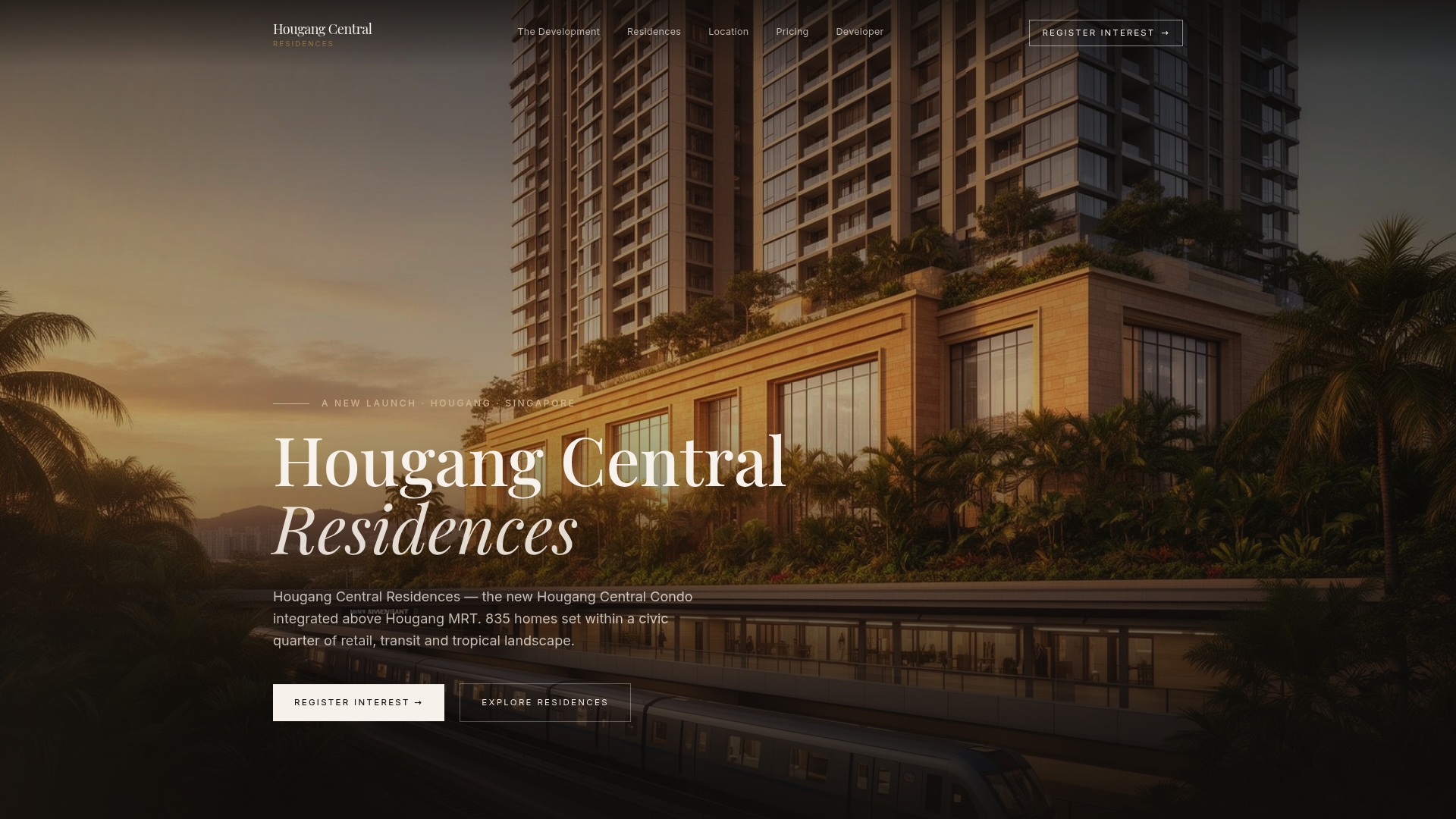
Units range from 1-bedroom-plus-study to 5-bedroom penthouses, covering solo buyers, couples, and growing families. Register for a showflat visit or request an e-brochure at Hougang Central Residences to see how the floor plans and facilities map to your commute and lifestyle needs.
FAQ
How close to an MRT should a young professional aim to live?
Under 200 meters is the optimal target, adding a 15–22% price premium, while 200–400 meters typically adds a 10–18% premium. Both ranges deliver significant daily value in time savings and resale liquidity.
Do new MRT lines increase the value of already-connected homes?
Yes. Research on the North East Line expansion found that pre-connected apartments gained roughly 1.5–2% in value when the network expanded, because a larger network makes every connected station more useful.
Are integrated developments worth the extra cost?
For commute-first buyers, usually yes. Integrated developments carry a 20–25% launch premium but offer zero-walk MRT access, integrated retail, and structural scarcity that supports the premium over time. The trade-off is less space per dollar and potentially higher maintenance fees.
What is the fastest way to test a property's real connectivity?
Run the door-to-desk commute on Google Maps at 8:30 AM on a Tuesday, count transfers, and walk the actual route to the MRT timed on foot. Sunday afternoon estimates routinely understate peak-hour travel time by 15–20 minutes.
Does digital connectivity matter as much as transport access?
For hybrid workers, yes. Fiber broadband availability should be confirmed at the unit level before signing. A well-located address with unreliable internet is a real productivity constraint for anyone working from home even part of the week.