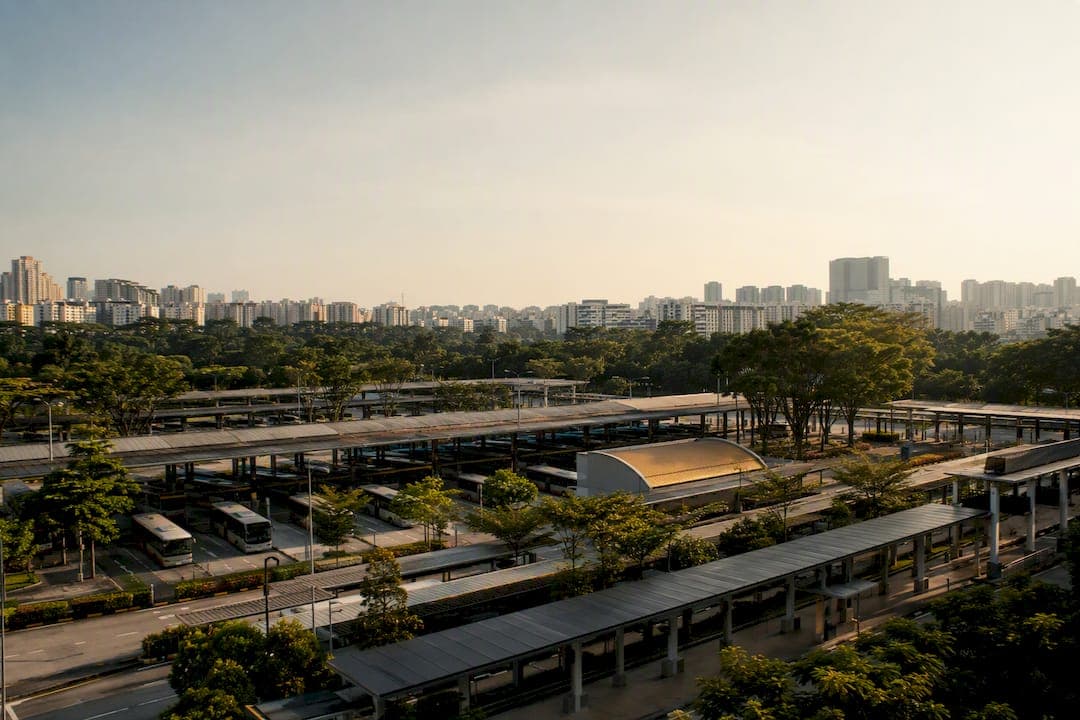
Living near a bus interchange in Singapore is a net positive for most homebuyers, mainly because it cuts commute friction and keeps resale demand steady. The trade-off is real, though: expect more noise and foot traffic than a quiet cul-de-sac unit. Integrated Transport Hubs (ITHs) usually soften that trade-off with sheltered, all-weather connections. The sections below walk through a buyer checklist and a real Hougang case study to help you weigh it properly.
TL;DR:
- Proximity to integrated transport hubs with sheltered, all-weather connections generally offers better value and convenience than standalone bus stops, especially with MRT links.
- Noise, crowding, and reduced privacy are significant downsides for units directly facing bus bays, particularly on lower floors or without soundproofing, and can impact resale value.
- The property premium for living near high-frequency interchanges is around 3.9%, but this benefit diminishes if sound and crowding issues outweigh the advantages of connectivity.
- Buyers should personally verify walking times, route diversity, sheltering, and unit orientation during viewings, especially during peak hours, to assess true convenience.
- Long-term planning and public consultation influence transit infrastructure changes that can significantly alter neighborhood accessibility and desirability over time.
Table of Contents
- What Are the Benefits of Living Near a Bus Interchange?
- What Are the Downsides of Living Near a Bus Interchange?
- Does Proximity to a Bus Interchange Raise Property Value?
- How Do You Evaluate a Specific Interchange Before Buying?
- What Does Transit-Integrated Living Actually Look Like? A Hougang Example
- What Other Singapore Interchanges Show About Transit Living
- Buyer Checklist: Ten Quick Checks and Red Flags
- Is It Safe to Live Near a Bus Interchange?
- How Does Proximity Affect Noise and Air Quality?
- How Does an Interchange Change the Feel of a Neighborhood?
- What Long-Term Development Plans Should Buyers Watch?
- How Does Public Feedback Shape Interchange Planning?
- When Living Near an Interchange Makes Sense (and When It Doesn't)
- Consider Hougang Central Residences for Transit-Integrated Living
- Sources
- FAQ
What Are the Benefits of Living Near a Bus Interchange?
The biggest win is time. A five-minute walk to a major interchange with 15 to 20 routes beats a longer walk to a single roadside stop with three. You get more first-mile and last-mile options, which matters more than raw distance once you're commuting daily rather than reading a floor plan.
ITHs push this further by combining the bus interchange with a mall, sheltered linkways, and often an MRT station under one roof. Bedok Bus Interchange is the clearest local example: it sits inside Bedok Mall, connected to Bedok Residences, so residents transfer between bus, train, and grocery run without stepping into the rain. That kind of barrier-free, all-weather layout is a genuine advantage for elderly residents and parents with strollers, not just a convenience footnote.
There's also a policy angle. Singapore's car-lite push means transit-accessible homes carry long-term value for households that never plan to own a car, since job and service access depends on the transit network staying strong.
Quick benefits rundown:
- Shorter door-to-destination times with more route choices at peak hours
- Sheltered, weatherproof transfers at ITHs, often bundled with retail
- Lower pressure to own a car, which saves on COE and parking costs over time
- Long-term demand support tied to Singapore's transit-oriented planning priorities
Pro Tip: Don't just count buses. Check how many distinct destinations those routes actually serve. A stop with ten buses that all go the same direction is less useful than one with five buses fanning out to different parts of the island.
What Are the Downsides of Living Near a Bus Interchange?
Noise is the honest answer. Interchanges generate activity from roughly 5:30 AM when the first services start, through late-night last buses, plus idling engines, PA announcements, and the general churn of commuters. Units facing the bus bays directly, especially on lower floors, absorb most of this.
Crowding is the second issue. Foot traffic through void decks and connecting walkways spikes hard during the morning and evening rush, and that same crowding can compromise privacy for ground-floor or podium-level units with sightlines onto the interchange.
Research on transit investment backs up what residents already sense: proximity brings real economic and access benefits, but it can also generate localized negative externalities that offset some of the upside if a unit is poorly positioned. A north-facing unit two blocks from an interchange can outperform a road-facing unit directly above it, even though both are "near" the same amenity.
Common friction points to check before you commit:
- Engine idling and PA announcements audible from bedroom windows
- Crowd surges during the 7 to 9 AM and 6 to 8 PM windows
- Reduced privacy on units with a direct line of sight to bus bays
- Possible resale hesitation from buyers who prioritize quiet over convenience
Mitigation isn't complicated. Ask about unit orientation away from the bus bay, confirm acoustic glazing on affected facades, and look for buildings with a landscaped setback between the tower and the road. A technical review of construction considerations for Singapore residential properties is worth a skim if you want to understand how acoustic buffering actually gets built into a facade.
Does Proximity to a Bus Interchange Raise Property Value?
Yes, generally, though the size of the premium depends on what kind of stop you're near. Studies on transit proximity in comparable urban contexts point to a premium for properties near high-frequency public transport and integrated hubs, with the strongest effect concentrated near ITHs rather than standalone bus stops
That gap between "any stop" and "the right stop" matters more than most buyers realize. Recent research on transit accessibility suggests network-level connectivity, which means how many direct links a location has via interchange plus MRT, explains price stability better than simple distance-to-stop measurements. A unit 500 meters from an ITH that also connects to an MRT line can hold value better than a unit 200 meters from an isolated bus stop with two routes.
The caveat: premiums shrink or disappear when disamenities dominate. If a unit takes the brunt of noise and crowding without the sheltered, integrated design that makes ITHs desirable, the connectivity premium can get erased by the discount buyers apply for those disamenities. For resale and rental purposes, the practical takeaway is to favor integrated hubs with MRT links over standalone interchanges, and to weigh unit-specific exposure separately from the location's headline transit score. Our breakdown of local Hougang pricing digs into how this plays out at street level.
How Do You Evaluate a Specific Interchange Before Buying?
A five-minute desk check before a viewing saves you from falling for a listing photo of a bus stop sign.
- Time the walk yourself, don't trust the listing. Google Maps often underestimates real walking time through void decks, overhead bridges, and traffic light waits.
- Check frequency and destination spread, not just the number of services, using LTA's official route information or LandTransportGuru for detailed interchange profiles.
- Confirm the route is sheltered end-to-end, or if you'll be exposed to rain for part of the walk.
- Check accessibility features like ramps, tactile paving, and lift access if you or a family member has mobility needs.
- Walk the road crossings near the interchange and note whether they have signaled crossings or require jaywalking-adjacent shortcuts locals have worn into the grass.
At the actual viewing, go twice: once during evening peak, once mid-morning on a weekday. Ask the agent or HDB office directly about planned construction, road widening, or route changes filed with LTA.
Pro Tip: Score each factor 1 to 3, add them up, and set your own threshold before you start touring units. It stops "the agent seemed nice" from overriding what your own ears told you at 6 PM on a Tuesday.
What Does Transit-Integrated Living Actually Look Like? A Hougang Example
A condominium development sits directly above Hougang MRT station, embodying the concept of "integrated" living in a walkable form. The development includes residences ranging from 1-bedroom units up to 5-bedroom homes, with a retail mall and bus interchange in the same footprint, plus a future connection to the Cross Island Line.
For a family, that layout removes the daily gap between "home" and "transit" almost entirely: no crossing a busy road with kids to catch a bus, no weather gamble on the walk to the platform.
What the integrated model changes day to day:
- Direct MRT access without an outdoor walk, useful on Singapore's frequent rain days
- Retail integrated at the base, so grocery runs don't require a separate trip
- Smart-home systems and premium fittings inside the units
- Tropical landscaped communal spaces that buffer residents from the street-level activity
This model tends to suit families with young kids or elderly parents, and investors targeting tenants who want zero-commute convenience, more than buyers chasing a quiet, low-density feel. Worth stating plainly: This project is presented here as a working example of integrated design, not a neutral third-party pick.
What Other Singapore Interchanges Show About Transit Living
A handful of recent projects illustrate how differently "near an interchange" can play out depending on design and timing.
- Bedok Bus Interchange sits inside Bedok Mall, linked to Bedok Residences, showing how retail and sheltered transfers get bundled into one ITH.
- Buangkok Bus Interchange, which opened December 1, 2024, added routes including a direct Changi Airport service, giving residents a connectivity boost that didn't exist a year earlier.
- Woodleigh's bus interchange handover in the Bidadari estate, completed in December 2024, closed a long gap for residents who had been living in a still-developing precinct without full transit infrastructure.
- Bayshore's planned interchange shows the other direction: it's part of a future car-lite precinct still on the drawing board, so buyers there are betting on a masterplan rather than buying into a finished network.
The pattern across all four: timing and integration quality matter as much as proximity itself.
Buyer Checklist: Ten Quick Checks and Red Flags
Print this out or screenshot it before your next viewing weekend.
- Walk time from the unit's block entrance to the interchange, timed yourself
- Audible noise level standing inside the actual unit with windows closed
- Number of distinct destinations served, not just number of bus services
- Whether the walking route is sheltered the whole way
- Any planned construction, road works, or route changes filed with LTA
- Unit orientation relative to the bus bay and main road
- Crowd density at 7:30 AM and 6:30 PM on a weekday
- Lift and ramp accessibility if mobility is a household concern
- Presence of acoustic glazing or double glazing on road-facing units
- Historical resale trends for similar units in the same block
Red flags that should drop your score: a unit directly overlooking the bus bay with single glazing, an agent who can't answer basic frequency questions, or visible construction fencing near the interchange with no completion date confirmed.
Simple scoring rule: give each item a 1 to 3, tally the total, and treat anything under 20 out of 30 as a "revisit before you commit" signal rather than an automatic pass.
Pro Tip: Bring a decibel meter app on your phone during the peak-hour viewing. A reading consistently above 60dB with windows closed is worth negotiating on price, not just noting and moving on.
Is It Safe to Live Near a Bus Interchange?
Safety near interchanges comes down to three practical factors: lighting, foot traffic visibility, and surveillance coverage, and all three tend to improve as an interchange gets more integrated rather than standing alone at a roadside.
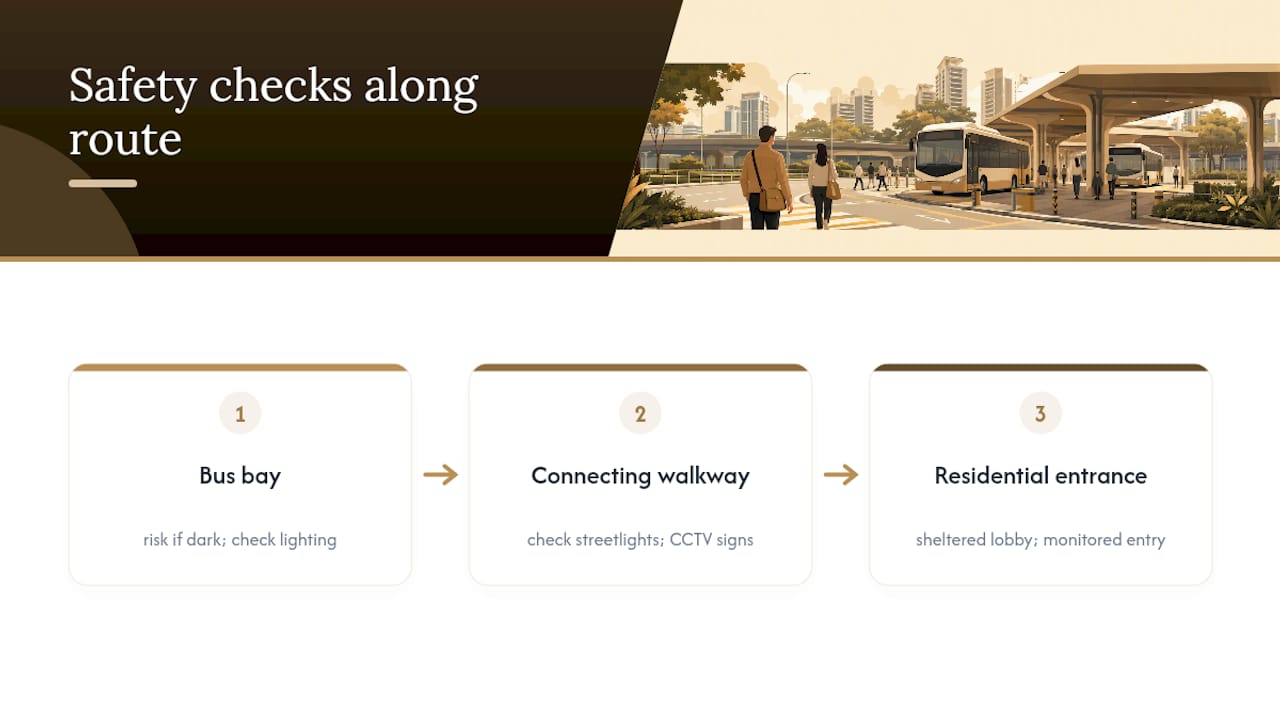
ITHs built into malls, like Bedok, benefit from mall-hours lighting, retail security presence, and the natural surveillance of shoppers and commuters passing through late into the evening. A standalone bus bay on a quiet stretch of road, by contrast, can go dark and empty after the last bus, which changes the safety profile of the walk home considerably.
Practical steps during a viewing: walk the route back from the interchange after dark and note streetlight spacing, check whether CCTV signage is visible along connecting walkways, and ask whether the void deck and stairwells near the interchange entrance are lit at night. Singapore's overall low crime rate makes interchange-adjacent living broadly comparable to other residential areas in safety terms, but the last 200 meters of the walk, specifically the stretch between the bus bay and your block, is the part worth checking in person rather than assuming from a map.
Buildings that route residents through a sheltered, monitored lobby rather than an open-air path from the interchange tend to score better on this front, which is part of why fully integrated developments have an edge over blocks that merely sit near a bus terminal without a connected walkway.
How Does Proximity Affect Noise and Air Quality?
Noise is the more immediate concern for most residents, and it comes from three sources: bus engines idling at bays, air brakes releasing, and PA announcements during peak service hours. The intensity depends heavily on how many bays face residential blocks and whether there's a buffer of retail, landscaping, or distance between the two.
Air quality is a smaller but real factor. Diesel bus fleets idling in a concentrated bay area can create localized pockets of exhaust, particularly noticeable at ground level near loading bays. Singapore's ongoing shift toward electric and hybrid buses is gradually reducing this, but older interchanges with a larger diesel fleet mix still generate more localized emissions than a fully electrified hub.
Landscaping does real work here beyond aesthetics. A tropical buffer zone between a tower and a bus bay, the kind increasingly standard in newer integrated developments, cuts both noise transmission and helps disperse exhaust before it reaches upper floors. Units above the fourth or fifth floor generally see a meaningful drop in both noise and air quality impact compared to podium-level units directly facing the bays.
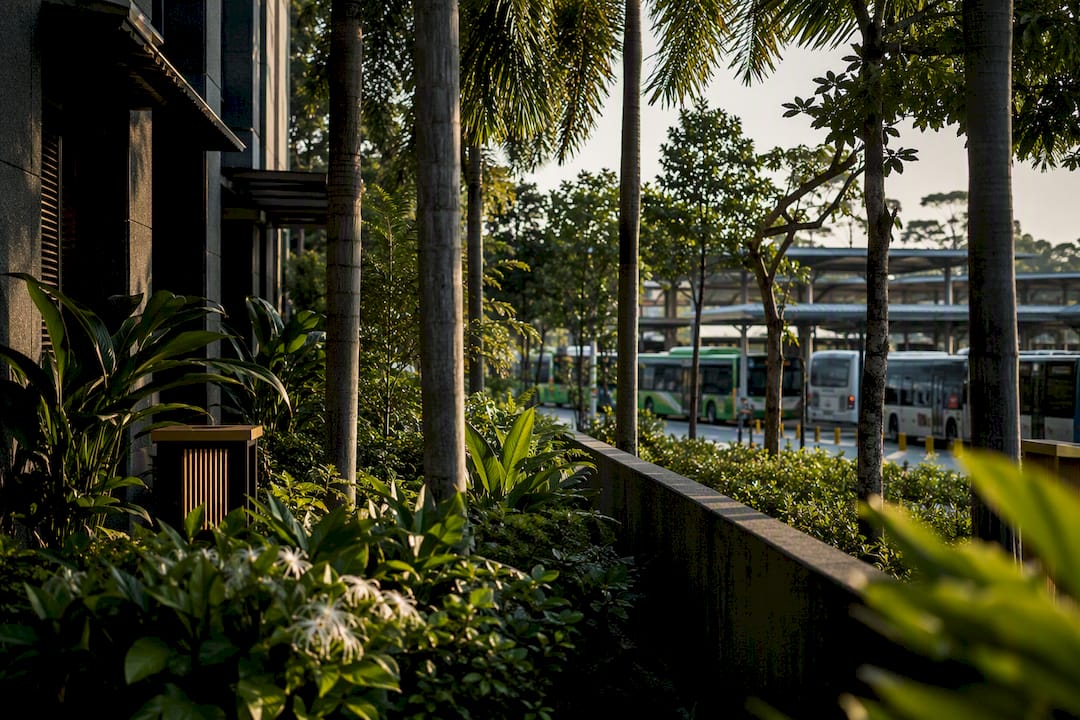
If air and noise quality matter to you specifically, ask during viewings whether the block uses double or acoustic glazing, and check the distance and orientation between your target unit and the nearest bus bay rather than just the interchange's overall distance from the block.
How Does an Interchange Change the Feel of a Neighborhood?
An interchange changes the rhythm of a neighborhood more than its architecture does. Foot traffic through void decks and connecting paths turns a quiet residential block into a small, informal gathering point at peak hours, with hawker stalls, convenience kiosks, and coffee shops often clustering nearby to catch that flow.
That density cuts both ways. It can create a genuinely lively, connected community feel, more casual interactions at the void deck, more foot traffic supporting local shops, more of a "always something happening" texture to daily life. Some residents find that energizing. Others find it erodes the quieter, closer-knit feel of a residential enclave further from major transit nodes.
Long-term transit access also supports a specific kind of social equity: households without cars, often lower-income families, elderly residents, and younger renters, depend on that proximity for job access and daily errands in a way that car-owning households simply don't. That's part of why transit-oriented estates in Singapore tend to have a more mixed, less homogenous resident profile than car-dependent suburbs elsewhere in the region. Whether that mix feels like a plus or a minus is genuinely a personal preference question, not one where there's an objectively right answer.
What Long-Term Development Plans Should Buyers Watch?
Bus interchanges are rarely static once you move in. Singapore's transport planning treats them as anchors for future precinct growth, which means the interchange near your unit today may look very different in a decade.
The clearest current example is the planned Bedok South interchange, designed specifically to serve the upcoming car-lite Bayshore precinct, a mixed-use development planned to house thousands of new residents. Buyers looking at precincts still on the masterplan stage should treat the interchange as a promise tied to a completion timeline, not a finished amenity.
Cross Island Line construction is another factor reshaping several interchange areas, including Hougang, where future MRT interchange status will change the accessibility profile of the surrounding precinct once complete. Buyers should check URA's masterplan documents and LTA's published rail and bus network expansion plans before assuming a current interchange's status is permanent. An interchange can be upgraded to full ITH status, relocated slightly to accommodate new rail infrastructure, or expanded to absorb population growth from a nearby BTO launch. None of these changes are guaranteed, but they're worth researching specifically for your shortlisted precinct rather than assuming today's bus stop layout is fixed for the next 20 years.
How Does Public Feedback Shape Interchange Planning?
LTA runs public consultation processes before major interchange projects break ground, and resident feedback has visibly shaped outcomes in several recent cases. Noise concerns, request for more sheltered walkways, and pushback on bus bay placement relative to residential blocks are common themes raised during these consultation windows.
The Buangkok interchange rollout is a useful recent example of how this plays out in practice: residents welcomed the added Changi Airport route and improved connectivity, and that kind of direct feedback tends to inform how LTA times and phases route additions in newly built estates. Public reception matters here because interchange planning isn't purely a top-down infrastructure decision. It responds, at least partially, to what nearby residents flag as priorities once a hub opens and real usage patterns emerge.
For prospective buyers, this means checking whether a planned interchange in your target precinct has gone through public consultation yet, and if so, what concerns residents raised. URA and LTA occasionally publish summary feedback from these sessions, and Members of Parliament for the relevant constituency sometimes highlight resident concerns in town hall updates. If you're buying into a precinct with an interchange still in the planning stage, that feedback history is a genuinely useful signal for what the finished version might actually look like, and whether current design plans have already addressed the noise and crowding concerns this article has covered.
When Living Near an Interchange Makes Sense (and When It Doesn't)
Living near an interchange makes the most sense for families without a second car, retirees who value flat, sheltered walks, and investors chasing tenant demand. It makes less sense for buyers who prioritize quiet above all else, or anyone eyeing a low-floor unit facing the bus bay directly. My one-line heuristic: if you'd be happy hearing bus announcements from your balcony, buy. If that thought makes you wince, keep looking or aim higher up the tower.
— Simon
Consider Hougang Central Residences for Transit-Integrated Living
If everything in this guide points you toward wanting the connectivity without the usual noise and crowding trade-offs, that's exactly the gap this development is built to close. Rather than living near an interchange, you'd be living directly above one, with units ranging from 1-bedroom to 5-bedroom layouts, a retail mall built into the base, smart-home systems, and a future Cross Island Line connection on top of existing MRT access.
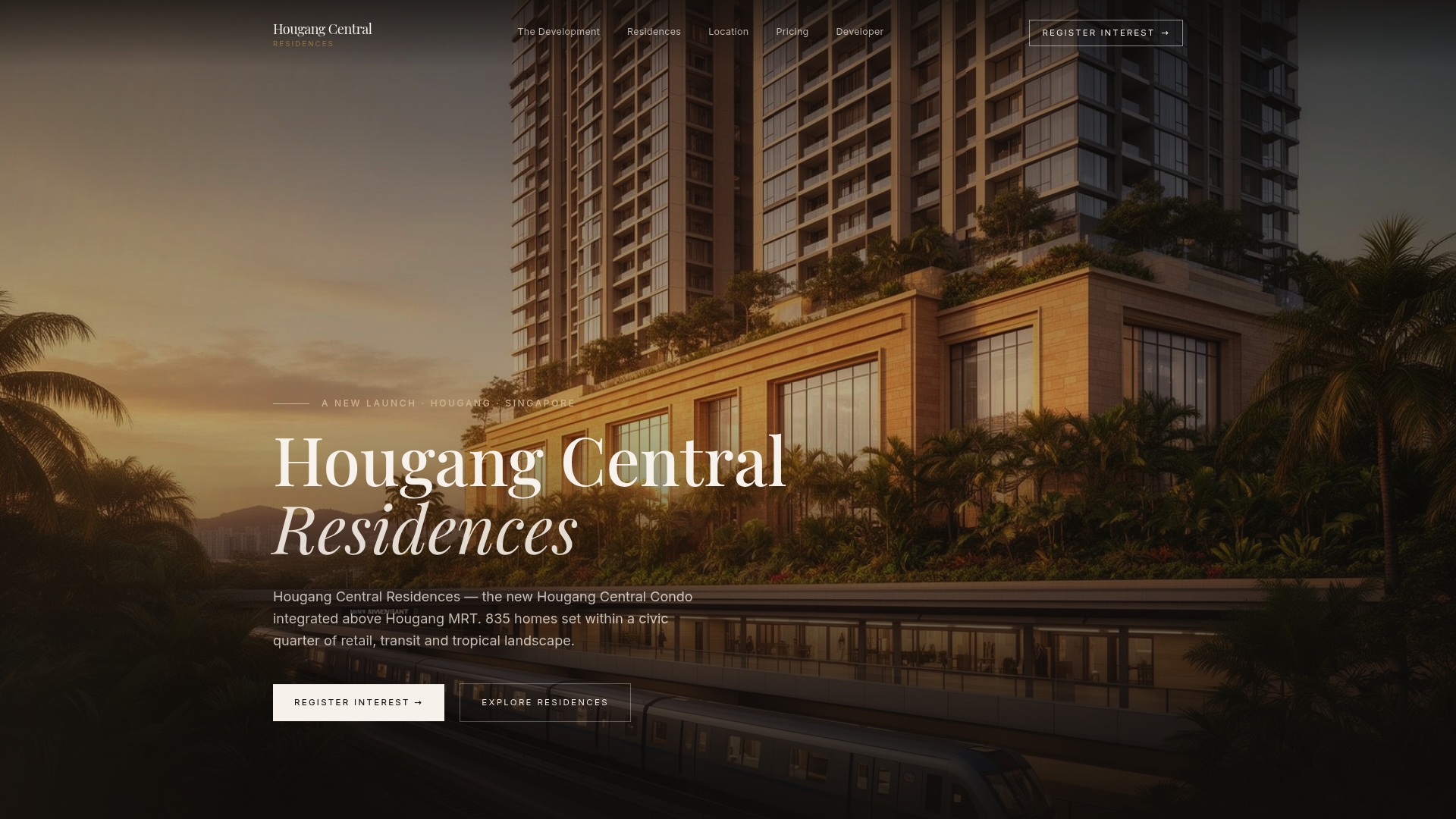
That direct-access design is the practical difference: no outdoor walk in the rain, no crossing a busy junction with kids or elderly parents in tow, and no guessing whether your unit faces the noisy side of a bus bay. Premium European fittings and tropical landscaped communal spaces are built in specifically to buffer residents from street-level activity while keeping transit two floors away instead of two blocks away. If transit-integrated living is genuinely what you're shortlisting for, visit the Hougang Central Residences project page to check current unit availability and register for showflat access.
Sources
- Transit proximity and property premiums (NUS research)
- Bedok Bus Interchange | Land Transport Guru
- Tap improved connectivity and convenience at new bus interchange in Buangkok | The Straits Times
- Public transport investments as generators of economic and social activity (ScienceDirect review)
- Does proximity to public transport matter for planning X-minute cities? Insights from public perceptions
This article is general information, not a substitute for advice from a qualified financial advisor. Consult a qualified financial professional about your own circumstances before acting on anything here.
FAQ
Is it convenient to live near a bus interchange in Singapore?
Yes, for most residents, since interchanges concentrate multiple routes and destinations within a short walk, cutting commute time compared to relying on a single roadside stop.
What is the biggest bus interchange in Singapore?
Among the well-known ITHs, Bedok Bus Interchange stands out for its scale and integration with Bedok Mall and Bedok Residences, combining retail, MRT, and bus services in one hub.
What is the average distance between bus stops in Singapore?
Bus stops in Singapore are generally spaced a few hundred meters apart along most routes, though exact spacing varies by road type and route density, and specific figures are published by LTA rather than fixed nationwide.
Does living near a bus interchange increase property value?
Generally yes. Research points to a premium of roughly 3.9% for properties near high-frequency transit and integrated hubs, though the effect is strongest near ITHs rather than standalone bus stops.
What should I check before buying a home near a bus interchange?
Walk the actual route yourself at peak hours, verify route frequency and destination spread through LTA or LandTransportGuru, and check unit orientation relative to the bus bay before assuming proximity alone guarantees a good outcome.