
TL;DR:
- Condo maintenance fees are mandatory monthly payments used to fund shared building expenses and reserve funds. They are based on ownership share and can significantly impact a seller's or buyer's budget, especially with increasing costs over time. Buyers should review the building’s financial health through official documents to ensure fees are reasonable and the reserve fund is well-funded.
Condo maintenance fees are mandatory monthly payments every unit owner makes to fund the shared operating and capital expenses of their building. They are not optional, not negotiable, and not limited to amenities you actually use. Fees typically range from $50 to over $1,000 per month, with most US buyers landing somewhere between $300 and $400 monthly depending on location, building age, and amenities. That number sits on top of your mortgage, property taxes, and personal insurance, so getting a clear picture of what you owe and why matters before you sign anything.
Your ownership share determines your fee. Larger units carry a proportionally bigger slice of the building's annual budget, because the unit factor or ownership percentage is usually tied directly to square footage. A 1,200-square-foot unit in the same building as a 600-square-foot studio will pay roughly twice as much each month. Reserve fund contributions are built into that figure too, covering future capital repairs like roof replacements and elevator overhauls that protect the building's long-term value.
How condo maintenance fees are calculated
The math behind your monthly bill starts with the condominium corporation's annual operating budget. The board totals every projected expense for the year, from cleaning contracts to insurance premiums to reserve fund contributions, then divides that total across all units according to each unit's ownership percentage.
- Annual budget total divided by 12 gives the monthly pool needed.
- Your unit factor (often expressed as a percentage of total building square footage) determines your share of that pool.
- Reserve fund contributions are included in the budget, not charged separately.
- New builds often launch with developer-estimated fees that adjust upward as actual operating costs become clear.
To verify exactly how your fee is calculated, review the status certificate for resale units or the disclosure statement for new construction. The operating budget, which the board is required to share, breaks down every line item.
Pro Tip: Ask for the last three years of operating budgets, not just the current one. A pattern of annual increases tells you far more about a building's financial discipline than a single snapshot.

What does your condo fee actually cover?
Most buyers are surprised by how many line items sit inside a single monthly payment. The breakdown below reflects typical allocation percentages across a standard residential building.
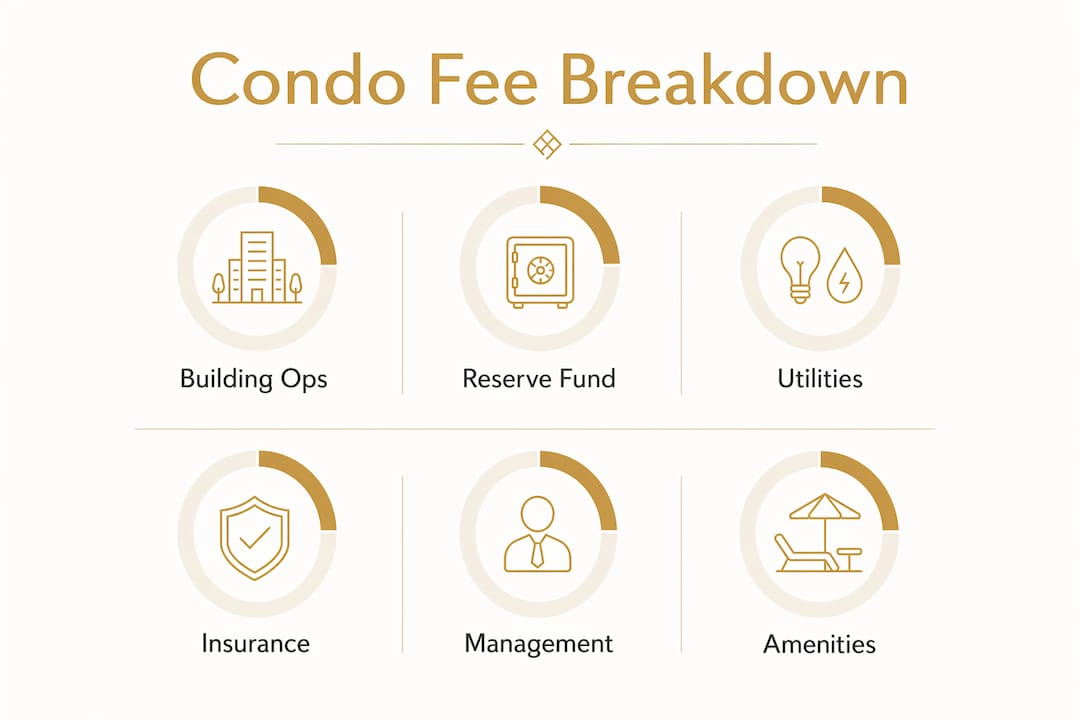
| Component | Typical Allocation | Monthly Example ($400 fee) |
|---|---|---|
| Building operations and maintenance | 35% | $140 |
| Utilities and common elements | 30% | — |
| Insurance | 20% | — |
| Reserve fund contribution | 10% | — |
| Management and administration | 10% | — |
Building operations covers daily cleaning, landscaping, snow removal, elevator maintenance, HVAC servicing, and security staff. Utilities pay for hallway lighting, lobby heating and cooling, elevator power, and in older buildings often domestic hot water. Insurance covers the building structure and common areas, not your personal belongings or unit improvements. You still need a separate HO-6 policy for those.
The reserve fund contribution is arguably the most consequential line. Reserve funds are legally mandated pools set aside for major capital repairs: roof replacement, elevator modernization, parking garage waterproofing, and window systems. A building without an adequately funded reserve is a building heading toward a special assessment. Management and administration, by contrast, tends to be the smallest slice, covering property management contracts, accounting, legal fees, and the reserve fund study conducted every few years by a licensed engineer.
One thing many buyers get wrong: condo fees are mandatory for every common element, including the pool you never swim in and the concierge desk you walk past every day. Buildings with more amenities charge more because those amenities cost real money to operate. A fitness center, rooftop terrace, or concierge-level services all show up in your monthly bill.
Financial impact: what fees mean for your budget
Fees affect your finances in two ways most buyers underestimate. First, lenders count them when calculating your debt-to-income ratio for mortgage approval. If your mortgage payment is $1,500 and your condo fee is $400, the lender sees $1,900 in monthly housing obligations before any other debt. That can shrink your approved loan amount considerably.
Second, fees tend to rise. Annual increases to cover inflation, rising insurance premiums, and growing reserve fund requirements are standard. Experts advise keeping total condo fees below roughly 20%–30% of your total monthly housing costs to maintain financial stability, though that threshold depends on your overall budget.
- Underfunded reserve funds are the most common trigger for sudden fee hikes or special assessments.
- New construction fees often start below actual operating costs and climb as the building ages and developer estimates give way to real expenses.
- Older buildings with deferred maintenance tend to carry higher fees or face larger special assessments down the road.
Pro Tip: Run the full number: mortgage payment plus condo fee plus property tax plus your HO-6 premium. That total is your real monthly housing cost, and it is the figure your lender uses too.
How to verify fees before you buy or rent
The documents that reveal a building's true financial health are the status certificate (for resale units), the disclosure statement (for new construction), and the annual operating budget. The status certificate is the single most important document a resale buyer can request. It discloses the current fee amount, the reserve fund balance, any pending special assessments, and active litigation against the corporation.
- Reserve fund study: Conducted by a licensed engineer, this projects long-term capital repair costs. A healthy fund covers projected expenses without requiring special assessments.
- Fee increase history: Ask for the past three to five years. Consistent annual increases of a few percent are normal; sudden large jumps signal financial stress.
- Pending litigation: Any active lawsuit against the corporation can result in a special assessment if the corporation loses.
- Operating budget line items: Verify that reserve fund contributions are included and not artificially suppressed to keep fees looking low.
For new construction, the disclosure statement is your equivalent document. Read it carefully, because developer fee estimates for new builds often rise as actual operating costs replace projections. Buyers exploring lease versus purchase decisions should factor in fee trajectory, not just the current monthly number.
How special assessments differ from regular fees
Regular condo fees are predictable monthly charges set by the annual budget. A special assessment is a separate, one-time charge levied when the corporation faces an expense it cannot cover from operating funds or the reserve fund.
Common triggers include an unexpected major repair, a reserve fund that was underfunded for years, or a legal judgment against the corporation. Special assessments can range from a few hundred dollars to tens of thousands per unit, depending on the scope of the repair. Low fees are a warning sign precisely because they often indicate a reserve fund that has been kept artificially thin, setting up owners for a large one-time bill later.
How fee increases are decided
The condominium board sets the annual budget and determines any fee increase, typically without a unit-owner vote. Boards are legally obligated to fund the reserve at levels recommended by the reserve fund study, so increases tied to capital planning are not discretionary. Inflation in labor, insurance, and utilities drives routine annual adjustments. Owners receive advance notice of upcoming changes, usually through the annual budget meeting, but they generally cannot block a fee increase if the board has properly justified it through the budget process.
What happens if you stop paying fees
Stopping payment is not a strategy. Condo fees are neither optional nor negotiable, and corporations have real legal tools to collect arrears. Most states allow the association to place a lien on your unit for unpaid fees. That lien can escalate to foreclosure if the debt goes unresolved, even if you are current on your mortgage. The process and timeline vary by state, but the outcome is the same: unpaid fees create a cloud on your title that complicates any future sale or refinancing.
How to evaluate whether fees are reasonable
A fee is not high or low in isolation. It is high or low relative to what the building delivers and how well it is funded. A moderate monthly fee in a building with a fully funded reserve, a well-maintained structure, and no pending special assessments is often a better deal than a lower fee in a building with deferred maintenance and a thin reserve. Ask your real estate agent to pull the fee history and reserve fund status for any building you are seriously considering. Buildings with family-oriented amenities like playgrounds and shared gathering spaces will naturally carry higher operating costs than a bare-bones building, and that is not a red flag if the budget is managed well.
Key Takeaways
Condo maintenance fees are mandatory, proportional monthly payments covering building operations, utilities, insurance, reserve fund contributions, and management, with US averages running $300–$400 per month.
| Point | Details |
|---|---|
| Fee range in the US | Fees typically run $50–$1,000+ per month, averaging $300–$400 depending on location and amenities. |
| How fees are calculated | Your ownership percentage, tied to unit size, determines your share of the building's annual operating budget. |
| Reserve fund matters most | An underfunded reserve is the leading cause of special assessments and sudden large fee increases. |
| Fees affect mortgage approval | Lenders include condo fees in your debt-to-income calculation, reducing your approved loan amount. |
| Verify before you buy | The status certificate, disclosure statement, and operating budget reveal fee history, reserve health, and pending assessments. |
FAQ
What do condo maintenance fees cover?
Condo fees cover building operations, common area utilities, landscaping, snow removal, building insurance, property management, security, and reserve fund contributions for major future repairs.
Why do condo fees vary so much between buildings?
Fees reflect the building's size, age, amenity level, and reserve fund requirements. A building with a pool, concierge, and aging mechanical systems will charge significantly more than a basic low-rise with minimal shared spaces.
Can condo fees increase without owner approval?
Yes. The board sets the annual budget and can raise fees to cover rising costs or reserve fund requirements, usually without a unit-owner vote, though owners receive advance notice.
What is a special assessment and how does it differ from regular fees?
A special assessment is a one-time charge on top of regular fees, levied when the corporation faces an expense the reserve fund cannot cover. Unlike monthly fees, it can arrive with little warning and vary widely in size.
What happens if a condo owner does not pay their fees?
The corporation can place a lien on the unit for unpaid fees, which can escalate to foreclosure if the debt remains unresolved, regardless of whether the owner is current on their mortgage.