Singapore's Buyer's Stamp Duty runs on a six band residential scale that tops out at 6% on amounts above S$3 million, with non-residential purchases capped at 5%. Buy at S$1,000,000 and you owe S$24,600 in BSD; at S$3,000,000, S$119,600. IRAS calculates the duty on whichever is higher, the price you agreed to pay or the property's market valuation, and you have 14 days from signing to pay in cash.
TL;DR:
- Homebuyers should verify if IRAS's market valuation exceeds their purchase price, as BSD is calculated on the higher figure, potentially increasing costs.
- The maximum BSD rate for residential property is 6%, applying only to amounts above S$3 million, but effective rates are generally lower even for multi-million dollar homes.
- Every buyer, regardless of residency status or property type, owes BSD, and it stacks with additional taxes like ABSD for certain profile and property combinations.
- BSD must be paid in cash within 14 days of signing; CPF cannot be used for upfront payment but can be reimbursed afterward.
- Accurate interpolation of BSD requires working through each marginal band separately, especially on high-value properties in the luxury segment.
Table of Contents
- What Are the Current Buyer Stamp Duty Rates?
- How Do You Calculate Stamp Duty on a Property Purchase?
- Who Has to Pay BSD, and Which Properties Are Covered?
- When Is Buyer Stamp Duty Due, and Can I Use CPF?
- Does BSD Stack With ABSD or Seller's Stamp Duty?
- Are There Remissions or Exemptions Available?
- Budgeting Checklist: Avoiding a Stamp Duty Shortfall
- Budgeting for BSD on a Hougang Central Residences Purchase
- What Buyers Should Take Away From the 2026 Rates
- See Hougang Central Residences Pricing and Payment Plans
- Where to Verify Current Rates Before You Sign
- Sources
- FAQ
What Are the Current Buyer Stamp Duty Rates?
IRAS applies BSD on a marginal basis, meaning each slice of the purchase price is taxed at its own rate rather than the whole amount getting hit with one flat percentage. For residential property, the current structure has six bands.
| Portion of price or value | Residential rate | Non-residential rate |
|---|---|---|
| First $180,000 | 1% | 1% |
| Next $180,000 | 2% | 2% |
| Next $640,000 | 3% | 3% |
| Next $500,000 | 4% | 4% |
| Next $1,500,000 | 5% | 5% (final band) |
| Remainder above $3,000,000 | 6% | 5% |
Non-residential property, which covers shophouses, commercial units, and industrial space, tops out at 5% once the price crosses S$1,500,000. There's no seventh band for commercial buyers. Residential buyers, on the other hand, keep climbing past that threshold until they hit the 6% ceiling on anything above S$3 million.
IRAS rounds every calculation down to the nearest dollar, and there's a minimum duty of S$1 on any transaction, however small. This six band structure isn't ancient history either. It was last reshaped on February 15, 2023, when the 5% and 6% residential bands were added on top of what had previously been a flatter scale. Rates can move again, so always confirm the numbers on IRAS before you sign anything.
How Do You Calculate Stamp Duty on a Property Purchase?
You work through the bands one slice at a time. Take the higher of your two figures, the agreed purchase price or the IRAS market valuation, and tax each portion at its own rate before adding the pieces together.
Here's how the math plays out at several common price points:
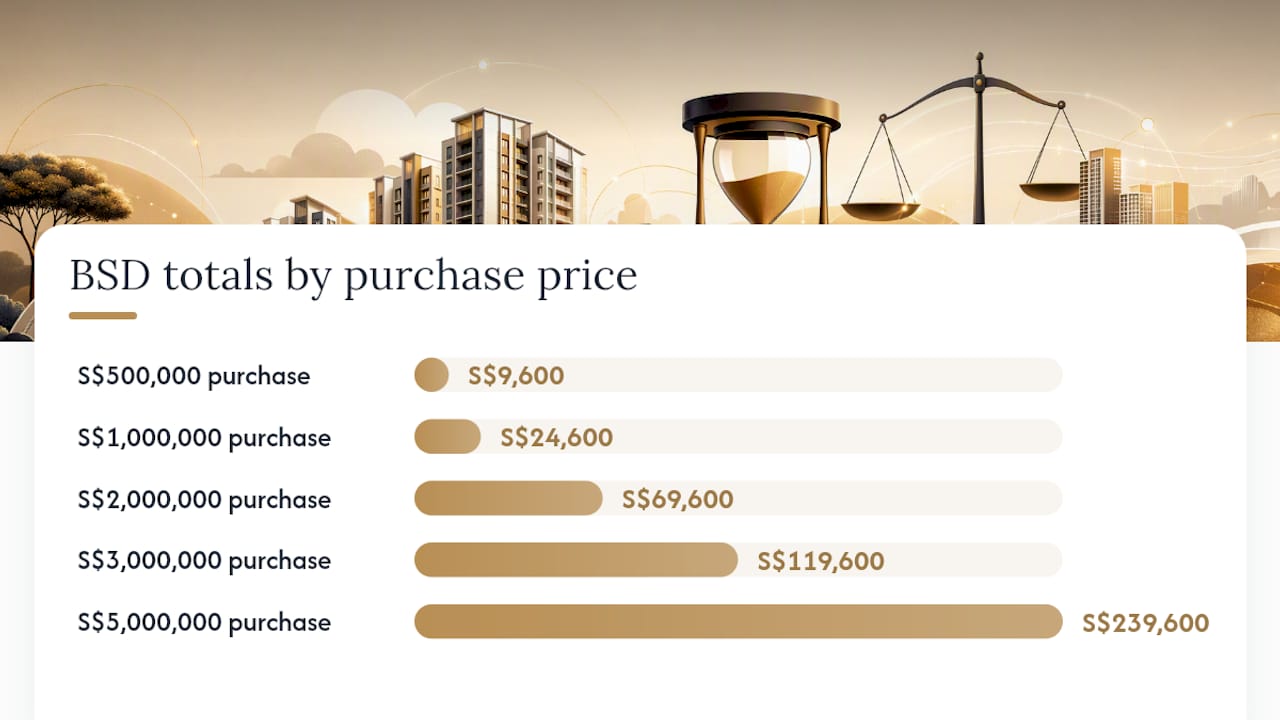
- S$500,000: 1% on the first $180,000 ($1,800) + 2% on the next $180,000 ($3,600) + 3% on the remaining $140,000 ($4,200) = $9,600, an effective rate of 1.92%.
- S$1,000,000: works out to $24,600, an effective rate of 2.46%.
- S$2,000,000: comes to $69,600, an effective rate of 3.48%.
- S$3,000,000: lands at $119,600, an effective rate of roughly 3.99%.
- S$5,000,000: crosses into the 6% band for the final $2 million, pushing total BSD to $239,600, an effective rate near 4.79%.
The effective rate never actually reaches 6%, even on multi-million dollar homes, because only the portion above S$3 million gets taxed at that top marginal rate. The earlier slices still sit at 1%, 2%, 3%, 4%, and 5%.
There's one wrinkle that trips up plenty of buyers. If IRAS assesses the market valuation higher than what you agreed to pay, say the contract says S$1,800,000 but IRAS values it at S$1,850,000, BSD gets calculated on the S$1,850,000 figure. You end up paying duty on money you never technically spent on paper.
Who Has to Pay BSD, and Which Properties Are Covered?
Every buyer of Singapore immovable property owes BSD, full stop. It doesn't matter whether you're a citizen, permanent resident, or foreigner. That's what separates BSD from Additional Buyer's Stamp Duty, which only kicks in depending on your residency status and how many properties you already own.
BSD applies broadly across property types:
- HDB resale flats and BTO units at their resale or purchase valuation.
- Executive condominiums, both during and after the minimum occupation period.
- Private condominiums and landed housing, including new launches.
- Commercial and industrial property, taxed under the non-residential scale.
If you're buying a second or subsequent residential property, or you're a foreign buyer, ABSD stacks on top of BSD as a separate calculation entirely. Don't confuse the two. BSD is the baseline tax every buyer owes. ABSD is a targeted cooling measure layered on for specific buyer profiles.
When Is Buyer Stamp Duty Due, and Can I Use CPF?
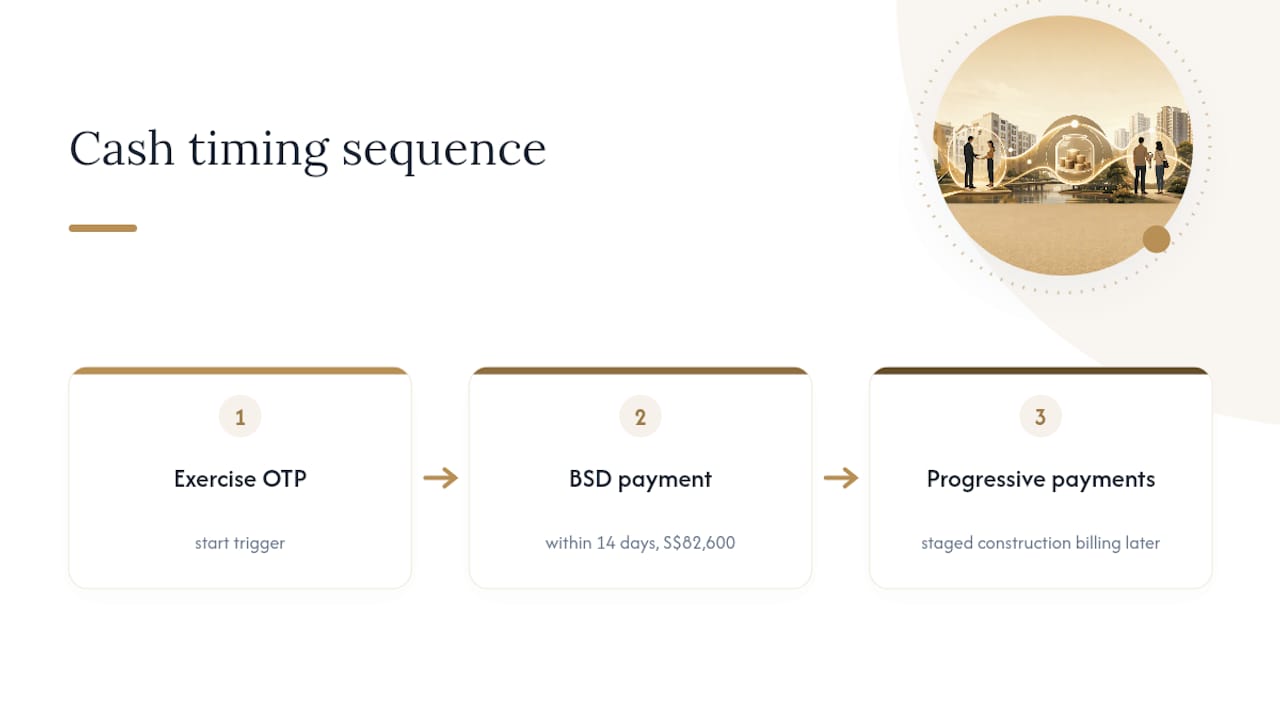
You have 14 days from the date you exercise your Option to Purchase or execute the Sale and Purchase Agreement to pay BSD in full. Sign the document overseas, and IRAS extends that window to 30 days from the date it's received in Singapore.
A few things to line up before that clock starts running:
- Confirm your "date of purchase," which is the OTP exercise date, the SPA date if there's no OTP, or the transfer date, since HDB flats follow their own specific timing rule.
- Pay BSD in cash upfront. IRAS does not accept CPF at the point of stamping.
- Apply for CPF Ordinary Account reimbursement afterward, which is only possible once the duty is already paid and stamped.
- Keep the stamped document and payment receipt, since you'll need both for the CPF reimbursement application.
Pro Tip: Don't assume your CPF balance will cover BSD on closing day. It won't. You need cash in hand first, then you claim it back from CPF later, so budget the duty as a cash line item separate from your CPF-funded downpayment.
Does BSD Stack With ABSD or Seller's Stamp Duty?
BSD and ABSD stack. If ABSD applies to your buyer profile, you pay both duties, calculated separately, on top of each other. A Singapore citizen buying a second residential property currently faces ABSD in addition to standard BSD, which materially changes the total cash needed at signing.
Seller's Stamp Duty works differently. It's charged to the seller if they sell within the holding period, and it has no bearing on your BSD calculation as the buyer. You'll see SSD referenced in transaction economics, but it never enters your own stamp duty math.
Here's a rough combined picture:
- A S$2,000,000 purchase carries S$69,600 in BSD alone.
- Add ABSD for a citizen's second property, and the total stamp duty bill climbs into six figures well beyond BSD by itself.
- Check ABSD rules against your specific profile before assuming your total exposure is BSD only.
Are There Remissions or Exemptions Available?
Some remissions exist, though eligibility is narrow and shouldn't be assumed. Common categories include:
- Remission for married couples buying jointly under certain conditions.
- Developer-related remissions tied to specific project structures.
- ABSD remission scenarios, such as replacing a matrimonial home within a set timeframe.
Applications typically require the OTP or SPA, proof of eligibility, and identity documents, submitted directly through IRAS. Because remission criteria shift and mistakes are costly, it's worth having a conveyancing lawyer or tax adviser review your situation before you assume any relief applies to your purchase.
Budgeting Checklist: Avoiding a Stamp Duty Shortfall
Before signing, verify what IRAS is likely to value the unit at, not just the asking price. A gap between contract price and market valuation means BSD calculated on the higher figure, and that surprise has caught out plenty of buyers who budgeted only against the number on the OTP.
Three things to nail down early:
- Confirm valuation exposure. Ask your agent for recent comparable transactions so you're not blindsided by an IRAS figure above your contract price.
- Confirm your payment deadline. Mark the 14 day (or 30 day) window on your calendar the moment you sign.
- Prepare cash, not CPF. Line up liquid funds or a bridging loan if your cash is tied up in an existing property sale.
Pro Tip: If you're upgrading and your cash is locked into your current home's sale proceeds, look at bridging finance early. BSD doesn't wait for your old flat to complete, and a financing gap at the 14 day mark is one of the most common (and avoidable) stumbles buyers make.
Budgeting for BSD on a Hougang Central Residences Purchase
Say you're eyeing a unit at Hougang Central Residences, priced from S$2,800 per square foot. A 900 square foot two bedroom at that entry price lands around S$2,520,000, putting BSD at roughly S$82,600. That cash is due within 14 days of exercising your OTP, well before your first progressive payment milestone.
Understanding the progressive payment schedule matters here, since BSD arrives as a separate upfront obligation, distinct from the staged construction billing that follows.
What Buyers Should Take Away From the 2026 Rates
The 6% top band mostly reshapes decisions at the luxury end. Once you're paying above S$3 million, every additional dollar carries a real tax cost, and that changes how aggressively buyers negotiate at that tier. For most homebuyers below that threshold, the bigger risk isn't the rate table. It's underestimating cash timing against financing and CPF availability.
— Simon
See Hougang Central Residences Pricing and Payment Plans
Once you know your likely BSD, the next question is how it fits against your actual unit budget, and that's where a generic calculator falls short compared to seeing real numbers for real layouts. Hougang Central Residences sits directly above Hougang MRT with 835 units ranging from one bedroom plus study to five bedroom penthouses, so you can match a specific floor plan to a specific price point rather than guessing.
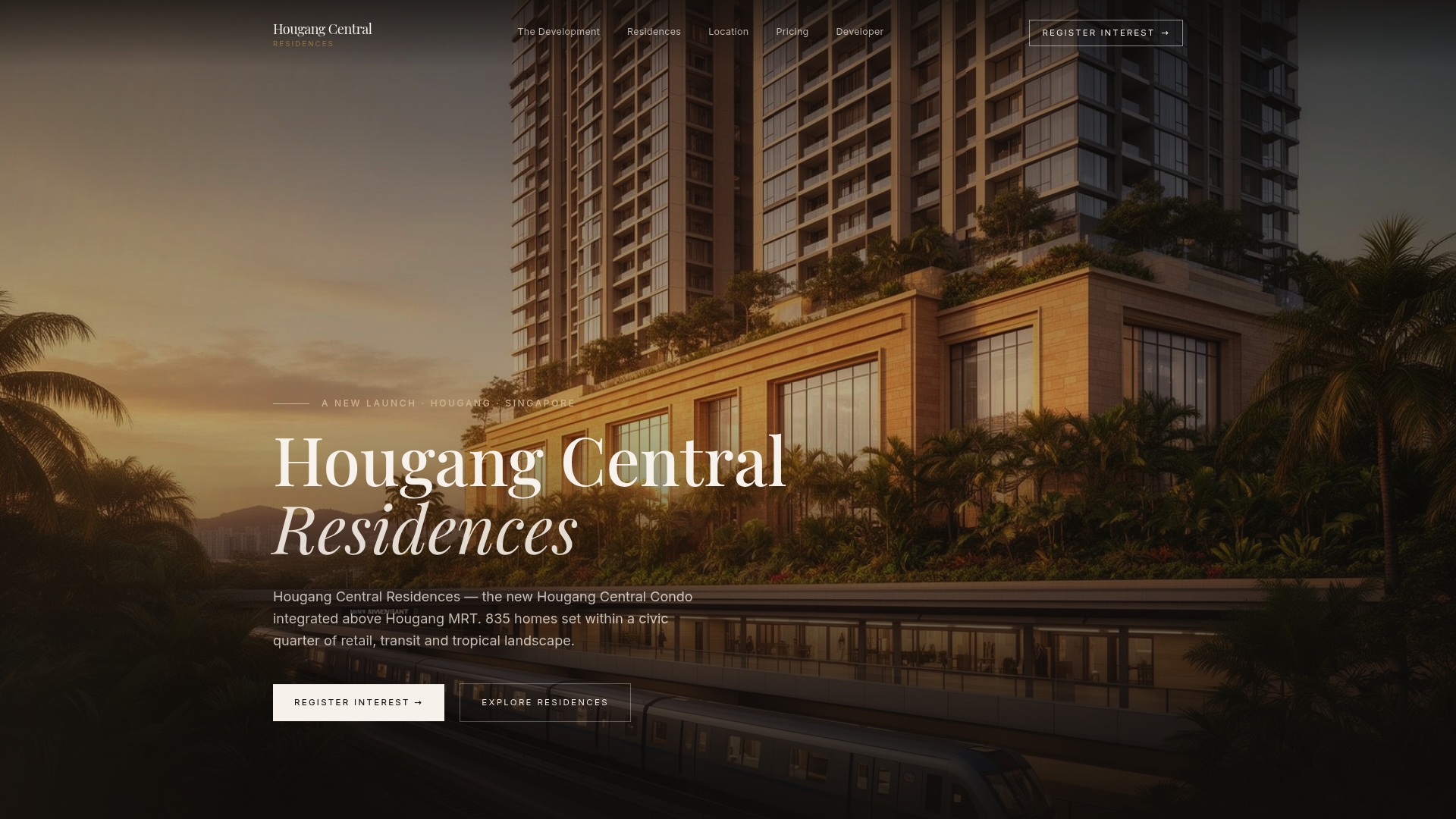
The pricing page lists current per square foot rates starting at S$2,800, letting you run your own BSD math against an actual unit rather than an estimate. Browse the full range of residences, from compact one bedroom layouts to five bedroom penthouses, and request an e-brochure to get exact pricing for the layout that fits your budget and your BSD calculation.
Where to Verify Current Rates Before You Sign
Confirm every figure directly with IRAS before committing to any purchase. Start with the official BSD page, the IRAS stamp duty rate summary, and the MOF stamp duty policy page for policy context. Rates can change, so check before signing an OTP or SPA.
This article is general information, not a substitute for advice from a qualified financial advisor. Consult a qualified financial professional about your own circumstances before acting on anything here.
Sources
FAQ
How Is Stamp Duty Calculated in Singapore?
BSD is calculated on the higher of your purchase price or the IRAS market valuation, taxed in marginal bands rather than as one flat percentage. A S$1,000,000 residential purchase works out to S$24,600, an effective rate of 2.46%.
Why Is Buyer Stamp Duty So High on Expensive Homes?
BSD climbs because Singapore uses a progressive scale, so higher priced homes get taxed at steeper marginal rates on the top slice of value. Anything above S$3 million falls into the 6% residential band, though earlier portions still sit at 1% through 5%, which keeps the effective rate well below 6% even on luxury purchases.
How Do I Calculate Seller's Stamp Duty in Singapore?
Seller's Stamp Duty applies to sellers who dispose of property within the holding period, not to buyers, and it's calculated separately from BSD using its own rate table tied to how long the seller held the property. It has no effect on what a buyer owes under BSD.
What Is the Formula for Calculating Stamp Duty?
The formula taxes each price band at its own percentage and adds the results together, rather than applying one rate to the full price. For a quick estimate on a specific unit, the Hougang Central Residences pricing page shows current per square foot rates you can run through the bands yourself.
Can I Use CPF to Pay Buyer Stamp Duty?
No. BSD must be paid in cash within 14 days of signing (30 days if signed overseas), and CPF reimbursement into your Ordinary Account is only available after the duty has already been paid and stamped.