
Yes, a VVIP preview condo event gives you priority access to a new launch before the public queue forms, and often a shot at earlier pricing. The three moves that matter most: register through the developer-appointed sales team (not a random agent link), have your deposit cheque and identification ready in advance, and confirm your loan eligibility under TDSR before preview day. Expect "no obligation" language on the registration form even though a ballot or deposit may still apply.
TL;DR:
- Early registration through the developer’s official channel and having your documents, deposit cheque, and loan eligibility ready can significantly improve your chances at getting a coveted VVIP unit.
- VVIP previews typically offer access to the smallest crowd, earliest pricing, and first pick of units, with units often allocated through ballots or first-come, first-served based on booking timing.
- Understanding unit stacking, floor preferences, and long-term resale factors can help you choose a unit that holds its value better beyond the initial preview.
- Confirming the developer’s appointed sales team and verifying showflat details directly with the developer are crucial steps to avoid losing money or facing incomplete information.
- Early access offers exclusive incentives like lower prices, optional discounts, or loyalty perks, which should supplement your financial readiness rather than influence your decision-making.
Table of Contents
- What Is a VVIP Preview Condo Event, and Why Do Developers Hold Them?
- How VVIP Previews Run: Registration, Showflat Access, and Who's in Charge
- What to Bring and Prepare Before the Preview: Documents, Deposits, and Forms
- Getting Your Finances Ready: TDSR, Loan Quantum, and Timing
- Balloting, Priority Booking, and Price Batches: What Actually Decides Who Gets a Unit
- Tactics That Actually Improve Your Odds of Getting the Unit You Want
- Common Mistakes and Red Flags at VVIP Previews
- Hougang Central Residences: What a VVIP Preview Might Look Like There
- Picking a Unit That Holds Its Value: Stack, Floor, and Layout Strategy
- VVIP Preview vs. VIP and Public Launch: What Actually Changes
- Developer Incentives and Promotions Exclusive to VVIP Previews
- How to Get Invited to a VVIP Preview in the First Place
- A Publisher's Take: Preparation Beats Excitement Every Time
- Ready for a Priority Look at Hougang Central Residences?
- Sources
- FAQ
What Is a VVIP Preview Condo Event, and Why Do Developers Hold Them?
A VVIP preview, sometimes called a VIP preview or soft launch, is a private showflat session held before a project's public launch. Developers use it to gauge demand, test pricing, and sell a controlled batch of units to a smaller pool of buyers before opening the floodgates. It's a business decision as much as a courtesy: selling the first batch quietly lets a developer read the market and adjust prices for the next release.
Invitations typically go to three groups: buyers who registered interest early through the official channel, clients of agencies the developer has appointed to market the project, and past buyers of the developer's other projects who get repeat-customer priority. A VIP preview is one notch below VVIP in exclusivity but runs on the same principle. A public launch, by contrast, opens booking to anyone who shows up, usually with a larger inventory pool and a price that's already been tested on the earlier crowd.
The practical differences that matter to you as a buyer:
- VVIP preview: smallest crowd, earliest price indications, first pick of stacks and floors, sometimes ballot-based if oversubscribed.
- VIP preview: broader invite list, similar mechanics, slightly less scarcity.
- Public launch: open to all, typically after several batches have already sold, with pricing that reflects earlier demand.
Understanding new property launches in Singapore means understanding this batching logic before anything else, since it shapes every decision that follows.
How VVIP Previews Run: Registration, Showflat Access, and Who's in Charge
The mechanics are fairly standardized across Singapore new launches, even though marketing language varies from project to project.
- Register through an official channel. This usually means the developer's own registration page, a mailing list sign-up, or an event listing managed by the developer-appointed sales team. Some projects even run their sign-ups through public event platforms, the way Pinery Residences managed its VVIP preview through Eventbrite, complete with dated slots and showflat details.
- Pick a slot. Previews run either as private one-on-one appointments or timed open slots with a cap on how many groups enter per hour. Private appointments give you more time with a consultant and less competition in the room; open slots move faster but you're viewing the showflat alongside other buyers.
- Get written confirmation. A legitimate registration produces a confirmation email or SMS with a reference number, date, and time. Treat that confirmation as proof of your place in line; screenshot it.
- Meet the sales team on-site. The people staffing the showflat should be from an agency the developer has formally appointed, not a freelance agent who heard about the launch secondhand. Ask directly who appointed them.
- Review the unit chart and pricing indications. At this stage you'll typically see a stack chart with units marked as available, reserved, or sold, along with indicative pricing for the batch being released that day.
The role of the appointed sales team is worth understanding upfront: they represent the developer's interests in the transaction, not yours. That doesn't make them adversarial, but it does mean their job is to move inventory, not to negotiate the lowest price on your behalf.
What to Bring and Prepare Before the Preview: Documents, Deposits, and Forms
Walking into a preview unprepared is the fastest way to lose a unit you actually want to a buyer who came ready.
Bring the following:
- NRIC or passport, plus a photocopy if the sales gallery requests one for its records.
- A cheque book or your bank's cheque facility set up, since deposits are almost always collected by cheque, not cash or instant transfer.
- An agent appointment letter, called an Option to Purchase Estate Agency Agreement in some cases, if you're working with a buyer's agent so their commission and representation are documented.
- Proof of funds or a pre-approval letter from your bank if you have one, which speeds up the conversation about loan quantum.
- A shortlist of acceptable stacks and floors, written down, so you're not deciding under pressure in the room.
Deposit practice in Singapore new launches usually works like this: you write a cheque, often for a percentage of the unit price, to hold your priority position. If you withdraw before the price release or the official launch, that cheque is typically returned uncashed or refunded, but the exact return conditions should be stated in writing, not just promised verbally.
Before you hand over anything, verify the developer's appointment of the sales team directly, and confirm the showflat address matches official marketing material rather than a link forwarded by a stranger.
Pro Tip: Call the developer's main sales hotline listed on their own corporate website to independently confirm the showflat address and the agency handling the launch, especially if you found the registration link through social media rather than a direct source.
Getting Your Finances Ready: TDSR, Loan Quantum, and Timing
Your Total Debt Servicing Ratio, or TDSR, caps how much of your gross monthly income can go toward all debt repayments, including the new mortgage you're about to take on. If you walk into a preview without knowing this number, you risk falling in love with a unit your bank won't finance.
Work through this before preview day, not after:
- Add up all existing monthly debt obligations: car loans, personal loans, credit card minimums, and any other property loans.
- Ask your bank or a mortgage broker to run a TDSR calculation against your gross income to find your maximum loan quantum.
- Stress-test the repayment at a higher interest rate than today's, since banks apply a medium term interest rate buffer when assessing your application.
- Factor in the Additional Buyer's Stamp Duty if this isn't your first property, since it changes your total cash outlay significantly.
- Set aside CPF or cash for the option fee and the progressive payments that follow as construction milestones are hit.
A quick gut check: buyers commonly skip TDSR verification entirely and rely on a sales consultant's verbal assurance that "financing won't be a problem." That's backwards. The bank's assessment, not the showroom conversation, decides what you can actually borrow.
Having cash or CPF ready for the option fee matters just as much as the loan approval itself, since a slow buyer with unclear funds can lose a reserved unit to someone who's ready to sign on the spot.
Balloting, Priority Booking, and Price Batches: What Actually Decides Who Gets a Unit
Three mechanisms determine who walks away with a unit, and they often operate together rather than separately.
- Price batching. Developers release units in tranches, often starting with a smaller batch at a lower indicative price to build momentum, then raising prices on subsequent batches as demand is proven. Buyers at the VVIP stage frequently see the first batch, which means earlier pricing can mean genuine savings compared to what public launch buyers pay for a similar stack later.
- Balloting. When a specific unit or stack draws more interest than available inventory, the developer runs a ballot, essentially a lucky draw among the interested cheque holders, to decide who gets first right to book. This tends to happen for standout units: high floors, corner stacks, or units with unblocked views.
- First-come, first-served booking. For less contested units, the process is simpler: whoever submits a valid cheque and paperwork first secures the unit, no ballot needed.
The binding moment isn't the cheque you hand over at the preview. It's the Option to Purchase, issued after your cheque clears and your booking is confirmed, that creates the actual reserved right to buy. Everything before that point, including the initial deposit cheque, is generally treated as a priority booking that can still be unwound if you decide not to proceed, provided the terms were documented clearly.
Buyers who care about a specific stack should also confirm which batch that stack actually belongs to. Remaining units in later batches often carry a different price per square foot and a different spread of floors than what was available in the first release.
Tactics That Actually Improve Your Odds of Getting the Unit You Want
None of this requires gaming the system. It requires being organized while other buyers are still figuring out what a TDSR even is.
- Register the moment the developer opens sign-ups, and keep your confirmation email or reference number as proof of your place in the queue.
- Use a formally appointed buyer's agent who represents your interests, not one who's also collecting commission from the developer's side of the deal without disclosing it.
- Keep deposit funds liquid and signatures ready. A cheque that bounces or a co-buyer who can't make it to sign kills a booking faster than almost anything else.
- Understand the cheque-return process before you write it, so you know exactly what happens to your money if you change your mind before the official launch.
- Pick two or three acceptable stacks, not just one. If your dream stack is contested in a ballot, having a fallback means you don't leave empty-handed.
- Set a hard price ceiling before you walk in, and treat it as non-negotiable regardless of what the sales consultant says about "limited time" pricing.
Pro Tip: Write your maximum acceptable price on a sticky note before you enter the showflat. The pressure in the room, especially during a live ballot, is designed to make you forget the number you walked in with.
Registering early through a platform that manages event sign-ups and slot bookings, similar to how some developers use event registration services to handle high-demand previews, is often the difference between getting a confirmed slot and being told the session is fully booked.
Common Mistakes and Red Flags at VVIP Previews
Most bad outcomes at previews trace back to a handful of avoidable errors.
- Buying under FOMO at price release without having verified your affordability first, then discovering the bank won't lend what you assumed it would.
- Handing over a deposit cheque with no written return conditions. If the terms of a refund aren't in writing, don't rely on a verbal promise.
- Skipping due diligence on the developer's track record, including how past projects were delivered and whether contract terms were transparent.
- Ignoring pressure-selling tactics, like artificial urgency about "only two units left" without any way to verify that claim.
- Inconsistent paperwork, such as a sales consultant who can't clearly explain who appointed them or produce documentation matching the developer's official marketing.
Local reporting has flagged real transparency concerns around VIP condo sales in Singapore, with calls for clearer rules and limits on how early access and pricing advantages are handled. That scrutiny exists because buyers have been burned by exactly the mistakes above. Treat verification of the sales team's appointment as a non-negotiable first step, not an optional extra.
Hougang Central Residences: What a VVIP Preview Might Look Like There
A new launch condominium integrated with MRT access, offering a range of units from one-bedroom-plus-study layouts to five-bedroom penthouses, smart-home systems, premium fittings, and tropical landscaped grounds, tends to draw strong early interest across varied buyer profiles: young couples, families, and investors.
Buyers preparing for a preview at a project like this should expect the same standard sequence covered above:
- Registration through the official developer-appointed channel, not a forwarded link of unknown origin.
- Showflat appointments, likely with slot limits given the range of unit types on offer.
- A stack chart showing which layouts are released in the first batch versus held for later release.
- Standard deposit cheque practice, with return conditions that should be confirmed in writing before you sign anything.
The broader lesson holds regardless of which project you're eyeing: an MRT-integrated launch with a wide unit mix draws pressure early, so the buyer who's done the finance homework beforehand moves faster than the one figuring it out in the showflat.
Picking a Unit That Holds Its Value: Stack, Floor, and Layout Strategy
The unit you fall for in the showflat isn't always the unit that performs best on resale. Corner stacks and units with unblocked views command a premium at launch, but that premium can also mean a smaller price gap to close if you're selling in a soft market, since everyone competing to buy already knows those units cost more.
Mid to high floors on stacks facing greenery or away from future construction tend to age better than ground-facing units, particularly near an MRT line where surrounding plots can still be developed. Layout efficiency matters just as much as square footage: a compact three-bedroom with minimal wasted corridor space often resells better than a larger unit with an awkward floor plan, because the eventual buyer pool cares about usable space, not the number on the floor plan.
Think about who buys resale in this location years from now. A unit near a station with strong owner-occupier demand, like families wanting school proximity or professionals wanting a short commute, tends to hold value better than a unit that only appeals to a narrow investor niche. If you're choosing between two available stacks at the same price point, lean toward the one with broader long-term appeal rather than the one that simply looks nicer in the showflat model.
Don't discount smaller unit types either. One and two-bedroom layouts near MRT stations often see faster resale turnover because the tenant and buyer pool for smaller units is larger than for penthouses.
VVIP Preview vs. VIP and Public Launch: What Actually Changes
The gap between these three stages is really about inventory and price, not the paperwork you fill out.
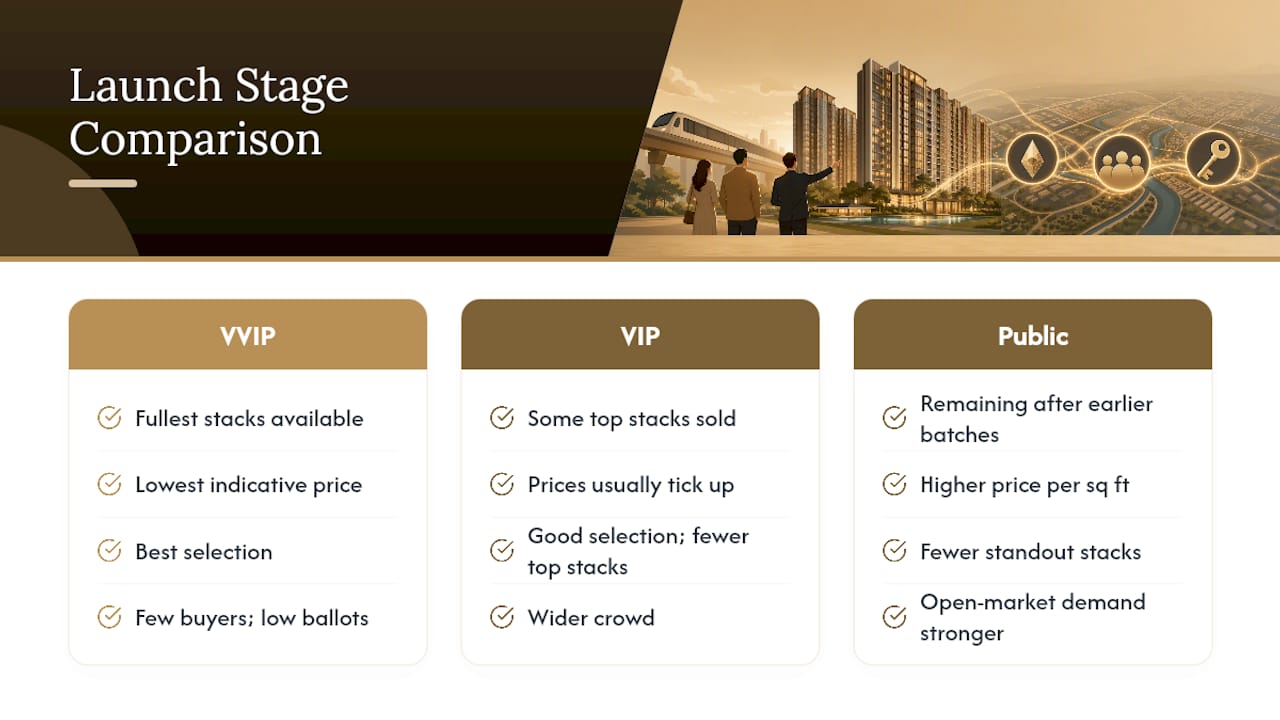
At the VVIP stage, you're typically choosing from the fullest available stack chart, since almost nothing has sold yet. Pricing is at its earliest and often lowest indicative level, though it's not guaranteed to stay that way once demand data comes in. Ballots are less likely here simply because fewer buyers are competing at this exact moment, though a standout unit can still trigger one.
Move to the VIP stage and the crowd widens slightly. Some of the best stacks from the first batch may already be gone, and pricing has usually ticked up in response to whatever demand the VVIP stage revealed. The mechanics are otherwise identical: same cheque process, same appointed sales team, same Option to Purchase structure.
By public launch, you're often looking at what's left after several batches, which can mean fewer standout stacks and a higher price per square foot than what VVIP buyers saw. The incentive structure shifts too. Developers sometimes offer stronger perks earlier to move volume quickly, then rely on genuine open-market demand once a project has momentum and doesn't need extra incentives to sell.
The practical takeaway: if the specific stack or floor matters to you, earlier access matters more than almost anything else in this process.
Developer Incentives and Promotions Exclusive to VVIP Previews
Developers sweeten early previews to reward buyers willing to commit before public marketing kicks in, and these incentives tend to disappear or shrink by the time a project reaches public launch.
Common examples include early-bird pricing on the first batch, where the indicative price per square foot sits below what later batches will see once demand is established. Absorption of certain costs, such as legal fees or a portion of stamp duty, sometimes appears as a preview-only perk to sweeten the deal for buyers signing early. Furniture or appliance vouchers occasionally get bundled in for VVIP bookings, though the value of these varies widely from project to project and shouldn't be the deciding factor in your purchase.
Some developers also extend loyalty perks to buyers of their previous projects, sometimes structured as a discount voucher or priority stack selection, which is one reason repeat buyers often get invited to previews before the general public even hears about a launch.
None of these incentives should override your own affordability math. A furniture voucher worth a few thousand dollars means nothing if the unit itself stretches your TDSR past a comfortable margin. Treat every incentive as a bonus on top of a decision you'd make anyway, never as the reason to make the decision in the first place.
How to Get Invited to a VVIP Preview in the First Place
Getting on the invite list is less about connections and more about being visible to the right channels before a launch is announced.
Start by registering interest directly with developers whose upcoming projects match your criteria, since most maintain a mailing list that feeds VVIP invitations before any public marketing goes out. Working with an agent who specializes in new launches helps too, since established agents often get early notice from developers they've sold for before and can add your name to a registration list the moment it opens.
Attending a preview, even for a project you don't end up buying, is itself useful groundwork. Sales teams and agents take note of serious, prepared buyers, and that visibility can lead to a call when their next project opens for VVIP registration. Developer loyalty programs matter here as well: if you've bought from a developer before, ask their sales office directly whether repeat buyers get early access to new projects, since many do without publicizing it widely.
Social media and property portals now play a growing role too. Developers and their appointed agencies frequently promote upcoming previews through these channels weeks before the general public catches wind, so following the right developer pages and agent networks directly often beats waiting for word of mouth.
A Publisher's Take: Preparation Beats Excitement Every Time
The buyers who walk away from a preview happy aren't the ones who got the best-located unit. They're the ones who knew their number before they walked in and didn't let a ballot or a countdown clock talk them out of it. Verify who's appointed to sell the project, get your TDSR sorted before you fall for a floor plan, and treat every deposit cheque as a real commitment even when the form says "no obligation."
If you're doing your homework on a specific launch, the booking process breakdown covers the paperwork side in more depth, and it's worth reading before your appointment, not after.
— Simon
Ready for a Priority Look at Hougang Central Residences?
A new condo integrated with an MRT station offers convenience that can reduce reliance on parking, bus connections, or longer commutes. If MRT-linked accessibility and a wide unit mix fit your needs, registering early can give you priority over the public queue.
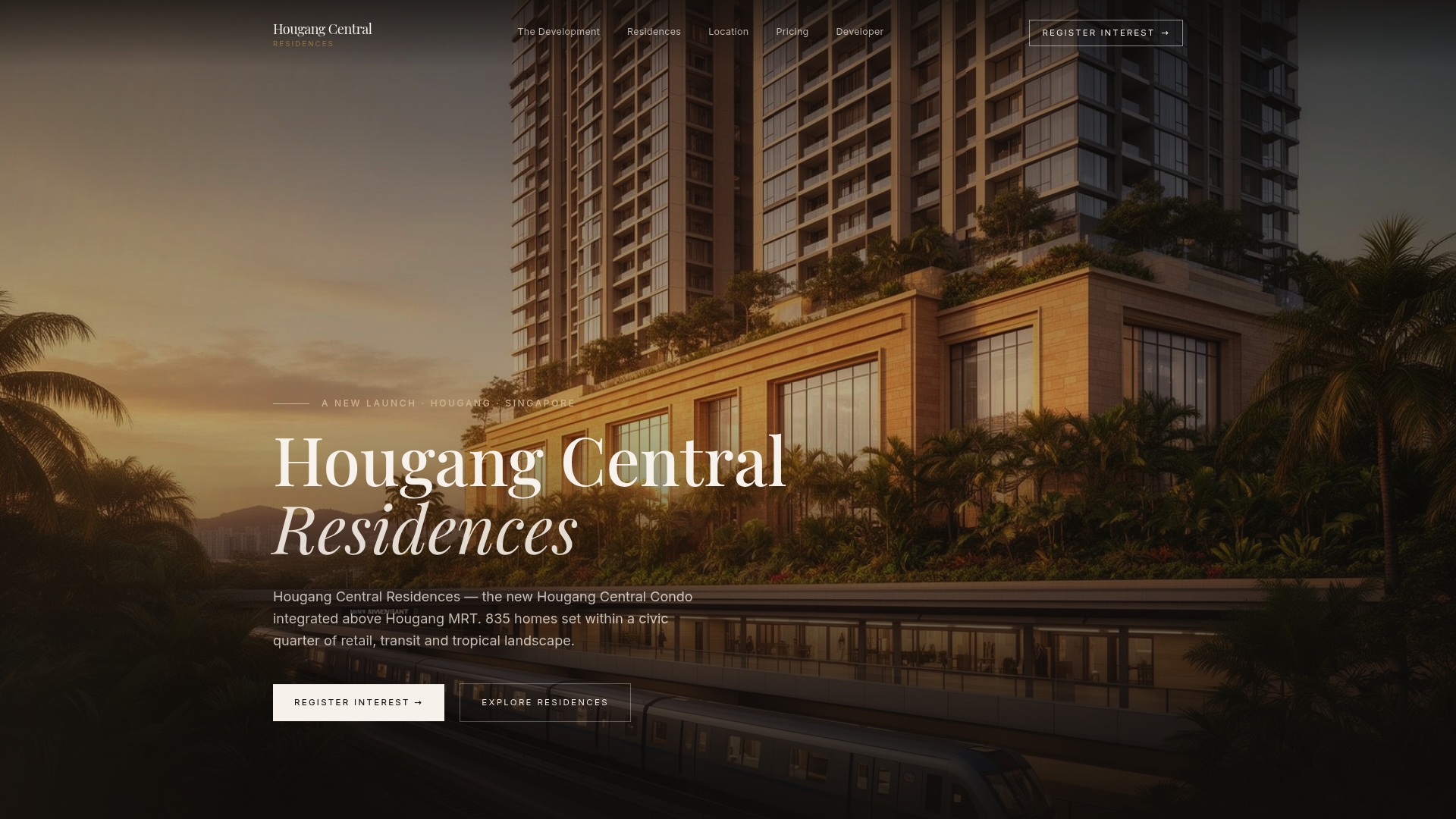
You can request the e-brochure and register for priority previews directly through the Hougang Central Residences project page, where the developer-appointed sales team manages showflat bookings and confirms available slots. If you're also weighing how a unit here might work for a family with kids in school, the family amenities checklist is worth a read before your appointment. Register now to secure a priority slot and get first sight of the stack chart before the general public does.
This article is general information, not a substitute for advice from a qualified financial advisor. Consult a qualified financial professional about your own circumstances before acting on anything here.
Sources
- Understanding New Property Launches in Singapore
- Condo VIP sales need clearer rules to ensure transparency
FAQ
What Does VVIP Mean in a Condo Launch Context?
VVIP refers to the earliest, most exclusive preview stage of a new launch, typically reserved for buyers who registered through the developer's official channel, past buyers, or clients of appointed sales agencies.
Do I Need to Pay a Deposit at a VVIP Preview?
Most developers collect a cheque deposit to hold your priority booking, and the return conditions if you withdraw before price release should always be confirmed in writing beforehand.
How Do I Know if a Sales Team Is Officially Appointed by the Developer?
Call the developer's main sales hotline listed on their own corporate website and ask directly which agency and consultants they've appointed for the launch, rather than trusting a link shared through social media.
Is VVIP Preview Pricing Always Lower Than Public Launch Pricing?
Early batches at a VVIP preview are often priced lower than later batches as developers test demand, but pricing can also rise quickly once a launch shows strong interest, so earlier access doesn't guarantee a discount forever.
Can I Register for a VVIP Preview at Hougang Central Residences?
Yes, priority registration and e-brochure requests for Hougang Central Residences are handled directly through the official project page, where the developer-appointed sales team manages showflat appointments and slot confirmations.