
A temporary occupation permit (or Temporary Certificate of Occupancy, commonly called a TCO or TOP) lets you legally use a building or public space before all final approvals are in place. If you need to move into a building that isn't fully complete, start with your local building department's TCO application. If you need to close a street, park a crane, or run a public event, contact your city's Public Works or Special Events office instead.
| Permit Family | Typical Use Cases | Who Issues It |
|---|---|---|
| Building TCO / TOP | Partial occupancy, model units, sales centers, multi-unit move-ins | Building Department |
| Public Right-of-Way Permit | Street closures, cranes, storage containers, sidewalk scaffolding, events | Public Works / Transportation / Special Events Office |
Neither permit is a permanent solution. Both carry expiration dates, and occupying beyond those dates triggers enforcement.
Table of Contents
- What does a temporary occupation permit actually cover?
- When do you actually need one of these permits?
- Which office issues your permit, and how do you find it fast?
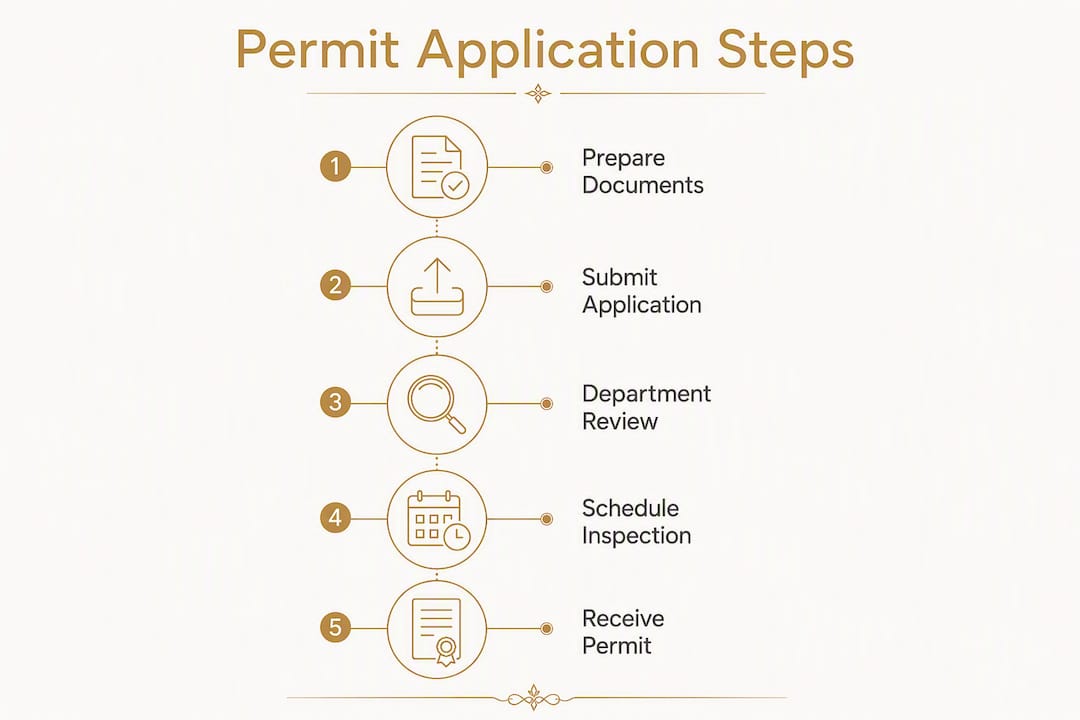
- How to apply: the step-by-step checklist
- Which departments must sign off, and what does each one check?
- What do fees and timelines actually look like?
- What inspectors check before they'll approve occupancy
- Special cases: events, construction trailers, and temporary utilities
- What happens if you ignore the rules or let a permit expire?
- How to expedite your approval: the consolidated checklist
- Key Takeaways
- The permit that buys you time, not permission to stop
- FAQ
- Useful sources
What does a temporary occupation permit actually cover?
Two distinct permit families share similar names, and mixing them up wastes days.
A building Temporary Certificate of Occupancy (TCO/TOP) is issued by the local Building Department. It authorizes occupancy of a structure, or a portion of one, while specific items remain incomplete, such as landscaping, minor finishes, or punch-list work. Miami's TOP guidance covers temporary trailers, fences, loading areas, and sales centers tied to active construction projects, with validity up to two years for certain uses. Philadelphia's TCO program, by contrast, explicitly excludes single-family dwellings from eligibility entirely.

A public right-of-way temporary occupation permit is a different animal. It authorizes temporary use of publicly owned space: a lane closure for a delivery crane, a sidewalk blockage for scaffolding, a full street closure for a festival. Public Works or the Transportation Department issues this one, not the Building Department.
Borderline cases where you need to decide which office to call first:
- A construction trailer parked on private property adjacent to a public sidewalk: start with the Building Department for the TOP, then check with Public Works about any sidewalk encroachment.
- A temporary sales center inside an unfinished building: Building Department TCO, with a separate right-of-way permit if any signage or access extends into the street.
- A food truck event in a parking lot: typically a Special Events permit, not a building TCO.
- Temporary fencing that blocks a public sidewalk: Public Works right-of-way permit required, even if the fence itself is on private land.
When do you actually need one of these permits?
The short answer: more often than most people expect.
Building-related cases include occupying any floor of a multi-story building before the whole structure passes final inspection, opening a model unit or sales center in a development that isn't complete, and moving tenants into one phase of a phased project while construction continues on another. Typical TCO durations run up to about two months, though some jurisdictions allow longer terms for specific construction-related uses.
Public-space cases cover a wide range. A crane swing over a public street requires a right-of-way permit before the crane operator can legally work. Storage containers dropped on a city sidewalk during a renovation need one too. Street festivals, farmers markets, and road races all fall under event-specific temporary occupation permits, usually with a traffic control plan attached.
Pro Tip: If your project involves both a building TCO and a right-of-way permit (say, a new mixed-use building with a construction crane), apply for both simultaneously. Sequential applications can add weeks to your timeline.
Typical durations by use case:
- Street closure for an event: 1–3 days
- Crane or lift operation: hours to several days, renewed per job
- Construction trailer or sales center TOP: up to two years in some jurisdictions
- Building TCO for partial occupancy: commonly up to 60 days, renewable
Which office issues your permit, and how do you find it fast?
The Building Department handles TCOs. Public Works, Transportation, or a dedicated Special Events office handles right-of-way permits. In smaller cities, one department may handle both. In larger ones, you may deal with three separate offices for a single project.
The fastest way to find the right portal: search "temporary certificate of occupancy [your city name]" or "temporary right-of-way permit [your city name]" directly in Google. The correct municipal page will typically show an online application form, a fee schedule, and an inspector contact. If you land on a page with none of those three things, keep searching.
Pro Tip: Look for the city's "eCLIPSE," "Accela," or "OpenGov" permit portal — these are the most common platforms U.S. municipalities use for online permit applications. Knowing the platform name helps you navigate faster once you're inside the system.
Oakland's TCO process, for example, runs through the city's permit portal and requires coordination with PG&E for electrical connections before issuance. Philadelphia's system uses eCLIPSE and lists a flat application fee on the services page. Miami's Building Department publishes a dedicated TOP page with a checklist specific to construction-related uses.
How to apply: the step-by-step checklist
The sequence matters. Submitting documents out of order is one of the most common reasons applications stall.
- Confirm your active building permit. For a building TCO or construction-related TOP, most jurisdictions require an active building permit before they'll accept a temporary occupancy application.
- Identify the correct office and portal. Use the search patterns above. Download or bookmark the application form before you start gathering documents.
- Assemble your documents. See the list below.
- Submit the application and receive an invoice. Most portals generate a fee invoice after submission. Do not upload supporting documents until payment is confirmed — some systems lock the upload queue until payment clears.
- Pay fees. Online payment is standard; some cities still require in-person payment at a cashier station.
- Upload supporting documents. After payment, upload all required files. Combine them into a single indexed PDF when the portal allows it.
- Schedule inspections. Some departments schedule automatically after document review; others require you to call or book online. Confirm which applies to your jurisdiction.
- Receive the permit. Issued digitally in most cities; some still mail a physical certificate.
Standard documents to have ready:
- Completed application form (city-specific)
- Site plan or floor plans (scaled, dimensioned)
- Proof of general liability insurance
- Traffic control plan (required for any right-of-way permit)
- Contractor license numbers for all active trades
- Inspection sign-offs from applicable departments
- Evidence of utility coordination (PG&E, local gas/electric provider)
- Impact fee payment receipts, if applicable
Pro Tip: Combine all departmental sign-off sheets, insurance certificates, and plans into one indexed PDF with bookmarks. Reviewers process indexed submissions faster, and you avoid the back-and-forth of "we can't find page 7."
Which departments must sign off, and what does each one check?
Multi-department approval is where most applications slow down. The table below shows the departments commonly involved and what each one reviews.
| Department | What They Check | Typical Evidence Required |
|---|---|---|
| Building Department | Structural completion, egress, minimum habitability | Inspection sign-offs, floor plans |
| Fire Prevention | Alarms, sprinklers, exit signage, fire-rated assemblies | Fire system test reports, inspection record |
| Public Works / Engineering | Right-of-way impacts, drainage, site access | Site plan, traffic control plan |
| Transportation / Traffic | Lane closures, signage, tow-away zones | Traffic control plan, tow-away notice |
| Environmental Health | Sanitation, food service (for events), hazardous materials | Health permit, waste plan |
| Electrical / Plumbing / Mechanical | Trade-specific completions | Trade inspection cards |
Oakland's TCO process requires signatures from all applicable parties, and impact fees must be resolved before issuance. In most cities, Fire Prevention and Building sign off sequentially — Fire won't sign until Building confirms structural safety, and the Building Department won't issue the TCO until Fire signs. Knowing that sequence in advance lets you schedule inspections in the right order instead of waiting for one department to tell you to call another.
What do fees and timelines actually look like?
Costs and timelines vary significantly by city, but the structure is consistent.
Common fee categories:
- Application fee (flat or based on project valuation)
- Impact fees (infrastructure-related, often calculated separately)
- Inspection fees (per visit, sometimes per trade)
- Renewal or extension fees if the initial term expires
Philadelphia, for example, lists an application fee for a TCO through its eCLIPSE portal. That figure covers the application itself; inspection fees and impact fees are separate line items. Always check your city's fee schedule before budgeting — some cities charge a percentage of construction value, which can be substantially higher.
Processing timelines depend on department workload and document completeness. A clean, complete application in a mid-size city typically moves through review in 5–15 business days. Incomplete applications restart the clock.
Validity periods: A standard building TCO is commonly valid for up to 60 days. Oakland's guidance confirms this term and notes that utilities may be disconnected if the project hasn't reached final approval by the end of that period. Miami's construction-related TOP can run up to two years for specific uses. Right-of-way permits for events are typically issued for the duration of the event plus setup and teardown time.
Renewals are possible in most jurisdictions but carry real risk. Each renewal requires a new application, new fees, and often a new inspection. Departments that see the same project renewing repeatedly may scrutinize it more closely.
What inspectors check before they'll approve occupancy
Permit Sonoma's temporary occupancy procedures lay out the standard clearly: the chief building official must find no substantial life, safety, or health hazards before issuing a temporary occupancy permit. That determination rests on a specific list of minimums.
Inspectors typically require all of the following before signing off:
- Final gas pressure test passed
- Smoke detectors installed and functional
- Heating and ventilation operational
- Electrical panels labeled and accessible
- At least one bathroom fully functional
- Handrails and guardrails in place on all required stairs and landings
- All required means of egress clear and accessible
- Fire alarm and sprinkler systems tested and operational
If any of these items fail, the inspector issues a correction notice. Occupancy cannot begin until corrections are made and a re-inspection is scheduled and passed. That re-inspection cycle can add one to three weeks to your timeline, depending on inspector availability.
Pro Tip: Request an informal pre-walkthrough with the inspector before the official inspection date. Many building officials will do a quick site visit and flag obvious issues informally, giving you time to correct them before the clock starts on the official inspection.
For a broader look at the habitability standards inspectors use, the family amenities condo checklist covers many of the same life-safety and accessibility features municipal inspectors review.
Special cases: events, construction trailers, and temporary utilities
Not every temporary use fits the standard TCO mold. These scenarios have their own rules.
Events and street closures almost always require a traffic control plan prepared by a licensed traffic engineer. The plan must show lane configurations, detour routes, signage placement, and tow-away zones. Many cities also require public notice posted at least 72 hours before the closure, and some require neighbor notification letters for residential streets.
Construction trailers and sales centers fall under construction-related TOP rules in most jurisdictions. Miami's TOP guidance specifically lists trailers, fences, loading areas, and sales centers as covered uses, with validity up to two years for qualifying projects. An active building permit for the main project is typically a prerequisite.
Storage containers placed on public sidewalks or streets require a right-of-way permit. Containers on private property may require a separate zoning or building approval depending on how long they'll remain.
Temporary utilities are a frequent bottleneck. Oakland's policy makes the issue concrete: gas and electric meter releases are commonly withheld until the project is near-complete, meaning utility engagement must begin at plan submission, not at permit application. Contact your gas and electric provider the same week you submit your building permit application.
Signage and public notice conditions are common across all special-case permits. Tow-away signs must be posted a minimum number of hours before enforcement begins (typically 72 hours in California jurisdictions; check your local ordinance). Failure to post correctly invalidates the permit's enforcement authority.
What happens if you ignore the rules or let a permit expire?
Enforcement is real and escalates quickly.
Typical enforcement actions, roughly in order of escalation:
- Written notice of violation
- Stop-work order (construction halts immediately)
- Fines (per day, per violation, or both)
- Utility disconnection (gas and electric meters pulled)
- Towing of vehicles or equipment occupying the right-of-way
- Forced evacuation of occupants
- Permit revocation
When a TCO expires without a final certificate or renewal in place, Oakland's guidance is direct: utilities may be disconnected. That means tenants lose power and gas, which creates immediate liability for the property owner.
A temporary occupancy permit is not a finish line. It is a countdown clock. Every day you operate under a TOP or TCO without actively pursuing final approval is a day closer to enforcement, utility disconnection, or forced evacuation. Treat the expiration date as a hard deadline, not a suggestion.
Pro Tip: If your permit is about to expire and you haven't resolved the outstanding items, contact the issuing department before the expiration date, not after. Proactive contact almost always results in a more cooperative response than showing up after the fact.
If a permit is denied or revoked, most jurisdictions have a formal appeals process through the Board of Building Appeals or an equivalent body. File within the deadline stated on the denial notice, typically 30 days.
How to expedite your approval: the consolidated checklist
Most delays are self-inflicted. Here's how to avoid them.
- Pull your active building permit first. No TCO or construction-related TOP application moves forward without it.
- Contact utilities at plan submission. Gas, electric, water, and sewer providers all have their own release timelines. Starting at permit application instead of permit issuance buys you weeks.
- Verify infrastructure approvals early. Permit Sonoma's guidance flags well, septic, sewer connections, and fire protection systems as commonly overlooked items. A correction notice on any of these adds weeks.
- Collect all departmental sign-offs before submitting. Don't submit the TCO application and then chase signatures. Have Fire Prevention, Public Works, and trade inspectors sign off first.
- Parallelize where possible. Schedule Fire and Building inspections on the same day when the inspector calendar allows it. Sequential scheduling is the single biggest source of avoidable delay.
- Submit a single indexed PDF. Combine all documents, sign-offs, and plans into one file with bookmarks. Reviewers process these faster.
- Book re-inspection immediately after corrections. Don't wait to see if the inspector noticed the issue. If you received a correction notice, fix it the same day and book re-inspection before the slot fills.
Pro Tip: Ask the building department whether a pre-application meeting is available. Many jurisdictions offer a 30-minute session with a plan checker who will identify likely correction items before you formally submit, saving you a full review cycle.
For a practical look at the building systems and accessibility features inspectors commonly evaluate, the amenities checklist for young professional condos covers many of the same categories.
Key Takeaways
A temporary occupation permit or TCO is a time-bound authorization, not a final approval, and every day under one should be spent actively pursuing the permanent certificate.
| Point | Details |
|---|---|
| Know which permit you need | Building TCO for early occupancy; right-of-way permit for street/sidewalk/event use. |
| Standard TCO validity | Commonly up to 60 days; construction-related TOPs can run up to two years in some jurisdictions. |
| Life-safety minimums are non-negotiable | Smoke detectors, egress, fire systems, and one functional bathroom must pass before any occupancy is authorized. |
| Utility coordination is a critical path item | Contact gas and electric providers at plan submission, not at permit application, to avoid last-mile delays. |
| Expiration triggers real consequences | Expired TCOs can result in utility disconnection, fines, and forced evacuation — contact the issuing department before the deadline, not after. |
The permit that buys you time, not permission to stop
The most common mistake experienced contractors make isn't the paperwork. It's the mindset. A TCO feels like a win — you're in the building, the client is happy, the pressure drops. That's exactly when projects stall on final approvals.
Every temporary occupancy permit has an expiration date for a reason. Municipal building officials have broad discretion to deny renewals, and Permit Sonoma's procedures make the standard explicit: no substantial life, safety, or health hazard can exist for occupancy to be authorized, even temporarily. That standard doesn't relax on renewal — if anything, officials scrutinize repeat applicants more closely.
The financial consequences of enforcement are also underestimated. Utility disconnection in an occupied building isn't just an inconvenience; it's a habitability violation that can expose a property owner to tenant claims, code fines, and forced relocation costs. The smarter approach: treat the TCO issuance date as the start of a final-approval sprint, not a rest period. Schedule final inspections the same week you receive the temporary permit. Keep the punch list visible and assigned. And if outstanding items are genuinely outside your control — a utility release, a municipal backlog — document that in writing with the issuing department.
Temporary permits exist to balance early project use with public safety. Use them as the bridge they're designed to be.
FAQ
What is a Temporary Certificate of Occupancy, and how long does it last?
A Temporary Certificate of Occupancy (TCO) authorizes occupancy of a building or portion of one while specific items remain incomplete. Standard validity is commonly time-limited, with construction-related TOPs in some jurisdictions allowing longer terms for specific uses.
What happens when a TCO expires?
If a TCO expires without a final certificate or approved renewal, utilities including gas and electric may be disconnected, and occupants can be subject to forced evacuation. Contact the issuing building department before the expiration date to avoid enforcement.
Can single-family homeowners get a Temporary Certificate of Occupancy?
Not in every jurisdiction. Philadelphia explicitly excludes single-family dwellings from TCO eligibility. Check your local building department's rules before applying, since eligibility varies by city and project type.
How do you get a Temporary Certificate of Occupancy in California?
California TCO requirements are set at the local level, not statewide. Contact your city or county building department, confirm life-safety minimums are met (smoke detectors, egress, fire systems, functional bathroom), and submit through the local permit portal. Permit Sonoma's published procedures are a useful reference for the minimum conditions inspectors require.
What is the difference between a TOP and a TCO?
The terms are often used interchangeably, but some jurisdictions distinguish them: a TCO (Temporary Certificate of Occupancy) typically refers to building occupancy before final completion, while a TOP (Temporary Occupancy Permit) may also cover construction-related uses like trailers and sales centers. Always check your local building department's definitions, since terminology varies by city.
Useful sources
The following official sources were used in this article and are the best starting points for finding local permit requirements.
- Apply for a Temporary Certificate of Occupancy — City of Oakland, CA: covers multi-department signoffs, utility coordination with PG&E, impact fees, and TCO validity terms.
- Get a Temporary Certificate of Occupancy — City of Philadelphia: lists the application fee, eCLIPSE portal instructions, and eligibility exclusions including single-family dwellings.
- Apply for a Temporary Occupancy Permit (TOP) — Construction Related, Miami: details construction-related TOP uses, two-year validity for qualifying projects, and the active building permit requirement.
- Temporary Occupancy Procedures — Permit Sonoma: the clearest published list of minimum life-safety conditions inspectors require before authorizing temporary occupancy.
To find your local office: search "temporary certificate of occupancy [your city]" or "temporary right-of-way permit [your city]" in Google. The correct page will show an application form, a fee schedule, and an inspector contact. For utility coordination contacts, search your city's municipal portal for the Public Works or Utilities department and call the service connection line at the same time you submit your building permit.