
Noise insulation is a core luxury amenity because it secures privacy, rest, and perceived property value. For a luxury condo, the minimum you should accept is an STC 50 baseline set by the International Building Code (IBC), but premium buyers often seek higher ratings for airborne and impact noise insulation. Those numbers are not marketing language. They represent the difference between hearing your neighbor's conversation and not hearing it at all.
- Code baseline: STC 50 / IIC 50 (IBC minimum for dwelling separations)
- Luxury target: above code minimums, reflecting improved privacy standards
- Field vs. lab gap: Apparent ratings (ASTC/AIIC) measured on-site often run 3–5 points below lab numbers
Table of Contents
- Why noise insulation defines the luxury condo experience
- What STC and IIC actually measure, and where the thresholds sit
- How luxury developers actually build for quiet
- What to ask developers and inspectors before you sign
- Retrofit options for existing units, and what they realistically deliver
- How acoustic testing works, and what counts as valid proof
- Health outcomes and resale value from superior acoustics
- How local regulations shape noise insulation requirements
- Key Takeaways
- Acoustics as a first-tier amenity, not an afterthought
- FAQ
- Useful sources
Why noise insulation defines the luxury condo experience
Audible neighbor noise does more than annoy. Research shows that poor acoustic environments increase cognitive load, disrupt sleep, and reduce perceived comfort in ways that compound over time. For remote workers, a quiet unit is not a preference; it is a productivity requirement. Developers now treat acoustic performance as a measurable building metric alongside air quality and thermal comfort.
The resale signal is equally clear. Luxury projects increasingly market acoustic performance alongside triple glazing, smart-home systems, and premium finishes. Buyers who understand what STC and IIC mean can distinguish a genuinely quiet building from one that simply claims to be. That knowledge gap is where value is won or lost at negotiation.
Quiet living spaces also support the kind of work-life balance that urban professionals increasingly prioritize, making acoustic quality a practical daily asset, not just a luxury signal.
What STC and IIC actually measure, and where the thresholds sit
STC (Sound Transmission Class) measures how much a wall, floor, or ceiling assembly reduces airborne sound: voices, music, television. IIC (Impact Insulation Class) measures resistance to structure-borne impact noise: footsteps, dropped objects, chair scraping. Both matter in condos because both failure modes are common.
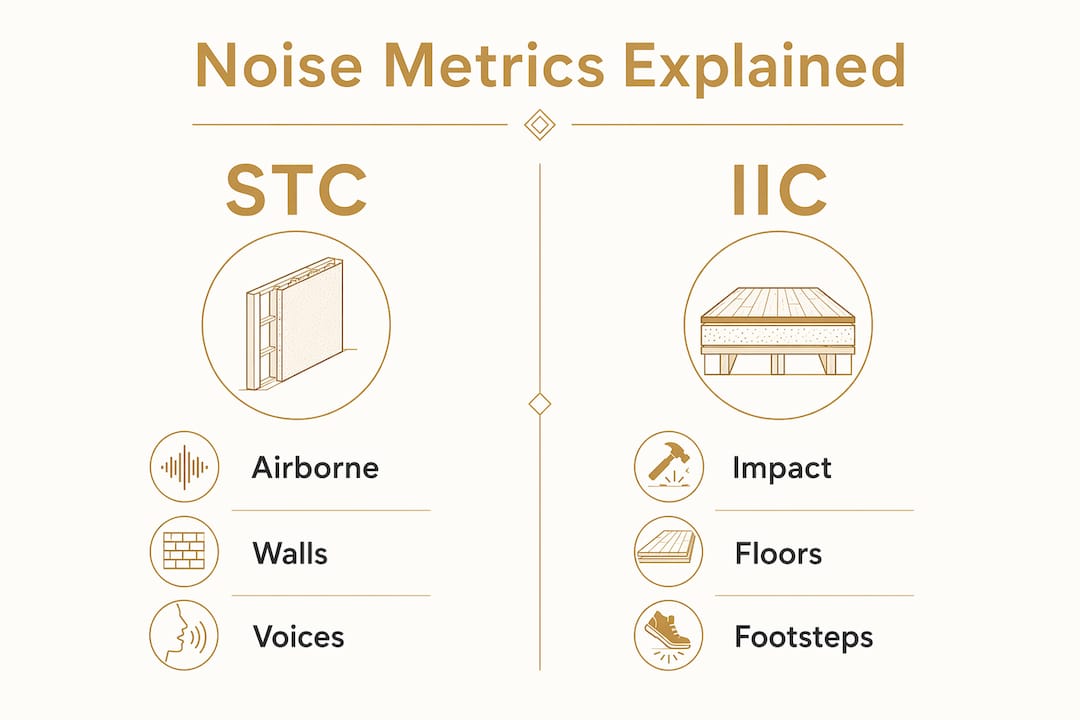
The lab-to-field gap is where buyers get surprised. Lab ratings (STC/IIC) are measured under controlled conditions. Field ratings, called ASTC and AIIC, reflect actual on-site performance after construction tolerances, penetrations, and flanking paths. Many residents find STC 50 insufficient; luxury buyers commonly prefer STC 55 or STC 60 for meaningful privacy.
| Metric | What It Measures | IBC Code Baseline | Luxury Target |
|---|---|---|---|
| STC / ASTC | Airborne noise (voices, music) | STC 50 | STC 55–60 |
| IIC / AIIC | Impact noise (footsteps, drops) | IIC 50 | IIC/AIIC 55+ |
| Field gap | Lab vs. on-site difference | N/A | Expect 3–5 pt drop |
Pro Tip: When reviewing a field test report, look for the full one-third octave band spectrum, not just the single-number rating. A building that scores STC 57 but has a weak low-frequency band will still transmit bass-heavy music clearly. Ask your acoustical consultant to flag any "red-notch" failures in the 125–250 Hz range.
How luxury developers actually build for quiet
Airborne and impact noise require different construction strategies, and high-end projects address both simultaneously.
For airborne noise, the primary tools are mass and airtight seals: double-stud or staggered-stud demising walls, multiple layers of drywall, rock wool or fiberglass cavity fill, Mass Loaded Vinyl (MLV) between wall layers, triple-glazed windows, and acoustical door seals. Every penetration, outlet box, and pipe sleeve is a potential leak. Premium projects seal all of them with acoustical caulk.
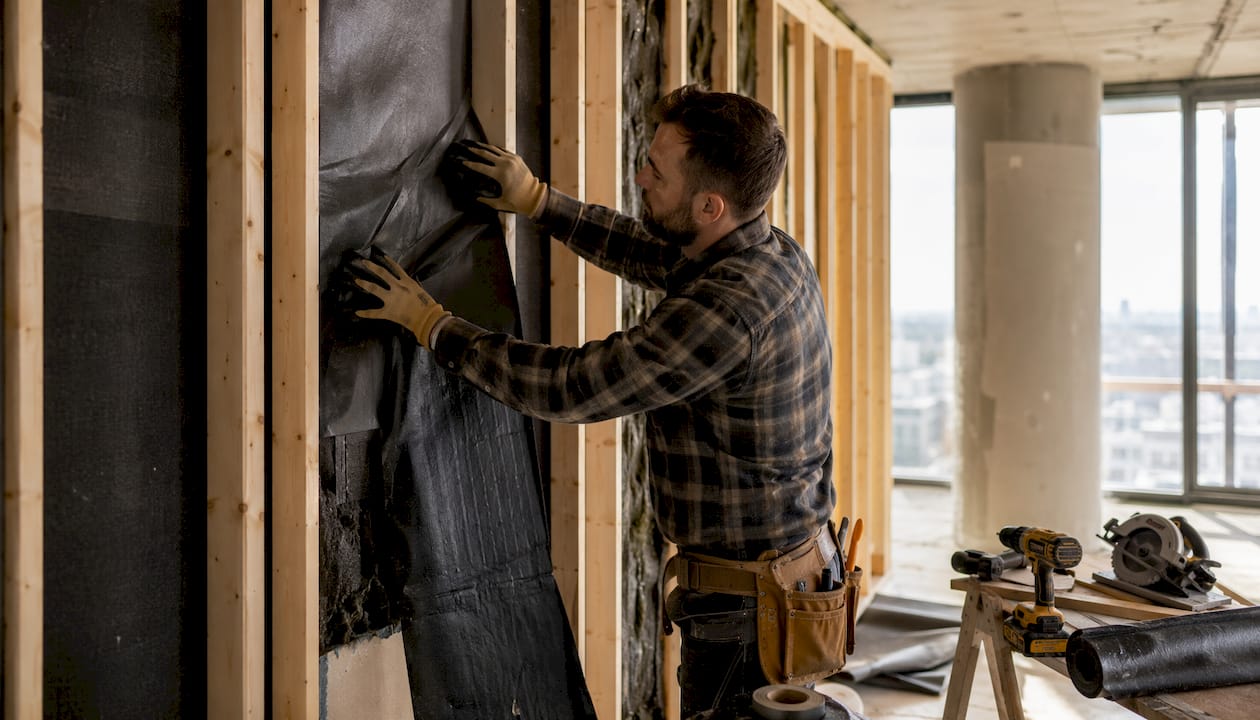
For impact noise, the strategy shifts to mechanical decoupling: floating floor systems with cork, rubber, or dense-foam underlayments, resilient channels or isolation clips between the structural slab and the ceiling finish, and insulated plumbing stacks that prevent water-flow noise from traveling through the building frame. HVAC systems are mounted on vibration isolators and routed to avoid direct contact with unit boundaries.
A well-executed luxury assembly layers all three: triple glazing at the facade, a staggered-stud wall with MLV and rock wool at demising partitions, and a floating floor with a high-IIC underlayment above. Each layer targets a different transmission path. Peaceful urban condo settings that achieve this layered approach consistently outperform buildings that rely on a single material or assembly.
| Solution Category | Typical Materials | Expected Gain | Disruption/Cost |
|---|---|---|---|
| Airborne (walls/glazing) | MLV, rock wool, triple glazing, seals | +5 STC pts | Moderate to high |
| Impact (floors/ceilings) | Floating floors, resilient channels, cork/rubber underlayment | +5–8 IIC pts | High |
| Mechanical (HVAC/plumbing) | Vibration isolators, insulated stacks | Eliminates tonal noise | Moderate |
Pro Tip: On a model suite tour, press your hand against the demising wall and knock. A hollow sound suggests a single-stud assembly with minimal fill. A dense, muffled thud suggests mass and cavity insulation. It is a crude test, but it tells you something before you ask for the spec sheet.
What to ask developers and inspectors before you sign
Acoustic claims in marketing brochures are not proof. Here is what to request and verify:
- Request the lab test reports for all demising wall and floor/ceiling assemblies, showing STC and IIC ratings with the full assembly description.
- Request field test (ASTC/AIIC) reports for completed units in the building, not just the model suite. Ask which ASTM or ISO test method was used.
- Ask for the acoustical consultant's sign-off letter, confirming that as-built conditions match the design specifications.
- Review the condo's technical specifications for stated STC/IIC minimums. If the documents do not list minimums, ask why.
- On site, check: window glazing spec labels, visible pipe routing near unit boundaries, door seal continuity, and HVAC diffuser placement relative to demising walls.
- Ask directly: "What is the as-built ASTC between adjacent units, and do you have a third-party field test report to confirm it?"
Property managers and acoustical consultants distinguish airborne from impact complaints by keyword: "voices through the wall" points to ASTC deficiency; "footsteps from above" points to AIIC deficiency. Knowing which problem you are diagnosing helps you ask the right question.
Retrofit options for existing units, and what they realistically deliver
Retrofitting an existing condo unit is possible, but the outcomes differ sharply between airborne and impact noise.
Airborne retrofits are the more accessible category. Adding a secondary wall with MLV and rock wool, installing acoustical door seals, upgrading to laminated or double-pane windows, and hanging heavy drapes all produce measurable STC gains with moderate disruption. These are often owner-initiated and require minimal structural work.
Impact retrofits are harder. A floating floor system or a ceiling rebuild with resilient mounts requires significant demolition, and effectiveness depends heavily on the original slab construction. Applying layered acoustic assemblies can raise construction cost noticeably while improving acoustic comfort considerably, according to MDPI research. That ratio holds for retrofits too.
Before starting any intrusive work, get formal acoustical specifications in writing and third-party sign-off. Contractor verbal assurances about STC or IIC gains are not sufficient. Most condo boards require permit applications and board approval for work that touches demising walls, floors, or ceilings. Budget 6–12 weeks for approvals in most U.S. jurisdictions, longer in cities with dense permit backlogs.
Pro Tip: For impact noise from above, the most cost-effective first step is often a conversation with the upstairs neighbor about adding area rugs or underlayment, before you invest in a ceiling rebuild. Many condo declarations give boards the authority to require minimum IIC-rated underlayment for hard-surface flooring installations.
How acoustic testing works, and what counts as valid proof
Two test types matter: lab tests and field tests.
Lab tests measure a specific assembly (wall, floor/ceiling) under controlled conditions and produce STC and IIC ratings. They tell you what the design can achieve. Field tests, conducted on-site using ASTM E336 (for ASTC) or ASTM E1007 (for AIIC), measure what the building actually delivers after construction. Field results are always the more relevant number for a buyer.
- Ask whether the developer used ASTM E336/E1007 or an ISO equivalent. Both are acceptable; the method should be stated in the report.
- Check that the report includes the test location (unit numbers), date, and the name of the testing firm.
- Look for the one-third octave band data, not just the single-number rating.
- Flag any report that covers only the model suite. You want data from multiple unit pairs across different floors.
- Prefer reports dated within 12 months of your purchase date. Buildings settle, and early-phase field tests may not reflect current conditions.
Pro Tip: Ask for a site photo of the test setup. A legitimate field test will show the speaker source, the microphone positions, and the test partition clearly. No photo is a red flag.
Health outcomes and resale value from superior acoustics
The evidence linking acoustic quality to resident well-being is consistent: reduced cognitive load, better sleep quality, and lower stress levels are all associated with quieter residential environments. For buyers who work from home, this translates directly into daily performance.
On the market side, acoustic performance has moved from a footnote to a feature line. Developers now list triple glazing, insulated plumbing, and acoustical ceiling assemblies in sales materials the same way they list appliance brands and floor finishes. Buyers who can verify those claims with actual field test data are in a stronger negotiating position than those who accept marketing copy at face value.
The ROI framing is straightforward: targeted upgrades like door seals and window lamination move buyer perception and cost relatively little. Wholesale assembly changes, like full floating floors or ceiling rebuilds, drive true dB reductions but require significant investment. Know which outcome you need before you budget.
How local regulations shape noise insulation requirements
The IBC sets the federal baseline for STC and IIC testing in U.S. residential construction, but local amendments frequently raise those minimums. New York City's building code, for example, layers additional requirements on top of IBC for multi-family residential. California's Title 24 includes specific STC minimums for party walls and floor/ceiling assemblies in new construction. Chicago, Seattle, and other dense urban markets have adopted local ordinances that address both construction standards and ongoing noise nuisance thresholds.
City ordinances also govern operational noise: permissible decibel levels at unit boundaries, quiet hours, and complaint procedures. These are separate from construction standards but affect how disputes are resolved. A building that meets IBC minimums may still generate complaints if local ordinance sets a stricter operational threshold. Buyers in high-density urban markets should review both the building's construction documentation and the local noise ordinance that governs day-to-day living.
HOA declarations and condo bylaws add a third layer. Many declarations specify minimum IIC-rated underlayment for hard-surface flooring, restrict renovation hours, and require board approval for any work affecting demising assemblies. Read those documents before you close.
Key Takeaways
Superior acoustic performance in a luxury condo requires verified field test results at STC 55–60 and IIC 55+, layered construction assemblies, and documented third-party sign-off, not marketing claims alone.
| Point | Details |
|---|---|
| Demand field test reports | Request ASTC/AIIC field test results (ASTM E336/E1007) for completed units, not just the model suite. |
| Target STC 55–60 / IIC 55+ | Code baseline (STC/IIC 50) is insufficient for luxury privacy; push for STC 55–60 and IIC 55+. |
| Verify construction details | Confirm floating floors, resilient channels, MLV, and triple glazing are in the as-built specs. |
| Budget for retrofits realistically | Layered acoustic assemblies can raise costs noticeably while improving acoustic comfort considerably. |
| Check local ordinances | IBC sets the floor; city codes and HOA bylaws often impose stricter minimums and operational limits. |
Acoustics as a first-tier amenity, not an afterthought
Most buyers spend hours comparing kitchen finishes and smart-home packages, then spend five minutes on acoustics. That order is backwards. A unit with a beautiful kitchen and an STC 50 demising wall will feel like a compromise within weeks. A unit with verified STC 58 performance and a floating floor system will feel like the investment it is, every single day.
The developers who treat acoustic performance as a design priority, not a code-compliance checkbox, are the ones worth your attention. Ask for the field test reports on day one of your tour. If they cannot produce them, that tells you something. If they can, read them carefully, check the one-third octave band data, and confirm the testing firm is independent.
At Hougang-central-residences, acoustic quality sits alongside smart-home integration and premium European fittings as a core design priority, not a line item added at the end of the specification process. That philosophy is what separates a building that performs from one that merely looks the part.
FAQ
What STC rating should a luxury condo have?
Luxury buyers should target STC 55–60 for demising walls; the IBC baseline of STC 50 is widely considered insufficient for meaningful privacy between adjacent units.
What is the difference between STC and ASTC?
STC is a lab-measured rating for a specific assembly; ASTC is the apparent field rating measured on-site, which typically runs 3–5 points lower due to construction tolerances and flanking paths.
Can you soundproof an existing condo unit?
Yes, but airborne retrofits (MLV, door seals, window upgrades) are more accessible than impact retrofits (floating floors, ceiling rebuilds), which require board approval, permits, and significant disruption.
What documents should I request from a developer?
Request lab test reports for all assemblies, field test (ASTC/AIIC) reports for completed units, the acoustical consultant's sign-off letter, and the condo's technical specifications listing STC/IIC minimums.
Do local building codes override the IBC on acoustics?
Local codes and city ordinances frequently add stricter minimums on top of the IBC baseline; always review both the building's construction documentation and the applicable local noise ordinance before purchasing.
Useful sources
- IBC 2021, Chapter 12 Interior Environment — The governing U.S. code baseline for STC and IIC testing requirements in residential construction. Code requirement.
- ASTM E336 — Standard test method for measuring ASTC in buildings (field test for airborne noise). Testing standard.
- ASTM E1007 — Standard test method for measuring AIIC in buildings (field test for impact noise). Testing standard.
- Construction Specifier: Building Acoustics Guide — Practitioner-level overview of acoustic design as a building performance metric. Recommended practice.
- MDPI: Noise Disturbance Mitigation in Human-Centric Environments — Peer-reviewed synthesis of technical, legal, and health dimensions of acoustic design. Research reference.
- WELL Building Standard (acoustics feature) — Sets recommended STC/IIC targets and background noise limits for health-focused buildings. Recommended practice, not code.
- LEED v4 (Indoor Environmental Quality credit) — Includes acoustic performance criteria for multi-family residential projects. Recommended practice, not code.
- National Council of Acoustical Consultants (NCAC) — Directory of certified acoustical consultants for pre-purchase and pre-closing evaluations. Practitioner directory.