
PSF is simply price divided by whatever floor-area figure a listing uses, and that second part is where buyers get burned. Since GFA harmonisation standardized how developers measure saleable area, headline PSF on new launches can look higher than an older resale unit with near-identical usable space. Treat quantum and usable area as your primary decision factors, and only compare PSF across units that are genuinely alike.
TL;DR:
- The GFA harmonisation rules reduced the saleable area measurement, causing headline PSF to appear higher even if livable space and prices remain unchanged.
- New launch units now typically follow harmonised measurement standards, which exclude spaces like ledges, voids, and planters that inflate saleable area.
- To accurately compare units, buyers should focus on quantum, usable area, and effective PSF, calculated by subtracting non-usable space from saleable area.
- Variations in PSF between units can be due to differences in bedroom sizes, tenancy, age, condition, or location factors like facing and floor level.
- Buyers should verify measurement methods with agents and compare based on consistent, comparable units rather than headlines alone.
Table of Contents
- PSF vs Floor Area: The Definitions Every Buyer Needs
- What Did GFA Harmonisation Actually Change?
- How Do You Calculate Effective PSF and Compare Quantum?
- What Should You Control for Before Comparing PSF?
- Checking Floor Plans at Hougang Central Residences
- Which Metric Should Actually Drive Your Decision?
- See Hougang Central Residences' Pricing and Floor Plans
- Where to Verify These Figures Yourself
- Sources
- FAQ
PSF vs Floor Area: The Definitions Every Buyer Needs
PSF, or price per square foot, is calculated as price divided by area. That sounds simple until you ask: which area? In Singapore at least four different area figures can appear in the same brochure, and each one changes the PSF you see.
Gross Floor Area (GFA) is the regulatory measurement URA uses for planning control. Its Gross Floor Area handbook sets out exactly what counts, what counts partially, and what's excluded, since GFA determines how much a developer is permitted to build on a site. GFA matters to developers and planners; it's not the number you'll use to judge your own unit.
Strata area (saleable area) is what actually appears on your Sale and Purchase Agreement. It's the figure most brochures quote for PSF.
Built-up area typically refers to the total constructed footprint, sometimes including shared spaces and structural elements that don't add to livable space.
Net internal area (usable/carpet area) strips out walls, columns, and structural elements to show what you can actually furnish and walk through.
Site area is the land parcel size, relevant mainly for landed property and en-bloc calculations, not for comparing condo units.
Items that commonly inflate the strata figure relative to what you'll actually use include:
- Air-con ledges and yard spaces
- Bay windows and planter boxes
- Shared corridors apportioned to your unit
- Void spaces above double-height ceilings
What Did GFA Harmonisation Actually Change?
Before 2023, measurement practices varied enough between developers that comparing two "3-bedroom, 900 sq ft" units could mean comparing apples to slightly smaller apples. The harmonisation circular fixed that by requiring area to be measured to the middle of party walls and excluding certain voids, ledges, and planters that used to count toward saleable area.
The practical result: new-launch saleable areas got smaller, and headline PSF went up, even when the actual livable space and the total price a buyer pays stayed roughly the same. A 900 sq ft unit priced at $1,800,000 works out to $2,000 psf. Shave 40 sq ft off the saleable area under the new rules, and that same $1,800,000 unit now reads as $2,093 psf, purely from the measurement change, not from the developer charging more.
Industry estimates suggest air-con ledges alone historically accounted for roughly 4 to 5 percent of a unit's saleable area. Strip that out, and a developer's overall efficiency ratio (usable area divided by saleable area) drops accordingly, even though nothing about the physical building changed.
How to spot which rules a listing follows:
- Check the launch date; anything marketed from 2023 onward is almost certainly measured under the harmonised standard
- Ask the agent directly whether the quoted area follows the harmonised measurement method
- Compare stated efficiency ratios; a sudden drop between phases of the same project is a harmonisation signal, not a design change
How Do You Calculate Effective PSF and Compare Quantum?
Three numbers matter more than the headline PSF on any listing: quantum (what you actually pay), usable area (what you can live in), and effective PSF (price recalculated against that usable area). Here's how to get from a brochure to a real comparison.
- Find the headline PSF and quantum. These sit on the price list or floor plan sheet. Quantum is simply the total price.
- Estimate the non-usable portion of the stated area. Ask for a furniture layout plan; it usually reveals ledges, bay windows, and yard space folded into the saleable figure.
- Recompute area on a usable basis. Subtract the non-usable portion from the saleable area to get an approximate net internal figure.
- Divide quantum by that usable figure. This gives you the effective PSF, the number that actually reflects what you're paying for livable space.
- Run the affordability check on quantum, not PSF. Monthly repayment depends on total loan size, not on the per-square-foot rate.
Notice the new-launch unit shows a higher headline PSF, but its effective PSF gap versus the resale unit narrows once you account for how much of each unit is actually usable. Quantum, not PSF, is what your mortgage banker cares about; a downpayment calculation always starts from the total price, not the rate per square foot. Treat these figures as estimates. Actual non-usable percentages vary by unit stack and layout, so verify specifics with the developer's floor plan pack or URA's own circulars on measurement rules before finalizing a decision.
What Should You Control for Before Comparing PSF?
PSF comparisons only mean something when the units being compared are genuinely alike. Before you put two PSF figures side by side, align these variables:
- Bedroom count and size band. A 2-bedroom and a 3-bedroom rarely carry the same PSF logic, even in the same building.
- Tenure. Freehold and 99-year leasehold properties price differently for reasons that have nothing to do with floor area.
- Age and condition. A resale unit's PSF reflects depreciation and renovation state; a new launch doesn't.
- Stack and facing. Corner units, higher floors, and better views routinely command a premium unrelated to area efficiency.
At the showflat, check the furniture template against real dimensions, not the marketing render. Walk the door swings; test whether wardrobes fit where the plan suggests. Usable space, not headline PSF, determines whether the unit actually works for your daily life.
Ask agents directly whether the quoted saleable area follows harmonised measurement rules and request a breakdown of what's included. A disciplined comparison approach treats PSF as a secondary filter, applied only after quantum and layout pass your own tests.
Pro Tip: If a unit's PSF looks unusually low but its total quantum is higher than comparable units, ask why. It usually means the saleable area includes more non-usable space than the listing lets on.
Checking Floor Plans at Hougang Central Residences
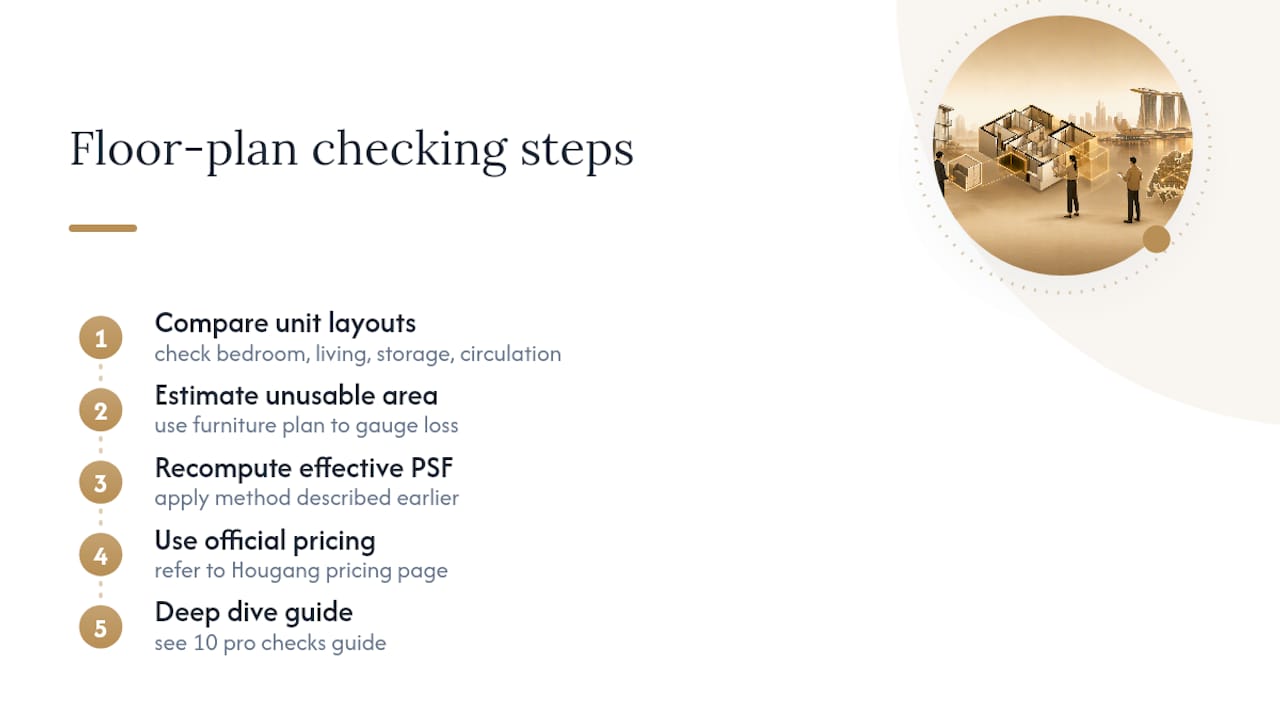
The same checklist applies whether you're looking at a resale flat in Toa Payoh or a new launch like Hougang Central Residences. With 835 units ranging from 1-bedroom-plus-study to 5-bedroom penthouses, floor plans will vary meaningfully even within the same bedroom count, so check bedroom footprint, living area proportions, storage allocation, and circulation loss before you look at PSF at all.
To translate a brochure PSF into something usable, take the quoted price for your chosen unit type, estimate the non-usable portion from the furniture plan, and recompute effective PSF the way outlined above. Exact current pricing sits on the Hougang Central Residences pricing page, which is the reference point to use rather than any third-party estimate. For a deeper walkthrough of layout efficiency checks, the 10 pro checks for Singapore buyers guide covers the same ground in more detail.
Which Metric Should Actually Drive Your Decision?
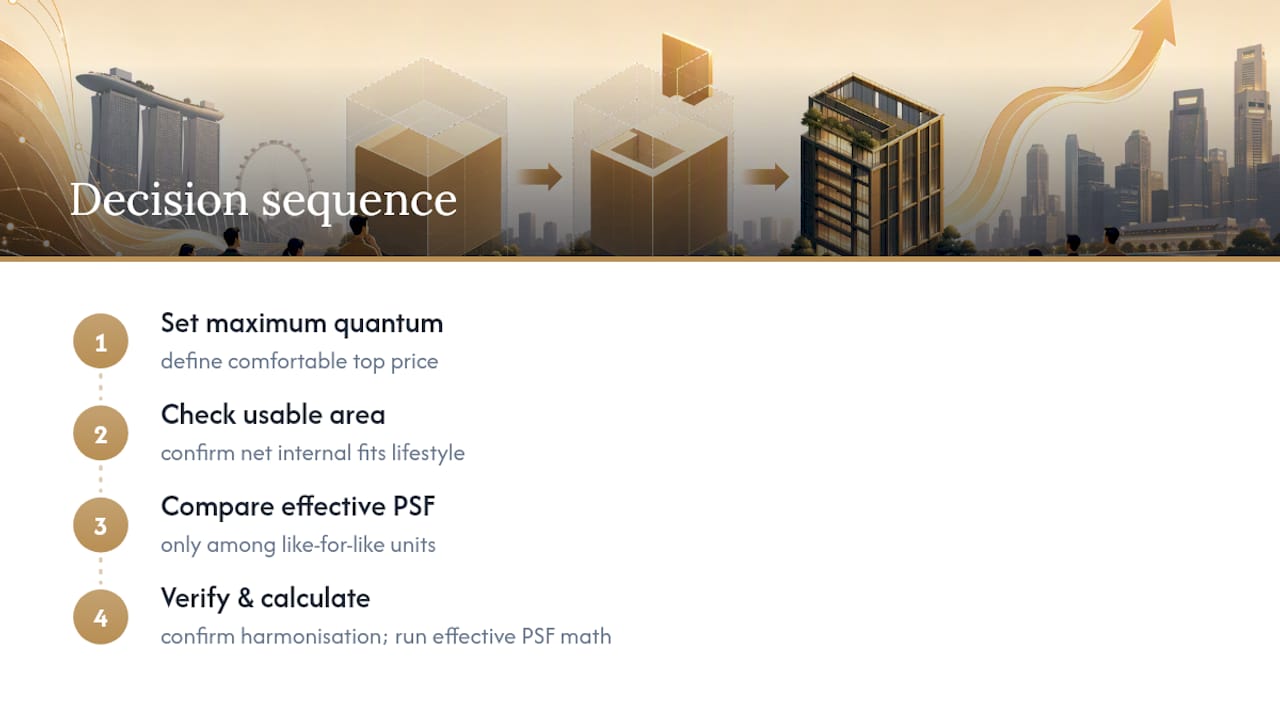
My own sequence, for what it's worth: set your maximum comfortable quantum first, before you look at a single PSF figure. Then screen for usable, net internal area, since that's what determines whether the unit fits your life. Only after both of those check out does effective PSF earn a place in the comparison, and even then, strictly among units that match on bedroom count, tenure, and age.
Investors chasing capital appreciation have more reason to lean on PSF, since like-for-like comps are the whole game in that world. Owner-occupiers should weight quantum and livability far more heavily; you don't live in a PSF figure. Whichever camp you're in, verify harmonisation status before trusting any headline number, and run the effective PSF math yourself rather than taking a brochure's word for it.
— Simon
See Hougang Central Residences' Pricing and Floor Plans
Hougang Central Residences sits directly above Hougang MRT, with a dual-line interchange (including the future Cross Island Line) and an integrated retail mall built into the same address, so the transit-and-errands math that usually eats into anyone's daily schedule mostly disappears. Unit types run the full spread, from 1-bedroom-plus-study through 5-bedroom penthouse, each fitted with smart-home systems and European fittings as standard rather than as an upgrade package.

If you've followed the calculations above, the next useful step is applying them to an actual unit. Browse sample floor plans across the unit range and pick a layout that matches your bedroom and size requirements, then check the current pricing page to run your own effective PSF calculation against quantum. From there, booking a showflat visit lets you verify the floor plan against the real layout, which is exactly the check this article recommends before any purchase decision.
Where to Verify These Figures Yourself
- URA's Gross Floor Area handbook for official area definitions
- URA circular DC22-09 for harmonisation rules
- PropertyNet's explainer on harmonisation's effect on resale value
- Singapore new launches buying guide for broader market context
- ScamShield to verify developer communications are legitimate
This article is general information, not a substitute for advice from a qualified financial advisor. Consult a qualified financial professional about your own circumstances before acting on anything here.
Sources
FAQ
What Is the Difference Between Gross Floor Area and Built-Up Area?
GFA is URA's regulatory measurement used to control how much a developer can build on a site, while built-up area generally refers to a building's total constructed footprint. They serve different purposes, and neither is the figure you'll find on your Sale and Purchase Agreement.
What Is the Difference Between Built-Up Area and Floor Area?
"Floor area" is a broad term that can mean saleable area, built-up area, or net internal area depending on context, while built-up area specifically refers to the constructed footprint including structural elements. Always ask which specific definition a listing is using before comparing PSF.
What Is the Difference Between Site Area and GFA?
Site area is the raw land parcel size, while GFA is the total floor area a developer is permitted to build across all levels, calculated using a plot ratio applied to that site area. Site area matters mainly for en-bloc and landed property calculations, not for comparing individual condo units.
Why Did PSF Go Up After GFA Harmonisation Even Though Prices Didn't Rise as Much?
Harmonisation excluded certain voids, ledges, and planters from saleable area calculations, which shrank the denominator in the PSF formula. The same or similar quantum divided by a smaller area produces a higher headline PSF, even when usable space stayed about the same.
Does Hougang Central Residences Publish Its Pricing by Unit Type?
Current pricing is available on the Hougang Central Residences pricing page, with pricing figures available on the official site; specific unit-type pricing should be checked directly on the site.