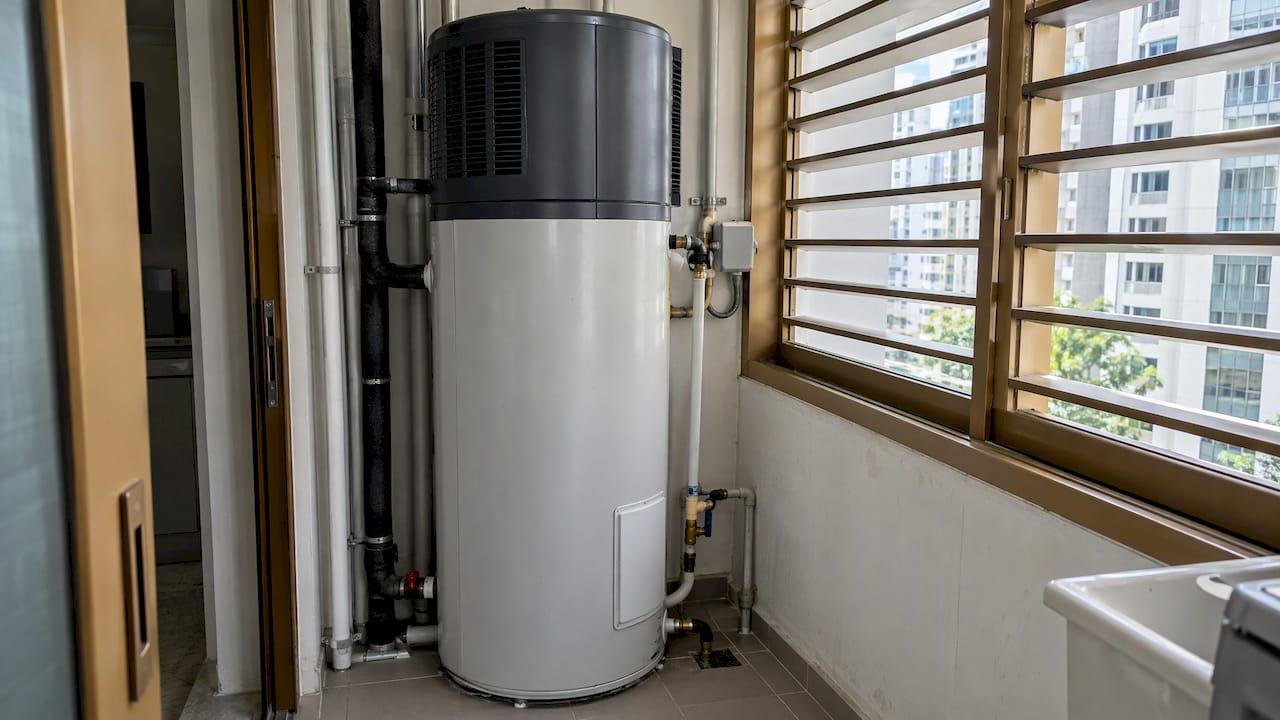
Yes, you can buy a heat pump water heater in Singapore, and the climate suits it. It pulls warmth from the surrounding air into a storage tank instead of heating water with an element, so it uses far less electricity than a conventional electric heater. The catch is that it is a bulky tank-and-compressor system. Whether it fits depends on your home's layout, airflow and who holds the right to install equipment. That is why condo buyers should settle hot water early, at the floor plan stage, and not after the keys are handed over. If you are weighing a new launch such as Hougang Central Residences, this guide shows what to check.
TL;DR
- A heat pump water heater moves heat from air into a tank. Suppliers in Singapore state it uses roughly one third of the electricity of a standard electric storage heater.
- It needs a floor that can carry a heavy full tank, airflow around the unit and a floor drain nearby. Fixed wiring must be done by an EMA-licensed electrician.
- Climate Vouchers can be used toward heat pump water heaters. Eligibility depends on whether you live in an HDB flat or a private home, and on your citizenship or PR status.
- Size by the number of people and bathrooms, not by tank litres alone.
- For a condo, ask about hot water layout and plant space before you commit. Floor plans show you where the options are.
Table of Contents
- How a heat pump water heater works
- What the efficiency figures mean
- Sizing: people, bathrooms and recovery
- Space, ventilation, noise and installation
- What it costs and what help exists
- Why this matters when you buy a condo
- See the layouts for yourself
- FAQ
- Sources
How a heat pump water heater works
Think of a refrigerator in reverse. ENERGY STAR explains that a heat pump water heater moves heat from the surrounding air into the tank. A normal electric storage heater creates heat directly with a resistance element, which is the expensive way to do it.
Three types of electric water heater are common in Singapore homes:
- Instant (tankless): heats water as it flows, with no tank. It is compact and the usual choice for one bathroom.
- Storage: keeps a tank of hot water ready and can serve several taps. Typical household tanks are small, in the tens of litres.
- Heat pump: heats a large storage tank using heat taken from the air.
One supplier's comparison puts the trade-off simply: heat pumps use less electricity, but cost more up front and need suitable space. That makes them most attractive for homes with high hot water use and a long time horizon.
Singapore's weather is the reason this technology is worth a look. AOS Bath, a local water-heater specialist, says heat pumps run well at ambient temperatures of 15°C to 40°C, a range that covers the island all year. There is no cold season to cut performance, and no dependence on sunlight, because the unit works day and night.
What the efficiency figures mean
Efficiency is measured by the coefficient of performance (COP): units of heat delivered for each unit of electricity used. A conventional element sits at 1. Published Singapore figures for heat pumps:
- LG Singapore states a COP of 3.2 on its 200 L model, with about 69% of the energy coming from absorbed air and 31% from electricity.
- The A. O. Smith CAHP-80 and CAHP-120 models have a COP of 4.20 and 875 W rated power, according to their user guide.
- Rheem Singapore lists residential models with a COP of 4.2 or higher that can produce water up to 60°C.
These are manufacturer figures measured under test conditions. Your own savings will depend on how much hot water you use, which model you pick and the tariff you pay. The reliable way to compare is the energy label and the model's rated power and capacity, set against your household's usage.
For context, the National Environment Agency (NEA) says the Mandatory Energy Labelling Scheme and Minimum Energy Performance Standards exist to lift appliance efficiency, and that buying more efficient models can reduce energy use and electricity bills.
Sizing: people, bathrooms and recovery
A heat pump tank is much larger than the tank of a storage heater, so sizing matters more here than anywhere else. A rough pattern from local suppliers:
| Household | What to look for |
|---|---|
| Couple or small household | A compact tank |
| Family of 3 to 5 | A mid-to-large tank so back-to-back showers do not run cold |
| Large home or many bathrooms | Larger capacity and faster recovery time |
This follows a sizing guide from a Singapore supplier. AOS Bath recommends heat pumps for HDB families of four and above and offers larger systems for homes with five or more bathrooms.
Range guides help here. LG's round models come in 100 L, 150 L and 200 L, and its square models in 200 L and 270 L, according to its product page. The A. O. Smith CAHP models have 300 L and 455 L tanks and deliver 79.7 L/h in normal use and 201 L/h at high demand.

If you want a method that goes beyond tank litres, sizing by first-hour rating explains how much hot water a heater can deliver in the first hour of heavy use, which is what a morning rush in a family home really tests. Count your peak simultaneous showers, add the bathtub if you use it, and compare that to the delivery figures above.
Space, ventilation, noise and installation
This is where heat pumps differ most from a small instant heater above a vanity. Check these points before you choose:
- Floor loading. The AOS Bath guide calls for a floor able to bear about 1.5 times the full weight of the tank. A 300 L tank full of water is heavy before you add the unit itself.
- Base and drainage. The same guide calls for a flameproof fixed base at least 20 mm high, with drainage, and for the relief-valve discharge pipe to be connected to a floor drain.
- Handling. It requires installation by at least three people, with a forklift if necessary, using the manufacturer's recommended installers.
- Airflow. A heat pump draws heat from the air, so there must be adequate airflow around the unit. Suppliers say it can be installed in HDB flats, condominiums and landed homes if this is met. Another local supplier notes that heat pumps need outdoor or well-ventilated space, which is why they suit landed properties and some condominiums.
- Noise. The CAHP guide lists operating noise of 54 dB(A). Position the unit away from bedroom walls.
- Electrical work. Under Singapore's Electricity Act, fixed wiring for a water heater must be done by an EMA-licensed electrician. Units in the guide run on 230V, 50 Hz supply.
Safe use matters too. The manufacturer's manual warns that dry heating can cause serious scalds, that the anode rod is a consumable part to be inspected and replaced at set intervals through an authorized dealer, and that the power must be cut off before any maintenance. Follow the maintenance schedule in your model's manual.
Since 1 July 2026, NEA has required end users who import regulated goods for their own use, including household water heaters, to register them with NEA. Advertisements for non-compliant regulated goods are also prohibited. Buy locally from a supplier that displays the energy label or tick rating and the COR number.
What it costs and what help exists
Heat pump prices vary widely by capacity and brand, and I would not trust a single number from a web page. What is documented in Singapore is the cost of ordinary installation work, which gives you a baseline. One electrician lists indicative prices from $80 for instant installation, $150 for storage and $280 for supply and install, with new circuit work adding $120 to $200. An installer's quote for a 56 L storage heater shows a higher installation charge for a condo ($548) than an HDB flat ($438), with extras such as $100 for removing a large tank and $150 for high ceilings or stairs. A heat pump is a bigger job than any of these, so expect to ask for a written quote.
On the saving side, Rheem Singapore claims up to 75% less energy than a standard electric water heater and savings of up to $576 a year for its ProTerra range. AOS Bath says heat pumps use only 33% of the energy of a regular electric heater. Those are supplier claims for specific products. Your bill will follow your usage.
Climate Vouchers
The government helps with the upfront cost. Under the enhanced Climate Friendly Households Programme, Singaporean and PR HDB households received $300 in Climate Vouchers from 15 April 2024, valid until 31 December 2027, and heat pump water heaters are one of the eligible product types. From 15 April 2025, an additional $100 became available (a total of $400), and the programme was extended to Singapore Citizen households in private residential properties.
The programme's FAQ says that eligibility covers Singapore Citizens and PRs in HDB flats, or Singapore Citizens in private residential property, with one set of vouchers per household address. It also lists 5-tick water heaters among the eligible products. Check that page for the current rules before you buy, as the programme terms can change.
Why this matters when you buy a condo
Most people shop for a water heater after they move in. A heat pump rewards you for thinking earlier, because the unit's size, drainage and ventilation needs interact with the way your home is laid out. A bulky tank cannot go just anywhere in a compact apartment, and it cannot always be added neatly later.
So when you look at a new launch, read the floor plan for these things:
- Service yard or utility space. Is there an area with floor drainage and airflow that could take a tank or its outdoor-type unit, subject to approvals?
- Number of bathrooms against household size. A family of five with three bathrooms has different peak demand than a couple with one. Our guide to family unit sizes in condos helps with matching unit to household.
- Layout efficiency. Short pipe runs from the heater to the bathrooms mean less wait for hot water. Our 10 checks for efficient condo layouts cover how to spot this quickly.
- Bathroom fittings. A thermostatic mixer holds the temperature steady, which matters when you store water at 60°C or higher. See thermostatic mixer vs single lever.
- Smart controls. Wi-Fi control and scheduling are common on heat pump models, and LG's range is also Smart-Grid Ready, preheating when electricity is cheaper. Our smart-home features checklist and smart bathroom features guide show what to look for.
If you are taking a wider view of running costs, the order in which you do energy upgrades matters too. Home energy improvements and what they cost gives a general view of where to start.
Our view: decide hot water before the keys
A water heater looks like a small purchase until you put a 300-litre tank in a small home. We think the better habit is to treat hot water as part of choosing a unit, like the number of bedrooms or the direction the home faces.
At Hougang Central Residences, 835 homes sit above the Hougang MRT station, from 1-bedroom plus study units to 5-bedroom penthouses. That range exists because households differ: a young professional commuting from the interchange and a family of five do not use hot water the same way. Our premium European fittings and smart-home systems are designed for a home that is easy to run, and we encourage buyers to read the floor plan for where space, drainage and ventilation sit before they decide on a heater.
The simplest test is demand. Count the bathrooms, count the morning showers, and choose the unit that fits that pattern. Efficiency then follows from a well-chosen layout, not a late fix.
Simon
See the layouts for yourself
If you are comparing homes and want to judge them on the details above, start with the floor plans and the unit types, from 1-bedroom plus study to 5-bedroom penthouse. Pricing starts from S$2,800 per sq ft, as published on our pricing page. You can register for a showflat viewing from the Hougang Central Residences site and bring your list of space, drainage and bathroom questions.
FAQ
Can I get a heat pump water heater in an HDB flat or condo?
Yes. Suppliers in Singapore say heat pump water heaters can be installed in HDB flats, condominiums and landed homes if there is enough airflow around the unit. The practical limit is space for a large tank, a floor that can carry it and a floor drain for the relief valve. Fixed wiring must be done by an EMA-licensed electrician.
How much electricity does a heat pump water heater save?
Supplier figures range widely. AOS Bath says heat pumps use about one third of the energy of a regular electric heater, and LG states its model is three times as efficient as a conventional electric system. Rheem claims savings of up to 75% for its ProTerra range. Your own saving depends on how much hot water you use and the model you buy.
Can I use Climate Vouchers for a heat pump water heater?
Heat pump water heaters are an eligible product type under the Climate Friendly Households Programme. Singaporean and PR HDB households, and Singapore Citizen households in private homes, can claim the vouchers, one set per household address. Check the programme's FAQ page for the current terms and expiry before you buy.
What maintenance does a heat pump water heater need?
The manufacturer's manual says the anode rod is a consumable part that must be inspected and replaced at set intervals through an authorized dealer. Always switch off the power supply before any maintenance, and never run the unit dry, which can cause serious scalds. Follow your model's schedule.
Sources
- Regulations Strengthened To Encourage More Energy Efficient Purchases, NEA
- Household Sector, NEA
- Enhanced Climate Friendly Households Programme, PUB
- How it Works: Heat Pump Water Heaters, ENERGY STAR
- Heat Pump Water Heaters Features You Need to Know, LG Singapore
- Residential Heat Pump Water Heaters, Rheem Singapore
- ProTerra Heat Pump Water Heaters, Rheem Singapore
- CAHP User Guide, AOS Bath
- Heat Pump Technology Singapore, AOS Bath
- Water Heater Singapore: Instant vs Storage vs Heat Pump
- Heat Pump Water Heater, Casa Singapore
- Water Heater Installation in Singapore: Types, Costs and Safety Guide
- Water Heater Installation Singapore, Trizone Electricals
- Joven Storage Water Heater JSH 56 L, HomeOne