
Decoupling a property in Singapore is legal, but only when it's a genuine transfer at fair market value, not a paper exercise to dodge Additional Buyer's Stamp Duty (ABSD). Before anything else, run two checks: is the property still inside the Seller's Stamp Duty (SSD) window, now four years for purchases from July 4, 2025, and can the remaining owner qualify for the mortgage alone under the Total Debt Servicing Ratio (TDSR)? Fail either test and decoupling usually costs more than it saves.
TL;DR:
- Decoupling requires a genuine transfer at fair market value, with proper valuation and legal documentation, or risk IRAS enforcement for tax avoidance.
- Inside the four-year SSD window, costs including SSD and CPF interest often outweigh the tax savings from avoiding ABSD.
- Successful decoupling depends on the remaining owner qualifying for an individual mortgage under TDSR, which requires pre-assessment from banks.
- HDB flats are largely ineligible for decoupling, while private property decoupling is possible if mortgage and ownership conditions are met.
- Enforcement actions like court rulings and audits scrutinize arrangements where beneficial ownership or mortgage payments suggest a paper transaction rather than a true transfer.
Table of Contents
- How Decoupling Works: Gifts, Part-Sales, and the Legal Mechanics
- Who Can and Cannot Decouple: HDB Rules and Private Property Eligibility
- What Decoupling Actually Costs: Stamp Duties, CPF, and a Worked Example
- Can the Remaining Owner Actually Qualify for the Mortgage Alone?
- Legal Risk: How IRAS and the Courts Treat 99-to-1 Decoupling Schemes
- When Decoupling Makes Sense: A Break-Even Checklist
- Step by Step: The Decoupling Timeline From Start to Registration
- What Condo Owners Should Know Before Restructuring Ownership
- Why the Real Risk in Decoupling Isn't the Tax, It's the Timing
- Sources
- FAQ
How Decoupling Works: Gifts, Part-Sales, and the Legal Mechanics
Decoupling means one co-owner transfers their entire share of a property to the other, leaving a single owner free to buy a second property without triggering ABSD on the first. There are two lawful routes to get there.
A gift transfers the share with no money changing hands. A part-sale involves the remaining owner paying the exiting owner for their share at fair market value. Both routes are legal, but they trigger different tax treatment and different scrutiny from the Inland Revenue Authority of Singapore (IRAS).
Whichever route you pick, Buyer's Stamp Duty (BSD) applies to the share being transferred, calculated on whichever is higher between the agreed price and the market valuation. Because BSD depends on valuation, most transactions require an independent valuation report from a licensed valuer rather than relying on the last transacted price in the development. Conveyancing lawyers typically insist on this to protect both parties and to satisfy the bank if a mortgage is involved, according to guidance from Yuen Law on decoupling private property.
Here's what usually needs to happen before the transfer is legally complete:
- Obtain an independent valuation of the property's current market value.
- Confirm whether ABSD applies to the remaining owner. It typically does not, since they already hold a share, but this must be checked against current IRAS ABSD rates) before assuming the exemption applies.
- Calculate BSD on the transferred share using the tiered BSD schedule.
- Discharge any Central Provident Fund (CPF) charge lodged against the property if either party used CPF funds to buy it.
- File the transfer with the Singapore Land Authority (SLA) once stamp duty is paid.
The CPF piece trips up more owners than any other step. If the exiting owner used CPF savings for the original purchase, those funds (plus accrued interest, calculated at the CPF Ordinary Account rate) must be refunded to their CPF account before the transfer can be registered. The CPF Board treats this as a mandatory refund, not optional, and the interest component often surprises people who assumed they'd get back exactly what they put in years earlier.
None of this happens instantly. A gift or part-sale still needs proper legal documentation, typically a Deed of Gift or a Sale and Purchase Agreement, drafted by a lawyer who understands that the paperwork has to reflect what actually happened financially. A transfer priced at S$1 when the flat is worth S$1.5 million doesn't hold up if IRAS asks questions later, a point that becomes critical in the enforcement discussion further down.
Who Can and Cannot Decouple: HDB Rules and Private Property Eligibility
Whether decoupling is even on the table depends heavily on what kind of property you own. Private condominiums and landed homes have far more flexibility than public housing.
HDB flats are largely off-limits. Since 2016, the Housing & Development Board (HDB) has disallowed owner-to-owner transfers specifically for decoupling purposes. The exceptions are narrow: death of an owner, divorce, or proven financial hardship, each of which requires HDB approval on a case-by-case basis. If you're holding an HDB flat and hoping to decouple to avoid ABSD on a second property, HDB's change-of-ownership guidance makes clear that route is essentially closed outside those circumstances.
Private property is a different story, provided a few conditions line up:
- The property must be fully owned or the mortgage/CPF charge must be dischargeable, either through refinancing or an outright cash payout.
- The remaining owner needs bank approval to take over the loan solely in their name, which means qualifying under TDSR without the exiting co-owner's income.
- Citizenship and residency status of the remaining owner still determines their ABSD liability on any future purchase. A Singapore citizen decoupling from a Permanent Resident (PR) co-owner, or vice versa, changes the ABSD math on the next buy.
- Joint tenancy must be severed into tenancy-in-common before a partial transfer can occur, since joint tenancy assumes equal, undivided ownership.
Bankruptcy and probate complicate things further. If either owner is undischarged from bankruptcy, the Official Assignee's consent is generally required before any transfer of their share. Where an owner has passed away and the property is under probate, the executor's authority and the terms of the will govern how the share moves, and this rarely aligns neatly with a straightforward decoupling timeline.
What Decoupling Actually Costs: Stamp Duties, CPF, and a Worked Example
The appeal of decoupling is straightforward: avoid ABSD on a second property, which currently runs as high as 20% to 30% for a Singapore citizen or PR buying an additional residential property, depending on citizenship status. The catch is that decoupling isn't free, and since July 2025, the math has gotten noticeably less forgiving.
Here's what actually shows up on the bill:
- BSD on the transferred share, calculated using the tiered schedule (1% to 6% depending on value) applied to the share's market value, not the full property price.
- SSD, if the property is still inside its holding period. This is the single biggest variable to check first, because it can wipe out the entire benefit.
- CPF refund plus accrued interest for any CPF funds the exiting owner used, refunded to their CPF Ordinary Account before the transfer completes.
- Legal fees for two separate lawyers, since each party needs independent counsel to avoid conflict of interest.
- Independent valuation fees, typically a few hundred dollars but mandatory for a defensible transaction price.
- Refinancing or prepayment penalties if the remaining owner needs a new loan and the old one is still in its lock-in period.
Statistic Callout: From July 4, 2025, the SSD holding period increased to four years for qualifying purchases, creating a significant new cost if decoupling occurs inside that window, according to analysis of the 2025 SSD changes. Decoupling within that four-year window now means paying SSD on top of everything else, a cost that didn't exist under the old three-year rule.
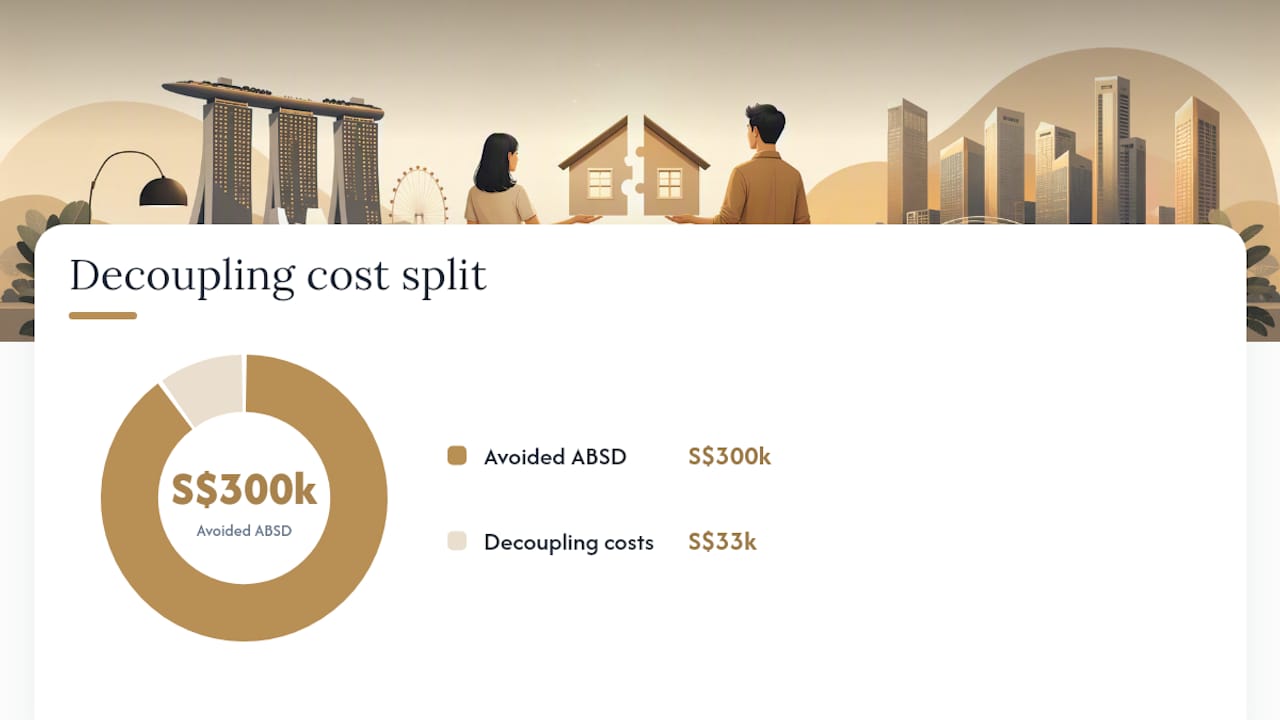
A worked example makes this concrete. Say a couple owns a condo now worth S$1.5 million and wants to decouple so one partner can buy a second property worth S$1.5 million without triggering ABSD. Without decoupling, ABSD on that second purchase would run roughly S$300,000 at the higher citizen or PR rate. Decoupling costs, in a straightforward case outside the SSD window, typically run around S$33,000, covering BSD on the transferred half-share, two sets of legal fees, valuation, and CPF refund processing. On paper, that's a clear win: S$300,000 avoided against S$33,000 spent.
Now put that same condo inside the four-year SSD window. If it was bought two years ago and is being decoupled today, SSD on the transferred share, calculated on the property's current value, could add tens of thousands of dollars depending on how far into the holding period the sale falls. Combine that with CPF accrued interest that's built up over those two years, and the "savings" can shrink dramatically or vanish entirely. This is exactly why the four-year rule changed the calculus for anyone who bought recently.
The hidden costs that catch people off guard almost always trace back to two sources: banks charging prepayment penalties nobody budgeted for, and CPF interest that's larger than expected because the original purchase used a big CPF sum years ago. Both of these erode the apparent ABSD savings faster than most spreadsheets account for.
Can the Remaining Owner Actually Qualify for the Mortgage Alone?
This is the question that kills more decoupling plans than tax math ever does. If the remaining owner can't service the loan solo, none of the ABSD savings matter, because the bank simply won't approve the refinancing.
Singapore banks apply TDSR, capping total monthly debt obligations, including the mortgage, car loans, credit card minimums, and other debt, at 55% of gross monthly income. When a co-owner exits, the bank reassesses the loan based only on the remaining owner's income, and that reassessment is where plans often stall. A household that comfortably qualified as a joint application can look very different as a single-income application, especially if the exiting spouse was the higher earner.
Before committing to lawyers and valuers, get a bank pre-assessment. Most banks will run a soft check on whether the remaining owner qualifies for the loan amount needed, factoring in existing debt, income documents, and credit history, without triggering a full underwriting process. This costs nothing and takes days, not weeks.
The practical sequence looks like this:
- Request pre-assessment from at least two banks to compare outcomes, since underwriting standards vary slightly.
- Gather income documents (Central Provident Fund contribution history, tax assessments, payslips) that prove the remaining owner's standalone qualifying income.
- Check the existing loan's lock-in period. Refinancing before it ends usually triggers a prepayment penalty, commonly 1.5% of the outstanding loan amount.
- Time the refinance to complete close to the ownership transfer date, since banks generally won't finalize a new loan on a property still legally held by two owners.
Pro Tip: Get the bank pre-assessment before you instruct a lawyer or pay for a valuation. If the remaining owner can't qualify solo, you've just saved yourself the legal fees, valuation costs, and weeks of paperwork on a plan that was never going to close.
Refinancing timelines add real friction here. A straightforward loan restructuring with the same bank can move quickly, but switching lenders to get a better rate or higher qualifying amount often takes six to eight weeks once you include valuation, credit assessment, and legal processing on the bank's end. Build that into your overall timeline, because the transfer and the refinance need to land close together.
Legal Risk: How IRAS and the Courts Treat 99-to-1 Decoupling Schemes
Decoupling gets illegal the moment it stops being a real transfer and starts being a paper trick to dodge tax, a situation that also draws comparison with international approaches such as Italian property tax for foreign buyers. IRAS and the courts apply what's called the substance-over-form test: they look past the deed to what actually happened financially, who kept paying the mortgage, who kept collecting rent, who still benefited from the property day to day.
This is not a theoretical risk. IRAS reviewed 187 cases involving 99-to-1 ownership arrangements, a structure where one owner holds a token 1% share specifically to preserve eligibility for a future ABSD-free purchase, and found that 166 of them involved deliberate tax avoidance, according to SMU research on substance-over-form enforcement. Enforcement here isn't a formality. It has escalated to clawbacks totaling roughly S$60 million and a 50% surcharge on top of the duty owed when avoidance is established, and in some cases, criminal prosecution.
The High Court has weighed in directly on this. In its 2024 ruling, the court found that decoupling structured solely to avoid ABSD, where the "selling" party retained beneficial interest in the property, doesn't hold up as a legitimate transfer. The judgment reinforces that the label on the paperwork means nothing if the underlying financial reality contradicts it, a point covered in detail by The Straits Times' report on the ruling.
The substance-over-form principle means the courts and IRAS examine what actually happened financially, not just what the deed says. If the "exiting" owner still pays the mortgage, still collects rental income, or still benefits from the property after the transfer, the transaction can be recharacterized and taxed as if it never occurred.
When IRAS audits a suspicious decoupling, investigators pull bank statements, mortgage payment records, and rental income flows to see who's actually benefiting. Certain patterns reliably draw scrutiny:
- A 99-to-1 split reversed back to joint ownership within a short window after the ABSD-exempt purchase closes.
- Mortgage payments continuing to come from the "exited" owner's bank account after the transfer.
- Rental income being split or shared informally despite one party legally holding zero stake.
- Shared household expenses or reimbursements that suggest the exited owner never really gave up their financial interest.
None of this means decoupling itself is risky. A genuine transfer, properly documented, with real money moving and the exiting owner genuinely walking away from the property's income and obligations, is legal and IRAS has no basis to challenge it. The risk lives entirely in the gap between what the paperwork claims and what the bank statements show.
When Decoupling Makes Sense: A Break-Even Checklist
Run through this before spending a dollar on lawyers or valuers. If more than one or two items fail, decoupling probably isn't worth pursuing right now.
- SSD timing. Confirm the purchase date against the four-year window that started July 4, 2025. If you're inside it, SSD costs likely erase most of the ABSD savings.
- Solo mortgage capacity. Has the remaining owner actually been pre-assessed by a bank under TDSR, not just estimated on a spreadsheet?
- CPF refund impact. Calculate the accrued interest owed on any CPF funds used in the original purchase. Older purchases with large CPF sums carry bigger interest bills.
- Available cash. For a part-sale, does the remaining owner have liquid funds to pay the exiting owner their share, on top of BSD, legal fees, and CPF refunds?
- Genuine commercial reason. Is there a real intention to buy a second property, or is this purely a tax-avoidance maneuver with no follow-through plan? The latter is exactly what invites IRAS scrutiny.
The break-even math itself is simple to frame even if the inputs take effort to nail down: ABSD avoided minus (BSD on the transferred share plus SSD if applicable plus CPF interest plus legal and valuation fees plus refinancing costs) equals net benefit.
Two quick profiles illustrate how this plays out. An owner who bought their condo five years ago, has strong solo income, and genuinely wants to buy a second property for rental income sits outside the SSD window and typically nets a strong benefit; that's the case to proceed on. An owner who bought eighteen months ago, isn't sure their income supports a solo mortgage, and hasn't identified a second property yet is inside the SSD window and financially uncertain; that's the case to shelve until the numbers firm up, as analysis of the 2025 SSD rule change suggests many owners in this position are now doing.
The practical rule: if you're inside the four-year SSD window from July 2025, wait unless every other number strongly favors moving now. Rushing rarely pays off when the SSD clock is still running.
Step by Step: The Decoupling Timeline From Start to Registration
The sequence matters as much as the individual steps. Doing them out of order is the fastest way to pay for a valuation or legal work you didn't end up needing.
Start with pre-checks: bank pre-assessment for the remaining owner, an independent valuation, confirmation of any outstanding CPF charge, and a firm read on where the property sits relative to the SSD holding period. Only once those clear do you move to engaging separate legal counsel, one lawyer for each party, since a single lawyer can't represent both sides of a transfer with opposing financial interests. The lawyers draft the transfer documents (a Deed of Gift or Sale and Purchase Agreement), file the stamp duty return, and apply for CPF discharge and refund where relevant.
Refinancing runs in parallel with the legal work. The bank finalizes the new loan in the remaining owner's name alone, and this typically needs to complete close to when the transfer documents are stamped, since the bank won't fund a loan against a property still under joint ownership.
Once stamp duty is paid and CPF matters are settled, the transfer gets lodged with the Singapore Land Authority for title registration, which formally updates who owns the property.
Timing varies a lot depending on financing:
- No mortgage involved: typically 2 to 4 weeks from instruction to registration.
- Refinancing required: typically 8 to 12 weeks, since bank underwriting, valuation cross-checks, and loan disbursement add real time.
Delays usually trace back to one of two things: a bank underwriting hiccup on the new loan, or a CPF refund calculation that takes longer than expected to finalize. Building in buffer time on both fronts saves a lot of frustration.
What Condo Owners Should Know Before Restructuring Ownership
Ownership changes on a condo carry a few practical wrinkles that go beyond the tax and legal mechanics. Once a transfer registers, the new sole owner inherits full responsibility for the unit's obligations under the Management Corporation Strata Title (MCST), including maintenance fees, renovation approval processes, and house rules that govern everything from flooring materials to parking allocation. Anyone renovating after a decoupling should check the MCST checklist for condo renovation rules before starting work, since approval requirements catch new sole owners off guard more often than joint owners who've already been through the process.
If you're the remaining owner freeing up your name to buy a second property, it's worth thinking through liquidity early. Our guide to condo downpayment mechanics walks through the upfront cash a second purchase requires, which matters directly to whether decoupling's math actually works for your situation. This question comes up regularly among owners weighing a move from an older unit into a new launch near an MRT interchange.
None of this replaces professional advice. Every decoupling case has enough moving parts, tax, CPF, financing, that independent legal counsel and a bank pre-assessment should come before any final decision, not after.
Why the Real Risk in Decoupling Isn't the Tax, It's the Timing
The conventional advice on decoupling treats it as a tax question first: calculate ABSD avoided, subtract costs, done. That framing was reasonable before July 2025. It isn't anymore. The four-year SSD window changed the sequencing entirely, and I think most owners underestimate how much a two-year-old purchase now costs to unwind compared to the same property bought five years ago.
The bigger blind spot, though, is TDSR. Owners spend weeks agonizing over BSD tiers and CPF interest calculations, then discover at the eleventh hour that the remaining spouse can't actually carry the mortgage alone. That's a solvable problem if caught early with a bank pre-assessment. It's an expensive one if caught after paying for valuations and legal drafting.
My honest read: the IRAS enforcement record on 99-to-1 schemes should worry anyone tempted to treat decoupling as a clever workaround rather than a genuine ownership decision. If your plan only works because nobody looks too closely at who's really paying the mortgage, it isn't a plan. It's an audit waiting to happen.
— Simon
This article is general information, not a substitute for advice from a qualified financial advisor. Consult a qualified financial professional about your own circumstances before acting on anything here.
Sources
- Decoupling Private Property Ownership in Singapore (Yuen Law)
- SMU research on substance-over-form and tax avoidance
FAQ
How Much Does It Cost to Decouple a Property in Singapore?
Costs typically run around S$33,000 in a straightforward case outside the SSD window, covering BSD on the transferred share, legal fees for two lawyers, valuation fees, and CPF refund processing. Inside the four-year SSD window, add SSD on the transferred share, which can add tens of thousands more depending on the sale value and how far into the holding period you are.
Is Decoupling Illegal in Singapore?
Decoupling itself is legal when it's a genuine transfer at market value with the exiting owner truly giving up beneficial interest. It becomes illegal when structured solely to dodge ABSD while the "exiting" owner keeps paying the mortgage or sharing in the property's benefits, a distinction the High Court has directly addressed.
How Do You Decouple a Property in Singapore?
Get a bank pre-assessment for the remaining owner, arrange an independent valuation, engage separate lawyers for each party, and complete the transfer through a Deed of Gift or Sale and Purchase Agreement, filing BSD and handling any CPF discharge along the way. The full process typically takes 2 to 4 weeks without a mortgage involved, or 8 to 12 weeks when refinancing is required.
What Does It Mean to Decouple a Property?
Decoupling means one co-owner transfers their entire ownership share to the other, leaving a single owner on the title so the departing party can buy a future property without triggering ABSD on the first. It happens through either a gift or a part-sale at fair market value.
Can HDB Flat Owners Decouple Like Private Property Owners?
No. HDB has disallowed owner-to-owner transfers for decoupling purposes since 2016, with narrow exceptions for death, divorce, or proven financial hardship. Private property owners have far more flexibility, provided the mortgage and CPF charge can be properly discharged or refinanced.