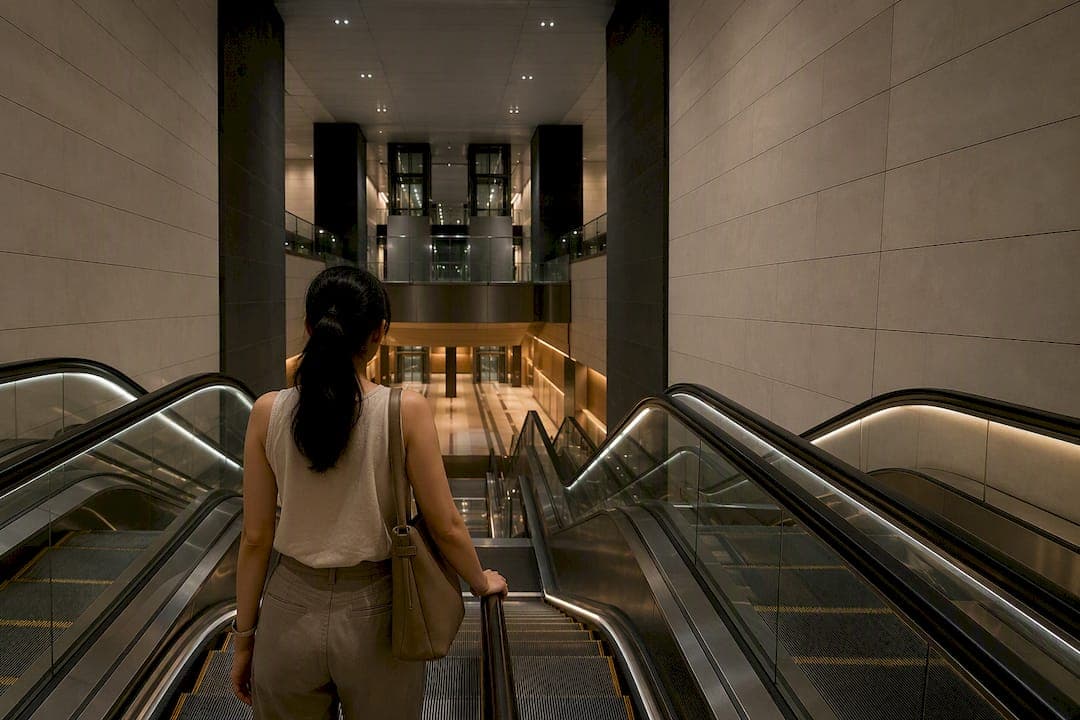
Hougang MRT station will become a two-line interchange when the Cross Island Line opens in 2030, connecting to the existing North East Line. The Land Transport Authority (LTA) awarded the civil contract for design and construction to Samsung C&T Corporation, with work starting in late 2021. For commuters, the upshot is simple: fewer transfers and more direct routes across the eastern and north-eastern parts of Singapore.
TL;DR:
- The Hougang interchange station will sit around 45 meters underground, making it one of the deeper stations in Singapore's network, requiring longer vertical journeys.
- Construction began in late 2021 and is scheduled to be completed by 2030, with Samsung C&T Corporation handling the design and build.
- Passengers will benefit from inside-station transfers, reducing travel times for key routes across the eastern and north-eastern corridors of Singapore.
- The station will have multiple exits linking directly to the bus interchange and Hougang Avenue, with minimal disruption to existing train services during construction.
- Future phases of the Cross Island Line are planned to extend westward, maintaining Hougang's importance as a permanent two-line interchange.
Table of Contents
- What Is the Cross Island Line Hougang Interchange?
- When Will Construction Finish and Who Is Building It?
- How Deep Is the Station and How Many Exits Will It Have?
- Which Neighborhoods Gain the Most From CRL1?
- What Disruptions Should Hougang Residents Expect?
- How Will the Interchange Reshape Hougang's Property Market?
- What Accessibility Features Will the Hougang CRL Station Have?
- What Safety Measures Apply at a Two-Line Interchange?
- Will Hougang Station Expand Further After 2030?
- How Will Buses and Taxis Connect at Hougang Station?
- What Happens to Traffic and Parking During Construction?
- Why This Interchange Actually Matters for Daily Commuters
- Looking for a Home Right Above the Interchange?
- Sources
- FAQ
What Is the Cross Island Line Hougang Interchange?
Hougang MRT station (NE14) already sits on the North East Line, but once the Cross Island Line opens it will carry a second code, CR8, marking its new role as a full interchange. That dual identity puts Hougang in a small club of stations built to handle two lines under one roof, rather than bolted on as an afterthought.
Hougang falls under Cross Island Line Phase 1 (CRL1), the first operational segment of a line designed to eventually stretch across the island without passing through the city center. CRL1 links stations running through the eastern and north-eastern corridors, and Hougang acts as one of the connection points where NEL riders can switch onto the new line without leaving the building.
What changes in practice:
- A commute from Punggol to Pasir Ris that once meant a transfer at Serangoon or a bus ride becomes a straighter shot through Hougang.
- Residents in Hougang Central heading toward Loyang or the eastern industrial belt gain a route that skips the current detour through the city.
- Cross-line transfers happen inside the same station complex instead of requiring an exit and re-entry.
None of this requires understanding tunnel boring or signal systems. It just means one more line meets you where you already are.
When Will Construction Finish and Who Is Building It?
LTA awarded the civil contract for the Hougang interchange station and its tunnels to Samsung C&T Corporation, confirmed in a March 2021 news release. The contract covers design and construction work valued at several hundred million Singapore dollars, one of the larger packages awarded under CRL1, which comprises 12 stations in total.
Key milestones so far:
- Contract awarded: March 2021, to Samsung C&T Corporation.
- Construction start: Q4 2021.
- Scheduled passenger service: 2030.
- Scope: new interchange station and tunnels, plus additions and alterations to the existing operational NEL station.
That last point matters more than it sounds. Building a new station is one job. Building it while the old one keeps running trains every few minutes, without shutting down Hougang's NEL service, is a different kind of engineering problem entirely. LTA's contract explicitly folds in the work needed to modify the existing structure while minimizing disruptions to the line commuters depend on.
How Deep Is the Station and How Many Exits Will It Have?
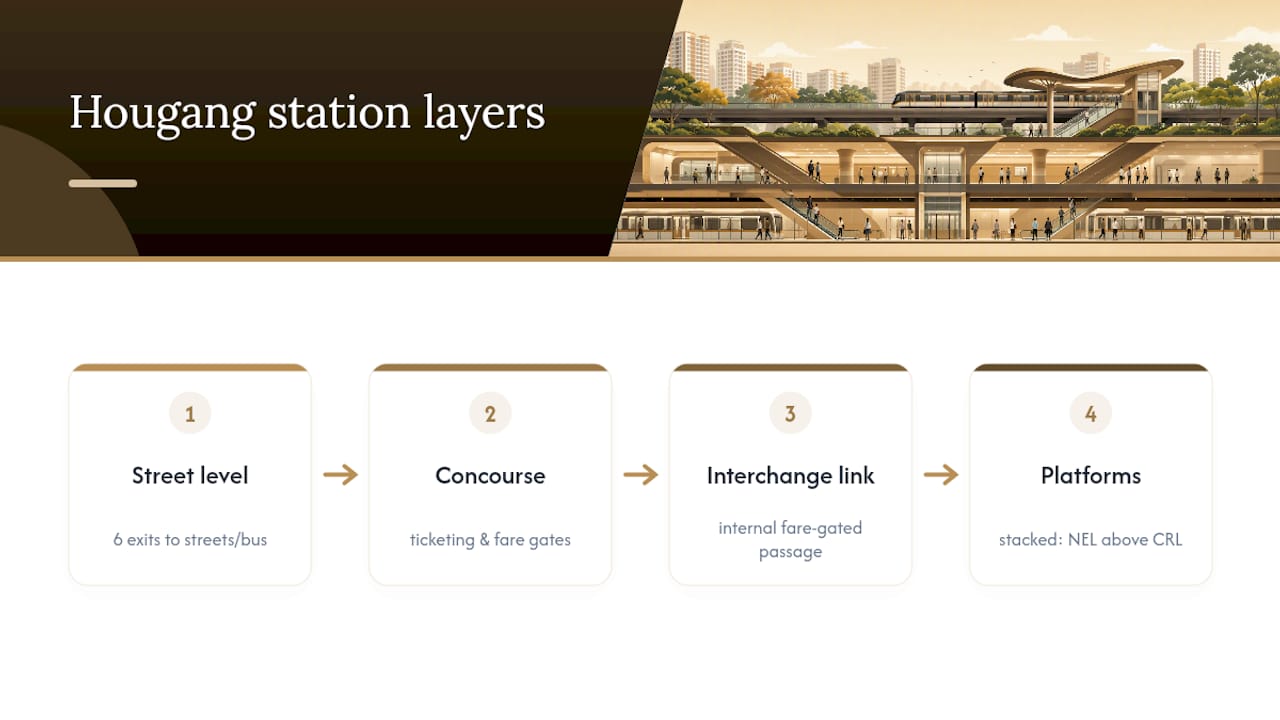
Hougang's interchange station will sit around 45 meters below ground, according to published station details, making it one of the deeper stations in the network. A station that deep needs more than a single staircase down. Expect a layered structure: upper concourse levels handling ticketing, fare gates, and pedestrian flow, with platform levels stacked further below to keep the two lines separated but connected.
Deeper stations mean longer vertical journeys. That's simply physics, not a design flaw. Riders should budget a little more time for lifts and escalators than they would at a shallower station like a surface-level NEL stop.
The station will have multiple exits, combining the existing ones with new additions for the interchange. Reporting on the project's station renders, including coverage from Mothership, points to new exits linking directly toward the bus interchange and Hougang Avenue, tightening the walk between bus, train, and street level.
The interchange link itself, the underground passage connecting NEL platforms to CRL platforms, is built to keep cross-line transfers inside fare gates. You won't need to tap out, walk outside, and tap back in just to switch lines.
Which Neighborhoods Gain the Most From CRL1?
Cross Island Line Phase 1 threads through some of the busiest residential and industrial corridors in the east and north-east: Loyang, Tampines, Pasir Ris, Defu, Serangoon North, and Ang Mo Kio. Hougang sits at a useful midpoint in that chain, giving residents a shortcut into corridors that currently require a transfer through the city centre or a longer bus connection.
By the numbers: LTA states that CRL1 will benefit more than 100,000 households across the corridors it serves, a scale that reflects how much commuter load currently funnels through a handful of interchange stations like Serangoon and Bishan.
Spreading that load across more direct routes doesn't just save individual commute minutes. It takes pressure off North East Line and Circle Line interchanges that have carried disproportionate transfer traffic for years, particularly during peak hours when Hougang, Serangoon, and Bishan riders converge on the same platforms.
What Disruptions Should Hougang Residents Expect?
Deep-station construction next to an operating rail line is noisy and slow by design. Expect the usual list: drilling and excavation noise during permitted hours, dust around active work zones, temporary fencing that reroutes pedestrian paths, and periodic shifts to bus interchange boarding points as contractors work in stages.
LTA's contract structure keeps the existing NEL station running throughout, which means work happens in phases rather than all at once. That's slower for the project timeline but far less disruptive than a full station closure would be.
- Watch for temporary walkway diversions near active construction fencing.
- Expect occasional adjustments to bus berth locations at the interchange.
- Noise and dust controls typically follow standard permitted working hours, with heavier works scheduled outside peak commuter windows where possible.
For anything specific to your daily route, LTA's project updates are the most reliable source, not word of mouth from neighbors.
Pro Tip: Screenshot the current bus interchange layout on your phone. When temporary signage goes up during phased works, having a mental map of the "before" state makes it much faster to spot what's changed and find your new boarding point.
How Will the Interchange Reshape Hougang's Property Market?
Interchange stations tend to anchor redevelopment around them, and Hougang is no exception. Plans for the area point toward an integrated transport hub that ties the new CRL station directly into retail and bus interchange facilities, following a pattern already familiar from other Singapore interchange nodes.
Direct interchange access historically shows up in how buyers and tenants value nearby homes, since a two-line station cuts both commute time and commute uncertainty. That's the logic behind projects like Hougang Central Residences, an integrated development positioned above the Hougang MRT station itself. The project spans 835 units, ranging from one-bedroom-plus-study layouts up to five-bedroom penthouses, and is built with smart-home systems integrated throughout.
For buyers weighing how much interchange access is actually worth, it helps to look at how connectivity gets evaluated before comparing specific units or floor plans.
What Accessibility Features Will the Hougang CRL Station Have?
Singapore's rail network has standardized a core set of accessibility features across MRT stations, and a deep interchange like Hougang's CRL platform is no exception. Expect step-free paths from street level to platform, meaning lifts serving every concourse and platform level rather than relying solely on escalators.
Given the station's roughly 45-meter depth, vertical accessibility carries more weight here than at a shallow surface station. Multiple lifts connecting concourse levels to platform levels reduce the walking distance wheelchair users, parents with strollers, and elderly commuters face compared to a single central lift serving the whole depth.
Tactile guidance strips typically run from station entrances through fare gates to platform edges, helping visually impaired commuters navigate without needing to memorize a new layout from scratch. Wide fare gates sized for wheelchairs and mobility devices are standard at interchange stations, usually positioned near staff-assisted counters rather than tucked at the end of a gate row.
Priority boarding zones marked on platform flooring line up with train doors, a detail that matters more at an interchange where platform crowding during transfer waves can make boarding harder for anyone who needs extra time or space.
Because Hougang's design links two separate lines through an interchange corridor, that connecting passage is built with the same step-free standard as the rest of the station, so a transfer between NEL and CRL platforms shouldn't require detouring to find a lift.
What Safety Measures Apply at a Two-Line Interchange?
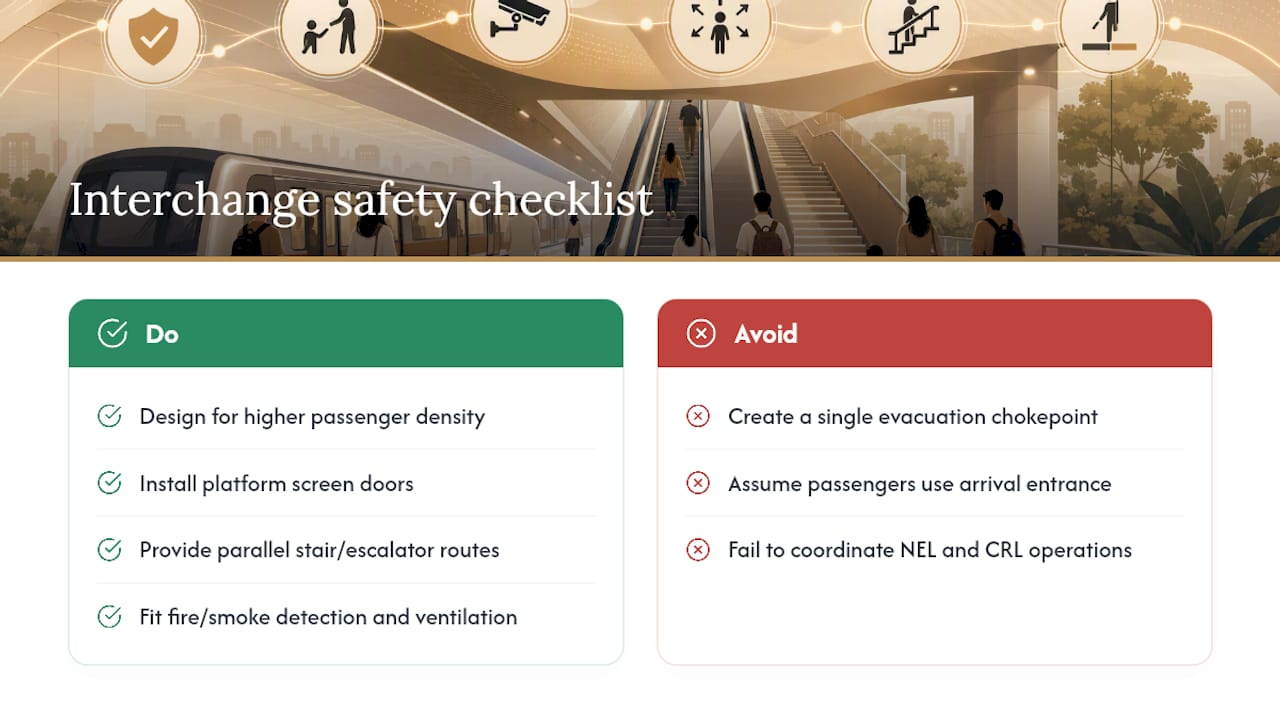
Interchange stations carry more foot traffic at pinch points, particularly around transfer corridors and escalator banks during peak hours, so safety planning accounts for higher passenger density than a single-line station would see.
Standard MRT safety infrastructure applies throughout: platform screen doors separating commuters from the track, emergency stop plungers positioned along platforms, and station staff trained in evacuation procedures specific to multi-level layouts. At a station roughly 45 meters deep, evacuation planning has to account for longer vertical distances to street level, which typically means multiple stairwell and escalator routes are designed as parallel evacuation paths rather than a single chokepoint.
Fire and smoke detection systems, along with ventilation designed to manage smoke movement in underground environments, are baseline requirements for deep stations under Singapore's building and rail safety codes. Emergency lighting and directional signage guide commuters toward the nearest exit rather than assuming everyone will head for the entrance they arrived through, which matters at a station with six exits spread across different sides of the complex.
Because Hougang's interchange link connects two lines that will likely run on independent signaling and operational systems, station staff and control room coordination between NEL and CRL operations will matter during any incident response, ensuring one line's disruption doesn't create confusion for passengers trying to evacuate through a shared concourse.
Will Hougang Station Expand Further After 2030?
Cross Island Line Phase 1 is just the opening chapter. LTA's broader CRL program includes additional phases extending the line further west, and national reporting has already detailed plans for four new stations linking Taman Jurong and western industrial estates as part of later phases through the late 2030s.
Hougang itself isn't slated for structural changes once CRL1 opens. It's built from the start as a permanent two-line interchange, not a temporary terminus awaiting a future upgrade. What does change is the value of that interchange status as later phases connect further west, since Hougang commuters gain access to a growing network rather than a single isolated extension.
That's worth keeping in mind if you're evaluating the station's long-term relevance. A station that's merely a branch endpoint loses value if plans shift. An interchange sitting on a line built to eventually span the island keeps its relevance regardless of how later phases unfold.
How Will Buses and Taxis Connect at Hougang Station?
The Hougang bus interchange already sits adjacent to the MRT station, and CRL construction is designed to tighten that connection rather than separate it further. New exits planned for the CRL interchange point toward the bus interchange directly, cutting the walk between train platform and bus berth compared to routes that currently require crossing outdoor plazas or road crossings.
Taxi and private-hire pickup points typically get positioned near major exits at interchange stations, following the pattern seen at other multi-line stations across the network. Given Hougang's six total exits, expect designated pickup and drop-off zones distributed across more than one side of the station rather than concentrated at a single point, reducing congestion at any one curb during peak hours.
For commuters combining last-mile options, that means a shorter transfer chain: train to bus, or train to taxi, without the outdoor walk that currently adds a few minutes to trips through Hougang Central. It's a small detail, but for anyone doing that transfer twice a day, five minutes saved each way adds up to real time back in a commuter's week.
What Happens to Traffic and Parking During Construction?
Construction zones around an active bus interchange and rail station inevitably squeeze road space nearby. Expect temporary lane closures on roads bordering the construction perimeter, particularly during excavation phases when heavy equipment needs street-level access to move materials underground.
Parking near Hougang Central typically tightens during major works, as contractors often need to use existing surface parking or roadside space for site facilities and material staging. Residents and shoppers relying on nearby parking should expect reduced availability at points during the construction period, with LTA and the contractor generally providing advance notice before major changes take effect.
Once construction wraps and the station opens in 2030, traffic patterns around Hougang Central should ease compared to the construction period, though the area will likely see a permanent increase in pedestrian and vehicle drop-off activity given the added ridership an interchange typically draws. That's a trade worth weighing if you're deciding whether to live nearby now or after the interchange opens. For anyone specifically weighing property near ongoing works, it's worth reviewing what to check before buying near a bus interchange before making that call.
Why This Interchange Actually Matters for Daily Commuters
The honest trade-off is this: construction inconvenience now for a genuinely shorter commute later. Six years is a long wait, and detours around fencing get old fast. But an interchange that removes a transfer point permanently changes your daily math, not just for one trip but for every trip you take through Hougang for as long as you live there. If you're weighing whether to buy near the station now, it's worth looking at how commuters currently use Hougang's MRT amenities to judge what 2030 actually adds.
— Simon
Looking for a Home Right Above the Interchange?
Most buyers weighing Hougang right now are choosing between waiting out the construction from a distance or living close enough to feel the payoff the moment CRL service starts. Hougang Central Residences sits directly above Hougang MRT station, meaning residents get the interchange at their doorstep rather than a bus ride away once it opens.
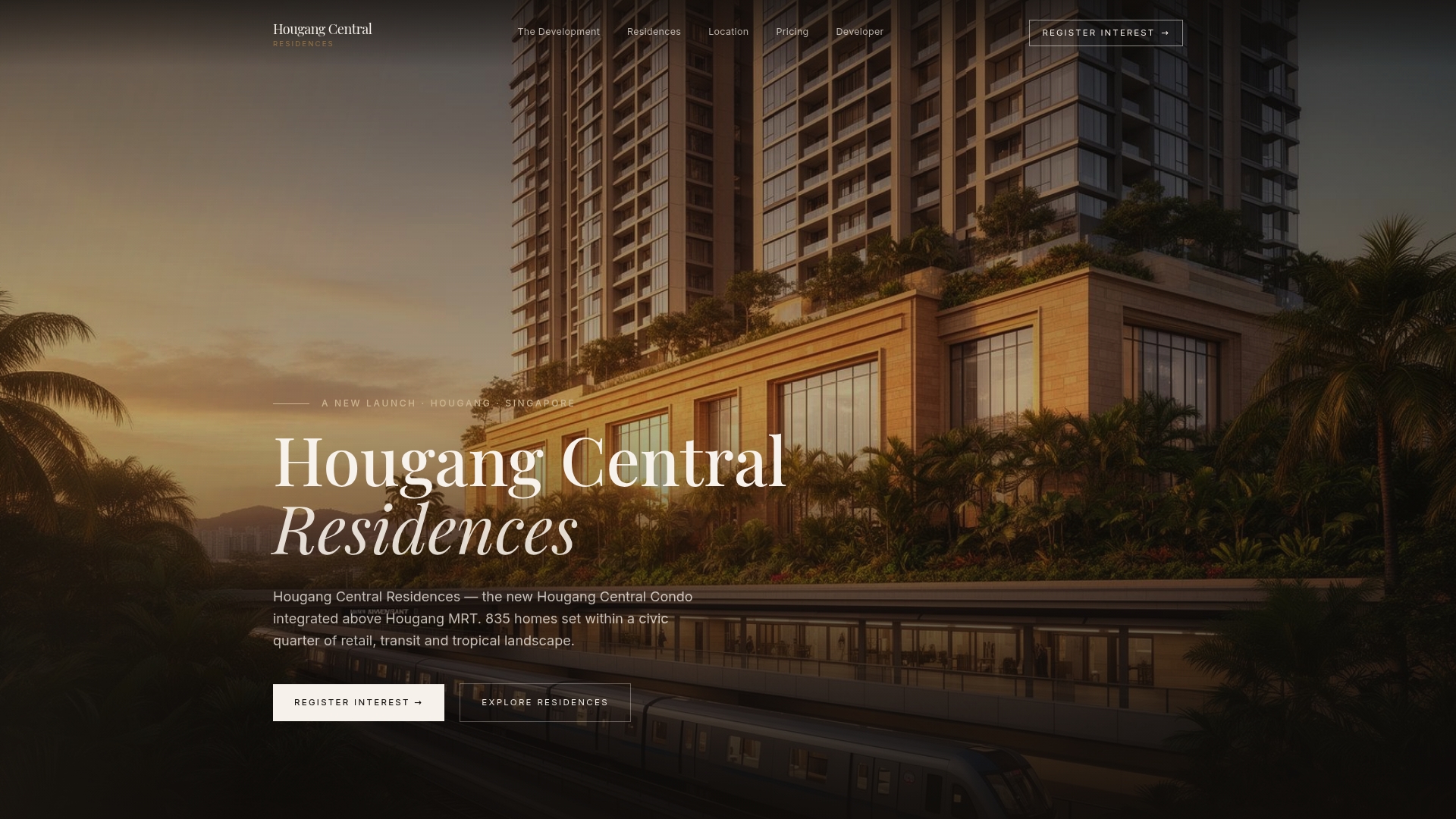
The development features a range of residential units in a setting connected to retail and transport facilities. For residents, that means groceries, transit, and daily errands all sit within the same complex, without stepping outside into construction dust or waiting on a connecting bus. Pricing at Hougang Central Residences starts from $2,800 SGD per square foot, and current unit layouts across all seven bedroom types are listed on the residences page. If direct interchange access matters to how you commute, checking availability now is worth the ten minutes it takes.
Sources
- LTA | LTA Awards Civil Contract for Design and Construction of Hougang Interchange Station and Tunnels for the Cross Island Line Phase 1
- Hougang MRT station — Wikipedia
- Cross Island Line to get 4 new stations linking Taman Jurong and western industrial estates by late 2030s - CNA
FAQ
Where Is Hougang Station Located on the Cross Island Line?
Hougang station sits within Cross Island Line Phase 1 (CRL1), functioning as an interchange with the existing North East Line. It will carry the station code CR8 on the Cross Island Line alongside its current NEL code, NE14.
What Stations Are Included in the Cross Island Line?
CRL1 comprises 12 stations running through eastern and north-eastern corridors including Hougang, with later phases planned to extend the line further west, adding stations linking toward Taman Jurong and western industrial estates.
What Are the Latest Updates on the Cross Island Line?
Construction on the Hougang interchange began in Q4 2021 after LTA awarded the civil contract to Samsung C&T Corporation, with passenger service scheduled for 2030. Later CRL phases, including new stations near Taman Jurong, are planned through the late 2030s.
Is There a New MRT Station at Hougang?
Hougang's existing NEL station is being expanded into a two-line interchange rather than replaced. The new Cross Island Line platforms and interchange link sit roughly 45 meters underground, with six total exits once construction finishes.