
For most HDB owners past their Minimum Occupation Period, sell-first is the safest upgrader path because it avoids Additional Buyer's Stamp Duty entirely and gives you a clear read on your real budget before you sign anything. Buy-first only makes sense if your flat is genuinely easy to sell and you can park a significant amount in cash to cover Additional Buyer's Stamp Duty (ABSD) until you get it refunded. New-launch condos on the Progressive Payment Scheme sit in between: you spread out payments until Temporary Occupation Permit (TOP), which buys you time to sell your flat closer to the finish line instead of racing the clock.
Before you do anything else, run three checks this week. First, confirm your exact Minimum Occupation Period (MOP) date with HDB, because it's calculated from key collection for a BTO flat or from your completion date for a resale purchase, and getting this wrong derails everything downstream. Second, sketch a rough cash buffer: booking deposit, Buyer's Stamp Duty (BSD), ABSD if you're buying before selling, and legal fees. Third, call a banker for an In-Principle Approval (IPA) so you know your real borrowing power before you fall in love with a showflat.
- Confirm MOP with HDB's e-service or your resale/BTO agreement.
- Estimate your cash buffer (most upgraders need $100,000 to $300,000 beyond CPF, according to one upgrader cashflow guide).
- Get an IPA from at least one bank before committing to a purchase.
Pro Tip: Ask your banker to run your TDSR with your existing HDB loan still active, not just your projected new loan. That's the number that actually breaks upgrader plans.
Key Takeaways
Sell-first minimizes ABSD and TDSR risk for most upgraders, while a Progressive Payment Scheme purchase lets you defer cash outflows and sell your HDB flat closer to TOP.
| Point | Details |
|---|---|
| Confirm MOP first | Verify your exact MOP date with HDB before making any purchase commitment. |
| CPF refund isn't cash | Principal plus accrued interest returns to your CPF OA, not your bank account. |
| ABSD window is six months | Married couples buying before selling must dispose of their HDB flat within six months of completion or TOP to claim remission. |
| TDSR breaks overlapping loans | Redeeming your HDB loan before applying for a new mortgage removes it from the 55% TDSR ceiling. |
| PPS eases cash timing | Hougang Central Residences' progressive payment structure lets upgraders sell their HDB flat closer to TOP instead of funding a lump sum upfront. |
Where to Verify the Rules Yourself
- HDB's conditions-after-purchase page confirms your exact MOP date and what happens if you sell early.
- IRAS's ABSD remission page lays out the married-couple remission conditions and filing process in full.
- MAS's TDSR and MSR explainer details the stress-test mechanics banks use to assess your loan eligibility.
- CPF's home ownership guidance explains how CPF savings and accrued interest refunds work for property transactions.
- For a deeper look at how progressive payment schedules work on new launches, or how ABSD rules apply to condo purchases, the linked guides walk through the mechanics step by step.
Table of Contents
- How Do You Calculate Your True HDB Sale Proceeds?
- What Is the ABSD Remission Window for Married Couples?
- What Loan Rules Do Upgraders Need to Clear?
- Should You Choose a New Launch or a Resale Condo?
- What Are the 9 Steps From MOP to ABSD Refund?
- An Example: Timing a PPS Purchase Around Your HDB Sale
- Sources
- FAQ
How Do You Calculate Your True HDB Sale Proceeds?
The number on your HDB resale contract is not the cash you get to keep. Between the sale price and what actually lands in your bank account, three things take a bite: your outstanding HDB loan balance, agent and legal fees, and the CPF refund, which includes both the principal you withdrew and the accrued interest that's been quietly compounding since your first CPF withdrawal.
That last part trips up more upgraders than any other line item. CPF rules require you to refund the CPF you used plus the interest it would have earned had it stayed in your Ordinary Account, at the OA rate, currently 2.5%. If you bought your flat 15 or 20 years ago, that accrued interest can run into tens of thousands of dollars, and it goes back into your CPF OA, not your bank account. It's still your money, but it's not spendable cash for a new down payment unless you're using it to pay for the next property's CPF-eligible components.
Here's how the math actually works, step by step:
- Start with your agreed HDB sale price.
- Subtract your outstanding HDB mortgage loan balance in full.
- Subtract agent commission (typically 1% to 2% of sale price) and legal conveyancing fees.
- Subtract your CPF refund: the principal you withdrew plus accrued interest, which returns to your CPF OA.
- What remains is your cash proceeds, deposited directly to your bank account.
Two worked examples make this concrete.
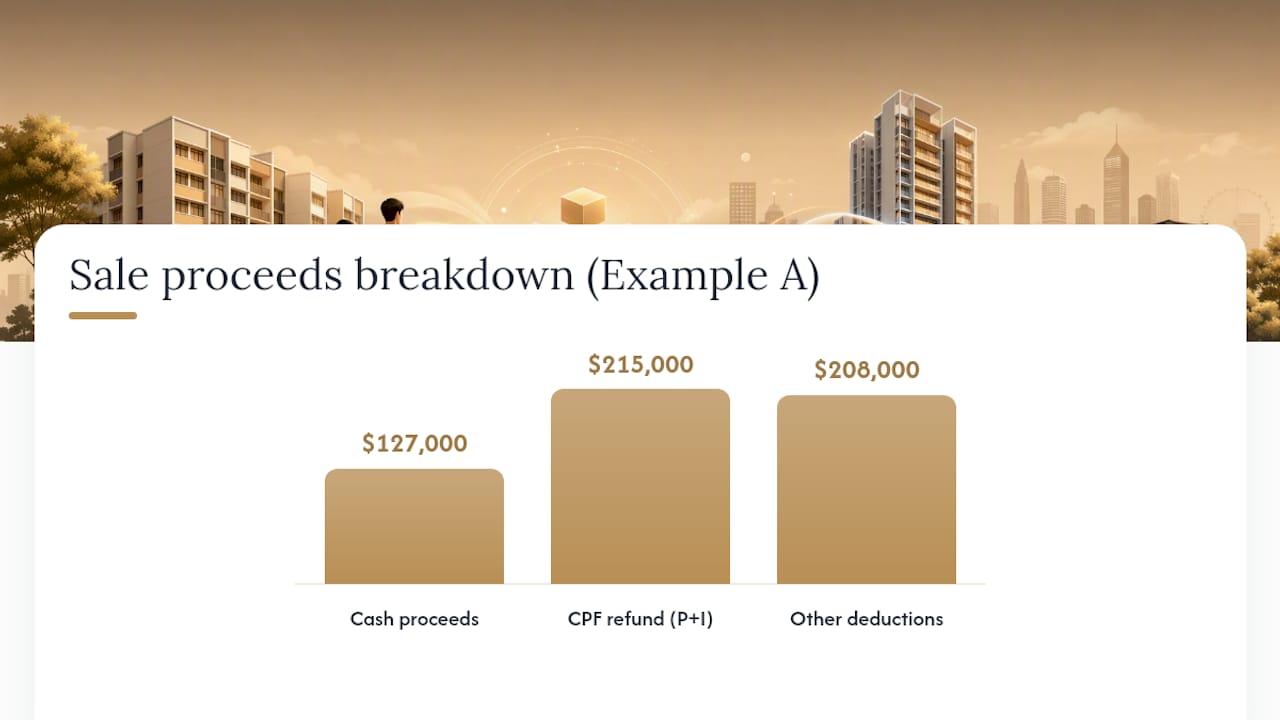
Example A: A $550,000 four-room resale flat. Say you have $200,000 left on your HDB loan and you withdrew $180,000 in CPF over the years, with $35,000 in accrued interest. After the loan redemption ($200,000), agent and legal fees (roughly $8,000), and the CPF refund ($215,000 including interest), you're left with about $127,000 in cash, plus $215,000 sitting back in your CPF OA that you can redeploy toward your next property's CPF-eligible costs.
Example B: An $850,000 five-room resale flat in a mature estate. With $150,000 remaining on the loan, $300,000 in CPF principal withdrawn, and $60,000 in accrued interest, your deductions total roughly $520,000. That leaves close to $330,000 in cash, on top of $360,000 refunded to CPF OA.
Notice the pattern: higher-value flats often generate more cash and a bigger CPF refund, because you've usually paid down more loan and accumulated more interest. That CPF refund matters enormously for your next purchase, since CPF can cover a real share of the down payment and monthly installments on a condo, subject to the CPF withdrawal limits tied to your property's valuation.
Before you model your own numbers, gather three documents: your latest HDB loan statement showing the exact redemption figure, your CPF transaction history (available through the CPF website) showing total withdrawals to date, and a recent HDB resale valuation or comparable transaction data for your block. Without these three, any cash buffer estimate you build is a guess dressed up as a plan.
What Is the ABSD Remission Window for Married Couples?
If you're buying your condo before selling your flat, ABSD is the single biggest number in your entire upgrade math, and misunderstanding the remission rules is the most expensive mistake an upgrader can make.
Here's the mechanic: a married couple buying a second residential property while still owning their HDB flat pays ABSD upfront at the point of purchase, currently a substantial percentage of the property price for Singapore citizens buying a second home. IRAS grants remission of that ABSD, refunded after the fact, on two conditions: the couple must hold the new property jointly, and they must sell their HDB flat within six months of whichever comes later, the new property's completion date or, for a new launch, its TOP.
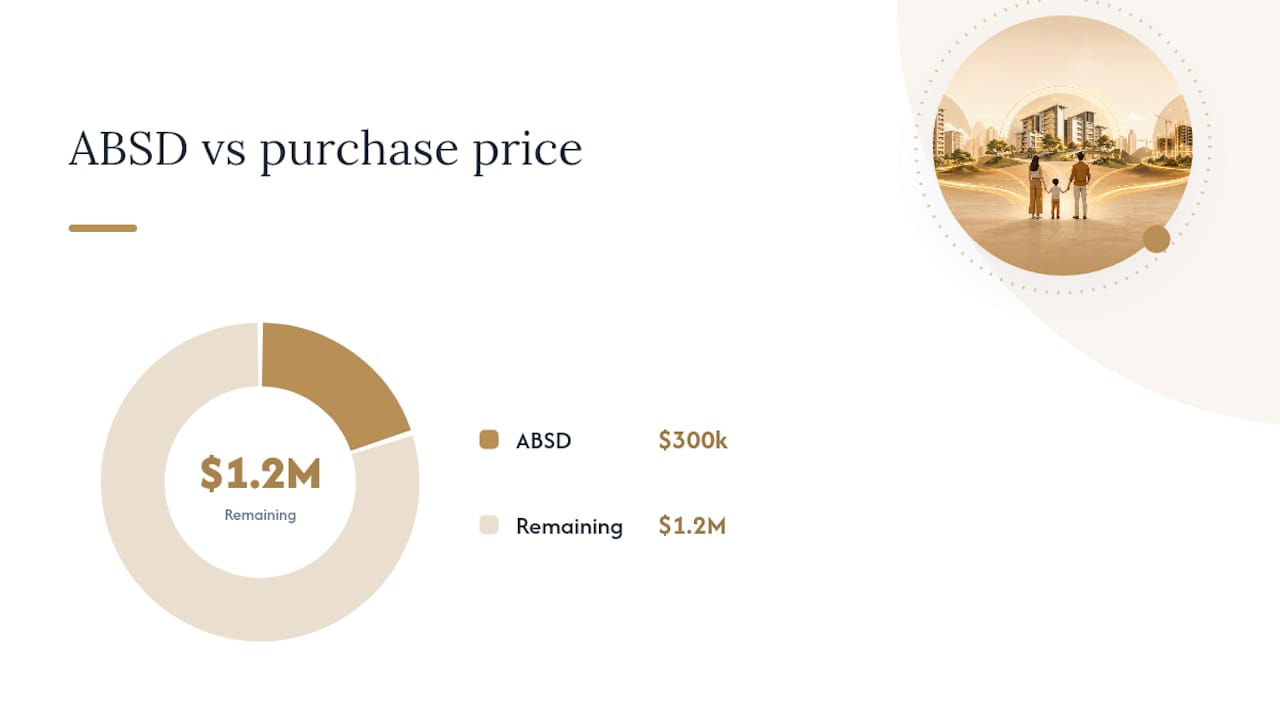
Run the numbers on a real scenario. On a $1,500,000 condo, ABSD at the applicable married-couple rate can mean roughly $300,000 tied up in cash or CPF at the point of purchase, money you won't see again until IRAS processes your remission claim after you've sold your HDB flat within the window. That's not a small bridge to fund. It's the size of a second down payment sitting idle for months, and it's exactly why buy-first only works for owners with either a highly liquid flat or a substantial cash reserve sitting outside their CPF.
A few mistakes show up again and again in upgrader cases:
- Buying the new property under one spouse's name only, which disqualifies the couple from the married-couple remission entirely.
- Underestimating how long a resale flat actually takes to sell in a softer market, then missing the six-month disposal deadline and forfeiting the remission.
- Assuming the remission is automatic. It isn't. You must file the application and provide proof of the HDB sale within the stipulated timeline.
- Forgetting that the six-month clock starts from completion or TOP, not from your purchase date, which can quietly compress your actual selling window if construction runs long.
Buy-first is justified when your flat sits in a location with consistently fast resale turnover and clean title, or when you have enough liquid cash to absorb the ABSD outlay without touching your emergency reserves or your children's education fund. If neither applies, sell-first removes this entire risk category from your plan, at the cost of a temporary rental period between selling and moving into your new home.
What Loan Rules Do Upgraders Need to Clear?
Financing is where upgrader plans quietly die, usually because owners assume their income alone determines what they can borrow, when in reality the Total Debt Servicing Ratio does the real gatekeeping.
MAS caps TDSR at 55% of your gross monthly income across all debt obligations, and crucially, it stress-tests every mortgage at a minimum interest rate floor of 4%, regardless of what rate your bank actually offers you. If you still hold your HDB mortgage when you apply for a condo loan, both mortgages count toward that 55% ceiling during the assessment.
MAS also caps Loan-to-Value ratios based on the number of outstanding housing loans you carry and your loan tenure relative to your age. If you're carrying your HDB loan into the new purchase, expect a lower LTV tier than a first-time buyer, which means a bigger down payment in cash and CPF.
Three remedies work in practice:
- Redeem your HDB loan before applying for the new mortgage, which removes it from the TDSR calculation entirely. This is the cleanest fix and the main argument for sell-first.
- Increase your cash down payment to shrink the loan quantum you need, which lowers the monthly installment counted against TDSR.
- Use a bridging loan to cover the gap between your new property's down payment and your HDB sale proceeds landing in your account. Bridging loans typically run for a matter of months at a higher interest rate than a standard mortgage, but they're often cheaper than the alternative of forfeiting an ABSD remission because your sale timeline slipped.
Before you talk numbers with anyone else, get an IPA from at least one bank, and bring these documents to that conversation: your last three months of payslips or two years of income tax statements if you're self-employed, your CPF statement showing OA balance and contribution history, your outstanding HDB loan statement, and an HDB valuation estimate or recent comparable transaction for your unit. A banker running your IPA with incomplete documents will give you an optimistic number that falls apart at the formal application stage, which is worse than no number at all.
Should You Choose a New Launch or a Resale Condo?
The choice between a new launch and a resale condo isn't really about taste in finishes. It's about when you need the cash and when you need the keys, and those two questions pull in opposite directions.
A new launch on the Progressive Payment Scheme spreads your payment across construction milestones, typically starting with 5% on booking and 15% on signing the Sale and Purchase Agreement, with the bulk of the remaining payments due as foundation, structural, and finishing work complete over two to four years. That structure is the entire appeal for an upgrader: you're not required to find a lump sum of cash on day one, which means you can stay in your HDB flat, collect rent-free housing, and sell it closer to the project's TOP instead of under immediate pressure.
A resale condo flips that trade-off. You get immediate move-in and a much shorter completion timeline, often within eight to ten weeks of exercising the Option to Purchase, but you need your full down payment, BSD, and (if buying before selling) ABSD ready at completion, not spread over years.
- If your HDB flat is highly saleable (good location, popular flat type, minimal outstanding issues), a resale condo purchased after your sale completes is generally straightforward.
- If you need more runway to sell your flat without renting a transition unit, a new launch on PPS lets you time your HDB sale to land closer to TOP.
- If you're renovating extensively, factor in that a new launch typically comes with fewer immediate renovation needs since fittings are new, while a resale unit may need work before you move in.
- Match the route to your cash buffer: thin buffer favors PPS; healthy buffer with a fast-selling flat opens up resale.
What Are the 9 Steps From MOP to ABSD Refund?
An upgrade that goes smoothly follows a sequence, not a scramble. Here's the order that keeps cash, CPF, and paperwork aligned.
- Confirm MOP date with HDB and pull your CPF transaction history. (Week 0)
- Get an IPA from your bank based on projected sale proceeds and current income. (Week 1 to 2)
- Engage an agent to value and market your HDB flat, or start browsing new launches if going the PPS route. (Week 2 to 4)
- List and market your flat, or exercise the Option to Purchase on your new unit if buying first. (Week 3 onward, timeline varies)
- Receive and accept an offer on your flat, then sign the Option to Purchase with your buyer. (Varies by market conditions)
- Exercise your own purchase Option on the new condo, paying the initial deposit. (Within 3 weeks of receiving the Option typically)
- Coordinate completion dates between your HDB sale and your new purchase with your lawyer, aiming for minimal or no overlap period. (2 to 3 months before completion)
- Complete both transactions, redeem your HDB loan, and refund CPF principal plus accrued interest. (Completion day)
- File your ABSD remission claim with IRAS if you bought before selling, providing proof of your HDB disposal within the six-month window. (Immediately after HDB sale completes)
If your HDB sale is dragging past the four-month mark and you bought before selling, contact your lawyer immediately to review your options against the six-month IRAS deadline. Ask your banker whether a short-term bridging facility can cover a delay without forcing a fire-sale price on your flat. Ask your agent for a frank read on whether your asking price is out of step with recent comparable transactions in your block.
An Example: Timing a PPS Purchase Around Your HDB Sale
Consider how this plays out with a project like Hougang Central Residences, situated directly above Hougang MRT station with integrated retail and a bus interchange below. An upgrader here on the Progressive Payment Scheme wouldn't need the bulk of their purchase price until structural and finishing stages complete, typically over a couple of years after booking, which means the HDB flat can stay occupied and generate no rental gap while the sale is timed for closer to TOP.
- Transit-integrated living removes the "which condo is near an MRT" search entirely, useful if your current flat's main selling point was also transit proximity.
- Unit mix from one-bedroom-plus-study through five-bedroom penthouses fits both downsizing retirees and growing families in the same building.
- PPS structure means the largest cash calls line up naturally with the point where most upgraders have already sold and banked their HDB proceeds.
The core value of a PPS purchase for an upgrader isn't the discount or the design. It's that the payment schedule and your HDB sale timeline can be made to move together instead of racing each other.
This is one illustrative scenario, not a financial projection for your specific situation. Run your own cash buffer numbers and speak with a banker and a property lawyer before committing to any purchase, new launch or resale.
A Few Honest Cautions From Watching Upgraders Get This Wrong
My rule of thumb: default to sell-first unless your flat has genuinely strong saleability or you're sitting on enough cash to absorb ABSD without touching savings you'll need elsewhere. Three patterns keep showing up in upgrader missteps. Buying on emotion after one showflat visit, before checking TDSR. Over-leveraging by assuming rental income or a bonus will cover a shortfall. And forgetting CPF accrued interest, which routinely turns a "we'll have $400,000 in cash" assumption into $280,000.
— Simon
A New-Launch Option Built for the PPS Timeline
Hougang Central Residences sits directly above Hougang MRT, which means the Progressive Payment Scheme timeline can line up with selling your HDB flat closer to TOP instead of scrambling for cash on day one. With unit types from one-bedroom-plus-study to five-bedroom penthouses, it suits both a couple downsizing and a family that's outgrown a four-room flat.
If the sell-first-then-move-into-a-new-launch sequence from this guide fits your situation, the next step is simple: register for the showflat or request the e-brochure to see current pricing, layouts, and payment milestones before you finalize your own upgrade timeline.
Sources
- HDB — Conditions after buying a new flat (MOP guidance)
- IRAS — Remission of ABSD for a married couple
- MAS — MSR and TDSR rules
- CPF — Using your CPF to buy a home
FAQ
Can a 70-Year-Old Buy an HDB Flat?
Yes, age alone doesn't disqualify a buyer from purchasing an HDB flat, though age affects loan tenure and LTV limits if financing is involved, and cash purchases avoid that constraint entirely.
What Is the HDB Main Upgrading Programme?
The Main Upgrading Programme refers to older estate-wide HDB improvement works like lift upgrading and common area enhancements, which is distinct from the upgrader path of selling an HDB flat to buy private property covered in this guide.
How Do You Avoid ABSD When Upgrading?
The most reliable way is to sell your HDB flat before buying your condo, which means ABSD never applies; if you buy first, married couples can claim remission by holding the new property jointly and selling their flat within six months of completion or TOP.
Will HDB Resale Prices Fall in 2026?
No single source can guarantee direction, but resale price trends move with interest rates, supply of upcoming BTO flats, and broader economic conditions, so upgraders should base timing decisions on their own flat's saleability and comparable transactions rather than a market-wide prediction.