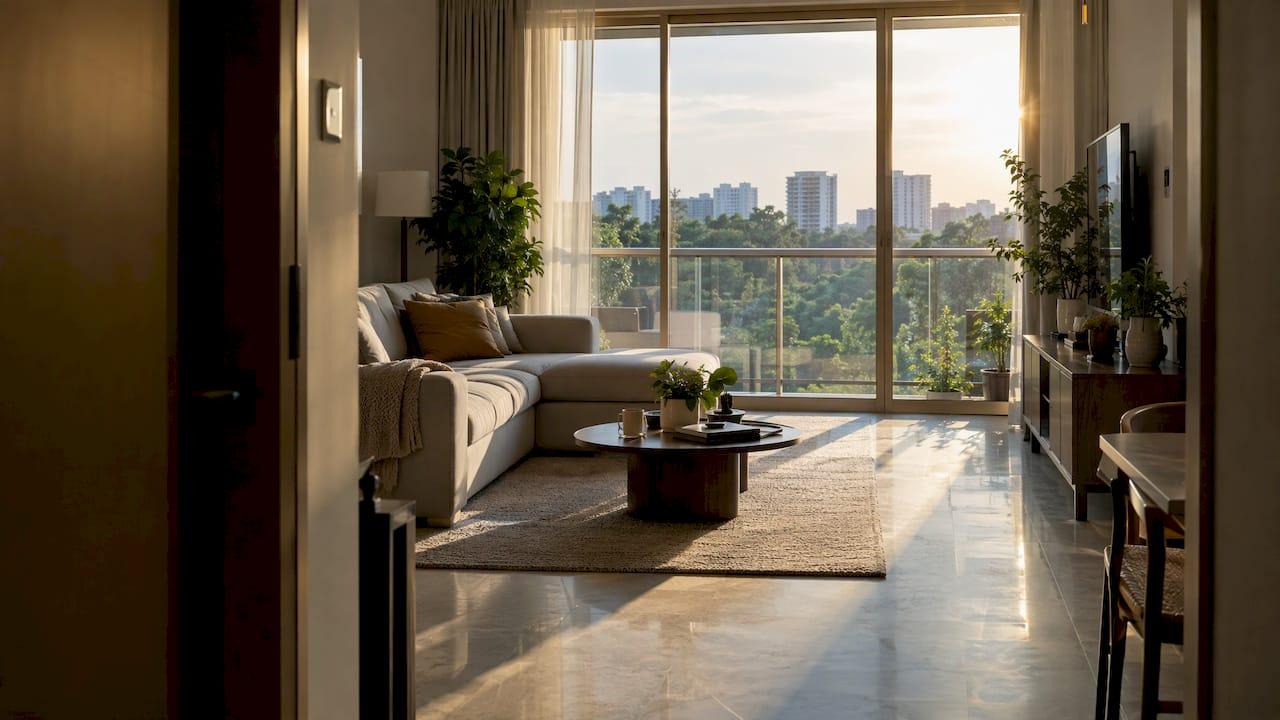
A west sun condo is a unit whose main windows or balcony face the western half of the sky, so direct sunlight pours in from early afternoon until sunset. In Singapore, which sits close to the equator, the sun rises in the east and sets in the west all year round, so a west-facing wall gets afternoon sun every day. That is a fact about orientation, not a verdict on the home. How much it matters depends on which rooms face west, how deep the shade is, whether the unit has cross-ventilation, and how you live. This guide shows you how to read all four before you commit, using the site plan and the floor plan.
TL;DR
- West-facing units get direct sun in the afternoon on essentially every day of the year, because the sun stays close to due east and due west in Singapore.
- A Singapore study of high-density housing found west-facing flats ran hotter and used more electricity than south-facing ones. Good cross-ventilation could offset much of that.
- North- or south-facing units take far less direct afternoon sun than east- or west-facing ones. East-facing units get their sun in the morning.
- Corner units usually offer windows on two sides, which helps airflow. Middle units have fewer exposed walls.
- Check the north arrow on the site plan, then the room layout, the distance to neighbouring blocks and what shades the windows.
Table of Contents
- What "west sun" actually means in Singapore
- When the sun reaches a west-facing unit
- What research says about west-facing flats
- West-facing versus east-facing
- Corner units versus middle units
- How big is the effect on your bills and comfort?
- How to check a unit's real sun exposure before you buy
- Managing west sun if you choose a west-facing unit
- Who should care most about west sun
- Our view: read orientation as one of five factors
- See the layouts for yourself
- FAQ
- Sources
What "west sun" actually means in Singapore
The sun rises in the east and sets in the west everywhere on Earth, but the angle it travels at depends on your latitude. Singapore is about one degree north of the equator. The sun therefore climbs almost straight overhead at midday and shifts only modestly north or south through the year. Near December it sets a little south of due west, and near June a little north of it.
For a buyer, this has two consequences:
- There is no "safe" side during the afternoon except north and south. A wall facing west, south-west or north-west catches the afternoon sun. A wall facing east, north-east or south-east is in the shade by then.
- The seasons do not rescue you. In temperate cities a west window gets weak winter sun. In Singapore the west sun is strong in every month, so you cannot count on a cooler season.
Note also that "west sun" is not the same as "bright". Rooms that face west are often lit well in the evening, which suits some households. The question is the heat and glare that come with it.
When the sun reaches a west-facing unit
Direct sun on a west-facing window typically starts after midday and lasts until sunset at about 7pm. Early in that window the sun is high, and a balcony, an overhang or the building's own ledge can shade the glass. Later the sun drops low and travels nearly horizontally, so it passes under overhangs and reaches deep into the room.
That low-angle period is what people mean when they complain about west sun. It lands on the sofa, the TV, the dining table or the bed in the late afternoon, just when you come home from work or school. Surfaces such as tiles, concrete and furniture absorb that energy and release it as heat into the evening.
What this means in practice:
- A living room facing west is warm and bright when the family gathers after work.
- A bedroom facing west can stay warm into the night, since it keeps releasing the stored heat.
- A home office or study facing west can have screen glare for the last hours of the working day.
- A kitchen or service area facing west matters less for comfort, since you use it briefly.
What research says about west-facing flats
Two academic studies on Singapore housing give a clear picture without relying on opinion.
An empirical study of high-density tropical housing in Singapore, published through the CIB W09 programme, compared flats by orientation. West-facing flats were significantly hotter than south- and south-east-facing flats for both daytime and night-time thermal comfort, and they used significantly more electricity. The same study found that good air circulation, for example windows on two orientations that allow cross-ventilation, could moderate or even outweigh the effect of solar heat gain.
A 2006 simulation by Wang Liping and Nyuk Hien Wong tested façade designs in naturally ventilated Singapore homes. Units facing south or north had a much better indoor thermal environment than east- or west-facing ones, and the authors advised avoiding east and west orientations where thermal comfort and energy use matter. Even a 900mm horizontal shade left thermal comfort in west-facing rooms too low to meet requirements most of the time in May.
Take two lessons from this. First, orientation is a real factor in heat and cooling cost, not a superstition. Second, orientation is not the only factor: airflow can change the result a great deal. A west-facing unit with a through breeze can feel better than a poorly ventilated unit facing a kinder direction.

West-facing versus east-facing
The two sides of the building sound symmetrical, but they behave differently.
| Factor | West-facing | East-facing |
|---|---|---|
| Direct sun | Afternoon to sunset | Morning only |
| Heat on the room | Added on top of the hottest part of the day, and stored through the evening | Gone by the time outdoor temperatures peak |
| Glare | Low sun in the evening on screens and seating | Early morning light in bedrooms |
| Evening mood | Warm light and sunset views | Cooler, shaded evenings |
| Cooling demand | Higher in the evening, when most households are home | Lower in the evening |
An east-facing bedroom wakes you with sunlight but cools off by midday. A west-facing bedroom is warm by the time you go to sleep. That difference in timing is why many Singaporean buyers rank east above west, and north or south above both.
Still, east is not automatically the best choice for everyone. If you are out all day and home only in the evening, the morning sun on an east wall is wasted, while the evening warmth on a west wall is what you notice. The reverse holds for a family with young children or a retiree at home in the afternoon: west sun is felt the most. For more on the choice between those directions, see what Singapore buyers should know about north-south facing condos.
Corner units versus middle units
You may also see "corner unit versus middle unit" and "corner versus corridor unit" on a site plan. These describe the position of the home on the floor, not the compass direction, but position changes how orientation plays out.
Corner units usually have windows on two sides. That gives more natural light and more chances for cross-ventilation, which, as the research above shows, can offset solar heat. A corner that faces both west and north may let you open a window on the shaded side to pull air through while the west glass stays shut or screened. A corner also tends to share fewer walls with neighbours, which helps privacy.

Middle units have neighbours on both sides, so they have only one or two exposed walls. If that wall faces west, the whole home takes the full afternoon load on one side, and ventilation depends on the layout. If the exposed wall faces north or south, the same position is a comfortable one.
Corridor-side versus outer-side. In slab-type blocks, a unit may face out to the view on one side and the common corridor on the other. The corridor side is rarely where the sun is a problem, but it affects privacy and noise. Look at where the bedrooms and living room sit relative to each.
The lesson is not that corners always win. It is that a corner facing west with openings on a second side can be easier to live in than a middle unit whose only windows face west.
How big is the effect on your bills and comfort?
It is hard to give one number, because glass area, shading, floor level and the building around you all change it. The studies cited above show the direction of the effect: more heat, more cooling load, higher electricity use for west-facing units. Because the effect scales with glass area, the main variables you can judge on a plan are:
- Window-to-wall ratio. Large floor-to-ceiling glazing on the west wall brings in the most heat. Smaller or recessed openings bring in less.
- Shading. A deep balcony, an overhang or a screen helps while the sun is high. It helps far less when the sun is low and the light comes in sideways.
- Floor level. Higher floors are less likely to be shaded by neighbouring blocks or trees, and so can get more sun.
- Neighbouring buildings. A block directly to the west, close by, can cut the late sun. A wide open view means sun until sunset.
- Airflow. Windows that open on two sides, or a layout that lets a breeze run through, are the single biggest relief.
How to check a unit's real sun exposure before you buy
A checklist you can run in one visit, with the plans in hand:
- Find the north arrow on the site plan. It tells you which way each block and each stack faces. Our site plan is the place to start for Hougang Central Residences.
- Match the stack to the floor plan. Note which rooms sit on the west-facing edge. A bedroom on the west edge is a different decision from a balcony or a kitchen on it. Browse the floor plans and compare the rooms for each unit type.
- Look at what the window faces. A neighbouring tower, a landscaped area or an open view each changes the sun in the late afternoon.
- Check for cross-ventilation. Can you open windows on two different sides? Is there a layout path for air to travel through the home?
- Visit in the afternoon. If you can, book your viewing for mid-to-late afternoon, so you feel the light and heat yourself rather than imagine them. Showflat conditions differ from a finished unit, so use the plans as the guide to the real orientation.
- Check the layout efficiency. A well-planned layout lets you place the living room, bedrooms and kitchen so the heat-sensitive spaces avoid the worst exposure. Our guide to spotting efficient condo layouts walks through those checks.
Managing west sun if you choose a west-facing unit
Many owners happily live with west-facing homes. These measures are common and work together:
- Layer the shading. Solar-rated or blackout-lined curtains, blinds, or external screens reduce the heat entering the room. The most effective shading stops sunlight outside the glass rather than inside it.
- Use the ventilation. Open windows on the shaded side in the late afternoon and early evening to flush the stored heat out.
- Choose furniture placement with care. Keep fabrics, leather and wood floors out of the direct beam, since long exposure fades colours.
- Cool smartly. Run the air-conditioner on a schedule or by room instead of all day. Our guide to smart aircon control choices covers three ways to cut idle running time.
- Look at the building's design. Singapore's building standards increasingly reward low-energy design, and the idea of Super Low Energy status shows how a building can be planned to limit the energy it needs, including heat through windows.
These measures do not remove the sun. They reduce how much of its heat you have to cool. That is why the choice of unit and the choice of fittings belong in the same conversation.
Who should care most about west sun
| Buyer | What to weigh |
|---|---|
| Young professionals | You are out in the afternoon and home at night, so stored heat in a west-facing bedroom matters more than the sun itself. |
| Families with children | Afternoon heat reaches the living room when children are home from school. Prioritise ventilation and shading. |
| Retirees | You are home during the heat of the day. Favour north or south exposure or a well-shaded, well-ventilated layout. |
| Investors | Tenants and later buyers often ask about orientation, so check the facing and the airflow, not the sunset view alone. |
| Smart-home buyers | Automated cooling and shading schedules can respond to the daily sun pattern. |
Our view: read orientation as one of five factors
We talk to buyers about sun every week, and the best conversations start with the plan, not with a single yes-or-no on "west".
West sun is real in Singapore, and the research agrees that it adds heat and cooling load. But it is one of five things that decide how a home feels: the direction of the wall, the size of the glass, the shading, the airflow and the room that takes the exposure. A buyer who checks all five can choose a unit that suits their day.
That is how we approach Hougang Central Residences. With 835 residences ranging from 1-bedroom plus study to 5-bedroom penthouses, there is a range of layouts to compare, and our smart-home systems and premium European fittings are part of the home you live in every day. We encourage you to look at the site plan, match the stack to the floor plan, and decide which rooms you want facing the afternoon light.
The location matters too. A home above Hougang MRT with direct access to the station and the mall saves hours of commuting in the afternoon sun. For many households, that is a bigger comfort gain than any compass bearing.
Simon
See the layouts for yourself
Hougang Central Residences is a new launch condominium above Hougang MRT, with 835 units, direct MRT access, an integrated retail mall and bus interchange, smart-home systems, premium European fittings and tropical landscaped communal spaces. Pricing starts from S$2,800 per sq ft, and you can see the full detail on our pricing page.
To compare unit types and see which suits your day, browse the residences, study the site plan, or register your interest through our main page for the showflat and e-brochure.
FAQ
Which direction does the afternoon sun come from in Singapore?
The afternoon sun comes from the west. Because Singapore is near the equator, the sun sets close to due west all year, a little south of west around December and a little north of west around June. West, south-west and north-west walls get afternoon sun, while east-facing walls are shaded by then.
Is a west-facing condo bad?
It is hotter in the afternoon and evening than a north- or south-facing one. Research in Singapore found west-facing flats ran hotter and used more electricity than south-facing flats. Good cross-ventilation, shading and a layout that puts the sun on less-used rooms can make a west-facing home very liveable.
Is west-facing or east-facing better?
For heat, east-facing is usually more comfortable, since its sun arrives in the morning and is gone before the hottest hours. West-facing gives warm evening light and sunset views, but also more evening heat. Your daily routine decides which suits you.
Is a corner unit better than a middle unit?
A corner unit usually has windows on two sides, so it gets more light and can use cross-ventilation to offset solar heat. A middle unit has fewer exposed walls but may rely on a single direction. The compass direction of each exposed wall matters as much as the position.
How do I check which way a unit faces?
Find the north arrow on the site plan, then match the stack to its floor plan and see which rooms sit on the west edge. Then visit in the afternoon to feel the light yourself. Our site plan and floor plans are the places to start.
Sources
- Urban Geometry, Indoor Thermal Comfort and Cooling Load: An empirical study of high-density tropical housing in Singapore (CIB W09)
- The impact of façade designs: orientations, window to wall ratios and shading devices on indoor environment for naturally ventilated residential buildings in Singapore