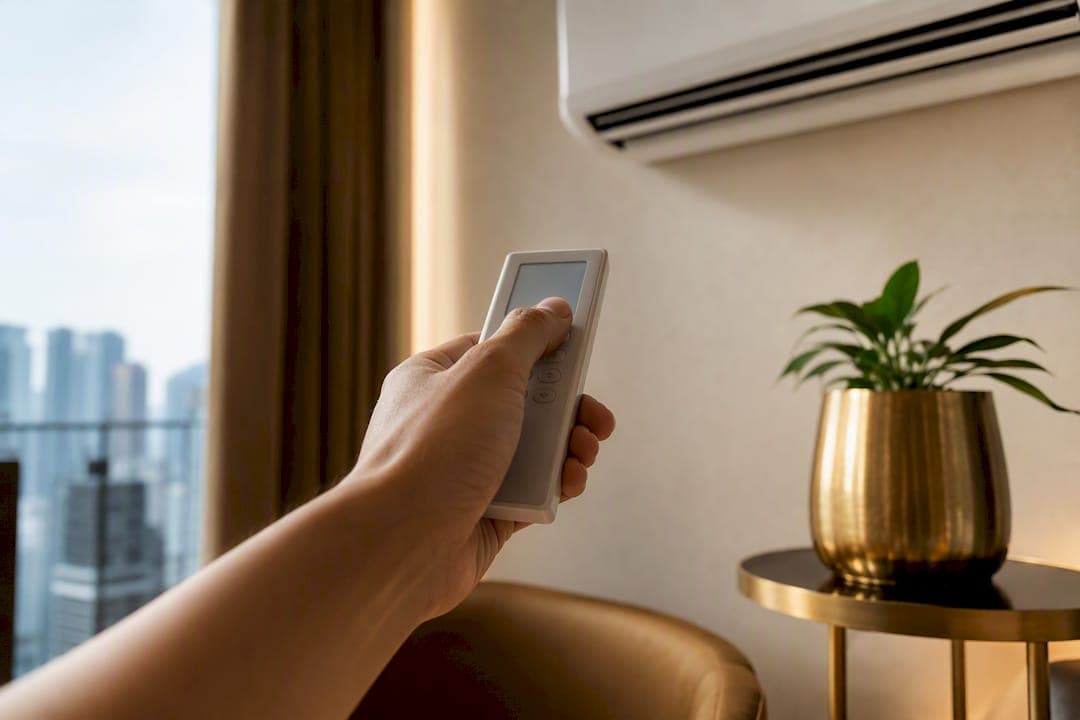
Singapore homeowners have three realistic ways to add smart aircon control: an IR plug-in controller that mimics your remote, a manufacturer's proprietary Wi-Fi adapter, or a built-in smart aircon system bought new. Before choosing, check whether your remote's display still shows the current mode, fan speed, and temperature. That single detail determines which options will actually work. Energy savings are real but modest, and none of these devices replace regular servicing.
TL;DR:
- Smart aircon controls with two-way feedback, like manufacturer Wi-Fi adapters, are limited to newer models from the same brand and support more reliable operation.
- Geofencing features offer the most significant savings by automatically turning off or pre-cooling the unit when nobody is home, unlike scheduling alone.
- Compatibility relies on remote display status, line-of-sight, and router band, with IR controllers working best when mounted at the same height and within 5 to 6 meters of the indoor unit.
- Regular maintenance such as filter cleaning every 2 to 3 months and annual servicing remains essential for optimal efficiency, regardless of smart control features.
- Integration with smart home ecosystems like Apple HomeKit or Google Home simplifies automation and control across multiple devices, but ecosystems should be chosen carefully to avoid hardware replacement later.
Table of Contents
- What Are the Different Types of Smart Aircon Control?
- Which Smart Aircon Features Actually Save You Money?
- Will My Aircon Remote Work With a Smart Controller?
- How Do You Install and Set Up a Smart Aircon Controller?
- Does Smart Aircon Control Actually Cut Your Electricity Bill?
- Can Smart Aircon Control Work With HomeKit or Google Home?
- What Should You Do If Your Smart Controller Stops Responding?
- How Do Leading Smart Aircon Brands Compare?
- Does Smart Aircon Control Improve Indoor Air Quality?
- Why Integrated Aircon Control Matters More in a Modern Condo
- Sources
- FAQ
What Are the Different Types of Smart Aircon Control?
Three approaches dominate the Singapore market, and each suits a different situation.
IR plug-in controllers sit near your indoor unit and learn your existing remote's infrared signals, then relay commands from a smartphone app over Wi-Fi. Sensibo Air works this way, and so does tado°'s Smart AC Control. Because they don't touch the aircon's wiring, they suit renters and condo owners who can't modify the indoor unit.
Proprietary Wi-Fi adapters from the manufacturer plug into a dedicated port inside or beside the indoor unit. Daikin's smart control and Mitsubishi Electric's Wi-Fi Control both work this way, and they talk directly to the compressor board rather than guessing based on a remote signal.
Built-in smart aircons ship with Wi-Fi already integrated, no add-on needed. Daikin's iSmile range is the clearest local example.
- IR controllers: cheapest, fastest to install, work with almost any brand.
- Proprietary adapters: two-way feedback, but limited to that manufacturer's newer models.
- Built-in units: cleanest look, but only relevant if you're buying a new aircon anyway.
Which Smart Aircon Features Actually Save You Money?
Not every feature marketed on a smart aircon controller box moves the needle on your bill. Scheduling turns the unit off during work hours and on before you're home. Geofencing goes further: it detects your phone leaving or approaching your home's radius and pre-cools or shuts down automatically. Sensibo's geofencing and Climate React features add humidity and temperature triggers on top of a simple schedule, so the aircon reacts to actual room conditions instead of a fixed clock.
Voice control through Alexa, Google Assistant, or Siri is convenient but rarely saves energy on its own.
- Scheduling: predictable, low-effort, moderate savings.
- Geofencing: the single feature with the biggest real-world impact on unnecessary run time.
- Humidity-aware modes (Climate React): useful given Singapore's average humidity often sitting above 70%.
- Voice control: convenience feature, not a savings driver.
Pro Tip: If you can only afford one upgrade, pick a controller with geofencing over one with only scheduling. A fixed schedule still runs your aircon on days you're out sick or working from a client's office.
Will My Aircon Remote Work With a Smart Controller?
Run through this checklist before buying anything.
- Check your remote's screen. If it still displays the current mode, fan speed, and set temperature, most IR controllers can sync state reliably. A remote with no display, or one with a worn-out screen, causes mode drift, where the app thinks the aircon is cooling at 24°C while the unit is actually off.
- Look up your model and year. If your indoor unit supports a manufacturer Wi-Fi adapter, prefer it over a universal IR controller. Two-way feedback means the app confirms the command actually reached the compressor, something Daikin's adapters and Mitsubishi's Wi-Fi Control both offer, though Mitsubishi notes some models are limited by manufacture year.
- Confirm line of sight. IR controllers need a clear path to the indoor unit's receiver. Curtains, decorative ceiling boxes, and bulkheads common in Singapore condos block the signal more often than people expect.
- Check your router band. Almost every smart aircon controller needs a 2.4 GHz network, not 5 GHz. Older mesh routers sometimes broadcast both under one name, which confuses pairing.
- Count your indoor units. Each split unit needs its own controller unless you've gone with a centralized ducted or VRF system, which usually requires professional integration instead.
Pro Tip: Mount the IR controller on the same wall as your indoor unit, roughly at the same height, rather than on a side table. A 90 degree angle mismatch is the most common reason a "compatible" controller fails to respond.
How Do You Install and Set Up a Smart Aircon Controller?
Most IR controllers are genuinely DIY. Here's the sequence that avoids the usual headaches.
- Confirm remote compatibility using the display check above.
- Position the controller with a direct sightline to the indoor unit, ideally within 5 to 6 meters.
- Connect it to your 2.4 GHz Wi-Fi network before mounting anything permanently.
- Pair the device through its app and run through every mode (cool, fan, dry) to confirm sync.
- Test again after 24 hours, since dense apartment blocks sometimes cause signal drops the first day.
Singapore's high-rise Wi-Fi density is the most common setup snag. If pairing keeps failing, move your router closer to the unit or add a mesh extender. If you're running multiple aircons across a larger unit, most apps let you group them under one account, but each still needs its own physical controller. Call a technician if you're dealing with a ducted system, a proprietary adapter that needs firmware pairing to the compressor board, or a managed condo that requires approval before altering common riser wiring.
Does Smart Aircon Control Actually Cut Your Electricity Bill?
Automation reduces wasted run time. That's the entire mechanism. Geofencing stops the aircon running while nobody's home, and schedules stop it running overnight in an empty study. Vendors including Sensibo and Cielo market meaningful savings from these features, though actual results depend heavily on how often your old routine left the unit running unnecessarily.
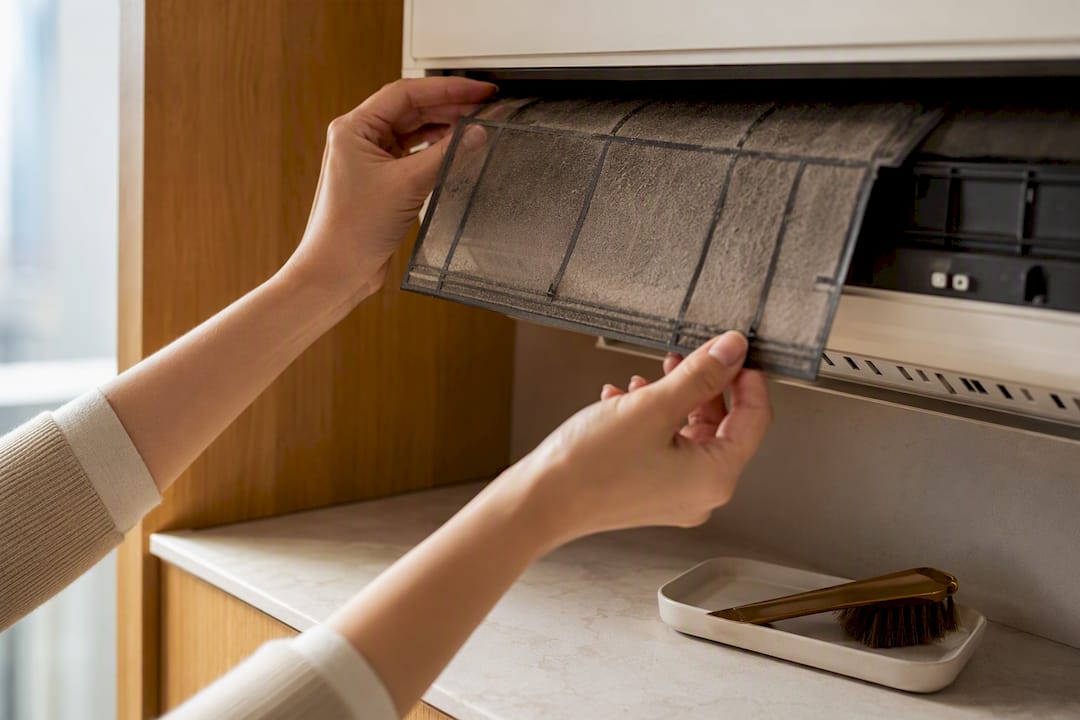
What smart control does not change is mechanical efficiency. Technicians consistently point out that clogged filters and worn compressors remain the biggest drag on performance in Singapore's climate, regardless of how smart the controller is. A perfectly scheduled aircon with a filter that hasn't been cleaned in six months still burns more electricity than it should.
- Clean or replace filters every 2 to 3 months in Singapore's humidity.
- Book professional servicing at least once a year, twice if you run the unit daily.
- Use the app's usage logs to spot unusual spikes, which often flag a servicing need before the unit audibly struggles.
Can Smart Aircon Control Work With HomeKit or Google Home?
Most established controllers support the big three platforms. That matters for condo residents who don't want a separate app for every device. Sensibo Air integrates with Apple HomeKit, Google Home, and Amazon Alexa, letting you build one routine that fires door locks, lights, and aircon together the moment you walk in.
- One app or voice interface instead of five separate ones.
- Cross-device automations, like triggering pre-cooling when a smart lock detects you're home.
- Compatibility with sensors for humidity or occupancy if you expand later.
Platform support matters more than it looks on a spec sheet, because switching ecosystems later usually means replacing hardware. In a condo, also check where you place sensors and gateways. Shared risers and dense concrete construction can weaken 2.4 GHz signal between units, and any change to common-area wiring for a proprietary adapter should go through your condo's management office first.
What Should You Do If Your Smart Controller Stops Responding?
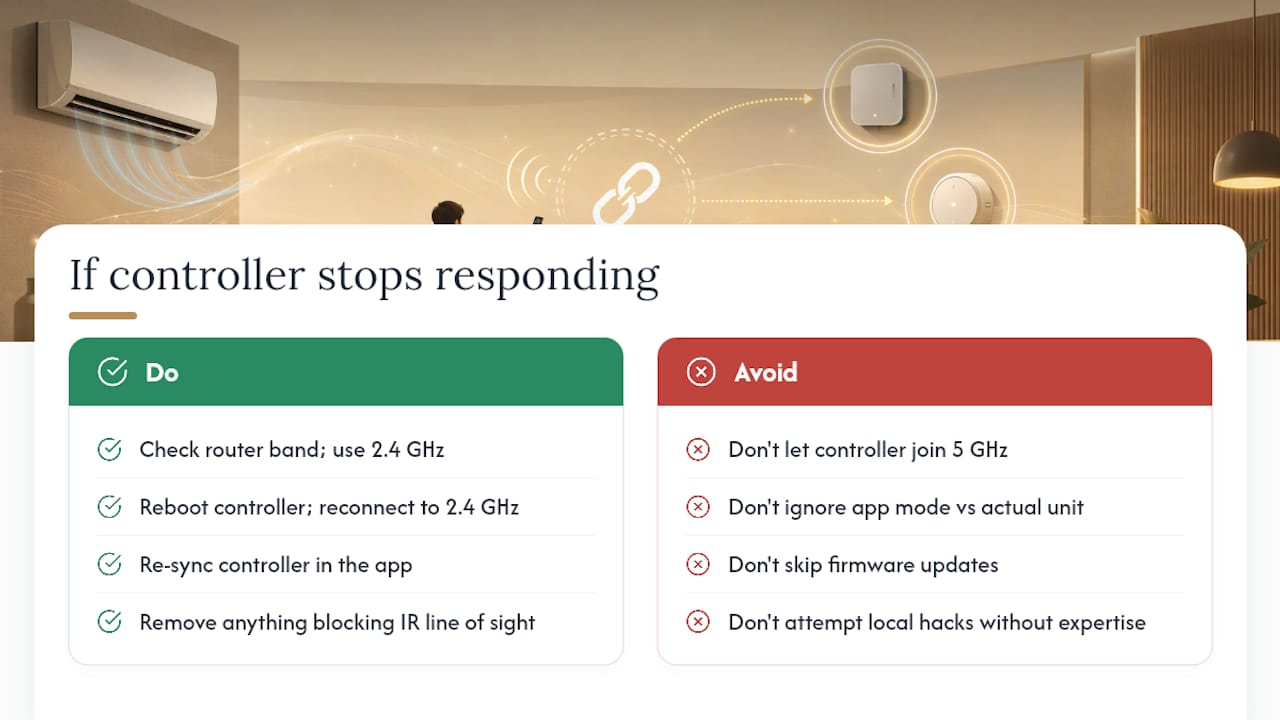
Most issues trace back to three causes: Wi-Fi drift, firmware gaps, or IR misalignment.
If commands stop reaching the unit, first check that your router hasn't switched the controller to a 5 GHz band during an automatic update. Many dual-band routers do this silently. Rebooting the controller and manually reconnecting it to the 2.4 GHz network fixes this more often than people expect.
If the app shows a different mode than what the aircon is actually doing, that's mode drift. It usually means the IR signal missed the receiver during the last command. Re-sync the controller through the app's setup menu, and physically check nothing new (a plant, a bag, a curtain) is blocking the line of sight.
Firmware updates matter more than most homeowners realize. Manufacturers push updates that fix pairing bugs and add new schedule options, and most apps update automatically in the background, but it's worth checking the app's settings menu monthly if you notice odd behavior. For proprietary adapters like Daikin's or Mitsubishi's, firmware updates sometimes require a brief power cycle of the indoor unit to complete.
If problems persist after these checks, and the aircon is on a centralized or ducted system, the fix usually isn't in the app at all. Advanced users sometimes turn to open-source projects like AirControl-Mini for local, cloud-free control through Home Assistant, but that route needs real hardware and firmware knowledge and isn't a fit for a casual setup.
How Do Leading Smart Aircon Brands Compare?
Each brand approaches the problem differently, and the right pick depends on what you already own.
Sensibo (Air and Sky) is the most flexible entry point because it works with almost any IR remote regardless of aircon brand. It supports Climate React, geofencing, and 7-day schedules, and pairs with Google Assistant, Alexa, and Siri. The tradeoff is one-way IR signaling, so it can't always confirm a command landed if your remote lacks a clear display.
Daikin's Wi-Fi and iSmile range gives you two-way feedback because the adapter talks straight to the compressor board. That's a real advantage for anyone who's been burned by an IR controller silently failing. The limitation is that it only works on compatible Daikin units, and older models may need a hardware adapter rather than a built-in one.
Mitsubishi Electric's Wi-Fi Control offers similar two-way communication and scheduling, with the same caveat that compatibility depends on the model and manufacture year.
Cielo Breez Plus takes a thermostat-style approach and stands out for multi-zone control across several mini-split or window units from one interface, which suits larger homes with more than two or three aircons.
tado° Smart AC Control is IR-based like Sensibo but leans into a cleaner physical design, including stands and mounting accessories, and requires the same remote-display check before you buy.
Does Smart Aircon Control Improve Indoor Air Quality?
Indirectly, yes, though it's a byproduct of behavior change rather than the controller itself doing anything to the air. When a schedule or geofencing trigger prevents the aircon from switching on and off erratically, the unit runs in longer, steadier cycles.
Comfort improves in a similar indirect way. Pre-cooling before you walk in means you're not sitting through 20 minutes of a room catching up to a comfortable temperature. Humidity-aware modes that respond to actual conditions rather than a fixed timer also reduce the clammy feeling that a straight temperature-only schedule can miss entirely.
None of this replaces basic air quality maintenance. A smart controller running a unit with a dirty filter still circulates the same dust and allergens, just on a more efficient schedule. The comfort and air quality gains come from combining smart scheduling with the filter cleaning and servicing routine covered earlier, not from the controller acting as a substitute for it.
Why Integrated Aircon Control Matters More in a Modern Condo
Smart aircon control works best as one piece of a wired-together home, not a standalone gadget bolted onto an old remote; integrating it with smart home systems enhances convenience and efficiency. In a unit already built with smart-home wiring and app-based systems, adding geofenced cooling to your lighting and door routines takes minutes instead of a weekend project. If you're setting up a new place, our smart-home features checklist for new condos and our guide to setting up home automation in a new unit walk through the sequencing that saves the most rework.
— Simon
Sources
FAQ
Does an IR aircon controller work with any air conditioner brand?
Most IR controllers work with any brand as long as the original remote has a display showing the current mode, fan speed, and temperature.
Is a manufacturer Wi-Fi adapter better than a universal IR controller?
Manufacturer adapters like Daikin's and Mitsubishi's offer two-way feedback confirming a command reached the unit, but they only work on compatible models by that brand.
Why does my smart aircon controller show the wrong mode?
This is called mode drift, and it happens when the IR signal misses the receiver, usually due to a blocked line of sight or a remote without a display.
Do smart aircon controllers reduce electricity bills in Singapore?
They can, mainly by cutting idle running time through geofencing and scheduling, but regular filter cleaning and professional servicing still determine overall efficiency.
Can I use one app to control my aircon, lights, and door locks together?
Yes, if your controller supports Apple HomeKit, Google Home, or Amazon Alexa, which lets you build routines across multiple smart devices from one interface.