
Yes: homes integrated with or near an MRT interchange in Singapore typically carry a measurable price premium, with studies and industry reporting pointing to a broad range of roughly 4% to 30%, while many integrated launches cluster around 20% to 25% above nearby private condos. Integrated developments built directly above MRT stations are a local example of the integrated format this premium applies to. The exact figure depends on how distance is measured, which market segment you're in, and how much of the future transit plan is already priced in.
TL;DR:
- Industry reports place integrated condo launches 20% to 25% above nearby private condos, but that figure includes retail, design, and launch timing.
- North East Line research found apartments rose 1.5% to 2% in value after confirmation, with newly connected homes gaining further value after stations opened.
- Compare recent transactions by district, unit size, and tenure, then measure the sheltered walking route; straight line distance can misclassify practical access.
- Premiums tend to show more clearly outside the Core Central Region; broader price cycles and cooling measures can outweigh transit access in CCR.
- Station integrated condos have the clearest documented premiums, while HDB resale gains are generally smaller and landed values depend more on land, privacy, and schools.
Table of Contents
- How big is the MRT interchange premium in Singapore?
- Why do interchange-integrated homes command higher prices?
- What makes the premium bigger or smaller for a given project?
- How do you verify a claimed MRT interchange premium yourself?
- What should you check before trusting a premium claim?
- Does an interchange premium hold up over the long term?
- How does the premium differ across condos, HDB flats, and landed homes?
- What do real interchange developments show about the premium?
- What I've learned evaluating interchange premiums
- See the integrated living model at Hougang Central Residences
- FAQ
- Sources
How big is the MRT interchange premium in Singapore?
Academic work on Singapore's rail network points to a wide spread of capitalization effects depending on methodology. Research using network-distance measures, which trace the actual walking path rather than a straight line, finds a meta-estimate of about 2.3% per 250 meters of proximity in wider international studies, with localized Singapore results varying depending on how distance and treatment zones are defined. Separately, a study of the North East Line found that pre-connected apartments rose about 1.5% to 2% in value once the line was confirmed, and newly connected apartments within 0.5 km appreciated 2% to 3.2% more than units farther away.
Integrated developments in Singapore often price 20% to 25% above comparable private condos nearby at launch, a pattern industry reporting has tracked across several recent projects. The spread between academic and industry figures comes down to what each measures: hedonic studies isolate distance holding other factors constant, while launch-pricing comparisons capture everything a developer bundles in, retail, branding, and timing included.
A few data points worth knowing before you compare any specific project:
- Network-distance studies generally produce smaller, more conservative premium estimates than simple straight-line comparisons.
- Launch-to-launch premium figures reported by industry press reflect bundled value (retail, design, timing), not distance alone.
- Resale transactions years after launch often show a different premium than the original launch pricing did.
Why do interchange-integrated homes command higher prices?
The premium isn't just about shaving minutes off a commute. An interchange multiplies the number of lines and destinations reachable without transferring outdoors, which compounds the value of living there as the network grows. Academic work on network effects found that confirmed line expansions lifted values before the station even opened, evidence that buyers price in future connectivity, not just current access.
Beyond transit, several forces stack on top of each other:
- On-site retail and F&B reduce the number of separate errands a household needs to run during the week.
- Sheltered, direct access from home to platform or mall matters more in Singapore's climate than in drier markets.
- Buyer surveys show connectivity often beats centrality: 79% of respondents preferred a non-central home with strong connectivity over a central one with weak connectivity, and 81% preferred living directly above a mall.
Pro Tip: When comparing two shortlisted condos, ask which one lets you run a full week of errands without stepping outside into the rain, that convenience is part of what you're paying the premium for.
What makes the premium bigger or smaller for a given project?
Not every interchange-adjacent home carries the same uplift, and the gap between a 5% premium and a 25% premium usually comes down to a handful of variables.
- Distance measurement: a unit that looks close on a straight-line map can fall outside the practical walkable zone once you trace the actual sheltered route; common cutoffs used in studies sit around 400 to 600 meters.
- Station function: a true interchange serving multiple lines with higher expected ridership tends to support a larger premium than a single-line stop.
- Market segment: premiums tend to show up more clearly outside the Core Central Region, where CCR interchange openings have sometimes coincided with price declines driven by broader macro and cooling-measure effects rather than proximity itself.
- Property attributes: floor level, unit size, and tenure (leasehold versus freehold) are statistically significant on their own and can amplify or dilute the distance effect.
Separating the location-cycle story from the pure proximity effect is the single most useful thing you can do before trusting a quoted premium figure.
How do you verify a claimed MRT interchange premium yourself?
You don't need to take a marketing brochure's word for it. A repeatable, five-step process using public data gets you most of the way to an honest estimate.
- Build a comparable set. Pull recent transactions for the same district, similar unit sizes, and matching tenure from URA and REALIS, excluding outliers like penthouses or ground-floor units.
- Compute the psf differential. Take the average price per square foot for interchange-adjacent units and divide by the average psf of otherwise similar non-interchange units nearby; subtract 1 and express as a percentage to get your estimated premium.
- Check launch pricing and take-up. Industry press coverage of recent launches often reports both the headline psf and the percentage sold in the first weekend, which tells you whether the market actually validated the asking premium.
- Walk the route. Use a mapping tool that measures network distance, or walk it yourself, to confirm the home is genuinely within a sheltered, short walk rather than a straight-line distance that ignores road crossings.
- Check what's already priced in. Confirm whether a planned line, such as the Cross Island Line, is already reflected in current pricing or still a future catalyst.
A simple comparison template helps keep this organized when you're assessing a specific unit:
What should you check before trusting a premium claim?
Before you negotiate on the assumption that an interchange location justifies a higher asking price, run through these six checks.
- Confirm the interchange status and which lines actually serve it, including any phased opening dates for lines still under construction.
- Measure the real walking distance using the sheltered, network route rather than a straight line on a map.
- Compare psf against immediate non-interchange neighbors using recent resale caveats, not just launch pricing.
- Assess the scale and tenant mix of the attached mall or retail podium, since a handful of shops supports less daily convenience than a full-size mall.
- Factor in market segment exposure: CCR properties can see interchange effects muted by cooling measures, while OCR and RCR premiums tend to show through more cleanly.
- Keep a record of your comparable set and sources so you can reference them later if you need to negotiate.
Pro Tip: Save your REALIS export and mapping screenshots in one folder before you start negotiating, having the comparable data ready to show makes a stronger case than citing a percentage from memory.
Does an interchange premium hold up over the long term?
A premium paid at launch doesn't automatically guarantee the same premium at resale, but interchange-integrated homes have structural advantages that tend to support value over time. The North East Line study found that value gains from confirmed network expansion persisted and in some cases grew once stations opened, rather than fading as a short-lived launch effect. That matters for anyone buying with a resale horizon of seven to ten years rather than flipping shortly after completion.
The clearest long-term risk sits with timing and segment rather than the interchange itself. Properties bought at the peak of a hype cycle in the Core Central Region have sometimes underperformed on resale even with strong connectivity, because broader price cycles and cooling measures outweighed the proximity benefit. Outside the CCR, where fewer macro headwinds compete with the connectivity story, interchange access has tended to show through more consistently in subsequent transactions.
For resale potential specifically, liquidity tends to improve near interchanges simply because a larger pool of buyers values the convenience, which can mean a shorter time on market even when the headline price doesn't move dramatically. Buyers assessing a long hold should weigh the interchange premium against the base rate of price growth in that planning area, rather than assuming the premium alone will outpace a well-located non-interchange alternative.
How does the premium differ across condos, HDB flats, and landed homes?
The size and visibility of an interchange premium shifts depending on the housing type, mostly because of how directly each format can integrate with the station.
Condominiums built directly above or adjacent to an interchange, often called integrated developments, show the clearest and best-documented premiums because they can offer sheltered, direct access and shared retail podiums as part of the design. This is the format where the 20% to 25% launch premium reported by industry sources is most consistently observed.
HDB flats near an interchange also see a measurable uplift in resale prices, but the effect tends to be smaller in percentage terms since public housing pricing is more tightly anchored by grant structures, income ceilings, and resale levy rules than by pure market comparables. The proximity benefit still shows up in faster resale transactions and in cash-over-valuation patterns near well-connected towns.
Landed homes are the least likely to show a clean interchange premium, partly because landed housing is comparatively rare near dense transit nodes and partly because buyers in that segment often prioritize land size, privacy, and school proximity over walkable transit access. Where a landed enclave does sit near an interchange, the premium tends to be diluted by these competing priorities rather than absent entirely.

What do real interchange developments show about the premium?
Looking at actual integrated projects helps ground these percentages in something concrete rather than abstract ranges. Industry analysis of recent launches has found that interchange stations outside the Core Central Region have generally supported clearer price growth after new lines were added, while CCR interchange openings have shown more mixed results tied to broader segment pricing cycles rather than the station itself.
This pattern lines up with the North East Line research: value gains from network connectivity showed up most reliably where the surrounding market wasn't already being pulled by other, larger forces like prime-district cooling measures. In practice, that means a buyer evaluating two interchange-adjacent projects, one in the CCR and one in the OCR or RCR, should expect the premium to be more visible and more durable in the latter.
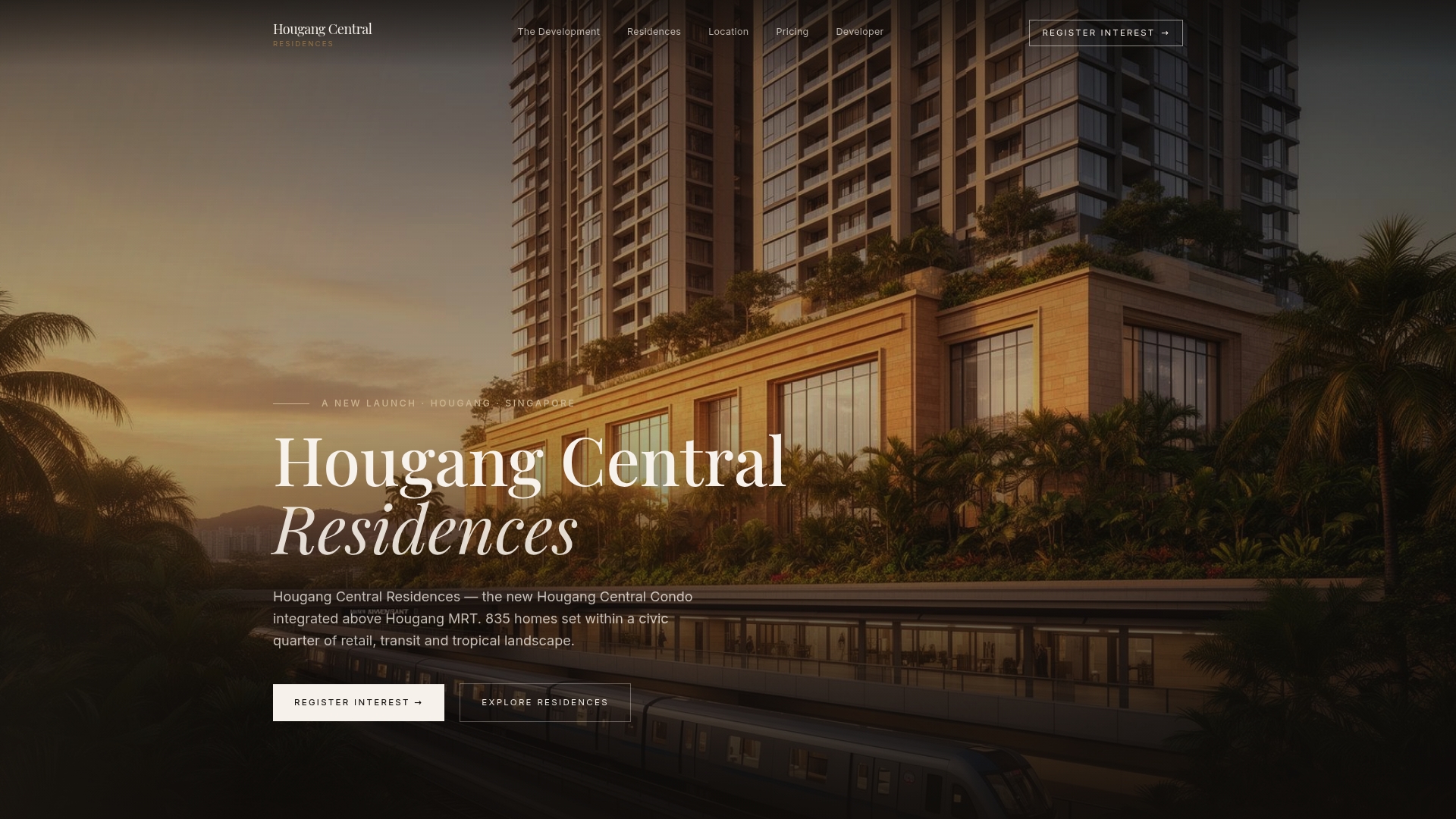
One example of the integrated format is a development with residences directly above an MRT station, combined with an attached retail podium and bus interchange, structurally similar to other integrated developments that industry reporting has tracked for premium pricing. Rather than taking a headline percentage at face value, the verification workflow above, building a comparable set from REALIS and URA data, checking launch take-up, and walking the actual sheltered route, lets you test whether that structural premium is showing up in a specific project's numbers.

What I've learned evaluating interchange premiums
The premium is real, but it's not a fixed number you can apply blindly to any address near a station. The range runs from a few percentage points in conservative academic estimates to a quarter or more in headline launch comparisons, and the honest answer for any specific property sits somewhere in between depending on segment, distance measurement, and timing. What separates a fair premium from an inflated one is almost always verification: pulling your own comparables, checking the real walking route, and confirming what future connectivity is already priced in.
The planning horizon matters too. Hougang's eventual Cross Island Line interchange link is a good example of a catalyst that may or may not be fully reflected in current pricing, which is exactly the kind of question a careful buyer should be asking rather than assuming. For a deeper look at proximity math and worked verification examples, our analysis of MRT proximity and property value walks through the numbers step by step.
— Simon
See the integrated living model at Hougang Central Residences
If the interchange premium story above makes sense to you, some new developments offer a direct way to own the format rather than just study it. These developments may include residences above an MRT station with an integrated retail mall and bus interchange, various residence types, smart-home systems, and premium fittings.
A few ways to look closer before deciding:
- Review the site plan to see exactly how the residences connect to the MRT and mall.
- Check pricing from $2,800 SGD per square foot for current unit availability.
- Browse the full unit mix and residence types to find the layout that fits your household or investment plan.
Request an e-brochure or book a viewing directly through Hougang Central Residences to see current availability for yourself.
This article is general information, not a substitute for advice from a qualified financial advisor. Consult a qualified financial professional about your own circumstances before acting on anything here.
FAQ
What counts as an MRT interchange for pricing purposes?
An interchange station serves two or more MRT lines, allowing transfers without leaving the station, which generally supports a stronger premium than a single-line stop. Industry reporting ties the largest premiums to developments physically integrated with such stations through shared retail and sheltered access.
How much more does an interchange-integrated condo typically cost?
Industry benchmarks show integrated developments often price 20% to 25% above comparable private condos nearby at launch, though academic studies using stricter distance methods find a wider range from about 4% up to 30% depending on location and measurement approach.
Does the premium hold up at resale, not just at launch?
Research on Singapore's North East Line found that value gains from confirmed network connectivity persisted after stations opened rather than fading quickly, though outcomes vary by market segment and broader price cycles.
Is the premium the same for HDB flats as for condos?
No. Condominiums integrated with a station podium show the clearest documented premiums, while HDB resale flats near an interchange see a measurable but generally smaller uplift because grant rules and income ceilings anchor pricing more tightly than open market comparables.
How do I check if a quoted premium is accurate for a specific property?
Pull comparable transactions from URA and REALIS for similar unit sizes and tenure nearby, calculate the psf difference as a percentage, and confirm the walking route to the station is genuinely sheltered and short rather than a straight-line estimate. For a structured walkthrough, our guide to evaluating interchange connectivity covers the process with Hougang Central Residences as a worked example, and a qualified property agent, such as one trained through listing presentation frameworks, can help you pressure-test the comparable set.
Sources
- Why integrated developments command a price premium - Singapore Property News
- How much do users value a network expansion? Evidence from the public transit system in Singapore - ScienceDirect
- Analysis of Housing Price Distributions Near MRT Stations