
If you bought your condo on or after July 4, 2025, yes, Seller's Stamp Duty applies to you if you sell within four years. There is no clean way around it if you sell inside that window. What you can do is plan around it, time it correctly, and make sure you are not paying more than the law actually requires.
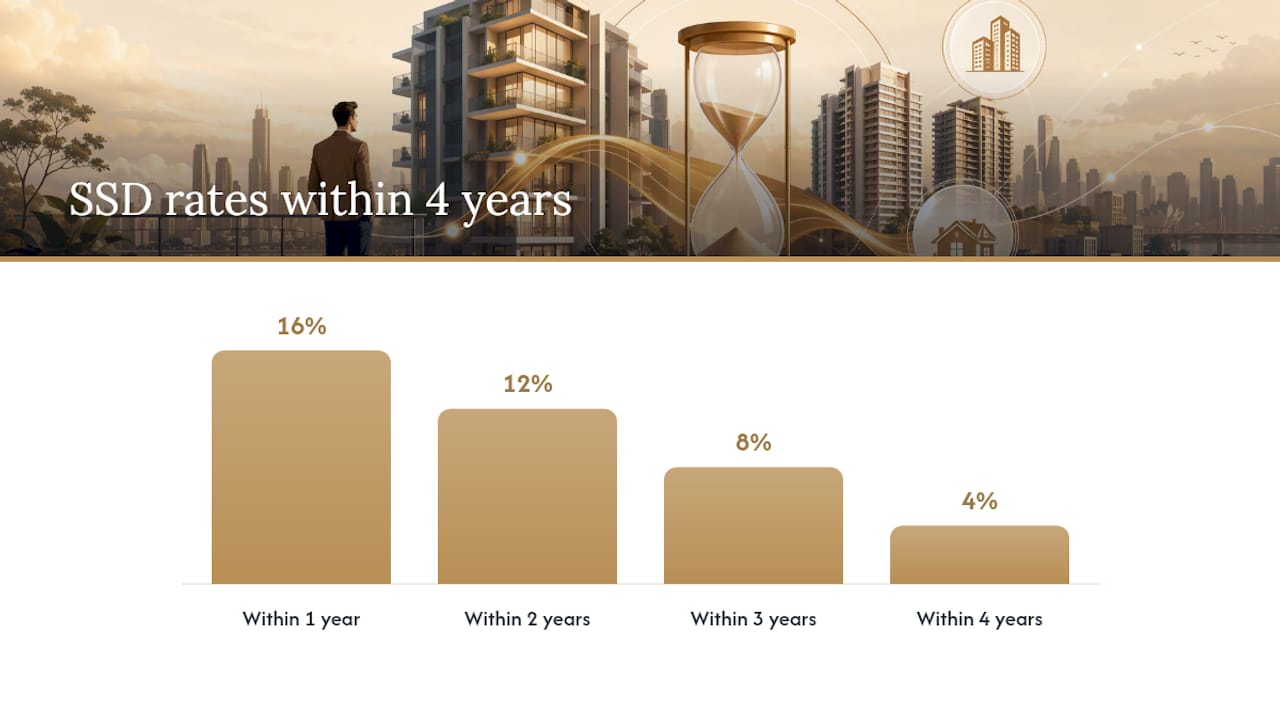
Here are the numbers that matter right now. For units purchased on or after July 4, 2025, IRAS charges SSD at 16% in year one, 12% in year two, 8% in year three, and 4% in year four. Sell after four years and SSD drops to zero. This follows the government's July 3, 2025 announcement extending the holding period from three years to four and raising every rate tier, a direct move by the Ministry of Finance to slow speculative flipping.
- Bought before July 4, 2025: you're still on the older 3-year regime (12%/8%/4%)
- Bought on or after July 4, 2025: you're on the new 4-year regime (16%/12%/8%/4%)
- Held past your applicable window: SSD is zero, regardless of profit
Quick stat: A condo bought after July 4, 2025 and sold in year one now faces a 16% SSD rate, up from 12% under the old rules, on whichever is higher between sale price and market value.
Pro Tip: Check your Option to Purchase (OTP) acceptance date before you do anything else. That date, not your completion date, usually starts the SSD clock, and getting it wrong can throw off your entire exit timeline.
This guide covers what SSD actually taxes, how to calculate it precisely, which exemptions genuinely apply, and where the line sits between smart tax planning and something IRAS will investigate. None of this is about dodging tax you legally owe. It's about not paying a cent more than required, and not accidentally triggering a much bigger bill through a careless transfer or a misjudged sale date.
Key Takeaways
Selling a condo within four years of a July 4, 2025 or later purchase triggers SSD at rates up to 16%, with lawful planning centered on timing your sale date rather than disguising it.
| Point | Details |
|---|---|
| Check your purchase date first | Purchases on or after July 4, 2025 fall under the new 4-year, 16%/12%/8%/4% SSD schedule. |
| SSD uses the higher value | IRAS charges SSD on whichever is greater: your sale price or the assessed market value. |
| Holding period starts at OTP acceptance | Count from your accepted Option to Purchase date, not your completion date, to find your tier. |
| Exemptions are narrow | Inheritance and specific statutory transfers qualify; most intra-family transfers still trigger SSD. |
| Consider holding instead of flipping | Hougang Central Residences suits buyers weighing a longer-hold, rental-income strategy over a quick flip. |
This article is general information, not a substitute for advice from a qualified financial advisor. Consult a qualified financial professional about your own circumstances before acting on anything here.
Table of Contents
- What Counts as a Flipping Condo SSD Avoidance Guide Situation?
- How Do You Calculate SSD and What Are the Current Rates?
- When Does the SSD Clock Start and Stop?
- Which Exemptions and Remissions Can Legally Remove SSD?
- How Does SSD Interact With ABSD and BSD?
- What Happens if You Try to Evade SSD Instead of Planning Around It?
- What Lawful Tactics Actually Reduce Your SSD Bill?
- How and When Do You Actually Pay SSD?
- Should You Sell Now or Wait Out the SSD Window?
- Consider Holding for Income Instead of Flipping
- Sources
- FAQ
What Counts as a Flipping Condo SSD Avoidance Guide Situation?
SSD is a seller-side tax charged when you dispose of residential property within a defined holding period after buying it. Unlike Buyer's Stamp Duty, which every buyer pays regardless of timing, SSD only bites if you sell (or otherwise dispose of) the unit too soon after acquiring it. The whole point of a flipping condo SSD avoidance strategy is timing your exit so you fall outside that window, or qualify for one of the narrow exemptions, rather than trying to hide the transaction from IRAS.
The disposals that trigger SSD are broader than most sellers expect:
- Outright sale or transfer of the property, including at undervalue
- Certain gifts of the property to non-exempt parties
- Collective sale (en bloc), even when you voted against it
- Sub-sale or assignment of a unit still under construction
Collective sales deserve special attention here. If your development goes en bloc while you're still inside your holding period, you owe SSD on your share of the proceeds, whether or not you supported the sale. IRAS treats collective sale participants the same as any other seller for SSD purposes, which has caught more than one unlucky owner off guard when a sale committee moved faster than expected.
Mixed residential-commercial units, like shophouses with a residential component, only attract SSD on the residential portion, so confirm your unit's classification with your conveyancer before assuming the full sale price is taxable.
How Do You Calculate SSD and What Are the Current Rates?
SSD is charged on whichever figure is higher: the actual selling price or the property's current market value at the time of sale. This anti-undervaluation rule exists specifically so sellers can't dodge tax by writing a lowball price into the sale agreement while quietly collecting a side payment. IRAS will independently assess market value and use that number if it exceeds your contract price.
Calculating your SSD liability comes down to four steps:
- Determine the relevant price: compare your actual selling price against the property's current market value and take the higher figure.
- Identify your holding period tier: count from your OTP acceptance date to your sale date, then match that duration to the applicable rate band.
- Apply the correct rate: use 16%, 12%, 8%, or 4% depending on which year of ownership you're in (for purchases on or after July 4, 2025).
- Compute the payable amount: multiply the relevant price by the applicable rate to get your SSD bill.
Here's what that looks like on a $2,000,000 condo bought on July 5, 2025:
- Sold in Year 1 (within 12 months): SSD at 16% = $320,000
- Sold in Year 3 (within 24 to 36 months): SSD at 8% = $160,000
- Sold after Year 4: SSD = $0
That gap between year one and year three alone is $160,000, on top of agent commissions, legal fees, and any ABSD you paid going in. If you bought before July 4, 2025, you're still under the older three-year, 12%/8%/4% schedule rather than this newer four-year table, a distinction several practical guides flag as the single most common point of confusion among sellers checking their exposure.
When Does the SSD Clock Start and Stop?
Your SSD holding period begins on the date you accepted the Option to Purchase, not your completion date and not the date you moved in. It ends on the date you execute the sale and purchase agreement for your disposal. Getting these two dates right matters more than almost anything else in this whole process, because a miscalculation of even a few weeks can push you into a materially higher rate tier.
- Confirm your acquisition date from your accepted OTP or the relevant transfer document.
- Confirm your disposal date from the executed sale contract, not the date you first listed the unit.
- Count the full duration between the two to identify your holding period tier.
The July 4, 2025 cutoff is a hard line. Buy on July 3, 2025, and you're grandfathered into the old three-year regime with lower rates. Buy one day later, on July 4, and you're locked into the new four-year, higher-rate schedule for the entire life of that purchase. There's no partial application; the effective date is fixed to your acquisition date, not your sale date.
A few edge cases worth flagging:
- Collective sales use the date the sale is legally completed, not the date the vote passed, to determine your holding period exposure.
- HDB resale flats follow a separate Minimum Occupation Period framework, distinct from condo SSD rules, so don't assume the two overlap.
- Sub-sales of units still under construction count the clock from your original OTP acceptance, not from the sub-sale agreement date.
Which Exemptions and Remissions Can Legally Remove SSD?
A handful of scenarios remove SSD liability entirely, and they're narrower than most sellers assume. Inheritance is the cleanest one: property passed to a beneficiary through a will or intestate succession is exempt, because there's no "purchase" event restarting the holding-period clock. Certain conversions of industrial or commercial property to residential use also fall outside SSD's scope, along with a small set of statutorily exempt transfers spelled out under the Stamp Duties Act.
Where an exemption isn't automatic, you may need to apply for remission from the Commissioner of Stamp Duties, providing documentation that supports your claim. Typical supporting evidence includes:
- Certified copies of the will or grant of probate for inheritance cases
- Court orders for transfers arising from divorce or bankruptcy proceedings
- Valuation reports supporting your claimed market value
- Original OTP and completion documents establishing your holding period
Pro Tip: Don't assume transferring a unit to a spouse or child sidesteps SSD. Most intra-family transfers within the holding period still trigger full SSD liability unless they fall squarely within a recognized exemption category, and "it's just family" is not a legal exemption IRAS recognizes.
How Does SSD Interact With ABSD and BSD?
SSD taxes the seller; Buyer's Stamp Duty and Additional Buyer's Stamp Duty tax the buyer. That distinction matters because any plan that touches ownership structure, like decoupling to free up ABSD room for a second purchase, has to be evaluated against SSD exposure at the same time, not in isolation.
| Duty | Who pays | When it applies | Typical rate driver |
|---|---|---|---|
| BSD | Buyer | Every purchase | Purchase price or market value |
| ABSD | Buyer | Purchases based on residency/citizenship and property count | Buyer profile and number of properties owned |
| SSD | Seller | Disposal within holding period | Holding period tier and higher of price or value |
Decoupling, where one co-owner transfers their share to the other, is often pitched as a way to reset ABSD eligibility for a future purchase. The problem is that the transfer itself is a disposal, and if the transferring party is still inside their SSD holding period, that decoupling move triggers full SSD on their share, on top of whatever ABSD savings you were chasing.
Watch for these combinations before you sign anything:
- A "tax-saving" transfer that avoids ABSD but creates a fresh SSD bill
- Restructuring that solves one tax problem while creating an estate-planning complication
- Any plan pitched purely as "SSD avoidance" that never mentions the buyer-side taxes
Run the combined math, SSD plus ABSD plus BSD plus legal and agent fees, before committing to any restructuring. A plan that looks clever on the SSD line alone often loses money once every other duty is added back in.
What Happens if You Try to Evade SSD Instead of Planning Around It?
SSD must be paid within 14 days of executing your sale contract. Miss that window and IRAS applies late-payment penalties on top of the duty itself, and those penalties compound the longer the account stays open.
Beyond late payment, certain patterns actively invite investigation. IRAS pays close attention to:
- Sale contracts priced noticeably below comparable market transactions
- Transfers dressed up as gifts between unrelated or loosely related parties
- Multiple related-party transactions in quick succession involving the same unit
- Side agreements or informal payments outside the stamped contract price
If a transaction structure only makes sense as a way to avoid SSD, and has no independent commercial logic, that's precisely the pattern IRAS audits are designed to catch.
If you're selling within your holding period for a genuine reason, job relocation, financial hardship, a change in family circumstances, keep records that support that reason. Have your OTP, sale and purchase agreement, valuation report, and bank statements organized before you list, not scrambled together after a query letter arrives.
Pro Tip: Write down your commercial reason for selling early, in an email to your agent or lawyer, before the transaction closes. A contemporaneous record is far more persuasive to IRAS than a reason you construct after the fact.
What Lawful Tactics Actually Reduce Your SSD Bill?
The most reliable SSD avoidance strategy is also the least exciting one: hold past your applicable window. Every other tactic on this list is a way to manage the tax if holding isn't an option, not a way to eliminate it while selling early.
- Extend your holding period where your financial situation allows, even by a few months, if it moves you into a lower rate tier.
- Time your sale contract execution date carefully around your tier boundary rather than rushing to close before a specific calendar deadline.
- Get an independent valuation before listing, so you're not blindsided by IRAS applying a market value higher than your contract price.
- Review joint ownership structure early if a future decoupling or restructuring is on the table, since timing errors here compound with SSD exposure.
Here's how the trade-offs compare:
| Tactic | Liquidity impact | Tax trade-off | Transaction cost | Watch for |
|---|---|---|---|---|
| Hold past SSD window | Capital tied up longer | SSD drops to zero | None beyond holding costs | Market risk during the wait |
| Sell just after a tier boundary | Modest delay | Rate drops one tier (e.g., 16% to 12%) | Minimal | Miscounting the exact date |
| Independent pre-sale valuation | None | Avoids overpaying on undervalued contract price | Valuer's fee | Valuation still below market triggers IRAS reassessment |
| Restructure ownership before sale | Can free liquidity | May trigger fresh SSD or ABSD | Legal fees, potential double duty | Treating it as a shortcut instead of a real transfer |

Consider a seller who bought at $1,800,000 in July 2025 and wants to sell fast at $2,100,000 in month 10. Waiting eight more months to cross into year two drops the rate to 12%, or $252,000, an $84,000 difference against a modest holding cost. Run that math against your own numbers before deciding an early exit is worth it.
Before you execute any plan, sit down with a property tax lawyer or conveyancer and ask directly:
- What is my exact SSD holding period start and end date, based on my documents?
- Does my planned transaction qualify for any exemption or remission, and what evidence do I need?
- How does this plan affect my ABSD and BSD position if I'm buying another property soon?
- What documentation should I be keeping now, in case IRAS asks questions later?
How and When Do You Actually Pay SSD?
SSD is due within 14 days of your executed sale contract. Your conveyancing solicitor typically handles the e-stamping submission on your behalf, with payment processed through IRAS's MyTax portal.
- Sign your sale contract and note the execution date immediately.
- Your solicitor submits the stamping request via e-stamping within the 14-day window.
- Payment is made through MyTax, with confirmation issued once processed.
The most common pitfall is a solicitor missing the 14-day deadline because supporting documents, like a valuation report, weren't ready in time. Confirm with your solicitor upfront who is responsible for gathering each document, and build in a buffer before the deadline rather than targeting it exactly.
Should You Sell Now or Wait Out the SSD Window?
Picture a $1,900,000 condo bought in July 2025. Wait until year four and SSD disappears entirely: net proceeds jump to roughly $2,010,000 on the same sale price, a swing worth running the numbers on before you commit either way.
Before deciding, weigh these factors:
- How urgently do you need the capital tied up in this unit?
- Do you genuinely expect further price appreciation that justifies holding, or are you guessing?
- Is the SSD saved by waiting larger than the market risk of holding through a downturn?
- Would renting the unit out during the wait offset your holding costs while the SSD clock runs down?
That last option, holding and renting rather than flipping, is often the quietest way to sidestep the entire SSD conversation.
A short take on flipping under the new rules
I think the four-year window changes the math for most flippers, not just at the margins but fundamentally. If you can hold, hold. If you must sell early, build the SSD cost into your offer price from day one rather than treating it as a surprise deduction at closing. That's the discipline that separates investors who still profit under this regime from those who get caught flat-footed by it.
Consider Holding for Income Instead of Flipping
If the math in this guide has you rethinking a quick flip, holding for rental income sidesteps the SSD conversation almost entirely. No sale within four years means no SSD exposure, and rental yield can offset your holding costs while the property appreciates on its own timeline. It's a fundamentally different play than flipping, and for many owners, a less stressful one.

Hougang Central Residences is built with exactly this kind of long-hold strategy in mind: 835 units directly above Hougang MRT, with a future Cross Island Line interchange on the horizon, smart-home systems, and premium European fittings that keep the unit competitive with newer stock years down the line. A well-located, well-specified unit near transit tends to hold rental demand better than one that depends purely on price appreciation to justify the hold. If you're weighing a longer-term investment position over a short flip, explore Hougang Central Residences and register for showflat access to see how the layouts and pricing compare to your current exit math. Speak with a qualified tax and legal adviser before making any final decision on your existing property.
Sources
- Government raises seller's stamp duties on residential properties to curb rise in ‘flipping’ — Business Times
- Seller's Stamp Duty (SSD) Singapore 2026: New 4-Year Rules Explained | RES Revision Portal
- Mytax
FAQ
Does SSD apply if I inherited my condo?
No. Property received through a will or intestate succession is exempt from SSD because there's no purchase event that starts a new holding period.
What if I bought before July 4, 2026?
Can I avoid SSD by transferring the unit to a family member?
Usually not. Most intra-family transfers within the holding period still trigger full SSD unless they fall under a specific statutory exemption.
How many days do I have to pay SSD after selling?
You must stamp and pay SSD within 14 days of executing your sale contract, or penalties apply.
Is holding a condo for rental income a way to avoid SSD entirely?
Yes. If you hold past your applicable four-year window, no SSD applies regardless of your profit, which is why developments like Hougang Central Residences appeal to buyers planning a longer hold rather than a fast flip.